We can also talk about how much lighter the Meteor is compared to R-37M and AIM-174B. The planes that would carry the Meteor’s competitors would no longer be missile buses but more of a missile dumptruck and their ability to evade missiles or give their missiles a high PK would become significantly hindered.
Those big missiles would be the first to get fired off so not really
If they’re dumped early game then you could have just wasted them with low PK. If you preserve them for mid-match where you have higher PK, you would have been lugging around all game with it and been open to being shot down to missiles like the Meteor since you’re less maneuverable. There’s also those looming reports hanging around the Super Hornet’s neck where it would have its acceleration nerfed significantly. Its hard to take the AIM-174B seriously as a potential competitor when its platform can’t provide it with equal footing.
Atleast with R-37M its platform on the Su-57 and Su-35S would provide it with launch energy behind it.
it would significantly outrange the meteor, youd still have solid pk from very far away
to my knowledge this is how Active Electronically Scanned Radars work with mid-course guidance. Do correct me if i’m wrong.
It has nothing to do with Active part. The electronic scanning is only ±60 but you get updates on things on the other side of the scope.
The most you could have is updates when its within that range but otherwise it should be software TWS with much longer update times
Missile vs missile, yes it would outrange the Meteor, it has to. The AIM-174B is 830kg each while the Meteor is ~190kg, that is more than 4x the weight of the Meteor, and with 4 of them (3320kg) on the Super Hornet, that is the equivalent of it carrying 16x Meteor for its weight.
If you fire the AIM-174B at greater than 100km, you would have better chances than the Meteor, but at the same time that is so much time people will have to dodge, but if you fire it within 100km then you’re worse off than the Meteor carriers since the Meteor should have similar time-to-kill while the missile is cruising Mach 3-4 in that timeframe.
And if they add jamming with no datalink, then you’re probably not going to be fire it above 100km+.
from in-game experience, the tracking part degrades a lot outside of search FoV. but i feel like we’re talking a little past eachother, could you elaborate on your point a little mroe?
its still going to be moving very fast at longer ranges, will be comparable to a close range normal fox 3 shot.
the AIM-174 would be one of the best missiles ingame when it comes to ECCM, 2 way DL + GPS guidance, with a late model AIM-120 seeker with upgraded ECCM and a much larger antenna surface area, with potentially greater power
I have it setup in one corner small scan but its updating on the other side
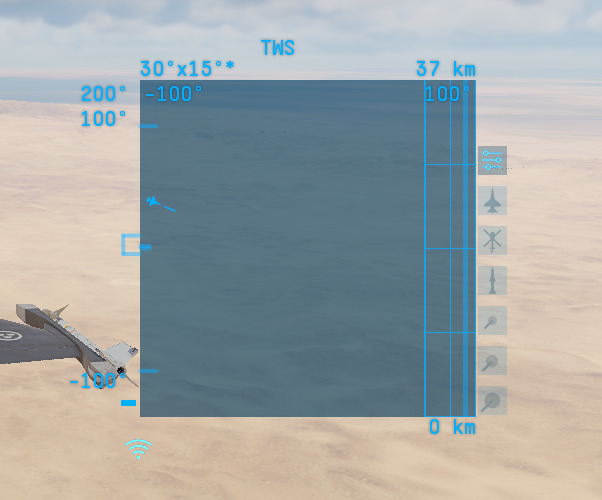
TWS is overperfoming on gimbaled ESAs currently
Oh man if the MCM meta isn’t addressed then I can see players just shooting down any incoming and then lobbing Meteors with no worries as the F/A-18Es can only carry four gunslingers.
if MCM isnt addressed itll just be F-15EX, Su-35, and F/A-18E shooting everyone elses missiles down with AIM-120/R-77
So not too much different.
Cool picture I found
Also just realized the picture is all European planes but the post is about the USAF’s birthday xd
1 Like
posted on NATO aircom, and the three participating airforces instagram in June. amazing pictures!
https://www.instagram.com/p/DZuRaChjvcS/
and yeah that is really fun that they chose to celebrate the US airforce with a Swedish, a Czech and two French planes
Total European takeover )))
1 Like
Square cube law. The amount of particles you can push out the back scales with the area, the amount of weight scales with volume. Acceleration for a larger missile will be less by default unless they use a way stronger propellant (that then also needs a thicker shell that weighs more to handle the forces). The impulse however will probably be greater for the larger missile because it can burn the booster for longer.
The amount of G it can pull is not a straight measurement of maneuverability. Being able to pull x amount of g-forces at 1000km/h is not at all the same as being able to pull the same amount of g-forces at 3000km/h . The one pulling the same g at a slower speed will be much more maneuverable.
For maneuverability it’s much more relevant what turning radius it has at what speed.
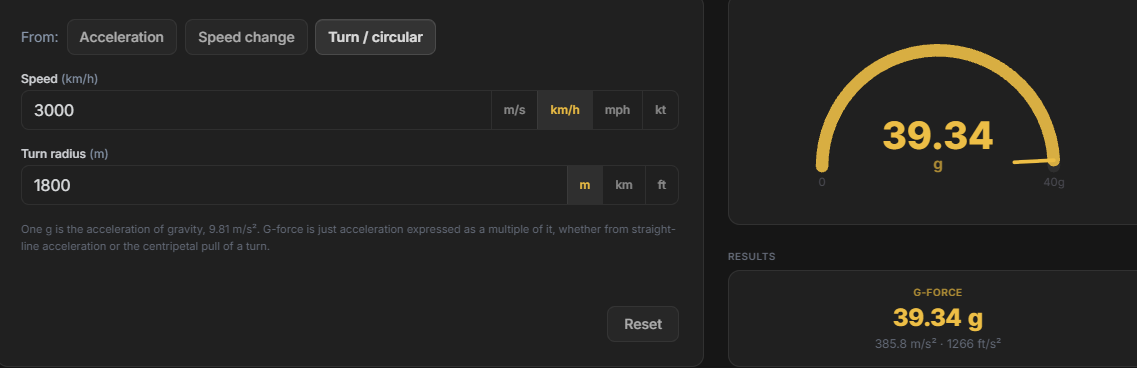
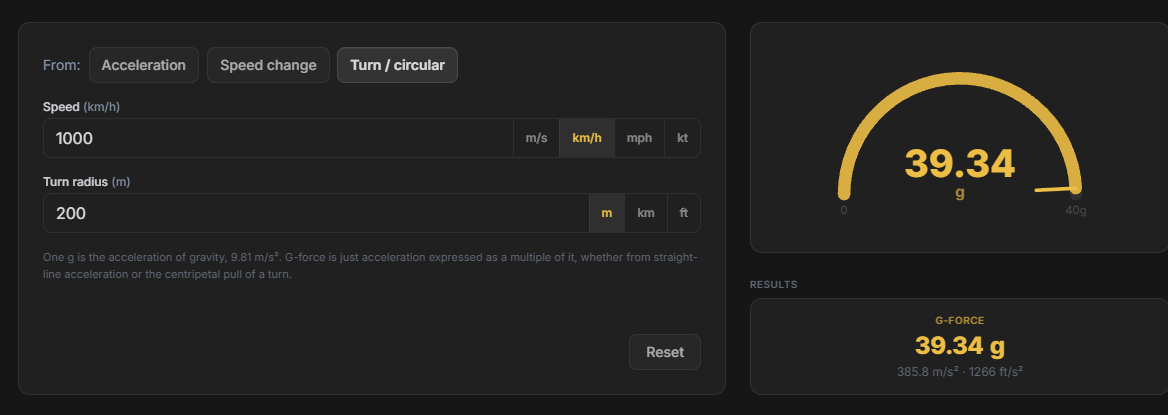
So being able to pull that may g at 3000km/h isn’t that maneuverable compared to pulling the same g at 1000km/h. So at what speed that happens plays a much larger role.
5 Likes
this is true, but you have to consider differences in propellant grain (mk104 on AIM-174 is boost-sustain), and efficiency since the meteor rocket booster doesnt use a nozzle iirc, which really screws up its efficiency compared to typical missile motors.
both are fast missiles, 38g at high supersonic speed is very effective as we can see ingame with the new missile models. neither will be reaching peak G at low speeds like 1000kmh so theres no point in bringing that up
According to the Defence Research Agency paper on a ramjet missile very similar to Meteor, being able to throttle the engine down to 10% provides a range improvement of over 3x compared to not being able to throttle the engine at all. So it is quite a significant capability. And in the paper 10% thrust was the amount required to maintain the desired cruising speed of Mach 3. So in that sense 10% is optimum.
4 Likes
Why not?
Also not sure why you are fixating on drag when a 90+ second burn time likely has far more benefit than the drag of the intakes. At the end of the day from what is known about Meteor’s performance it far exceeds that of AIM-120, so I’m not sure why you are saying the AIM-120 having less drag is some sort of trump card.