It was still based on F-15C platform iirc which is the main selling point in this case.
On other hand I haven’t seen a single Su-27/30’s with double racks even as mockup and iirc the main reason why they cannot equip is the gap between engine intakes are not big enough to fit double racks compare to Su-35.
However my point still stands, if you can find a single photo that shows current Su-27SM/30SM is equipped with double racks I will retreat my statement.
Provide proof that R-77 dual pylons cannot be fitted to Flankers [Su-35/30/27].
The only newer service Sukhoi aircraft with different engine spacing are Su-34 and Su-57.
Provide proof that Su-30 or Su-35 aren’t Flankers. Su-35 adds wing-span, but not engine spacing as that would require a brand new airframe and cause issues with engine distance stability.
Here’s proof that R-77s are correctly modeled in War Thunder which proves that the photograph is identical engine spacing with all other Flankers. Unless that dual R-77 photograph somehow isn’t an Su-35 and is instead an Su-27/30 of some kind… but I think it’s an Su-35.
“It’s still based on the Flanker platform, which is the main selling point of the R-77 dual pylons.”
Again, MRMLs and R-77 dual pylons [I forgot their official name the day after reading it] are the same exact situation if & when Su-30MKI is added to the game to Britain with them.
How can the dual R-77s not fit on Flankers [which includes Su-35] due to engine width?
We have photographic evidence, it’s linked in the post you replied to.
Weird how the R-77 fins perfectly overlap between the in-game screenshot and the IRL photo.
If they can’t fit, why is there a photo of a Flanker with them?
Or are you going to claim these images aren’t an IRL photo of Su-35, and in-game screenshot of Su-27?
Are you going to claim that R-77s and R-27ERs are both modeled too small to justify your existing beliefs?
Or are you going to stop perpetuating myths?
Edit added the dual pylon images from the quoted post.
What width?
You can clearly see there’s no added width in the provided photographs comparing to screenshots of in-game Flankers.
The Su-35 is not featured in War Thunder, so how can those screenshots in my post be of an Su-35?
When Su-35 is added to War Thunder with no added engine width, don’t be surprised. Cause Sukhoi didn’t add engine width, they added wingspan.
If Sukhoi added engine width the singspan would be over 16 meters instead of 15.3.
So either those dual pylons aren’t on an Su-35 in that photograph which proves they fit on Su-30s, or it’s an Su-35 which proves Su-35’s engine width is identical which we knew was identical for a decade now.
I’m unsure how this myth started and how it’s perpetuated.
You have zero proof that the engine spacing is different.
The front intakes of Su-35 could’ve been modernized, but the engine mounting position is blatantly identical between Su-27 [original] through Su-35S.
Note, NONE of these facts are being used to justify dual racks on Su-27SM2/3 in-game.
I am not doing that.
All I am doing is refuting the spacing myth, because I find it annoying and have evidence.
There’s a reason I grabbed photographs that have weapons mounted in the center for good reference.
I am not your enemy, KYoo, I am at worst an ally.
We’re all on the same page of loving aviation.
Edit:
I haven’t found a good top-down of Su-35 and Su-27 to provide 100% proof of wing span differences, but I know from underside photographs of Su-35s mounted with weapons that the added aircraft width is purely from the new wingspan, which also adds the extra fuel to Su-35.
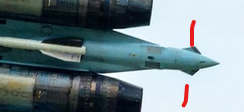
Because the photographer cited it, I have the full image on my primary desktop which shows the full wingspan [which also shows the Su-35’s wingtips], and the cropped image shows the iconic Su-35 tail with the protrusions… oh and you can see the extra flare/chaff dispensers on it as well.
So yeah, I have no reason to believe that this isn’t a photograph of a real Su-35 doing a flight.
I mean, read the full run-on sentence of mine. :)
If I didn’t include the photographer’s claim, I felt my reasoning would be incomplete.
I also never noticed the extra flare/chaff of that Su-35 photograph until today. XD
Nope, and that argument is easily used against you.
There are dozens of service Su-35s photographed with the same exact engine spacing as all other Flankers, because they’re all still Flankers. Su-35 adds 1 foot of wingspan on each side of the aircraft, that’s where all the ~2 feet of extra width comes from.
If there’s an experimental aircraft… extra spacing could’ve easily been an experimental version that never passed experiments.
Which is why despite these engine spacing claims occurring every few months, a total of zero photos have been posted proving the case.
Yet 5? to dozens of photos proving identical engine spacing have been posted.
All Su-35s have the same wingspan.
And dual R-77s were cited “Su-35” with no specific variant, as well as one of the either testing Su-30s or modernized service Su-30s prior to the thrust vectoring variants, and perhaps one other vehicle I forgot.
Either way, Su-30SM and 35 can both use them, which means Su-30MKM’s is correct because that’s a 2019 vectoring Flanker using many modernized systems.
The only contention is if the Su-27SM2/3’s fire control computer can handle it, and we won’t know without a manual, which we won’t get under normal circumstances for like 30 years, and can’t share on this forum until it’s unclassified.