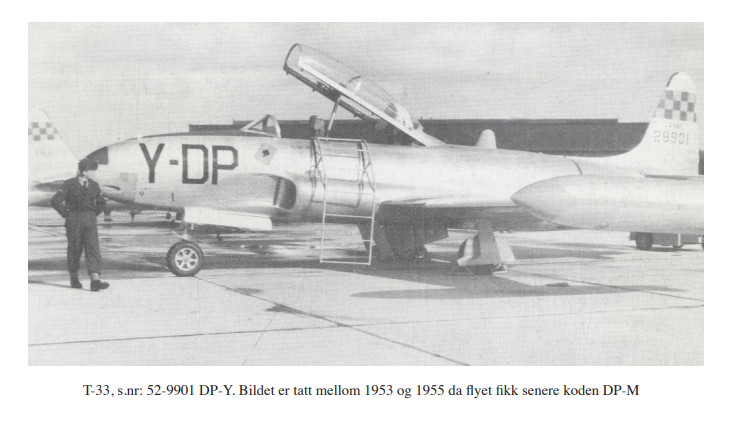
TYPE: Two seat jet trainer
ARMAMENT
- 2x 12.7x99mm M3 Colt-Browning Machineguns
-Bore: 12.7mm
-Muzzle velocity: 2,870 feet per second
-Rate of fire: 1,250 rounds per minute
-Bullet weight: 49 grams
-Gun weight: 65 lbs.
-Ammunition stowage: Uncertain
-Ammunition producer: Raufoss Ammunisjonsfabrikker
TECHNICAL DATA
Wingspan: 11.8 Meter
Length: 11.5 Meter
Empty weight: 3,794 kg
Maximum gross weight: 6,850 kg
Eigne: 1x Allison J33-A-35 turbojet
Crew: 1-2x
PERFORMANCE
Maximum speed: 970 km/h at sea level
Range: 2055 km
Serial Numbers of the specific planes with 2x M3 browning’s and K14 sights added
- 51-9033
- 51-9901
- 51-17452
- 51-17497
- 51-17522
- 51-17544
- 51-17546
HISTORY
The Lockheed T-33 “Shooting Star” is an American developed and designed jet trainer, wich was produced by Lockheed and had it’s first flight as early as 1948. This was based on the older Lockheed P-80/F-80’s. The main differences between the T-33 and these were the lengthening the fuselage by a little bit more than 1m and adding a second seat for the trainer, new instrumentation, and flight controls. This plane was adopted by a bunch of nations, existing in dozens of different modifications and used for many purposes, not only training.
In Norway, the first of the T-33’s arrived the 27th of April 1953 as a part of the American weapon’s aid, and from 1953 to 58 there were delivered 22 units. Advanced training had been carried out on 6 two-seaters of the de Havilland DH. 115 T. Mk.55 Vampire type since the summer of 1952. Three aircraft were allocated to 336 and 337 squadrons respectively, but when new pilots arrived after basic training from the USA and Canada for further distribution to the operational squadrons with the F-84 “Thunderjet”, the Air Force decided to establish an "Operational Training Unit (OTU). This was established at Sola air station with the designation Jettreningsvingen (JTV) on 11 October 1952. The unit was then transferred four Vampire two-seaters and given the squadron code DP.
Gradually more “T-birds” arrived, and the first instrument course with 4 students began on 15 May 1953. During the year there were 12 instructors at JTV. The phasing out of Vampire began and from February 1954 there was only one type of aircraft at the department. The last aircraft that year arrived directly from Kelly Air Force Base in Texas and they were all of the T-33A-1-LO type. When the Jet Training Wing consisted of 12 aircraft, it was decided that it should be given the status of a independent squadron. From 1 July 1954, it was designated 718 Jet Training Squadron (JTS). From May to September 1955, the squadron was assigned 8 new aircraft, which were flown from the USA to Gardermoen for acceptance testing. The aircraft were then transferred to 718 Squadron. The last two T-33A arrived in Stavanger by boat from the USA, and they were of the T-33A-5-LO version.
The difference between the first 20 aircraft of the A-1 type was that they had a nose section similar to the single-seater F-80, with the possibility of installing two 0.5" machine guns. The last aircraft therefore had to operate with ballast in the nose section to maintain the same center of gravity. In the 1960s, the aircraft’s nose, tail section and tip tanks were painted with “day-glow” fluorescent orange color, to make them more visible in the air. As the aircraft were mostly used for instrument training, weapons were not installed in 7 of the aircraft until 1959. However, the installation of K-14 sights in the forward cockpit prevented the pilot’s view, so the sights were installed and removed before shooting training. In addition to the training activities, which also involved annual instrument certificate check-outs for Luftfors-var pilots, the activity at the squadron was extensive. Over the years, courier flights, flights with tow targets for shooting training with fighter aircraft, approach training for GCA controllers (Ground Control Approach), and Forward Air Control (FAC) in cooperation with the Army. The Air Force’s Bombing and Shooting School (LBSS), which was also located at Sola, early on entered into close cooperation with 718 Squadron. When LBSS discontinued its courses for the other squadrons of the Luftfors Air Force, both aircraft and personnel were loaned to this activity. From the autumn of 1965, the cooperation had become so close that both units moved together in hangars 4 and 5 at “Sola-land”, but the merger of the two departments was not realized until the new aircraft type F-5 arrived. All T-33As were delivered with American ejection seats. However, at very low altitudes these were not safe, so the remaining aircraft were modified with Martin Baker seats in the period 1962-63. During the entire period, the aircraft type was stationed at Sola, with further training of new pilots from the USA/Canada as its main task.
In 1965, the F-5 Freedom Fighter was introduced to the Air Force. This resulted in the decision to phase out the 15 remaining T-33 aircraft. On July 4, 1968, the first of 5 two-seat F-5Bs and 11 single-seat F-5As arrived. In September of the same year, 5 of the American-owned T-33As were delivered to Italy. On December 17, the 10 remaining aircraft were flown by Norwegian pilots to the American base in Ramstein, where they were then loaned to the French Air Force. Thus, the “T-bird” era in the Air Force was over, unfortunately without a single example being retained for museum purposes. The reason was that the aircraft were on loan (MAP) and had to be returned to the American authorities. Seven aircraft totaled in the period from 1953 to 1968, in which 5 pilots and 3 flight students, as well as 1 passenger, died.
IN GAME
it’s only armed with two 12.7mm machineguns, so it won’t be useful for much other than air to air combat in air battles or to support your ground teammates from helicopters and other planes in ground RB. It could be a really good plane at an br between 6.0-6.3, and be a decent first jet in the potential tech tree it could be added to.
ALBUM
Spoiler
SOURCES
Spoiler
Oppdrag utført : Norges luftmilitære kulturarv
ISBN: 9788291218557
Published: [Oslo]:[Forsvarsmuseet], 2012 (Defence Museum)
Author: Glenne, Roar (Served the Norwegian air force from 1946-2006
Dewey: 358.4009481, 623.74
UDC: 629.7(091), 623.746, 355.354(481)(091)
Link: Nasjonalbiblioteket
Luftforsvarets historie. 1 : Fra opptakt til nederlag : (juni 1912 - juni 1940)
Link: Nasjonalbiblioteket
Lockheed T-33 - Wikipedia
Norske militærfly - Sverre Mo - Innbundet (9788284033037) » Bokkilden
Norli Bokhandel
- Yes
- No