- Yes
- No
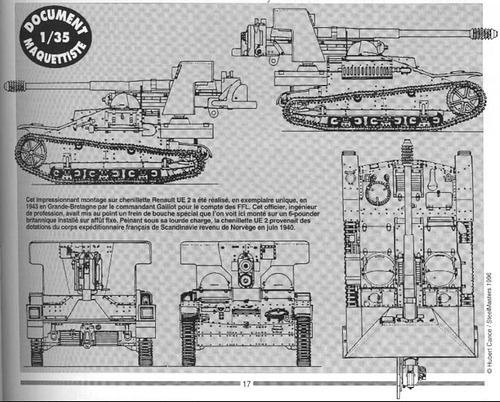
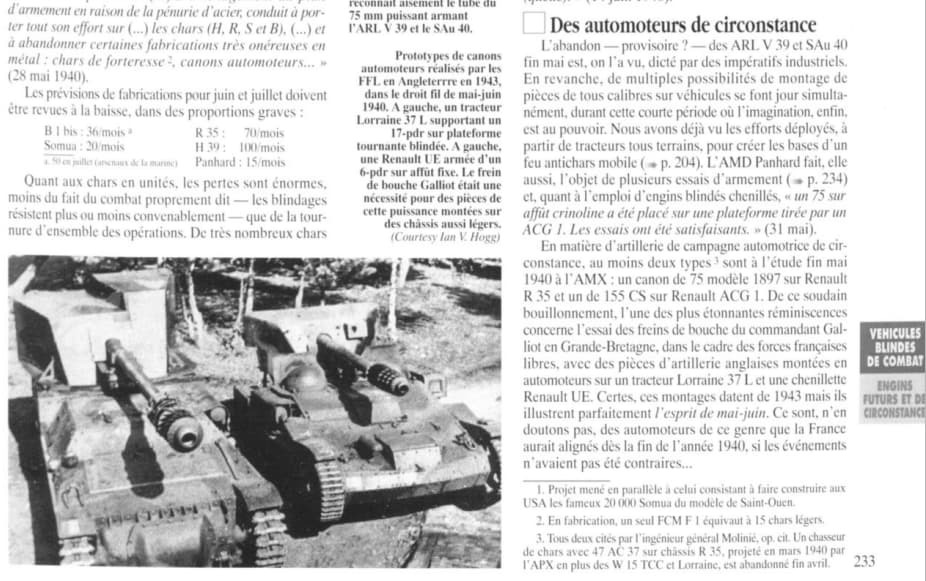
Hello! Today, I’d like to present a conversion of a Free French forces’ artillery tractor into a tank destroyer, made by installing the British 57 mm gun on a tiny Renault UE2. The little fella is pretty famous on the web as UE 57!
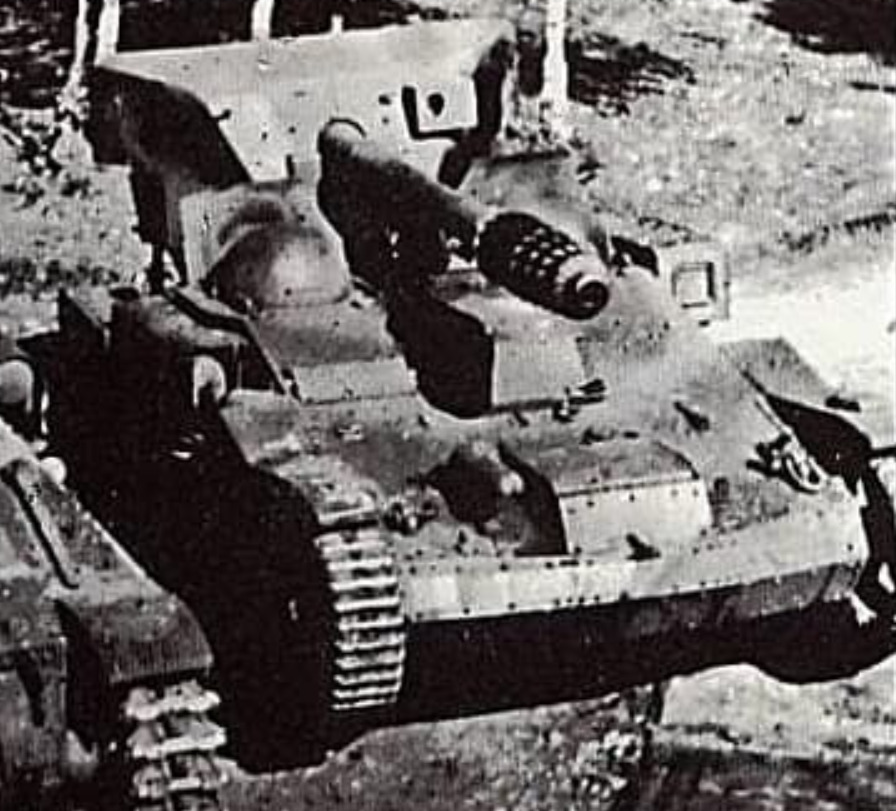
- The only known photograph of UE 57:
History:
Click
French artillery tractors
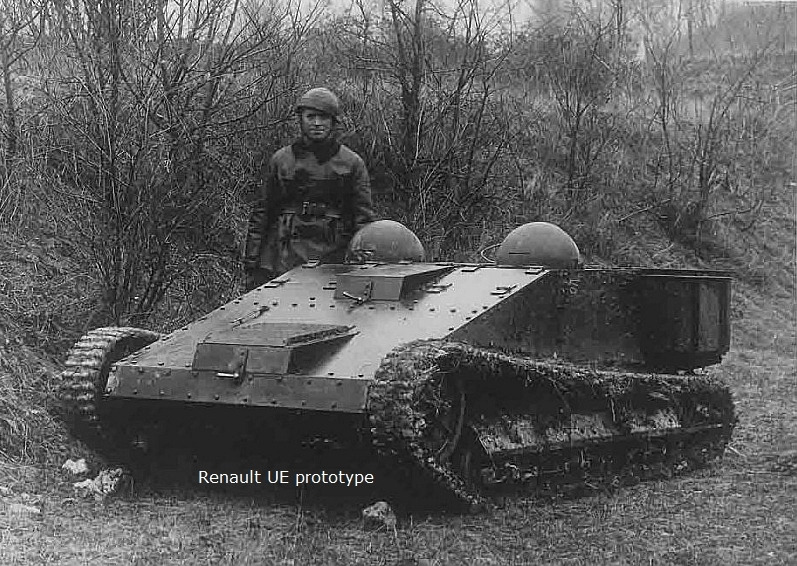
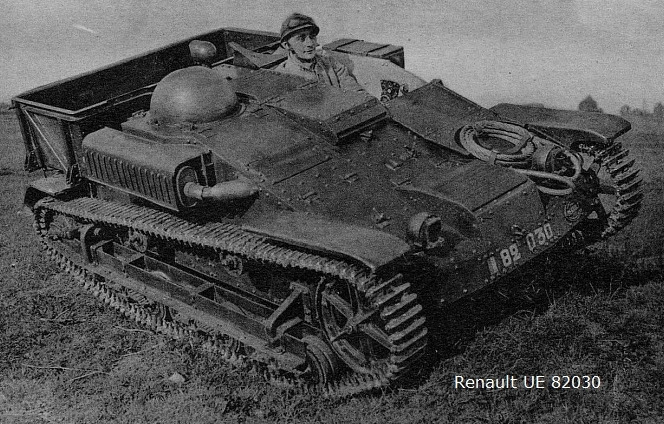
In the start of 1930s, French army needed motorization means for it’s army. Multiple companies – Renault, Citroen, and co-op of Brandt and Latil, were offered to design a lightweight artillery tractor, similar to Carden-Loyd Mk.VI. With more successful prototype tests and longer experience of making vehicles efficiently, Renault’s design, the UE, was chosen for mass production and service in the French army. It was a lightweight full-tracked artillery tractor, controlled by the crew of two: a driver and a commander. It’s production started in 1932. It has not been a very reliable and mobile vehicle, but it was cheap and light, as the army required.
-
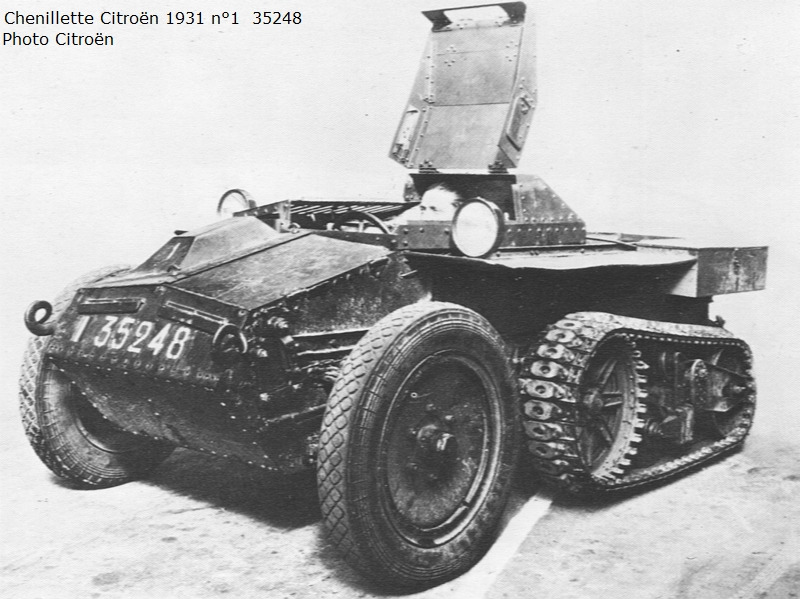
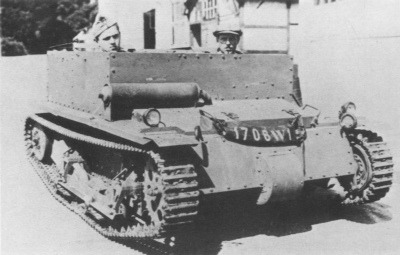
Artillery tractor prototypes of Citroen, Brandt & Latil, and Renault, respectively:
-
Serial model of Renault UE:
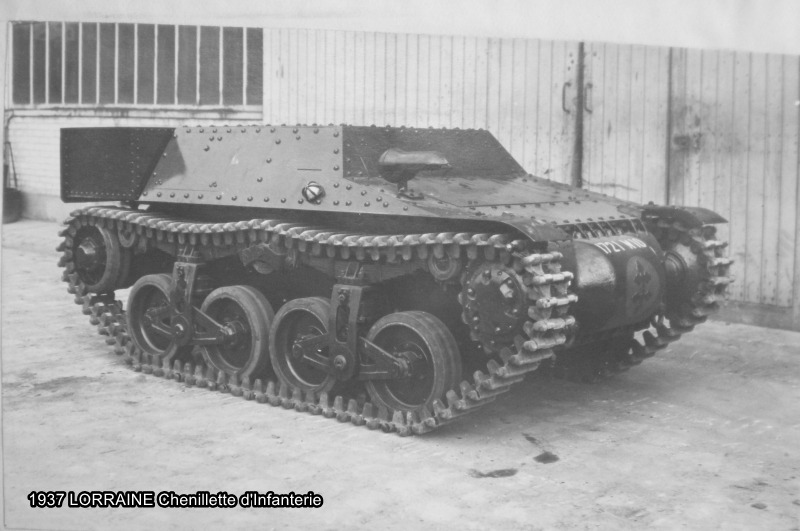
In 1935, France was conducting large military reforms to supply it’s army with multiple types of armored vehicles – new infantry, cavalry and battle tanks. It also included upgrading the remaining artillery tractors. That task was offered to multiple companies, such as Lorraine and Hotchkiss. Even despite seemingly more successful attempts of multiple companies to replace the UE in 1937, as the new designs had more powerful engine or superior construction allowing them to carry heavier load, the army went on with the redesign of Renault’s own UE, which featured a number of visual and mechanical modifications (such as changing two headlights to a single headlight with armored cover, different mudguards, reinforced engine pistons, and 4F/1R transmission instead of 6F/2R). Obviously, the decisive factor was the ease of mass-production of only slightly changed model.
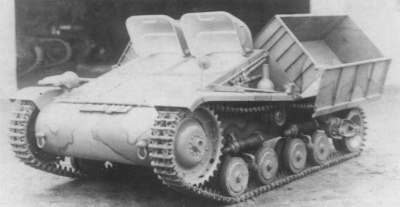
- New artillery tractor projects from Hotchkiss, Lorraine and Renault, the latter renamed to UE2:
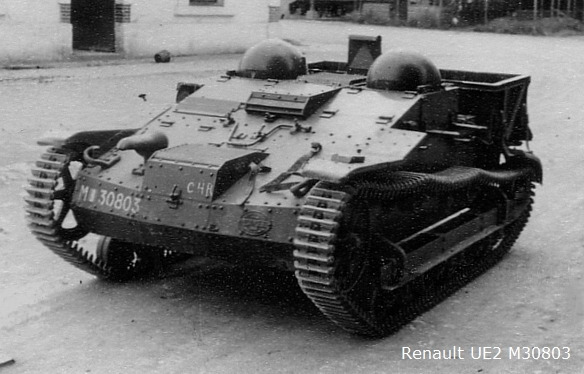
Reincarnation
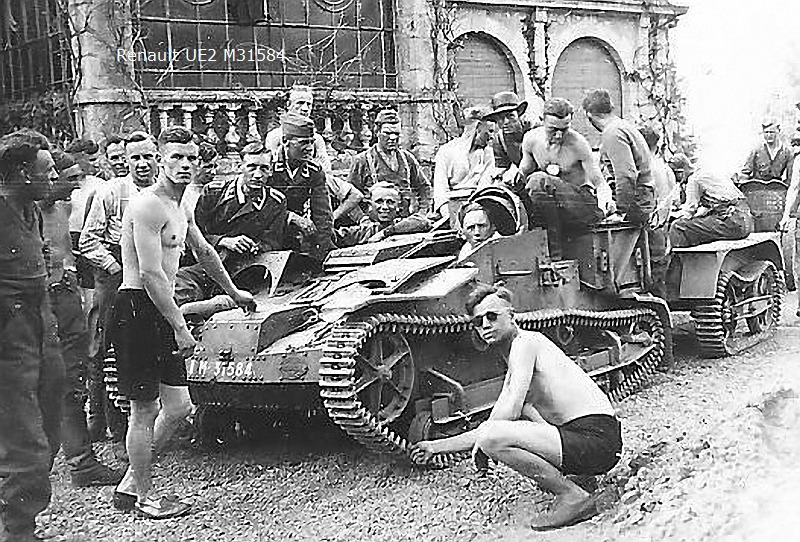
On May 10, 1940, German Reich has invaded Benelux and France. Along with the other armored vehicles, the UE and UE2 were mobilized. The Wehrmacht, advancing from the Netherlands in south-western direction, through Ardennes, then tried to cut off the united Franco-British forces in Dunkirk by advancing to La Manche. The Dunkirk rescue plan was initiated, with large amount of various heavy armaments and vehicles, including a number of Renault UE2. Some of them were evacuated to the British Isles to be later used by the Free French Army.
- A number of German soldiers are posing inside and near the captured Renault UE2:
In the summer of 1943, a team of Free French soldiers in Britain, led by French inventor Norbert Jules Andre Galliot, participated in converting two vehicles, the artillery tractor Renault UE2, and the tank support APC Lorraine 37L, into heavily-armed tank destroyers. They were to be armed by 57 mm and 76 mm anti-tank guns respectively. Due to the heavy recoil for such light and tiny tracteur and chenillette, Galliot has decided to equip the gun with a specially designed muzzle brake.
Additional historical throwback:
The muzzle brake was developed by Galliot and Bory in 1919. It was being tested in the US the same year. In 1924, the results of the experiments were submitted to the US authorities. The muzzle brake worked by directing the blast backwards through a series of spiral channels. It was an incredibly complex piece of equipment that several UK manufacturers have refused to build.
- Galliot muzzle brake in Defense Capabilities Center in Shrivenham. Look at the pictures on the wall – familiar, aren’t they?:
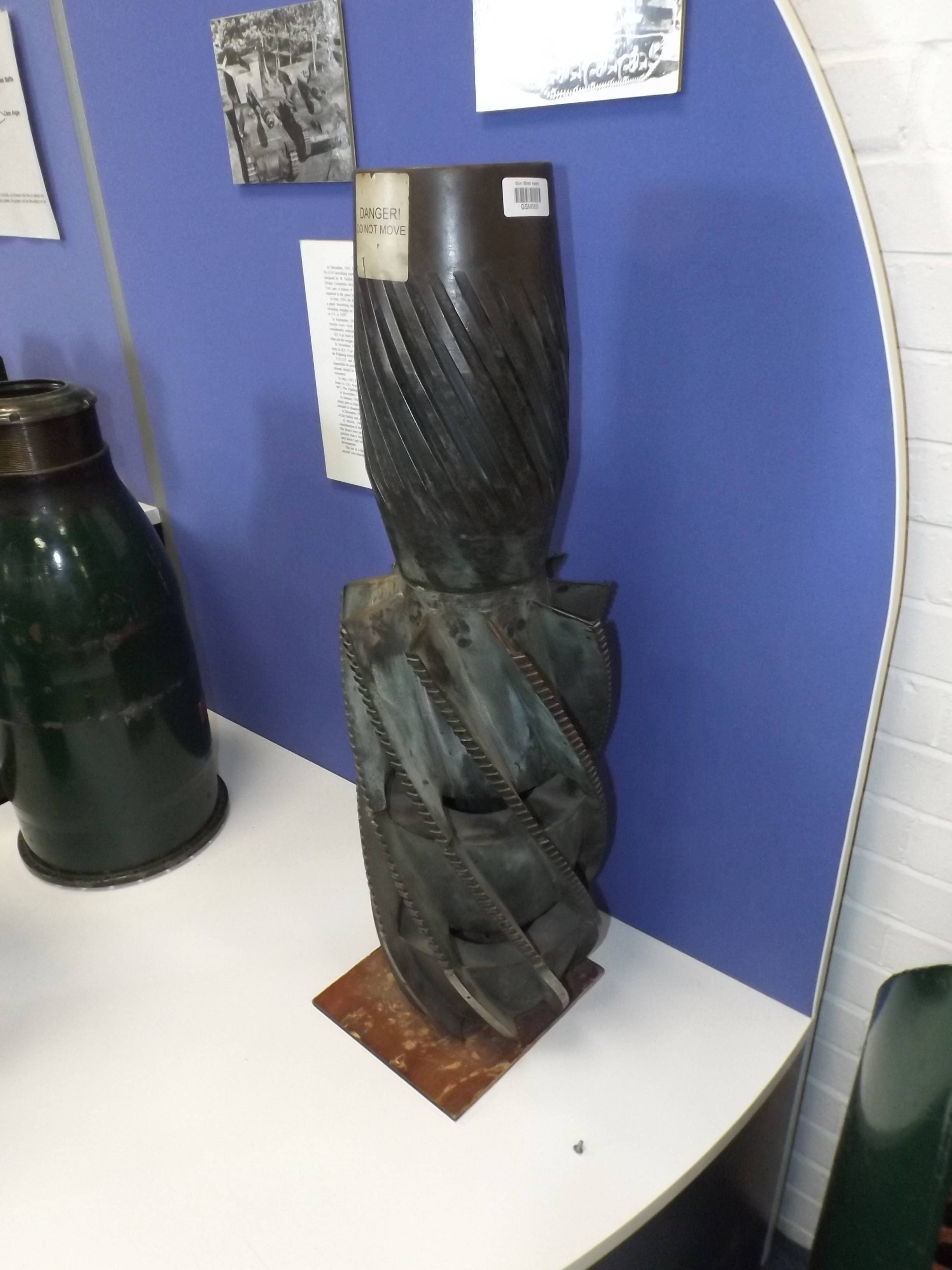
The muzzle brake had multiple spiralling rows where the gunpowder gasses would press at the gun at once, reducing the recoil by whopping EIGHTY-ONE percent! However, the issue was the immensive force of the gasses’ backblast. Some experts say that it could even damage the engine and transmission compartment. However, the muzzle brake made it possible for the UE2 to be equipped with OQF 6-pdr gun, capable of delivering high-velocity shots with decent penetration and damage for the vehicle’s tiny size.
Unfortunately, the trials of both vehicles didn’t end up being very successful: unlike the Soviets and the Germans, the French have always been extremely picky on the mass issues of Ersatz vehicles, and the relatively weak engine of UE2 was not coping with immense mass of it’s new weapon. It has been converted back into an artillery tractor. It’s further fate is unknown.
Design:
Click
The Renault UE2 (6-pdr), or simply the UE 57, is a really little tankette, standing at 1.25 m tall by the crew cupolas, or just 1.04 m by the hull roof. With the gun, the height raises to about 1.67 meters. Still pretty small! It has an all-around armor thickness of about 9 mm. Sounds horrible on paper, but it’s actually gonna be enough against regular 7.62 mm steel bullet frontally, as most plates remain angled at least a bit. So most likely the enemy will neccessary have to have a 12.7 mm machine gun, or waste a shell on your little bugger.
Your vulnerability would likely be exposed cannon operators: it is not known if the vehicle is intended to be operated by the crew of original two or extended four, but if there were any constructional features that would allow the two additional gun operators – gunner and loader, to ride the UE 57 (as there is a bit of flat space to stand on, but it’s neccessary to hold onto something tight), they would be easily shootable by the machine gun. Otherwise, if it would be operated by two, the vehicle would require a stop-to-fire mechanic, but increase the survivability by a little.
Similar to what the ELC AMX and ELC bis could have received in return of full turret traverse, if the developers wanted to achieve more unique and useful mechanics in the game, the UE 57 would need to come to a full stop to let the gun function as intended.
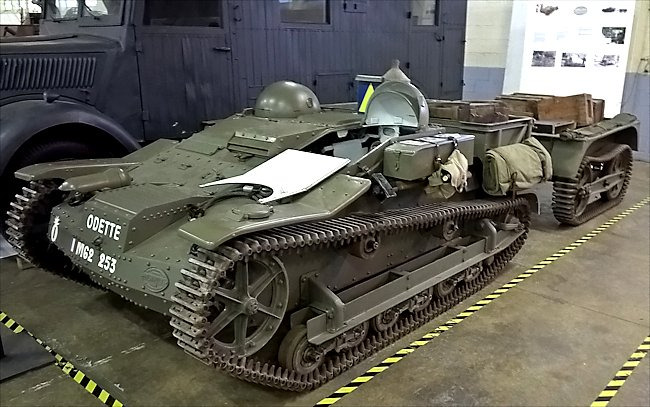
Your weapon is 57 mm Ordnance QF 6-pounder gun Mk.II (a largely-serial L/43 version of towed, less-produced Mk.I L/50), located on the rear flat platform with the barrel horizontally locked between crew hatches, able to fire a variety of solid shots – capped and uncapped for various purposes and with maximum armor penetration capability of 122 mm. Against soft targets, you, as well, get access to a high-explosive shell. No secondary armaments are featured. The ammo quantity largely depends on what is not seen on the photo, but is likely dependent on the box to the right and left of the (potential) gun operators, and on a towed trailer that was issued to Renault UE units in France.
- An UE2 with it’s own tracked trailer for carrying various equipment such as anti-tank cannon and mortar ammunition:
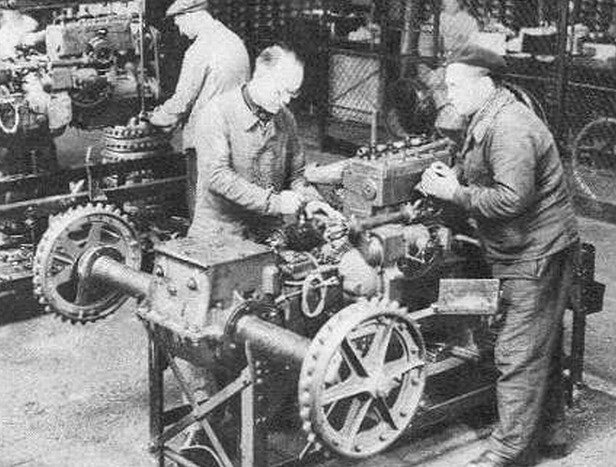
Lastly, the Renault UE2 features inline-4 petrol engine of 3-liter displacement, the Renault Type 85, capable of delivering 38 horsepower at approximately 2800 RPM. If we divice the power onto the mass of the UE2 (2.64 t) and 6-pounder Mk.II (1.14 t) combined, we get about 10 hp/ton. That low engine rotation speed and 4-gear transmission limit our maximum speed by just 30 km/h. Both of these values are definitely not great, but eventually we trade the mobility and survivability for sneakiness and hard-hitting and quick-firing gun. Very important during defensive tactics!
- Renault UE power unit during assembly at one of the French factories:
Specifications:
Click
- Operator country:
 Free France
 - Name option №1 (full): Renault UE2 (6-pdr)
- Name option №2 (short): UE 57
- Year: 1943
- Size specifications:
– Length: 2.75 m
– Width: 1.05 m
– Height: 1.67 m
– Ground clearance: 30 cm - Protection:
– Hull, all-around: 9 mm RHA
– Gun shield: 10 mm RHA - Armament:
– 1x 57 mm Ordnance QF 6-pounder Mk.II, ammo capacity: at least 9 rounds (AP, APC, APCBC, HE) - Horizontal traverse: ±13 degrees
- Vertical traverse: -5…+15 degrees
- Engine: Renault Type 85, gasoline, inline 4-cylinder
- Power: 38 PS / 2800 RPM
- Max speed: 30 km/h
- Suspension: leaf spring type
Gallery:
Click
-
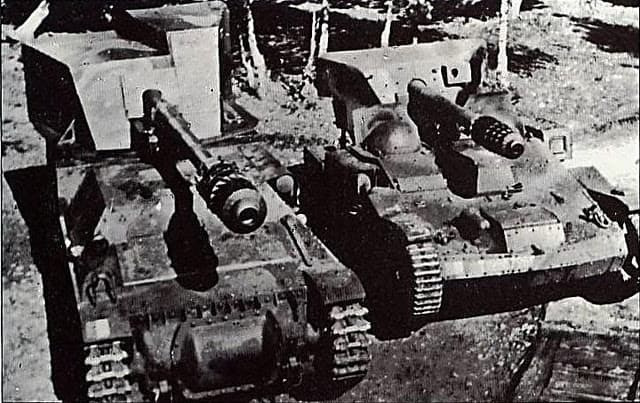
The original of the photograph, featuring both Lorraine 37L and Renault UE2 armed with the heavy British anti-tank cannons
-
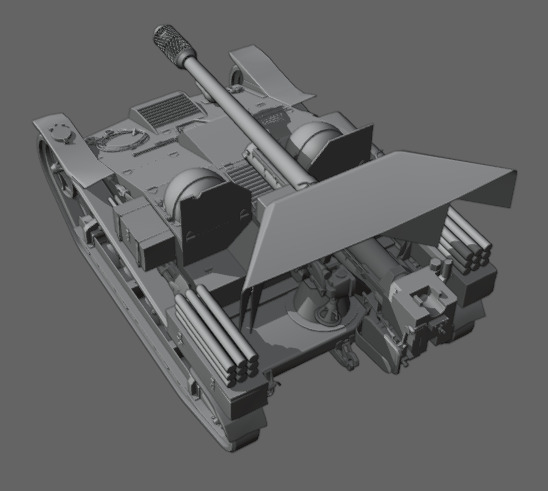
A 3D-reconstruction attempt using avaiable UE 57 and proper, short OQF 6-pdr Mk.II models, and fitting the 57x441R ammo inside visible boxes, with total count of at least 18:
-
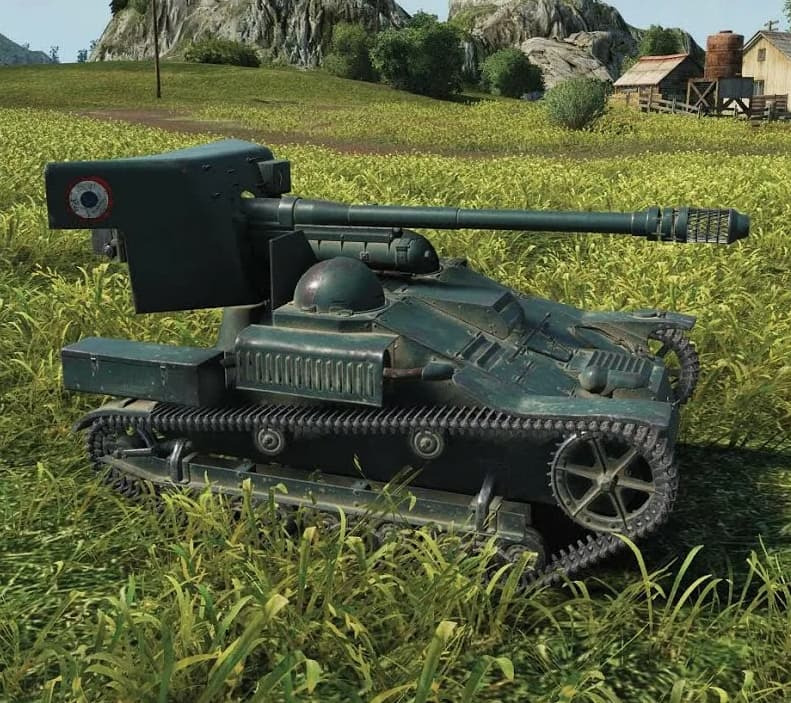
Artistic interpretation of UE 57, featuring incorrectly long Mk.IV barrel of the 57 mm gun:
List of sources:
Click
-
François Vauvillier, Jean-Michel Touraine, Jean-Gabriel Jeudy — L’automobile sous l’uniforme, 1939—1940, publications Massin, 1992 edition, ISBN 2707201979:
-
François Vauvillier — Steel Masters, publications Histoire&Collections, edition 1996: