Chinese Testing Method for Projectiles of 85 mm Caliber and Above (GJB 2390—1995)
The Chinese testing method for projectiles of 85 mm caliber and above is specified in GJB 2390—1995.
1. Ammunition control
The test should use “standard projectiles”—a batch of projectiles that meet the specified technical requirements and have passed an initial inspection in armor-piercing performance tests—to eliminate the effect of individual ammunition differences on penetration-depth data.
2. Target plate selection
Select equivalent target plates according to the testing purpose. When measuring the maximum armor-piercing depth, use a semi-infinite target or a thick homogeneous armor steel plate. When assessing whether a specific thickness or equivalent-level armor can be penetrated, use a limited-thickness target or an equivalent target plate. When necessary, a double-layer target with a specified gap may be used. The target plate may be placed vertically or at an incline to simulate actual combat impact angles.
3. Shooting condition control
According to GJB 59.17—88, the shooting distance, angle, and ammunition-type selection principles must be clearly defined to ensure test reproducibility. Public U.S. military test procedures may be used for reference: the weapon is positioned at least 400 m from the target, and shots are fired at impact angles of 0° (vertical), 30°, 45°, and 60°. In addition, the projectile’s yaw angle (flight attitude) must be controlled within allowable limits to ensure “normal penetration” and avoid data distortion due to attitude deviation. The above 400 m distance and 0°, 30°, 45°, and 60° impact angles are publicly available reference information; they are not explicitly specified in GJB 2390—95 or GJB 59.17—88. Formal tests must follow the standard text and test outline.
4. Shot execution and data recording
For each valid hit, record the target distance, impact velocity, nominal impact angle, crater depth, nominal crater diameter, and signs of damage on the rear face of the target plate, such as spalling or fragmentation; photograph for archival purposes.
5. Penetration capability evaluation—direct penetration depth measurement
For semi-infinite or thick targets, directly measure the maximum depth penetrated by the projectile—i.e., the horizontal armor-piercing depth—and express it as “millimeters of homogeneous armor steel penetrated at a given distance” to indicate effectiveness.
6. Penetration capability evaluation—ballistic limit method
For limited-thickness targets, adjust the propellant charge or shooting distance to vary the impact velocity and determine the critical velocity at which the penetration probability is 50%. Usually, at least 3 complete penetrations and 3 partial penetrations are required, with valid hits falling within a certain velocity range, to ensure a reasonably accurate ballistic-limit assessment.
7. Determination of test validity
Boundary effects and interference from pre-damage by prior shots should be excluded. Common principles in similar ballistic tests include maintaining sufficient spacing between crater edges and between craters and target edges; for example, GJB 59.18—88 small-arms projectile tests specify no less than 2.5 times the projectile diameter. The specific spacing and validity criteria for 125 mm artillery test rounds should refer to GJB 59.17—88, GJB 2390—95, and the test outline, and small-arms standards should not be adopted directly.
8. Result expression
Finally, the armor-piercing capability of 125 mm armor-piercing projectiles should be assessed based on penetration depth or ballistic-limit data obtained with standard projectiles, specified target plates, and controlled shooting conditions. Publicly reported penetration values may serve only as a magnitude reference and cannot replace formal evaluation data.
9. Definition and requirements of equivalent target plates
GJB 2390—1995 defines an “equivalent target plate” as a single-layer, double-layer, or multi-layer target plate whose ballistic resistance is equivalent to that of a homogeneous armor steel plate of a given penetration depth. This means that the core requirement is that the target plate’s ballistic resistance must be equivalent to that of standard homogeneous armor steel (RHA) of known thickness. The specific form of the target plate—single-layer, multi-layer, or double-layer with a gap—may be chosen flexibly, provided that such equivalence is confirmed.
The target plate material is generally homogeneous armor steel plate, and its manufacture and acceptance must comply with specialized technical conditions, such as WJ 524—1966, “Technical Conditions for the Manufacture and Acceptance of 25–120 mm Homogeneous Target Plates.” Studies and standard analyses of the yield strength of homogeneous target plates provide an important indicator of armor-piercing performance against them and directly affect penetration results. Therefore, the mechanical properties of the target plate material (such as yield strength and hardness) must be strictly controlled to ensure its reliability as an “equivalent” benchmark. Some references provide hardness ranges for target plates, for example, 450–520 HB for armor steel plates.
Internal quality: Target plates must undergo non-destructive testing, such as ultrasonic inspection, to ensure that there are no internal cracks, slag inclusions, incomplete welds, or other defects, thereby avoiding test-data deviations caused by material inhomogeneity.
Thickness and number of layers: Owing to limitations of the rolling process, commonly used single rolled armor plate thicknesses are 150 mm or 220 mm. When a greater equivalent penetration depth (such as above 600 mm) must be simulated, multiple steel plates may be stacked (e.g., double-layer targets); however, the overall equivalence after stacking needs to be corrected through experiments or calculations.
Inclined arrangement: To simulate inclined hit positions such as the upper frontal armor of a tank and to use target plate thickness more effectively, inclined target plates are a common choice. For example, penetrating a 220 mm thick target plate inclined at 68.5° corresponds to a horizontal armor penetration depth equivalent to approximately 600 mm of vertical homogeneous armor steel (220 / cos 68.5° ≈ 600 mm). This conversion relationship forms the basis for presenting results.
Verification plate (optional reference): In some protective-armor testing systems (e.g., AEP-55), a 0.5 mm thick aluminum verification plate is placed at a certain distance behind the main target plate (e.g., 150 mm) to determine whether fragments or projectile remnants have penetrated, serving as an auxiliary criterion for “complete penetration/partial penetration.” This is a supplementary reference requirement; whether its use is mandatory in the GJB 2390—95 power qualification test should be based on the standard text or the test outline.

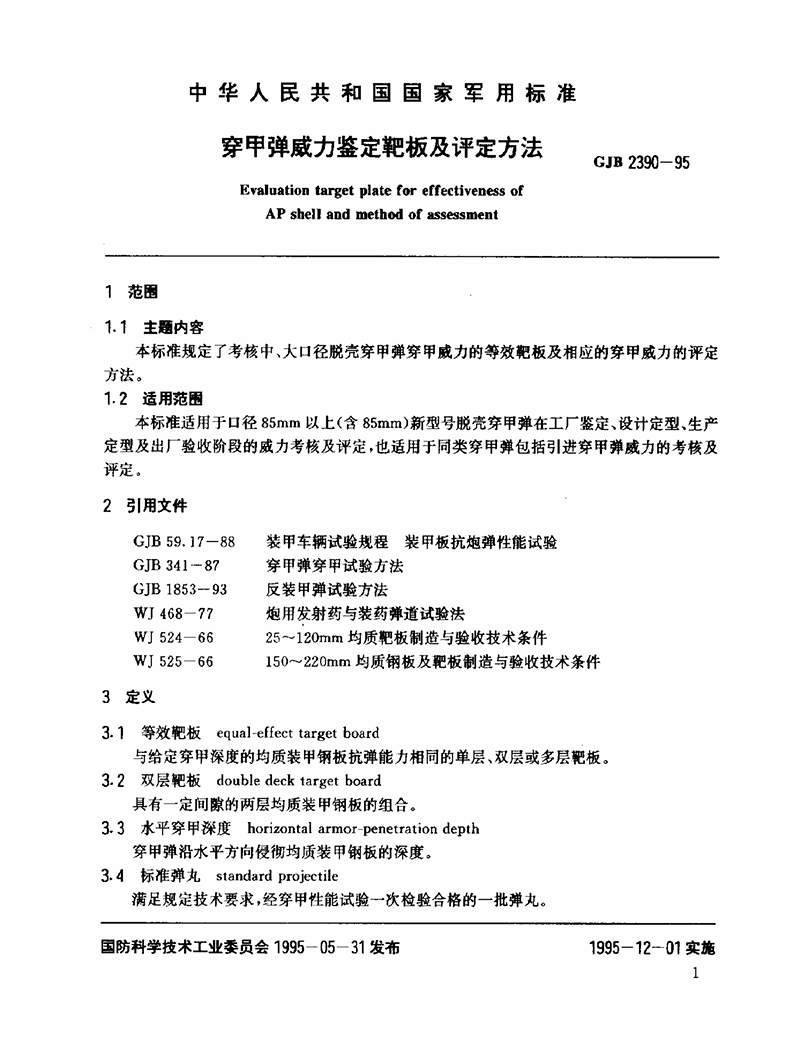
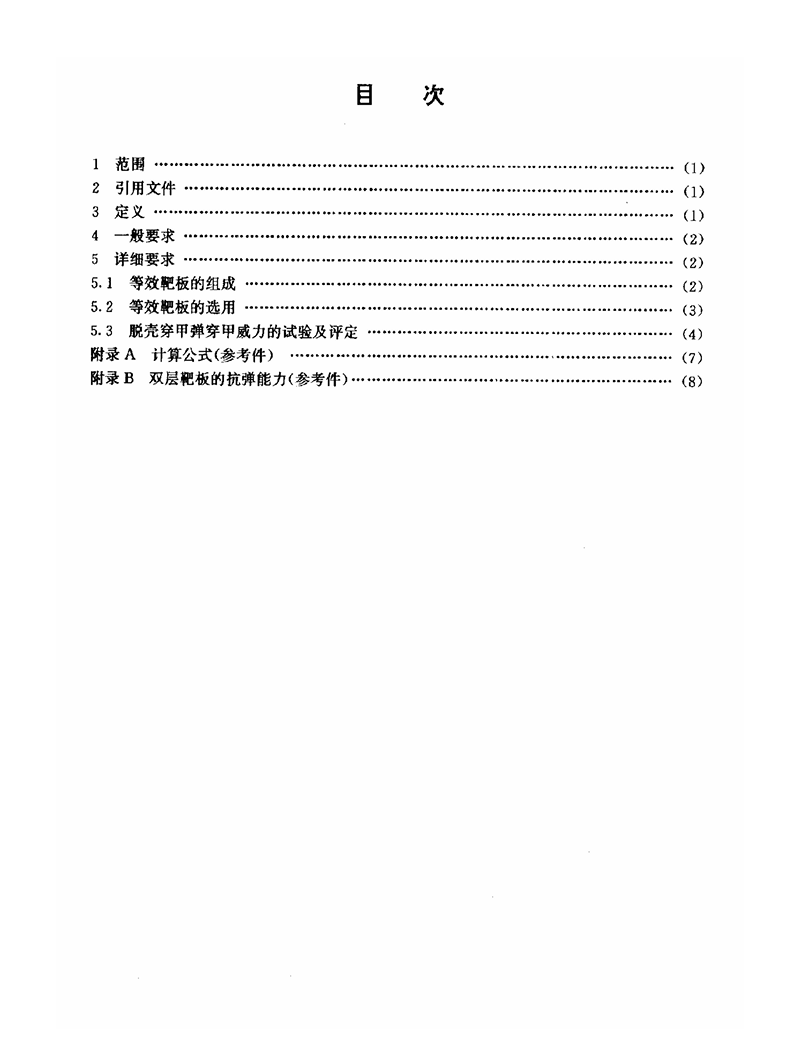
The reason for introducing GJB 2390-1995 and GJB 59.17—88 is that the Chinese side has some unusual indicators in their publicity, which may be genuine, as shown in the following figure:
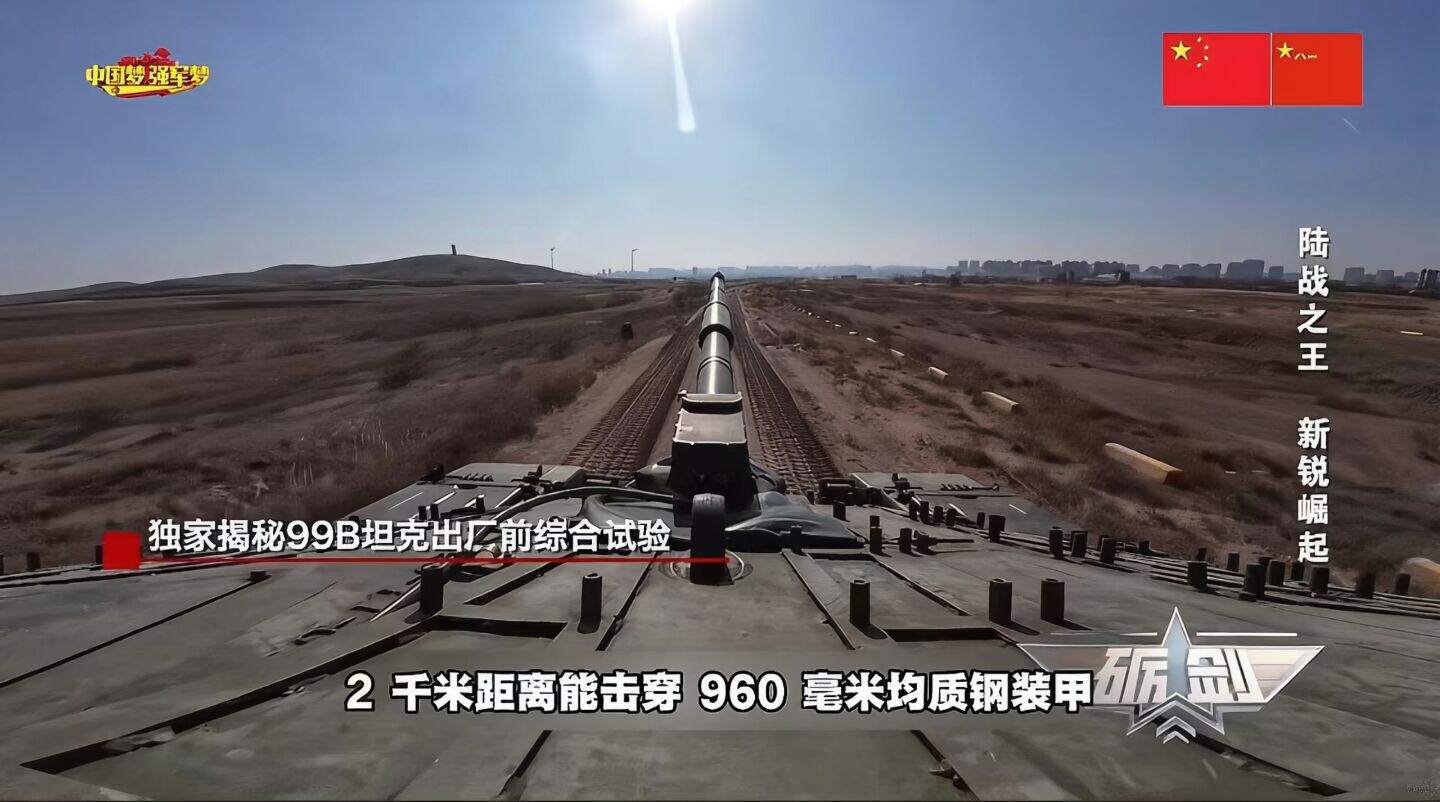

“piercing 960 mm of homogeneous steel armor at a distance of 2 km”
960mm, a very strange value, but its earliest exposure in an official article about the Type 99 dedicated long-rod tungsten alloy and special alloy armor-piercing rounds was on 12.30.2010
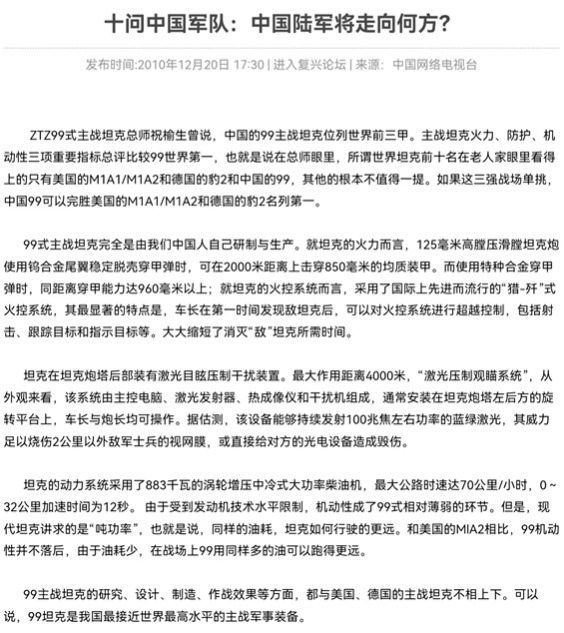
这应该是全网最早曝光99专用长杆钨合金、特种合金穿甲弹的官方文章,穿深960mm的特种合金穿甲弹在当时就已服役,并非现在才与99B同步服役_哔哩哔哩_bilibili
In this view, DTC10-125 does not seem to be China’s most advanced APFSDS (excluding some kind of forward-propelled round). Is there another long-unreleased APFSDS? And does it have two different material versions? For example, L26A1/L27A1, 3BM59/60, M829A3.