- Yes.
- No.
- In a future Dutch/BeNeLux techtree.
- In the French BeNeLux sub-tree.
- Other (Please explain in the comments).
- I said “No” in the first question.
- As laid down (2 x 230mm) ← Muzzleloading guns, as a joke ofcourse
- 1888’s refit (1 x 280mm, 4 x 37mm)
- I said “No” in the first question.
Today I’m going to suggest a real old ship of the Dutch Navy.
This is the “Ramtorenschip 2de klasse” HNLMS Guinea (1870)!
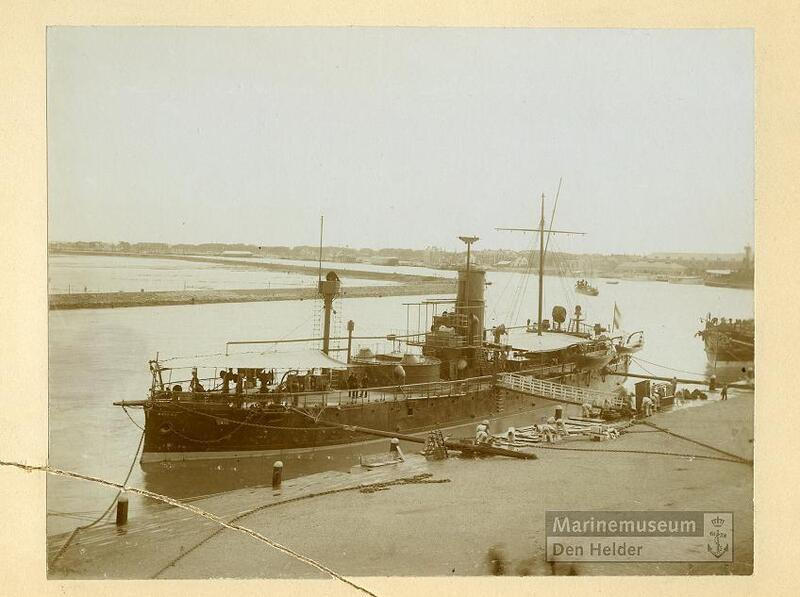
HNLMS Guinea in dock at Den Helder
Source: https://www.maritiemdigitaal.nl/index.cfm?event=search.getdetail&id=103019703
About the “Ramtorenschip 2de klasse” classification
As the name suggests, what this simply means is turret ram ship 2nd-class. And there is something interesting about this. Back in the day when ships like these were being built, the Dutch Navy didn’t quite use “proper” class names for their ships.
Nowadays we all know ships by their class names, Yamato-class battleship, Admiral Hipper-class cruiser, etc etc.
What the Dutch Navy had back in the day was a more simple system using 1st and 2nd-class names to group certain ships together. HNLMS Guinea (1870) was not the only turret ram ship 2nd-class, there were three more. These four ships were build in three different shipyards, and so the ships all different in design. But all four of the ships had a primary gun turret, and all ships fulfilled the same role they were designed for. Therefor the four ships were put under the same classification of “Ramtorenschip 2de klasse”.
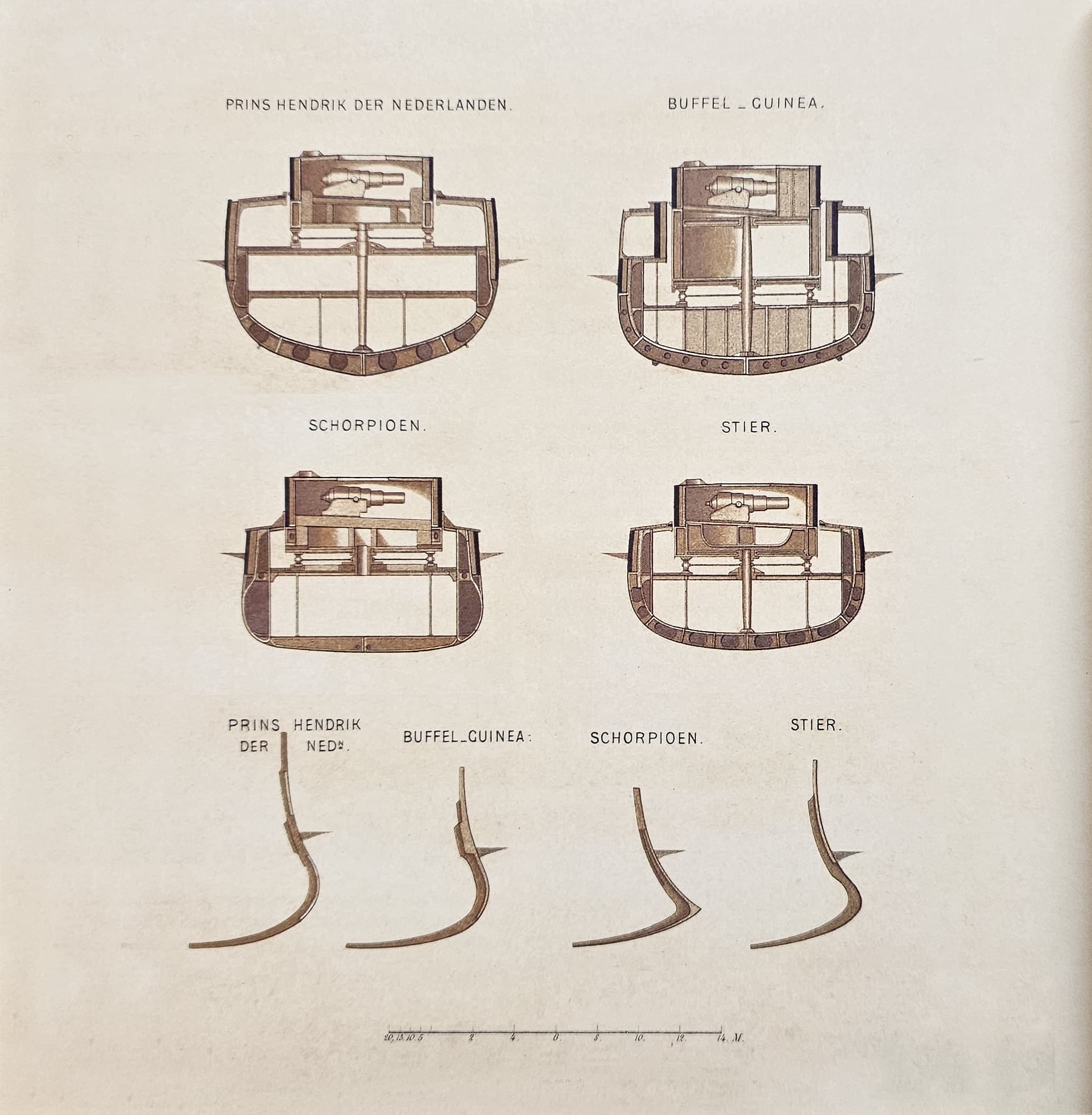
A very nice illustration showing the different hull and bow designs of different turret ram ships of the Dutch Navy. Top and bottom left is the HNLMS Prins Hendrik der Nederlanden, which is a turret ram ship 1st-class, but all the others are the turret ram ship 2nd-class. Here we perfectly see the differences between the ships. Two of the ships (Buffel and Guinea) were build at the same dockyard however, so these are the same in design.
Source: “Zr.Ms. Schorpioen, Van ramschip tot museumschip” book by Jan Klootwijk and Dick VriesIf we wanted to be super specific about the classification of the HNLMS Guinea (1870), and it’s “sister ships”, then this is how we would do it:
- Turret ram ship 2nd-class
- Buffel-type
- HNLMS Buffel (1868)
- HNLMS Guinea (1870)
- Schorpioen-type
- HNLMS Schorpioen (1868)
- Stier-type
- HNLMS Stier (1868)
History
Spoiler
HNLMS Guinea was launched on the 5th of May 1870, and would be accepted into service on the 16th of October 1873. The Dutch Navy didn’t have any experience with the construction of these new turret ship designs, so she would be made abroad, at the Robert Napier and Sons, Glasgow, Scotland.
A cool little fact is that HNLMS Guinea was originally given the name HNLMS Matadior, but this was changed early on to Guinea. The name Matador would be used some years later for a “Rammonitor 1ste klasse”. HNLMS Guinea would stay in the homewaters of the Netherlands for all of her carreer. And sadly there isn’t much to mention here.
In may of 1876 she was tasked to protect Dutch fishing vessels from harassing British fishing vessels near the North-Holland and Frisian islands.
Around 1879 and 1980 she also helped keep the North Sea Canal ice free during the winters.
In 1894 she was taken out of service, and in 1879 she was sold for scrap.
Design
Spoiler
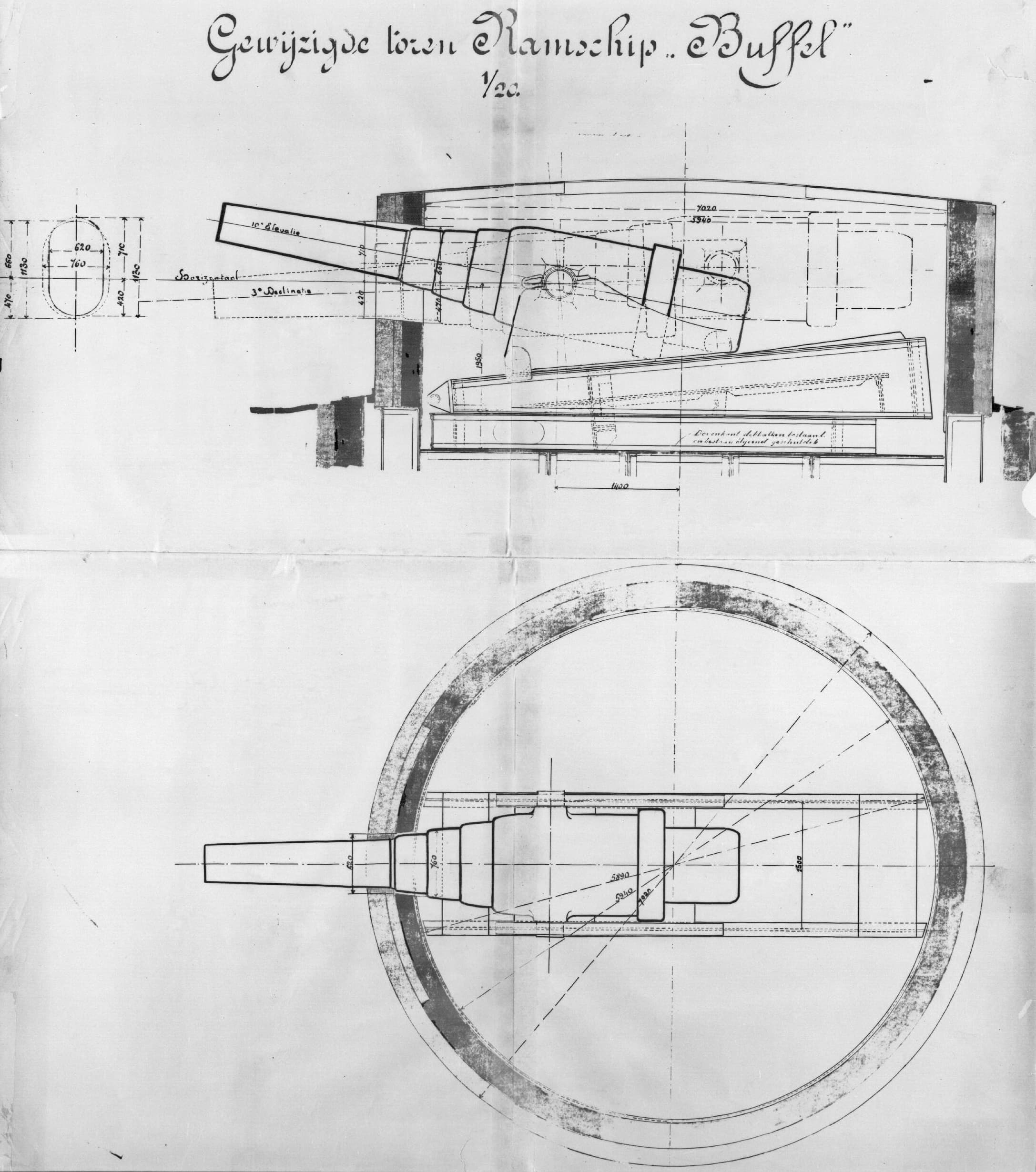
A blueprint of the sister ship HNLMS Buffel. This is of the 1888 refit where the 28 cm A No. 1 breachloading gun was added to the turret
Source: | Nationaal ArchiefHNLMS Guinea was 62,68 metres long, had a beam of 12,25 metres and a draft of 5,10 meters, and had a displacement of 2.378 tons. She had a crew of 117 men (This was later expanded to 159) and was able to reach a top speed of 10,43 knots.
She was originally armed with a two 23 cm RML 9-inch Armstrong guns in one central turret.
These guns had acces to various AP and Schrapnel rounds. But ofcourse these are muzzle loading guns, and those don’t really fit ingame at all.Thankfully the ship went through a refit in 1887 that saw the removal of these muzzle loading guns and had them replaced with a single 28 cm A No. 1 breachloading gun.
This gun was capable of firing Common, AP and Canister rounds.During this 1887 refit four 37mm Hotchkiss guns were added too. Two five barrel revolving guns were added to each side of the rear superstructure. And two single barrel guns were added to the ends of the ship. One was at the front in a crows nest, and the other at the very rear.
Some sources keep mentioning that two additional 75 mm guns were added to the ship during this 1888 refit, but I can find no hard proof of this.
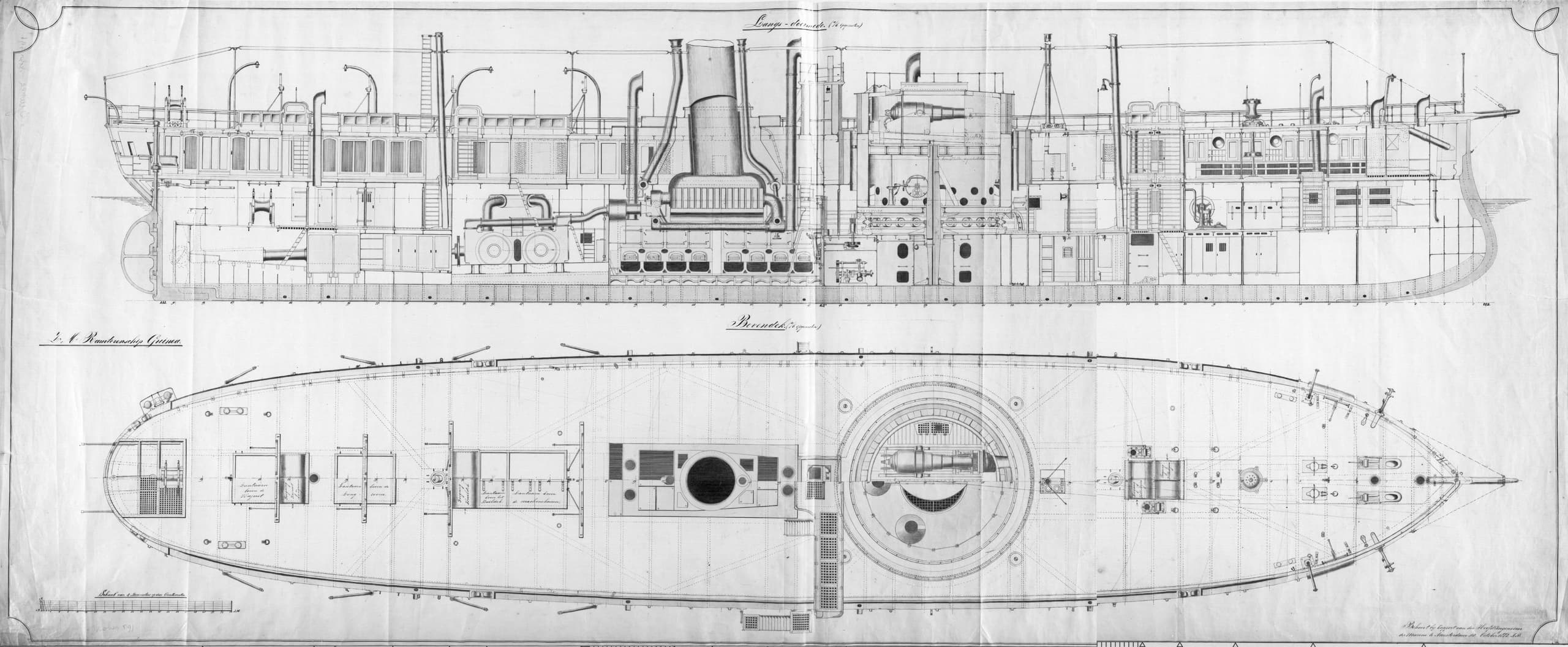
A cutaway blueprint of the HNLMS Guinea in her original refit
Source: | Nationaal ArchiefHNLMS Guinea was protected by a 152 - 76 mm thick belt. The deck was 25 - 19 mm thick, and the command tower was 114 mm.
The gun turret was 280 - 203 mm thick.
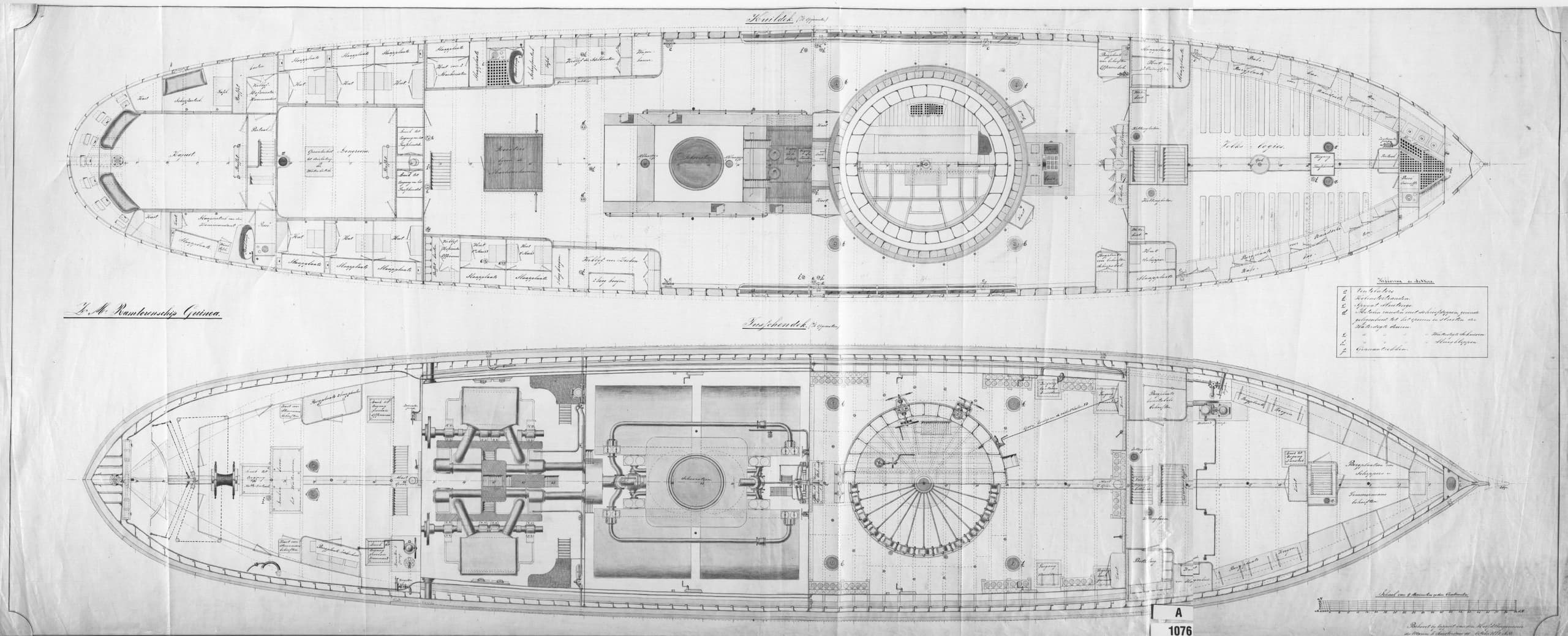
A blueprint of the lower decks on HNLMS Guinea
Source: | Nationaal Archief
Ingame
Spoiler
The HNLMS Guinea would be a real weird ship to add ingame. The current Naval gamemode is not really made for these very old ships. This ship would be best added in some sort of Pre-WW1 Naval gamemode for it to be really fun to play ingame. HNLMS Guinea is very closely related to 1860’s to 1900’s monitors. Luckily HNLMS Guinea does have a breachloading gun that is still capable of dishing out some damage against lower rank Naval Vessels. If Guinea had to be added somewhere ingame right now, I would say put her in the Coastal Fleet. I think a ship like her is best added there.
Now where should these boats go to? As usualy with my Dutch vehicle suggestions, I ofcourse want to see this ingame in a Dutch or BeNeLux techtree. Ofcourse the BeNeLux has been added to France, so this is now the only option where Dutch vessels will go to.
I’m not very well versed with early French Naval stuff, so I don’t know if France has many ships like HNLMS Guinea. But in the French tree the HNLMS Guinea would most likely fit right in with other older French vessels.
Specifications
Spoiler
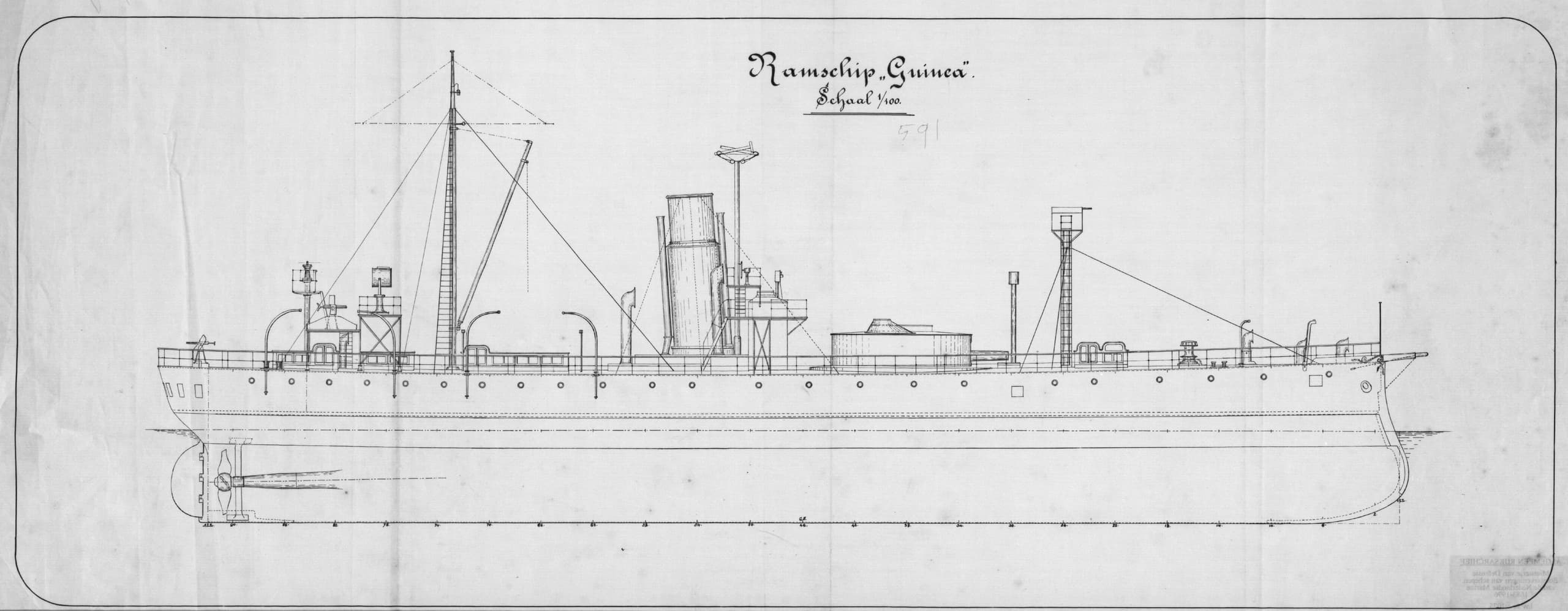
Blueprint of HNLMS Guinea in her 1887 refit
Source: | Nationaal ArchiefDisplacement: 2.378 tons
Length: 62,68 m
Beam: 12,25 m
Draft: 5,10 m
Powerplant: 2 x steam engines, 4 x boilers
Power output: 2.200 hp
Maximum speed: 10,43 knots (19,31 km/h)
Crew: 117 men (This was increased to 159, but unclear during what time this was)Armor:
Belt: 152 - 76 mm
Deck: 25 - 19 mm
Command tower: 114 mm
Turret: 280 - 203 mmArmament: (As laid down)
1 x 2 23 cm RML 9-inch Armstrong muzzleloading guns1887 refit:
1 x 1 28 cm A No. 1 breachloading gun
2 x 5 37 mm Hotchkiss revolving guns
2 x 1 37 mm Hotchkiss guns
Some sources say two 75mm guns were added too, but I can find no hard proof of this anywhereAmmunition:
23 cm RML 9-inch Armstrong muzzleloading gun
- [AP] Iron Projectile
–Length: 68 cm
–Weight: 105 kg- [AP] Hardened Projectile
–Length: 52 cm
–Weight: 112 kg- [AP] Steel Projectile
–Length: 51 cm
–Weight: 109 kg- [AP] Pointed Bullet (“Puntkogel”)
–Length: 46 cm
–Weight: 113 kg- [Schrapnel] Three types were used, all of the same weight
–Length: Unknown
–Weight: 68.5 kg28 cm A No. 1 breachloading gun
- [Common] Gewone granaat v/ 28cm A L2,8
–Projectile: 206,7 kg round with a 9,3 kg filling, for a total weight of 216 kg
–Charge: 60 kg prismatic gunpowder No. 2
–Velocity: 510 mps- [AP] Glasharde Puntgranaat v/ 28cm A L2,8
–Projectile: 251 kg round with a 2,7 kg filling, for a total weight of 253,7 kg
–Charge: 58,5 kg prismatic gunpowder No. 2
–Velocity: 475 mps (453,5 mps when fired with 50 kg prismatic gunpowder No. 1)
–Penetration: 454 mm of iron at 0 meters- [AP] Stalen Puntgranaat v/ 28cm A L2,8 (1ste model)
–Projectile: 247,25 kg round with a 4,95 kg filling, for a total weight of 252,2 kg
–Charge: 58,5 kg prismatic gunpowder No. 2
–Velocity: 475 mps (453,5 mps when fired with 50 kg prismatic gunpowder No. 1)
–Penetration: 454 mm of iron at 0 meters- [AP] Stalen Puntgranaat v/ 28cm A L2,8 (2de & 3de model)
–Projectile: 250 kg round with a 3,7 kg filling, for a total weight of 253,7 kg
–Charge: 58,5 kg prismatic gunpowder No. 2
–Velocity: 475 mps (453,5 mps when fired with 50 kg prismatic gunpowder No. 1)
–Penetration: 454 mm of iron at 0 meters- [Canister] Kartetsgranaat v/ 28cm A
–Projectile: 124 kg round filled with 251 zinc balls of 0,368 kg each.
–Charge: Unknown
–Velocity: Unknown
And there you have it! I hope you enjoyed reading about interesting ship of the Dutch Navy.
See you on the battlefield!
Sources
Spoiler
History and information:
Extra sources:
- “Zr.Ms. Schorpioen, Van ramschip tot museumschip” book by Jan Klootwijk and Dick Vries
Photos:
Blueprints: