- Yes, as tech tree vehicles
- Yes, as rank 1 premiums
- Yes, as event vehicles
- No
- German Tech Tree
- Sweden Tech Tree
- British Tech Tree
- French Tech Tree
- Future Polish Air Tree
- I said no

Introduction:
The PZL.50 Jastrząb (Hawk) was a Polish fighter aircraft from the late 1930s. While originally designed as a successor to the PZL.11 and PZL.24 fighters, its role shifted toward that of an interceptor during development. It was intended to serve as a multi purpose fighter and escort aircraft. Only two prototypes and a handful of unfinished airframes were built before the Invasion of Poland halted the project.
In War Thunder, both the PZL.50A and PZL.50B would make excellent rank 1 fighters (or interceptors, to get an airspawn). The 50A would do well at 1.3–1.7, while the more powerful 50B version could go to 2.0–2.3. The prototype PZL.50/I and II could also serve as a unique Rank 1/2 Premium or a low-tier event vehicle.
History:
Spoiler
In the mid 1930s, the Polish Air Force sought to replace their aging PZL.11 and PZL.24 fighters. The initial candidate, the heavy twin engine PZL.38 Wilk, was cancelled after severe engine and performance problems. Consequently, in late 1936, the Armament Committee (KSUS) issued a requirement for a modern singleseat fighter. The PZL.50 Jastrząb design was selected, and development began under the leadership of PZL’s Chief Designer, Wsiewołod Jakimiuk.
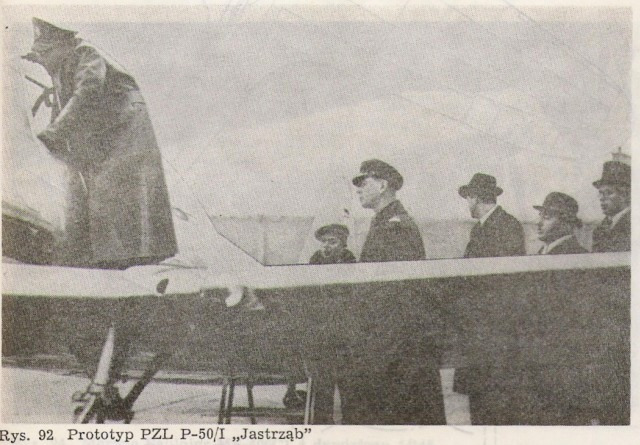
The first prototype, PZL.50/I, was completed in late 1938 and made its maiden flight on February 22nd, 1939. It was powered by an 840 hp Bristol Mercury VIII engine. While the design called for British Dowty retractable landing gear, delivery delays forced the engineers to use a heavier, modified Polish Avia 4L mechanism.

Performance was initially underwhelming. The aircraft achieved a top speed of only 420 km/h at 3,600 meters, barely faster than the older gull wing PZL.24. Maneuverability was also poor; in a mock dogfight, the Jastrząb was easily outmaneuvered by a PZL.37 Łoś medium bomber (which was flying without a payload). The fighter suffered in low speed turns and had a tendency to wobble at high speeds. In May 1939, it was discovered that the carburetor air intake was too small, choking the engine. After modifying the intake and refining the control surfaces, the top speed improved slightly to ~442 km/h.
The second prototype, PZL.50/II, was intended to fix many of these issues and was redesignated as an interceptor. It featured a major structural change: the original fuselage was replaced with a razorback spine (similar to early P-47s) to improve aerodynamics. It also featured a larger wing, increasing the surface area from 15.8 m² to 19 m² to prioritize maneuverability and climb rate over raw speed. This variant was intended to mount more powerful engines, such as the 1,100 hp Gnome-Rhône 14N21, the 1,060 hp Bristol Taurus II/III, or the domestic PZL Waran.

There were two main planned production variants:
-
PZL.50A : The initial production version based on the refined PZL.50/I but with the razorback fuselage. Powered by the 840 hp Bristol Mercury VIII, with a projected top speed of 500 km/h.
-
PZL.50B : An improved version powered by the ~1,100 hp Gnome-Rhône 14N21 (or potentially the 1,000 hp Pratt & Whitney R-1830 Twin Wasp).
Unfortunately, the outbreak of World War II ended the program. As German forces advanced, the Warsaw PZL factory was evacuated. Pilot Jerzy Widawski attempted to fly the PZL.50/I prototype to Lwów, but due to either engine failure or fuel starvation, he crashed near Rawa Ruska. The remaining unfinished airframes (including the PZL.50/II) were moved from the bombed WP-1 factory to a makeshift PZL reserve base at the Citroën car plant on Górnośląska street in Warsaw. They were captured there by the Germans, dragged out of the halls, and subsequently scrapped.

Specifications:
Spoiler
PZL.50A:
Wingspan: 31 ft 9.875 in / 9.7 m
Length: 25 ft 3.125 in / 7.7 m
Height: 8 ft 10.25 in / 2.7 m
Wing Area: 208.83 ft² / 19.4 m²
Engine: 1x 840hp (648.8kW) Bristol Mercury VIII
Empty Weight: 3,748 lbs / 1,700 kg
Maximum Takeoff Weight: 5,511 lbs / 2,500 kg
Maximum Speed: 310.6 mph / 500 km/h
Range: 466 mi / 750 km
Maximum Service Ceiling: 24,600 ft / 7,500 m
Crew: 1 pilot
PZL.50B:
Engine: ~1,100 hp Gnome-Rhône 14N21 (or Bristol Taurus)
Maximum speed: ~500 km/h (Projected), Achieved speed: ~442 km/h
Armaments:
Spoiler
PZL.50A : 4 x 7.92 mm PWU wz.36 machine guns (either 4x wing mounted, or 2x cowl mounted and 2x wing mounted) + up to 100 kg of bombs (2x 50 kg).
PZL.50B : 2 x 7.92 mm PWU wz.36 machine guns (cowl mounted) + 2 x 20 mm Nkm wz.38 FK cannons (wing mounted) + 1x 300 kg bomb.

More pictures:
Spoiler


Sources:
Spoiler
PZL P.50 Jastrząb | Plane-Encyclopedia
Dlaczego Jastrząb zawiódł? Część I
Wikipedia
Visegrad Group - Aviation tech tree, Page 9 old WT forum.
Old WT forum PZL.50 post.
MULTIDISCIPLINARY PROJECT OF HISTORICAL AIRCRAFT VIRTUAL RECONSTRUCTIONS AS A WAY OF POPULARIZING SCIENCE, Page 47-50.
Afternote:
Spoiler
This one was tough to write as many sources conflict each other and information are sacred, i believe there is also one post about this on the old forum but it was copy paste and didn’t even make the suggestion list. If i am wrong about that then uh oops, sorry.
Any feedbacks are appreciated if you think that anything is wrong or have any suggestions.