- Yes
- No
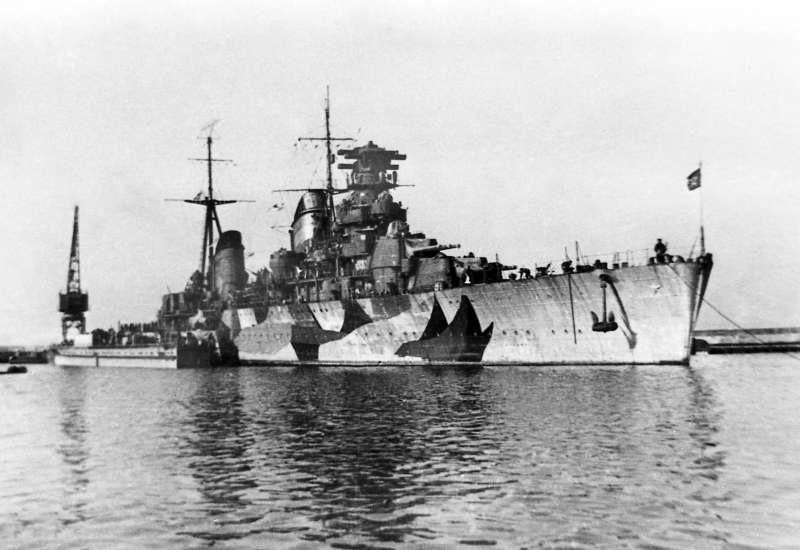
 Project 26bis Molotovsk (1942) - Catapult launched Spitfires
History:
The ship’s story began in January 1937 when it was laid down at the Marti South shipyard in Nikolayev. The Soviet Union wanted a modern navy but lacked the domestic design experience to build advanced cruisers, so they partnered with the Italian firm Ansaldo. The result was the Kirov class (Project 26), which the Soviets quickly upgraded into the Project 26bis class, of which Molotov was the second ship. They gave it heavier armor, a modified bridge, and improved anti-aircraft systems. When it was commissioned in January 1941, it possessed a secret weapon that no other Soviet warship had: the “Redut-K” air-warning radar. This single piece of technology made the Molotov one of the most valuable assets in the Black Sea, as it could detect incoming German aircraft long before they could be seen by the naked eye.
When Germany invaded the Soviet Union in June 1941, Molotov was immediately thrust into frontline action at Sevastopol. Its primary role quickly became air defense and shore bombardment. However, German air superiority was a massive problem. The cruiser was equipped with a centrally mounted ZK-1 pneumatic catapult, which was originally intended to launch small Beriev seaplanes for scouting and spotting artillery fire. But seaplanes were slow, defenseless, and completely useless against modern German fighters and bombers.
This problem sparked a radical experiment. Through the Lend-Lease program, the Soviet Union was receiving high-performance Supermarine Spitfire Mk.V fighters from Great Britain. Soviet naval engineers realized that the ZK-1 catapult was incredibly powerful, using high-pressure air to sling heavy weights. They calculated that if they modified the catapult with reinforced launching cradles and adjusted the pressure settings, they could actually launch a fully loaded, land-based Spitfire directly into the sky.
The engineering was a success, but the tactics were incredibly risky. Unlike a seaplane, a Spitfire had no floats, and unlike an aircraft carrier, the Molotov had no runway for the plane to return to. This meant every single launch was a one-way trip. If German bombers attacked the fleet, the Molotov would catapult a Spitfire into the air. The pilot would engage the enemy bombers, defend the ship, and then, with his fuel running low, have to fly toward the coast to find a friendly, land-based Soviet airfield. If the ship was too far out at sea, the pilot would have to ditch the aircraft in the water and hope a friendly ship could pick him up before he drowned or froze. While the system was fully functional, it was kept as an emergency measure because losing a fighter plane and risking a pilot on every single deployment was incredibly costly.
While these aviation experiments were being developed, Molotov was constantly under fire. Throughout late 1941 and early 1942, the ship acted as a high-speed transport, rushing thousands of Soviet troops into the besieged city of Sevastopol and bombarding German troops on the cliffs. It survived dozens of air raids, using its radar to dodge bombs and its own guns to shoot down attackers.
The ship’s luck finally ran out on the night of August 2, 1942. After completing a bombardment mission near Feodosiya, Molotov was ambushed by a coordinated force of German Heinkel He 111 torpedo bombers and Italian motor torpedo boats. In the darkness, a torpedo struck the ship dead on the stern. The explosion was catastrophic, completely blowing off the back 20 meters of the ship, destroying the steering gear, and killing 18 sailors.
Most ships would have sunk, but Molotov’s crew managed to keep her afloat. Steering purely by varying the speeds of her left and right propellers, the crippled cruiser limped all the way back to the port of Poti.
Repairing the ship presented a seemingly impossible challenge. Soviet shipyards were under constant bombardment, materials were scarce, and manufacturing a brand-new stern section would take years that the Soviets didn’t have. Engineers came up with a brilliant, desperate “Frankenstein” solution. The hull of an unfinished, older design Project 68 cruiser named Frunze was sitting in a nearby shipyard. Workers took heavy cutting torches, sliced the entire rear end off the uncompleted Frunze, towed it over, and welded it directly onto the damaged Molotov. It was a massive structural graft, and although the mismatched hull shapes permanently reduced Molotov’s top speed by a few knots, it worked.
By July 1943, Molotov was fully repaired and returned to active service. However, the war had changed during her year in the drydock. The Soviet Air Force had finally gained control of the skies over the Black Sea, meaning the dangerous practice of catapulting land-based Spitfires from the deck of a cruiser was no longer necessary. Furthermore, after a disastrous raid in October 1943 where German bombers sank three Soviet destroyers in a single afternoon, Joseph Stalin personally stepped in and ordered that all major surface warships be placed into reserve. They were simply too valuable and too vulnerable to lose.
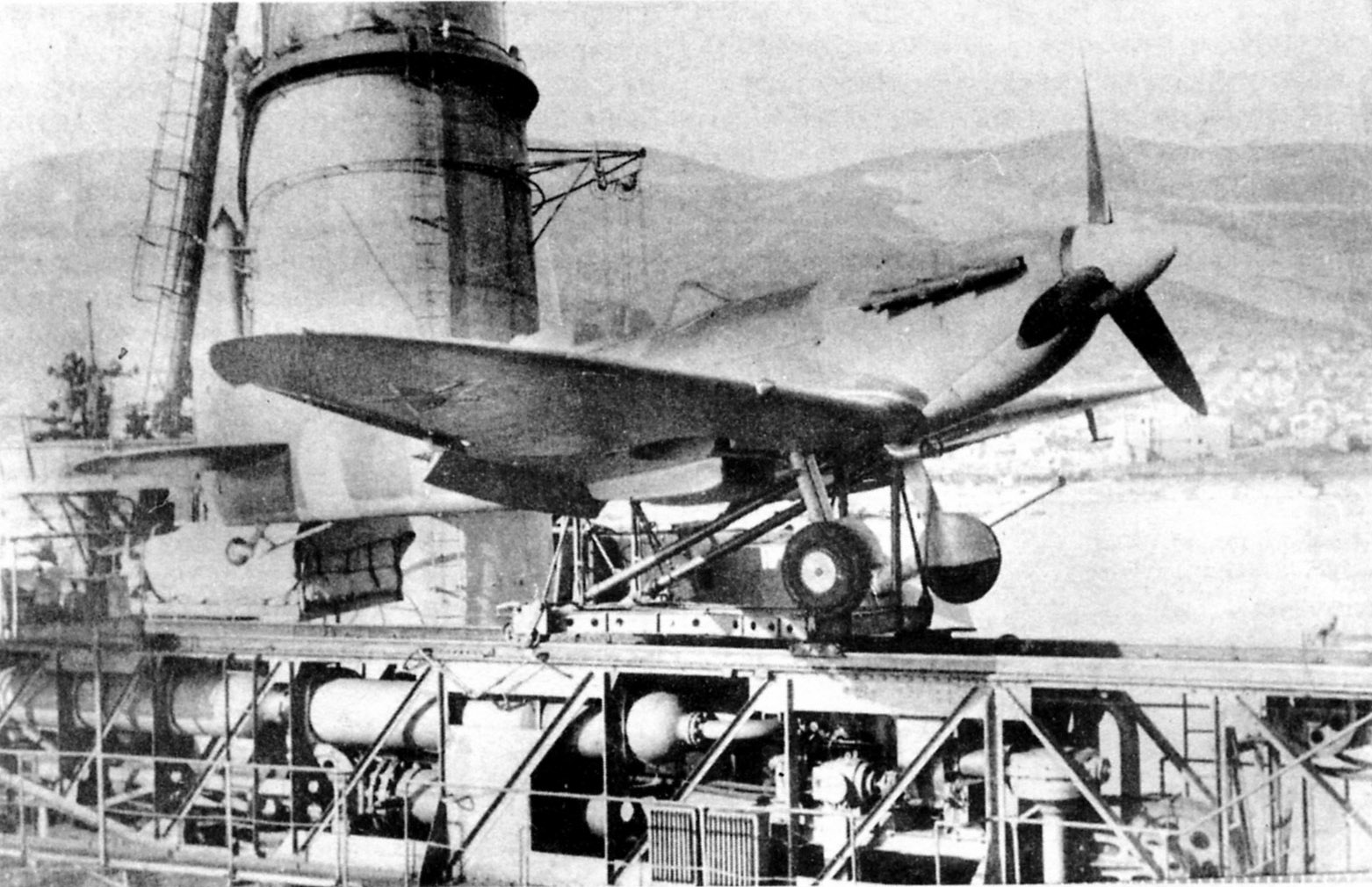
Spitfire Mk.Vb aboard the Molotovsk
Specifications:
General Characteristics
- Standard Displacement: 8,177 metric tons
- Full Load Displacement: 9,728 metric tons
- Length (Overall): 191.4 meters (627 feet 11 inches)
- Beam: 17.66 meters (57 feet 11 inches)
- Draft (Full Load): 6.3 meters (20 feet 8 inches)
- Crew Complement: 963 officers and enlisted (wartime expansion)
Propulsion and Performance
- Power Plant: 6 Yarrow-Normand oil-fired boilers driving 2 TB-7 geared steam turbines
- Shaft Horsepower: 129,750 shp
- Screws: 2 shafts
- Maximum Speed (Design): 36.72 knots
- Maximum Speed (Post-1943 Repair): 35 knots (slightly reduced due to the mismatched hull line of the grafted Project 68 Frunze stern)
- Fuel Capacity: 1,660 metric tons (Full) / 1,750 metric tons (Overload)
- Operational Range: 4,220 nautical miles at an economic speed of 18 knots
Armor Profile
- Waterline Belt: 70mm (homogeneous steel Krupp-type)
- Deck Armor: 50mm
- Main Battery Turrets: 70mm (Face, sides, and roof)
- Barbettes: 70mm
- Conning Tower: 150mm
Armament Configuration (Late 1942-3)
Main Battery
- Guns: 9x 180 mm/57 B-1-P Pattern 1932 guns
- Mounting: 3x MK-3-180 triple turrets (2 forward superfiring, 1 aft)
- Projectile Weight: 97.55 kg (High Explosive / Armor Piercing)
- Muzzle Velocity: 900-920 m/s
- Maximum Firing Range: 38,000 meters
Secondary / Dual-Purpose Battery
- Guns: 6x 100 mm/56 B-34 Pattern 1940 dual-purpose guns
- Mounting: 6x 1 single mounts (3 positioned on each side of the aft funnel)
Anti-Aircraft (AA) Suite
- Autocannons: 12x 37mm/67 70-K automatic AA guns (Single mounts, replaced older semi-automatic 45mm units)
- Heavy Machine Guns: 6x 12.7 mm DShK anti-aircraft machine guns
Torpedoes and Mine Warfare
- Torpedo Tubes: 2x 3 533 mm triple launchers (mounted midships)
- Torpedo Model: 53-38
- Mine Capacity: 96 to 150 naval mines (via deck rails)
- Depth Charges: 2 depth charge racks, carrying 20 large BB-1 and 30 small BM-1 charges
Sensors and Electronics
- Air Search Radar: Redut-K early warning system (First operational radar set installed on a Soviet warship)
- Underwater Sensors: Arktur hydrophone system
Aviation Facilities
- A centrally mounted ZK-1 pneumatic catapult fitted with a Spitfire Mk.Vb
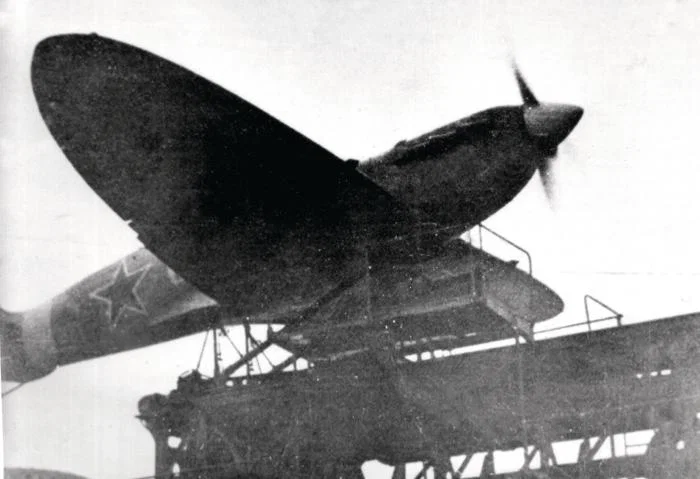
Image of the Spitfire Mk.5b preparing to take off.
I also propose the Spitfire Mk.Vb added as a Soviet rank II 4.0 premium as it was used extensively by the Soviet Air Force. among tons of other leased equipment.