- Yes
- No
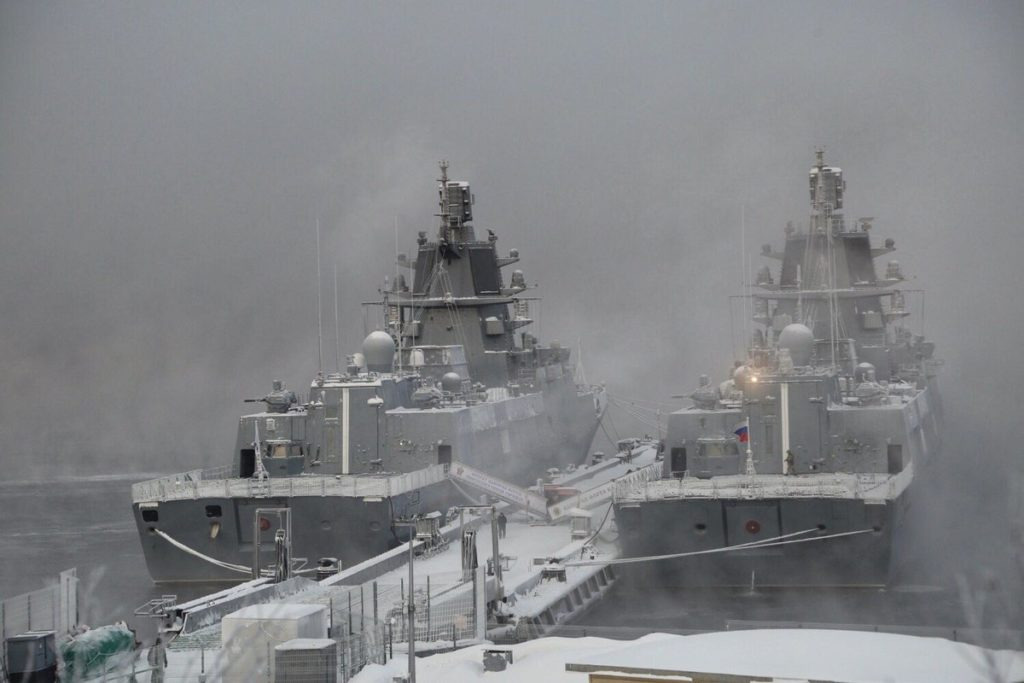
 Project 22350 Admiral Gorshkov-class Frigate - Shield of the Barents
Construction
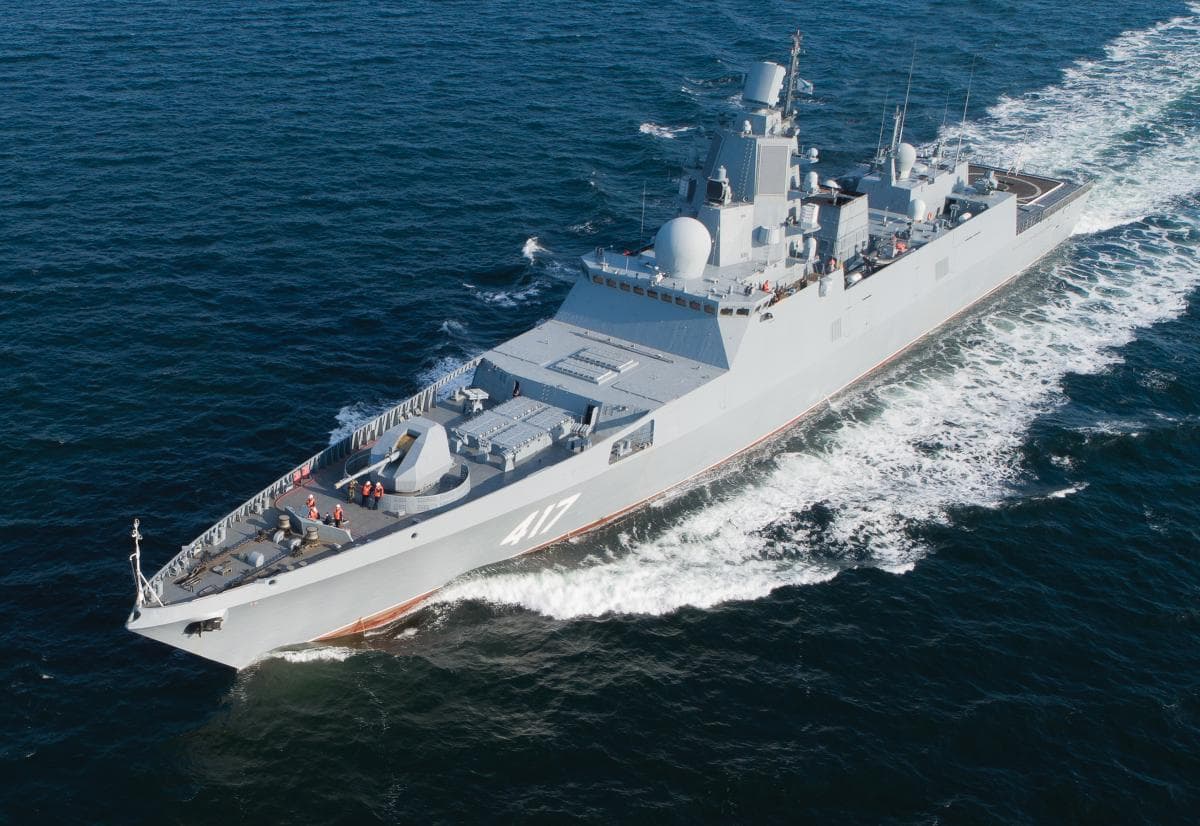
- Ship Name: Admiral Flota Sovetskogo Soyuza Gorshkov
- Yard Number: №921
- Shipbuilder Severnaya Verf, St. Petersburg
- Laid Down: February 1, 2006
- Launched: October 29, 2010
- Commissioned: July 28, 2018
- Fleet Assignment: Northern Fleet
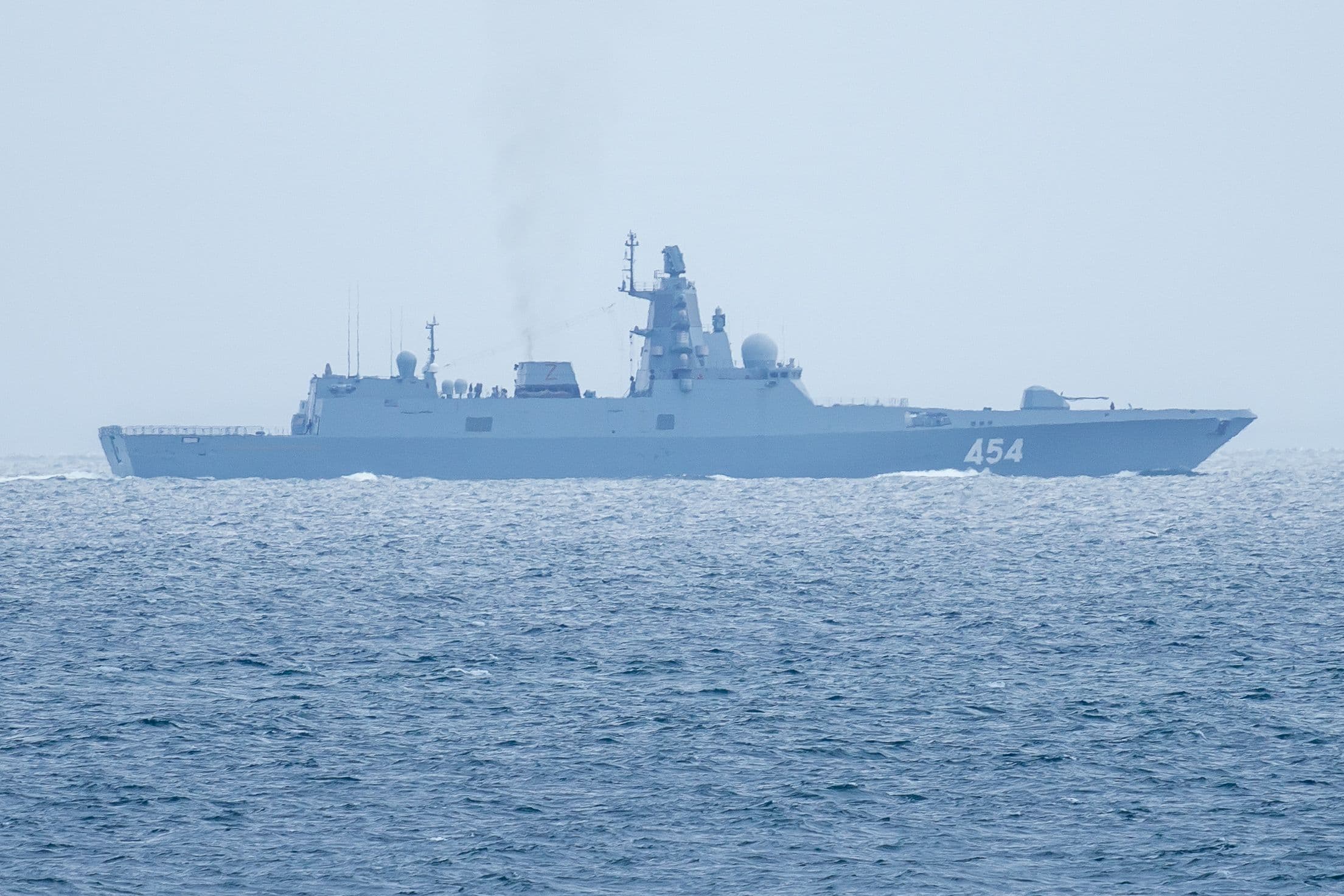
- Hull Numbers: 417 (2013), 454 (2018)
History:
When the Russian Navy laid down the hull of the Admiral Gorshkov at Saint Petersburg’s Severnaya Verf shipyard in early 2006, it was trying to prove that the domestic defense industry could design and build a complex, modern surface combatant entirely from scratch. Designated Project 22350, the vessel was conceived as a compact, stealthy, multi-role frigate that could deliver the firepower of a heavy Soviet-era cruiser within a much smaller footprint. Measuring 135 meters in length with a 16-meter beam, a draft of 4.5 meters, and a full-load displacement of roughly 5,400 tons, the design heavily emphasized signature reduction. Its superstructure was constructed using composite, radar-absorbent materials with sloped deck angles, an enclosed bow structure, and underwater acoustic quietening measures specifically tailored to minimize both its radar cross-section and sonar footprint for a crew of roughly 170 to 210 officers and sailors.
What was originally planned as a rapid modernization program quickly turned into a twelve-year developmental ordeal before the lead ship officially entered service with the Northern Fleet in July 2018. The ship relies on a Combined Diesel and Gas propulsion architecture centered around the M55R engine suite, pairing two 10D49 cruise diesel engines providing 5,200 shaft horsepower with two powerful M90FR boost gas turbines generating 27,500 horsepower each. Together, this 65,000-horsepower system drives two fixed-pitch shafts, giving the frigate a top speed of 29.5 knots, a 4,850-nautical-mile cruising range at 14 knots, and a 30-day autonomous endurance.
Despite being classified as a frigate, the Admiral Gorshkov carries an armament suite more aligned with guided-missile destroyers. Its primary offensive punch comes from a 16-cell UKSK 3S14 vertical launching system embedded in the forward deck, capable of firing a customizable mix of Kalibr land-attack cruise missiles, P-800 Oniks supersonic anti-ship missiles, Otvet anti-submarine rockets, and Zircon hypersonic cruise missiles. Main gun fire support is delivered by a bow-mounted 130mm A-192M Armat naval gun firing high-explosive shells at up to 45 rounds per minute out to 23 kilometers, guided by a 5P-10 Puma radar fire control system. Air defense relies on a 32-cell 3S97 Poliment-Redut vertical launch system, housing short-range 9M100, medium-range 9M96E, and long-range 9M96E2 interceptors to create a defensive shield stretching out to 150 kilometers. Point defense against close-range sea-skimming threats is provided by two 30mm Palash close-in weapon systems, while anti-submarine operations rely on quad-tube Paket-NK launchers firing 324mm homing torpedoes alongside a Kamov Ka-27, Ka-29 or Ka-31 helicopter operating from the stern flight deck and hangar.
Tying all these combat systems together is the 5P-20K Poliment radar, featuring four active electronically scanned array flat panels mounted directly into the main mast structure. This main radar works in tandem with a 5P-27 Furke-4 3D air search radar, a Monolit surface search radar for over-the-horizon missile targeting, and an integrated sonar suite combining a Zarya-3.3 bow sonar with a Vinyetka-M towed low-frequency array. Everything feeds into the Sigma-22350 combat management system to automate sensor integration and threat tracking. Since commissioning, the Admiral Gorshkov has functioned as the primary operational showcase for Russian naval power, completing a 35,000-nautical-mile circumnavigation of the globe in 2019 and serving as the lead testbed for live-fire trials of the Mach 8 Zircon hypersonic missile between 2020 and 2022. Today, alongside its sister ships Admiral Kasatonov and Admiral Golovko, the frigate routinely deploys across the Atlantic, Mediterranean, and Caribbean as the operational blueprint for Russia’s modern surface fleet.
Specifications:
General Characteristics & Propulsion
- Displacement: 4,550 tons (standard) / 5,400 tons (full load)
- Length: 135 meters (442 ft 11 in)
- Beam: 16 meters (52 ft 6 in)
- Draft: 4.5 meters (14 ft 9 in)
- Propulsion: Combined Diesel and Gas (CODAG) M55R suite featuring 2x 10D49 cruise diesel engines (5,200 shp each) paired with 2x NPO Saturn M90FR gas turbines (27,500 shp each) generating 65,000 shaft horsepower (shp)
- Top Speed: 29.5 knots (54.6 km/h)
- Range: 4,850 nautical miles at 14 knots; 30 days autonomous endurance
Armor & Internal Protection
- Radar-Absorbent Composite Superstructure: Built using layered fiberglass and polymeric resin composite materials to significantly reduce the hull’s overall Radar Cross-Section.
- Fragment Shielding: Kevlar armor lining and high-tensile steel plating protecting ammunition magazines, engine rooms, and central command spaces.
- NBC & Environmental Shielding: Hermetically sealed inner citadel with automated overpressure systems for operation in chemical, biological, or radiological environments.
- Stealth Geometry: Sloped superstructure angles, an enclosed bow, and vibration-dampened engine mounts to suppress acoustic, infrared, and radar signatures.
Sensors & Fire Control
Air Defense & Primary Radar Suite
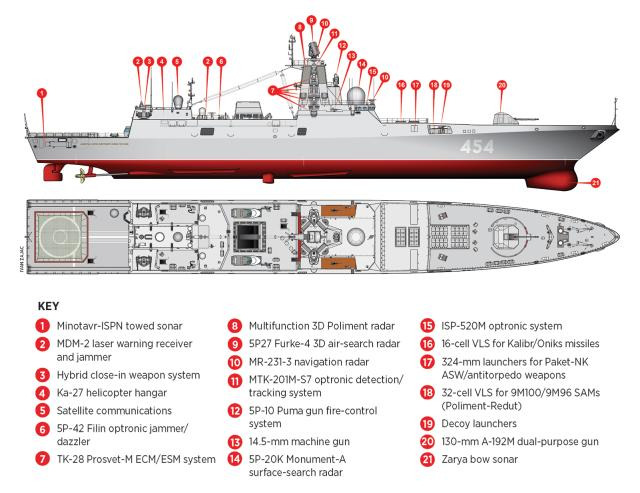
- 5P-20K “Poliment” Multi-Function AESA: Four-faced Active Electronically Scanned Array integrated directly into the pyramidal mast. Operates in the X-band, tracking up to 200 targets simultaneously. Serves as the primary engagement and fire-control radar for the Poliment-Redut SAM system, handling mid-course updates and target illumination for 9M96E, 9M96E2, and 9M100 missiles.
- 5P-27 “Furke-4” 3D Air Search Radar: Rotating volume-search radar enclosed in a radome at the top of the main mast. Operates in the E/F-band to provide early detection and cueing of high-altitude and sea-skimming threats.
Surface Strike & Missile Fire Control
- 34K1 “Monolit” (Monolit-3K) Surface Radar: Over-the-horizon (OTH) radar operating in active radar and passive ESM modes. Uses atmospheric ducting to detect and track surface targets beyond the visual horizon. Feeds target data directly to the 3R14N-22350 fire control system managing the 3S14 VLS (launching 3M54 Kalibr, P-800 Oniks, and 3M22 Zircon cruise missiles).
Gunfire Control & Point Defense
- 5P-10 “Puma” Main Gun FCS: Radar/optronic director mounted above the bridge. Handles target tracking, ballistic computation, and corrections for the 130mm A-192M main deck gun against air, surface, and shore targets.
- Palash / Palma CIWS Directors: Independent optronic, infrared, and radar illuminators on the aft superstructure dedicated to guiding the two 30mm 3M89 Palash CIWS mounts.
Sonar Suite
- Zarya-3.3 (Zarya-M): Low-frequency hull-mounted sonar for medium-range submarine detection and torpedo tracking.
- Vinyetka-M / Minotavr-ISPN: Low-frequency towed variable-depth active/passive sonar array (VDS) optimized for deep-water ASW tracking.
Electronic Warfare & Combat Management
- TK-28 (5P-28) EW Suite: Integrated ESM/ECM system providing radar threat warning, signal interception, and active jamming.
- 5P-42 “Filin” Electro-Optical Countermeasure: Optical dazzler system emitting high-intensity pulsed visual interference to blind enemy electro-optical sensors, laser rangefinders, and weapon gunners at night.
- Prosvet-M System: Decoy launchers (KT-308 / KT-216) dispensing radar chaff and thermal flares.
- Sigma-22350 CMS: Central Command and Control (C4I) system that fuses sensor telemetry across radar, optical, and acoustic domains to automate threat evaluation and engagement.
- MDM-2 Laser Warning Receiver and Jammer: Detects hostile laser rangefinders/designators and deploys active optical countermeasures.
Weaponry and Countermeasures
Cannon
- A-192M 130mm
- Configuration: Single-barrel 130mm automatic naval gun mount.
- Stealth Design: Features a lightweight, faceted low-RCS composite housing engineered to deflect radar waves away from hostile search radars.
- Rate of Fire: Up to 45 rounds per minute with automated ammunition feeding and water-cooled barrel assembly.
- Engagement Capabilities:
- Surface Targets: Effective range of up to 23 km against surface combatants and coastal targets.
- Airborne Targets: Effective ceiling of up to 18 km for anti-aircraft engagement.
- Advanced Fire Control: Slaved to the 5P-10 Puma digital radar and optical-electronic tracking systems for automated, real-time fire correction.
Small-arms
- x2 14.5-mm Machine Gun: Pedestal-mounted heavy machine guns for close-range surface defense against light craft.
Anti-shipping/Land Attack
- 16x UKSK (3S14) Universal VLS Cells: Modular vertical launch assembly capable of housing:
-
- 3M22 Zircon: Hypersonic anti-ship/land-attack cruise missile (Mach 8+, 500–1,000 km range).
-
- P-800 Oniks: Supersonic low-altitude anti-ship cruise missile (Mach 2.5, up to 600 km range).
-
- 3M54/3M14 Kalibr: High-precision long-range land-attack (2,000+ km) and anti-ship cruise missiles.
-
- 91RT Otvet: Anti-submarine standoff rocket carrying a light acoustic homing torpedo payload.
Air defence
- 32x Poliment-Redut VLS SAM Cells: Layered air defense vertical launch array featuring:
- 9M96E: Medium-range interceptors with active radar homing with 40km range
- 9M96E2: Long range Interceptors with active radar homing with 150km range
- 9M100: Quad-packed short-range imaging infrared homing point-defense missiles with 15km range
- 2x Palash (Palma) CIWS Modules: Close-in weapon systems equipped with twin 30mm AO-18KD 6-barrel rotary cannons (10,000 rpm combined) guided by integrated optical/radar tracking modules
Anti-Torpedo Defense
- Paket-NK System: 2x quad 324mm SM-588 torpedo tubes capable of firing M-15 anti-torpedo interceptors (ATT) to physically destroy incoming homing torpedoes, as well as MTT acoustic torpedoesgainst hostile submarines.
- Hydroacoustic Countermeasures: Towed acoustic noise generators and expendable lures to disrupt incoming acoustic homing torpedo seekers.
Datalinks
- MTK-201M-S7 Optronic System: Multi-channel optical/infrared detection and tracking system.
- ISP-520M Optronic System: Secondary electro-optical tracking array.
- Satellite Communications: Centaurus-NM SATCOM antenna domes for real-time datalinks.
Aircraft Hangar:
The ship features a single aft landing pad and one enclosed stern hangar. The hangar space and flight deck facilities are configured to accommodate one medium naval aircraft, typically rotated depending on the mission profile.
Options are as follows:
- Kamov Ka-27PL “Helix-A” (Anti-Submarine Warfare)
- Kamov Ka-29 “Helix-B” (Naval Assault / Transport)
- Kamov Ka-31 “Helix-E” (Airborne Early Warning)