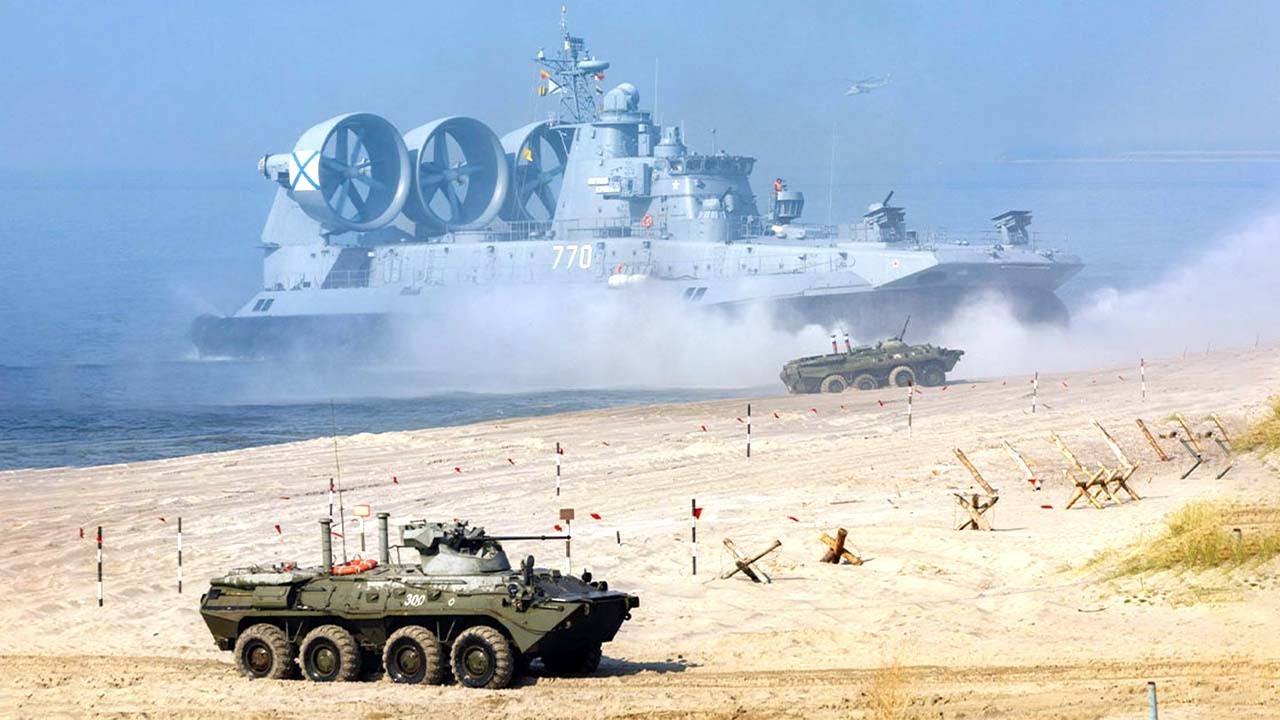
In the mid to late Cold War, the Soviet Union needed a flexible amphibious craft for insertion of forces. The first true military craft to be presented was Pr.1205 Gus-class. Having no armament, and able to carry a small force of 25 men with equipment. It was built from 1969 to 1974 a fleet of 32 were built, and eventually all decommissioned, some as museum pieces and others as scrap.
The next and truly revolutionary design was the Pr.12321 Aist-class. This LCAC featured a long and fairly narrow design, with a front ramp opening to the belly of the roughly 300 metric ton beast of a machine, able to carry up to 80 tons worth of Light or medium tanks, as well as APC’s. This much more advanced craft had an armament and radar system, with two twin-30mm batteries on each front side, and two quad-launchers for Strela-2’s. Twenty of these were built with their higher cost, and six are still in service with the Russian navy today.
But the main event is the Pr.1232.2 Zubr-class. Being named after the European Bison, this craft truly embodies its given name: With two front 140mm Ogon rocket turrets like horns, its large and wide frame, extreme strength, yet high speed and agility. This craft was designed for rapid clearing and deployment of assault units to anywhere within its range at a moments notice. With an emphasis on its strength it has the ability to carry 130 metric tonnes of troops, main battle tanks, armored vehicles, or APC’s on top of its already hefty 56 metric tonnes of fuel. Fitted with the aforementioned 140mm Ogon Incendiary rockets, able to carry 22 ready to fire and 132 total, as well as two AK-630 close-in defense systems. And that’s just the surface of its amazing capabilities. While it’s such a interesting piece of technology, it’s hard to come by up-to-date data on how many instances are built, the widely accepted number is twelve, two in use by the Russian Navy, five used by the Hellenic Army, and five used by the PLA Navy.
Length: ~57 m
Beam: ~22–25 m
Full Displacement: ~550 t
Draft (hover): ~1.5 m
Speed: 55–60 knots
Range: ~300 nmi
Endurance: ~5 days
Cargo Capacity:
- 3 MBTs, or
- 10+ APC/IFVs, or
- ~140 troops with vehicles, or
- Up to ~500 troops (bench seating)
Cargo Deck Area: ~400 m²
Crew: ~27–31
Weapons
- AK-630 30 mm CIWS (2)
- A-22 Ogon 140 mm 22-tube rocket launchers (2)
- Strela-3 / SA-N-5 MANPADS mounts (4, variant-dependent)
- Mine rails (Can be added or removed based on mission parameters)
Sensors & Electronics
- Pozitiv (surface-search radar)
- Ekran-1 (navigation radar)
- R-782 Buran (communications)
- MS-227 decoy launchers and EW suite (variant-dependent)
Propulsion
- Engines:
- 3 × NK-12MK gas turbines for propulsion
- 2 × M-70 gas turbines for lift
- Power Output:
- NK-12MK: ~15,000 hp each (about 11.2 MW)
- M-70: ~10,000 hp each (about 7.5 MW)
- Drive System:
- 3 shrouded propellers (propulsion)
- 4 lift fans (air cushion)
Should I format this to a suggestion post?
- Yes
- No