- Yes - In the Tech Tree.
- Yes - Event/BP.
- Yes - Premium.
- Yes - Squadron
- No - I would not like to see HMAS Platypus in game.
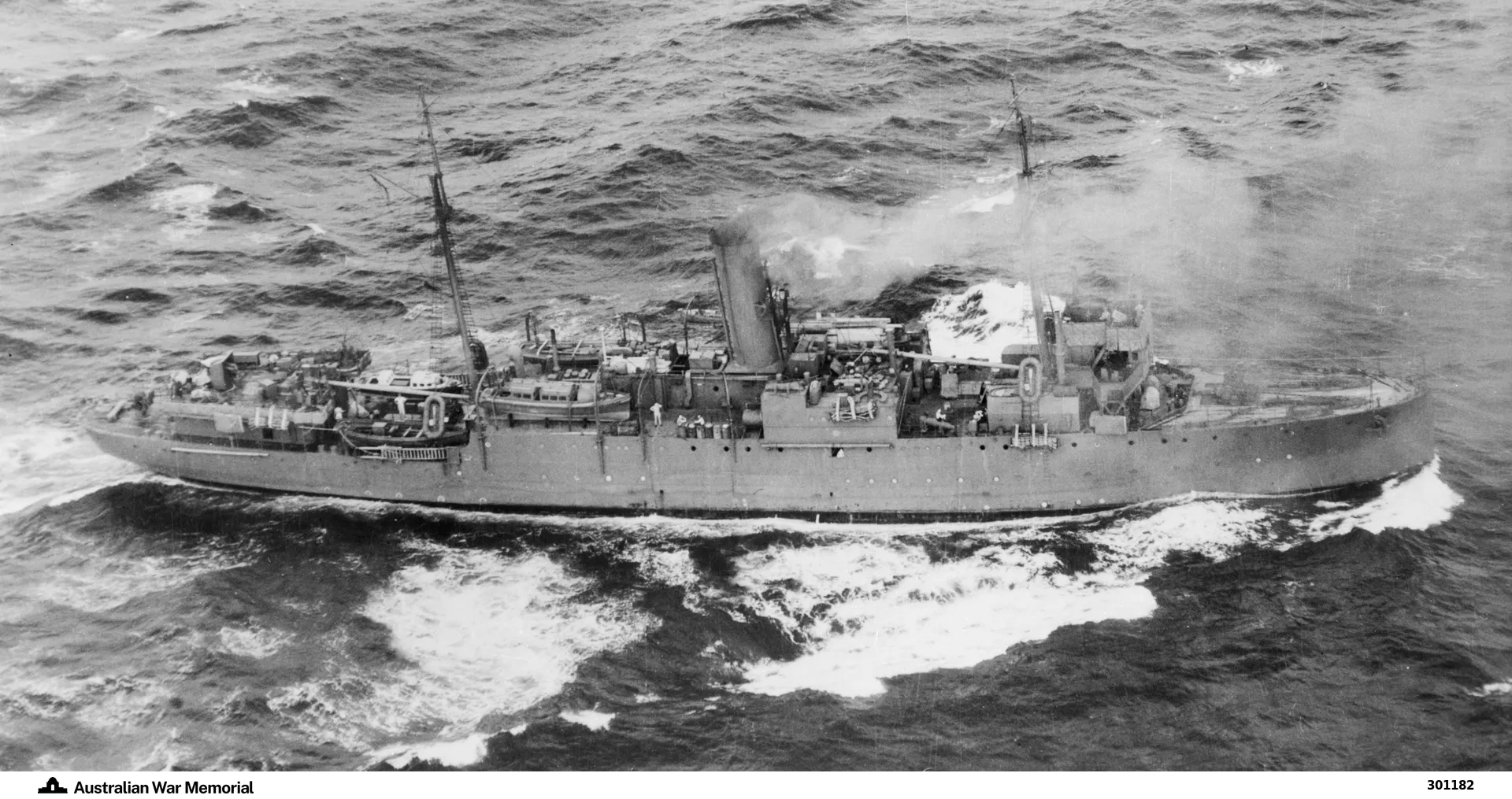
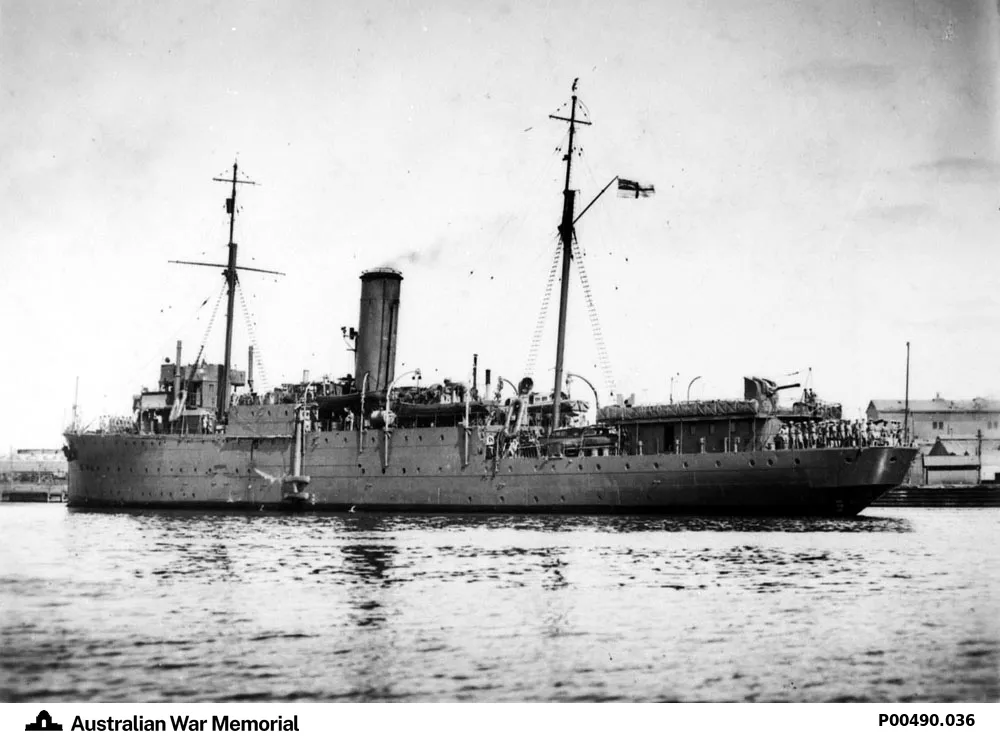
HMAS Platypus during her voyage from Sydney to New Guinea after her refit into a repair vessel. (1944)
Background:
With the Royal Australian Navy (RAN) ordering two of the British E-class submarines for use in Australian Waters in 1911, it was decided that a surface vessel should also be built as to act as a submarine depot and tender, who would support these submarines via replenishment at sea, maintenance support, etc.
As such a ship would not be in use constant by the RAN due to the subs which it would support needing refit every few years, it was also designed to be fitted out as a depot ship, allowing for the hull to be useful, when otherwise she would be sitting around doing nothing. Due to financial constraints, the tender would only be ordered in 1914, 3 years after the submarines it was supposed to support.
This suggestion is for HMAS Platypus in her 1944 refit as a repair and maintenance vessel. HMAS Platypus is the only vessel of her class, and the first of her name.
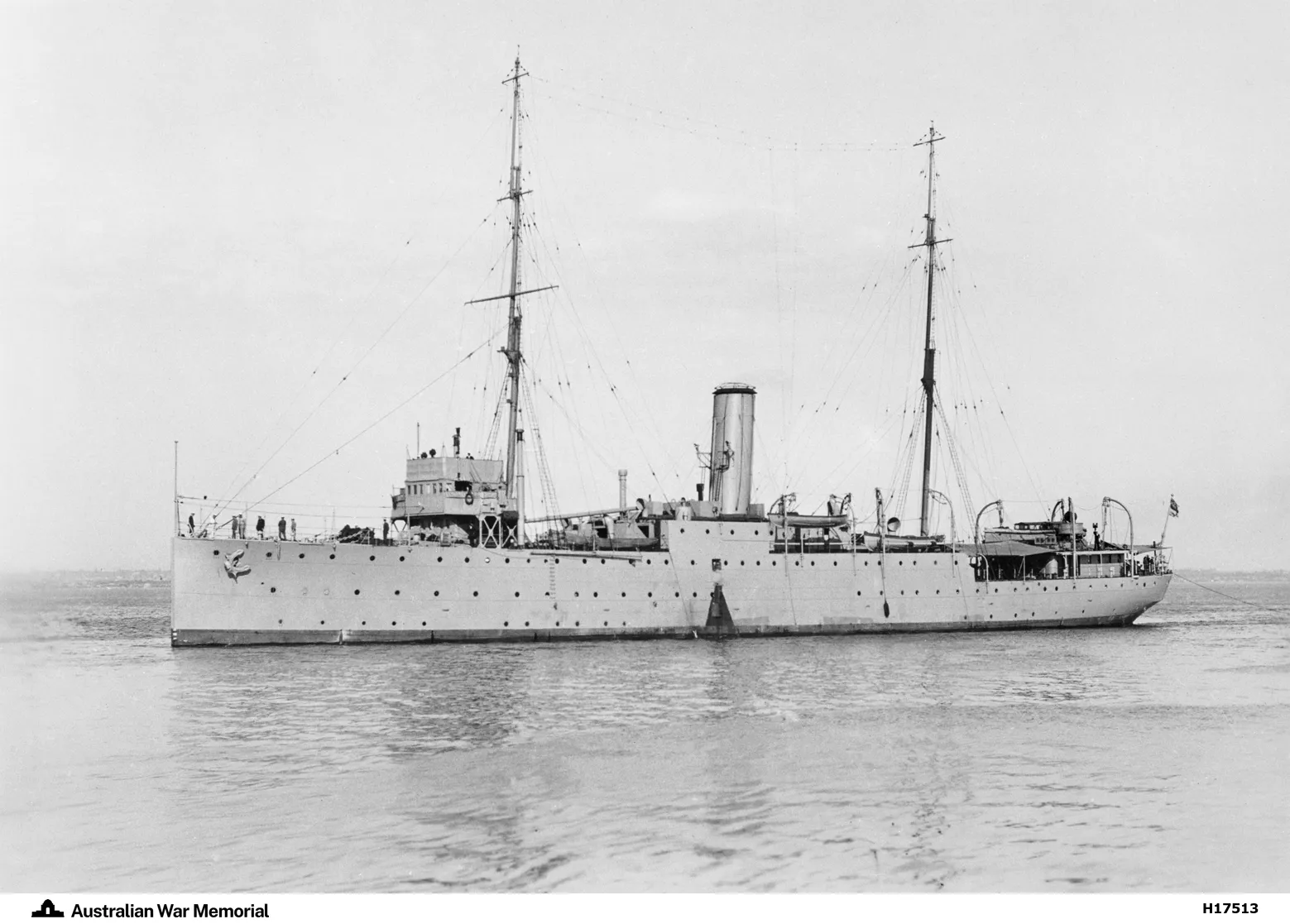
HMAS Platypus in British service after being taken over by the Royal Navy during the first world war. (~1917-18)
History:
Laid down on the 14th of October 1914 by John Brown & Co on the Clydebank, Scotland, she would launch into the Clyde on the 28th of October 1916, finally fitting out and commissioning on the 21st of March 1917. Although she had indeed commissioned, it wasn’t into the Royal Australian Navy, rather during her building she had been requisitioned by the Royal Navy, and had been pressed into their service as the HMS Platypus.
This would be somewhat fortunate for the RAN, as both E-class submarines the Platypus had been built to support, HMAS AE1 & AE2, had been lost by this point, HMAS AE1 in September 1914, and HMAS AE2 in April 1915. Her requisition meant that the RAN did not need to spend their limited manpower and money on a ship with no job, as the RAN now lacked submarines.
Royal Navy Service:
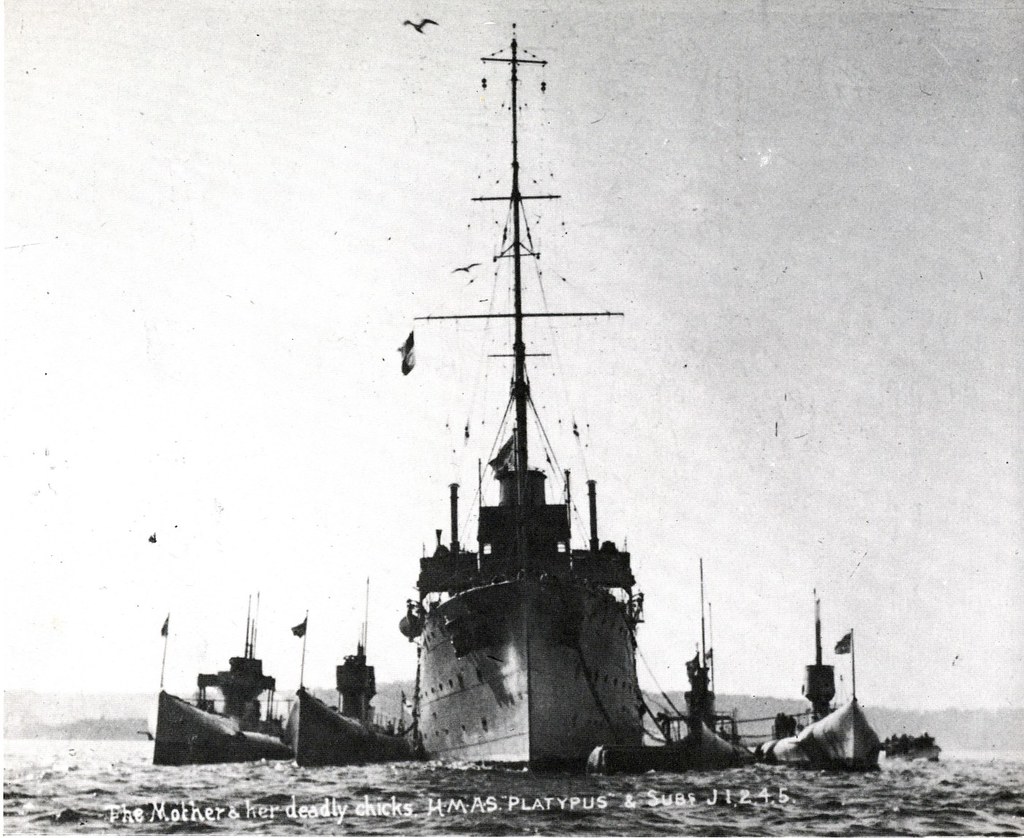
While acting as the HMS Platypus she would support British subs as the leader for ‘Platypus’s Flotilla’, which was named after herself. They would operate alongside ‘Vulcan’s Fotilla’ out of Killybegs, Ireland under the command of Commander-in-Chief, Coast of Ireland, Admiral Sir Lewis Bayly. Platypus’s Flotilla would comprise the submarines HMS D1, D3, D4, D6, D7, and D8. By September 1917, HMS D1 had been transferred out, leaving HMS D3, D4, D6, D7, and D8, and by November, they were joined by HMS E 38.
By January 1918 the Flotilla had shrunk down to only four subs and Platypus herself. These were the HMS D6, D7, D8, and E38, by February they had moved to Campeltown. HMS D6 went missing in June 1918, and in July HMS E23, E32 and R7 joined, however by August HMS E 32 also went missing, but HMS R8 and R11 joined the Flotilla. By December 1918 HMS D7 and D8 had left, and R12 joined.
The Flotilla would be disbanded by February 1919, as the Admiralty made preparations to give the HMS Platypus back to the Australians. On the 25th of March 1919 HMS Platypus would recommission as the HMAS Platypus, and would sail to Australia via the Suez Canal in company with the six J-class submarines that had just been gifted to the RAN by the Royal Navy. They would arrive on the 15th of July 1919 at Sydney.
Royal Australian Navy Service:
Now commissioned into the RAN, HMAS Platypus would operate in active service at the submarine base at Geelong in company with the former HMAS Cerberus, which had been renamed to the HMS Platypus (II), and was acting as a secondary submarine tender. HMAS Platypus (I) would only operate here for three years, this was due to the poor condition of the submarines, a product of their hard work and use with the Royal Navy during the First World War, but also a large financial pressure from the treasury due to post war cuts.
Due to the many problems with the J-class in RAN use, their Depot and repair ship, the Platypus (I), would naturally be very active fixing these problems. These issues were mostly extreme battery defects leading to dangerous conditions inside machinery spaces, a problem so prevalent they had a number of breakdowns of these boats during their voyage to Australia. By May 1922 the Royal Australian Navy Submarine Service was disbanded.
Not wanting to waste money on a useful ship, HMAS Platypus was converted into a Destroyer Tender for the RAN’s S-class Destroyers. This work was uninteresting, as it mostly consisted of repairing defective equipment in the few operational ships, but also maintaining the mothballed destroyers, as not all of the RAN’s S-class fleet were active at once during this time.
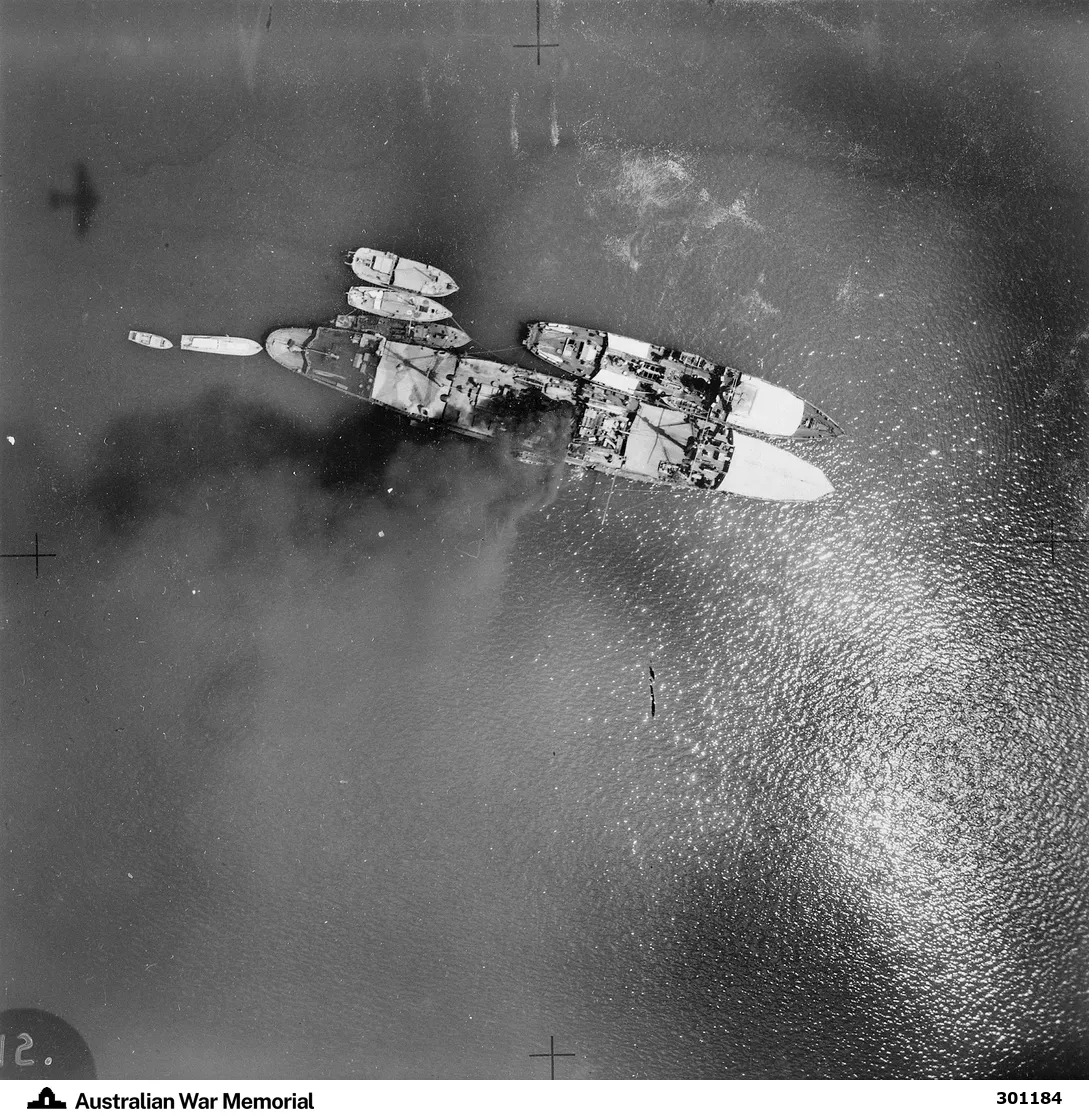
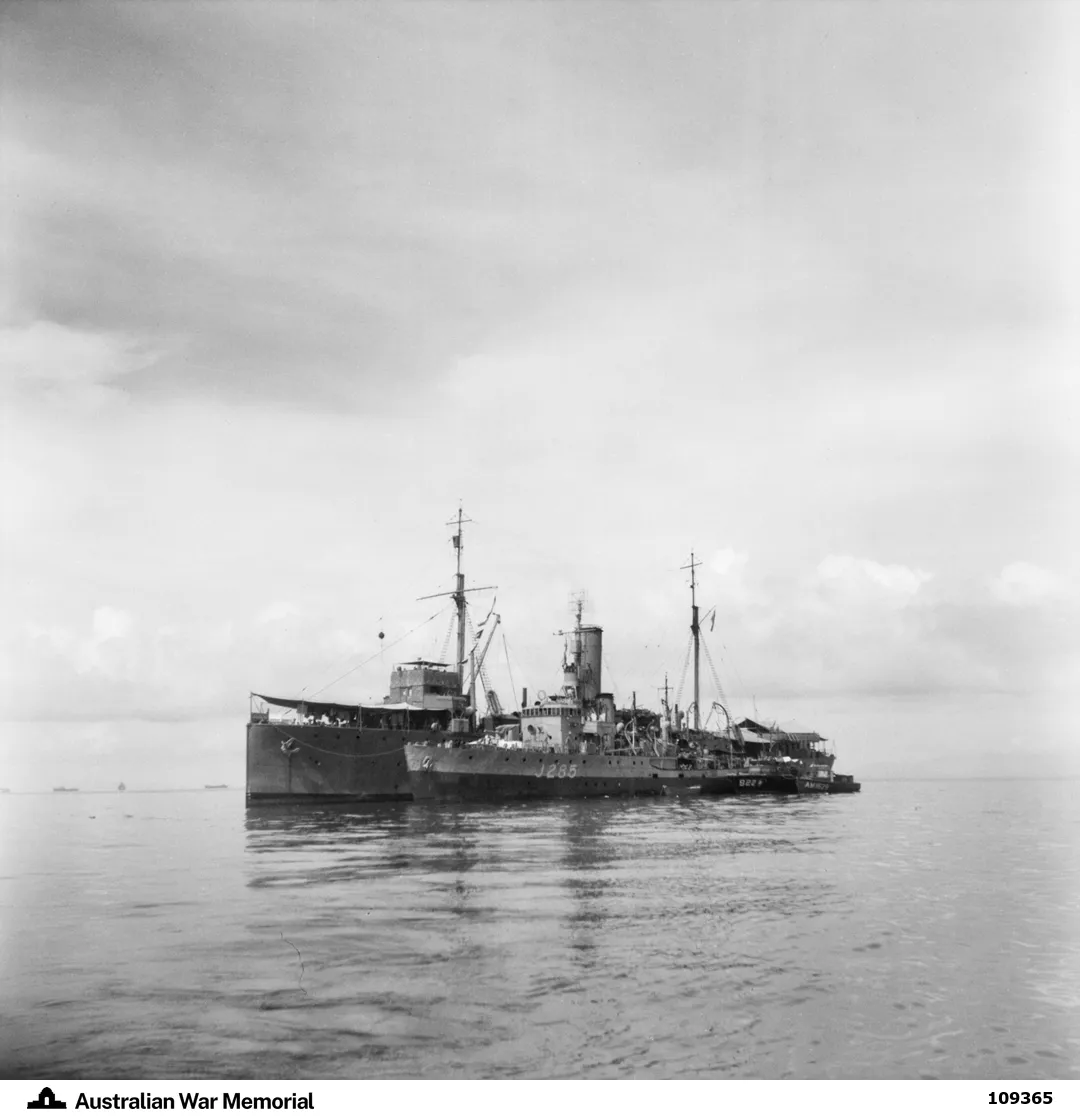
Aerial view of the HMAS Platypus tied up with the corvette HMAS Bowen, as well as two 62’ fast launches and another motorboat. (1945)
However, this work would not last long, as in 1924 a five year fleet development plan had been approved by the Australian Government, which permitted and gave funding for a new RAN Submarine Service with 6 boats and a tender. For this an experimental order of two O-class boats was made in 1928, with two ex RN vessels being delivered, these being the HMAS Oxley and Otway. These boats arrived in Sydney on the 14th of February 1929, although they had departed Portsmouth in February 1928, taking a year to sail to Australia.
This was due to many technical issues encountered by the boats, forcing many maintenance periods where they could not sail at all. Further issues were encountered during their service life in the RAN, and both boats were placed in reserve by 1930 as their many issues and respective repairs were a large drain on the RAN’s budget. Instead of also being placed in reserve, HMAS Platypus would be reconditioned into a fleet Depot ship at Garden Island. For this role she would be renamed to HMAS Penguin, a name shared by all of the RANs Depot vessels. She was the HMAS Penguin (III), and was the third vessel to fill this role.
In October 1932, her sailors refused work in an act of Mutiny. This was due to several pay cuts made by the Australian Government to their pay, and that they had no method to complain.
As her machinery was maintained, albeit not used during this period, she was in seaworthy condition upon the outbreak of war in September 1939. She would remain as the Depot ship until may 1941, when she would be recommissioned as HMAS Platypus (as she would no longer be the Depot Ship), and would act as a training vessel. She would be re-armed, and fitted with two 4-inch guns, one QF 4-inch Mk.V on a HA (high angle) mount, and another QF 4-inch Mk.IV on a LA (low angle), she was also fitted with two .303 Lewis MGs.
These two main guns were both mounted aft, and were superfiring. The LA mount was designed for surface warfare only, while the HA mount was designed for both surface and anti air uses. Upon completion of this refit she would sail to Darwin. She would still be present at this port for the February 1942 Japanese attack on this port. During this attack she would have three near misses by large 1000lb bombs, which sank the lugger Mavie, the vessel moored next to the Platypus, which itself sustained heavy damage to the condensers, immobilising the vessel. During this attack her AA armament was poor, mostly due to half of her armament not being able to engage aircraft, but also due to the lack of an AA director for the HA 4-inch gun. She would score a single AA kill on a bomber.
Elsewise during these attacks her boats would pick up survivors from other vessels that had been sunk in the Harbour. The day after these attacks she would be manned only by a series of gunners for her AA, as although she could not sail, she could serve as a floating AA platform. She would remain at Darwin until January 1943, when she would sail to Cairns, Queensland, where she would serve as a base ship. She would have another armament refit for this purpose, removing all the 4-inch guns, fitting a single 40mm Bofors gun aft, 20mm Oerlikons were fitted just fore of the new Bofors mounts, and also to the bridge wings. Her machinery was repaired, and she was again seaworthy.
She would serve in this role until June 1944, when she underwent another major refit to turn her into a repair and maintenance vessel for use in New Guinea. Her 40mm Bofors was moved down a deck and placed further aft, and a QF 4-inch Mk.V gun on a Mk.XX mount placed where it had been sitting. Her repair spaces were reconditioned and crewing areas modernised. Two of her four boilers were also reconditioned to burn oil instead of coal.
This work was completed in December 1944, and she would sail from Sydney to New Guinea on the 5th of January 1945. This work would be completed by December 1945 as the New Guinea campaign calmed down. She would be placed in reserve status in April 1946, and would act as the depot ship for all of the ships in E-class reserve; she was planned to be kept in this role until all of the wartime excess vessels had been disposed of.
This work would be completed by the 1st of November 1956, and she would be listed for sale. She would be sold for scrap to Mitsubishi Shoji Kaisha Ltd in April 1958.
| General Characteristics | |||||
|---|---|---|---|---|---|
| Name: HMAS Platypus | |||||
| Country: Australia | |||||
| Type: Repair ship | |||||
| Class name: Platypus | |||||
| Year of commission: 1919 | |||||
| Refit: 1944 | |||||
| ----------------------------------------------------------------------------------------------------------------------------------------- | |||||
| Dimensions: | |||||
| Length: 325 ft (99 m) | |||||
| Beam: 44 ft (13 m) | |||||
| Draught: 15 ft 8 in (4.78 m) | |||||
| Displacement: 3,476t | |||||
| ----------------------------------------------------------------------------------------------------------------------------------------- | |||||
| Propulsion: | |||||
| Powerplant: 2x coal and 2x oil fired boilers, driving triple expansion steam engines @ 3,500hp (2609kW) overall | |||||
| Speed: 15.5kt | |||||
| Endurance: unknown | |||||
| ----------------------------------------------------------------------------------------------------------------------------------------- | |||||
| Armament & sensors: | |||||
| Compliment: 50-80 | |||||
| Primary armament: 1x1 QF-4 inch Mk IV on LA Mk.XX | |||||
| Secondary armament: 1x1 40mm Bofors Mk.VII, 4x1 20mm Oerlikon | |||||
| Tertiary armament :2x1 .303 Lewis MGs | |||||
| Radar: -nil | |||||
| Sonar: -nil |
HMAS Platypus during her refit at Williamstown for conversion to a repair and maintenance vessel, (1944)
Extra Photos:
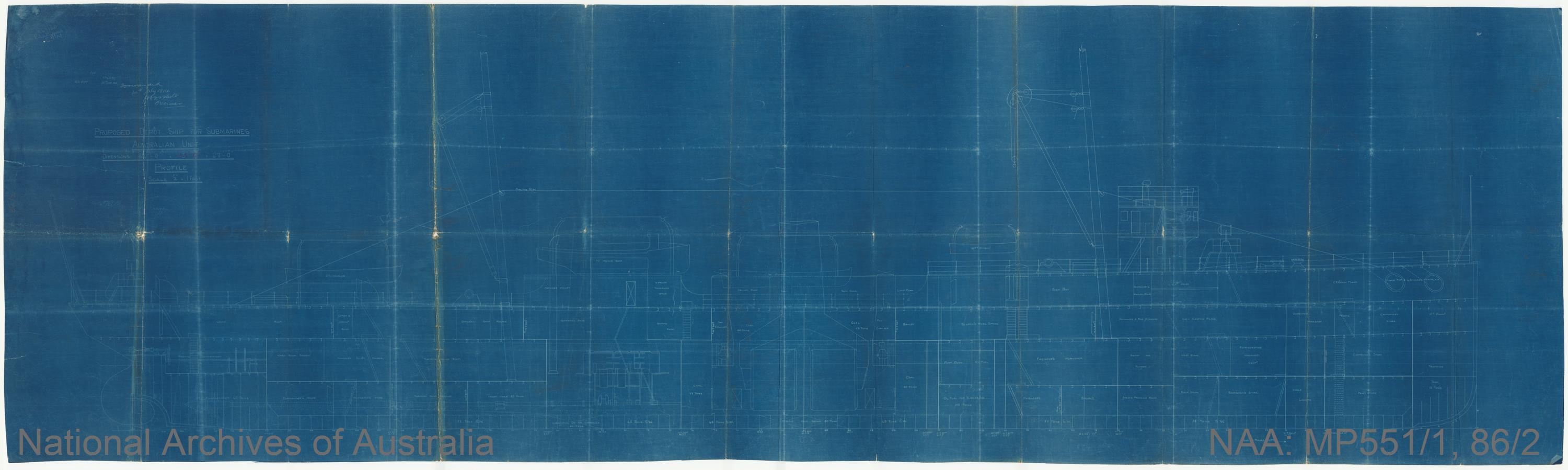
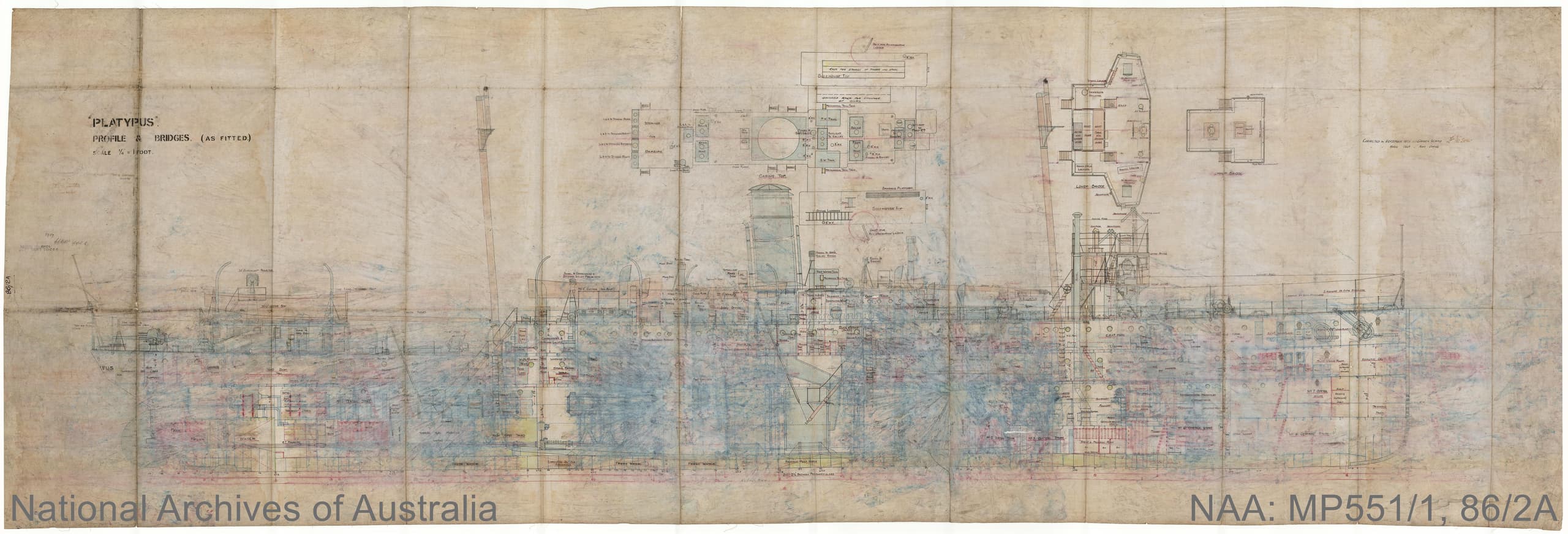
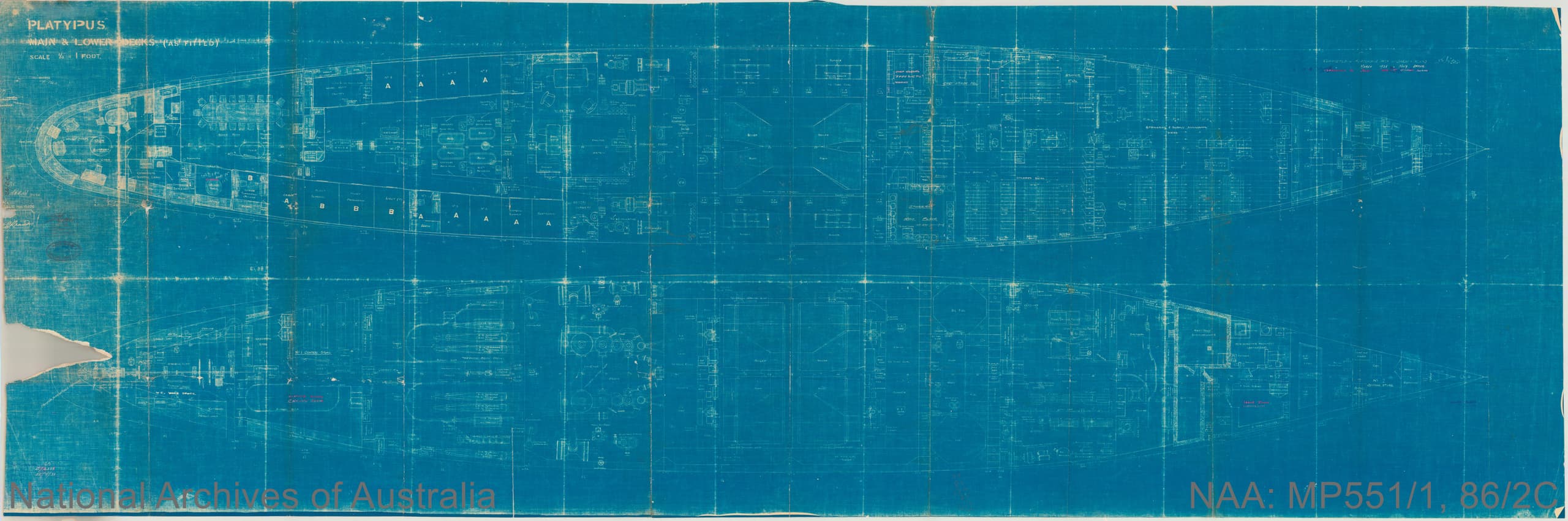
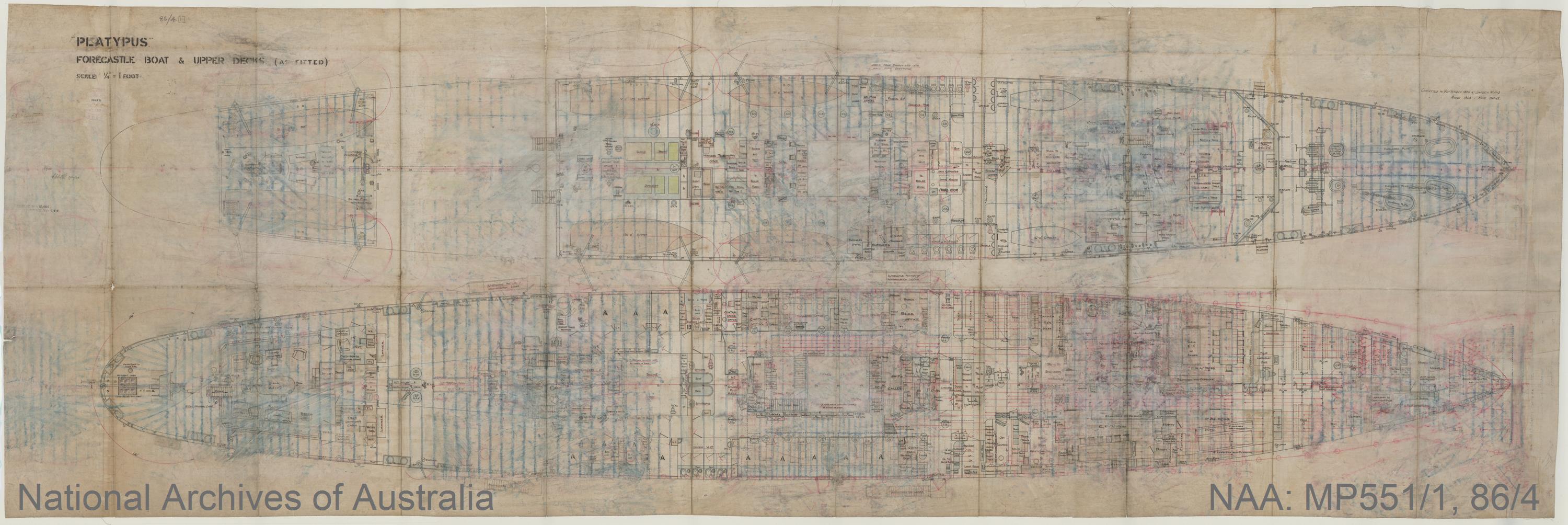
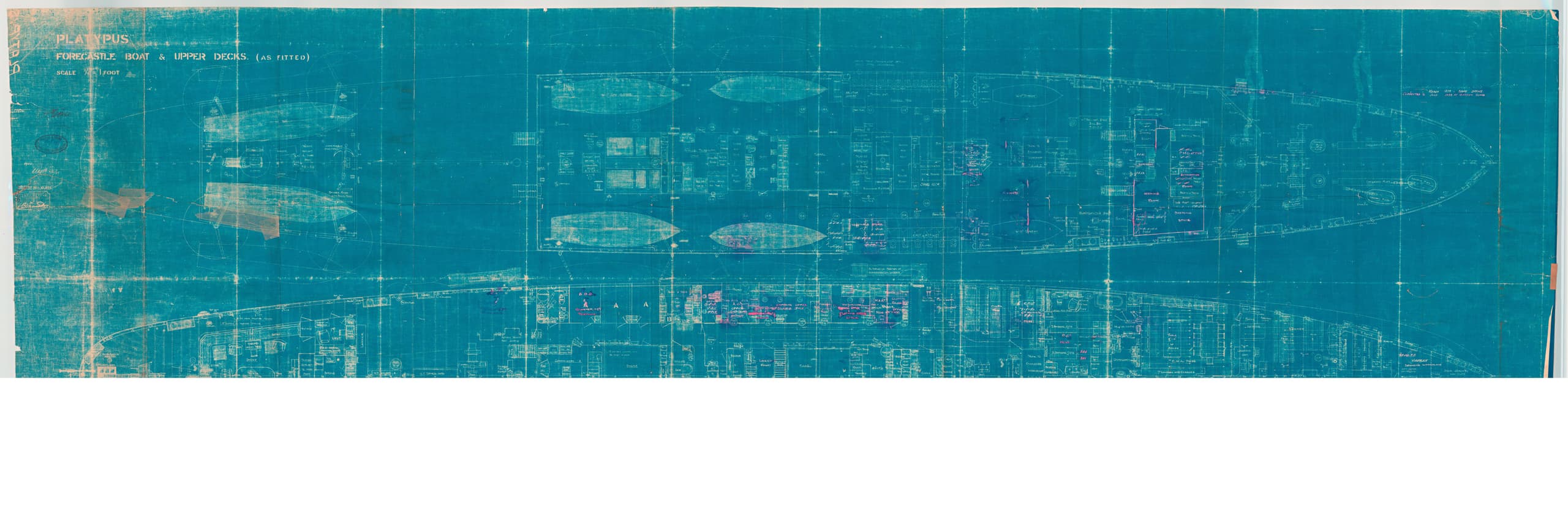
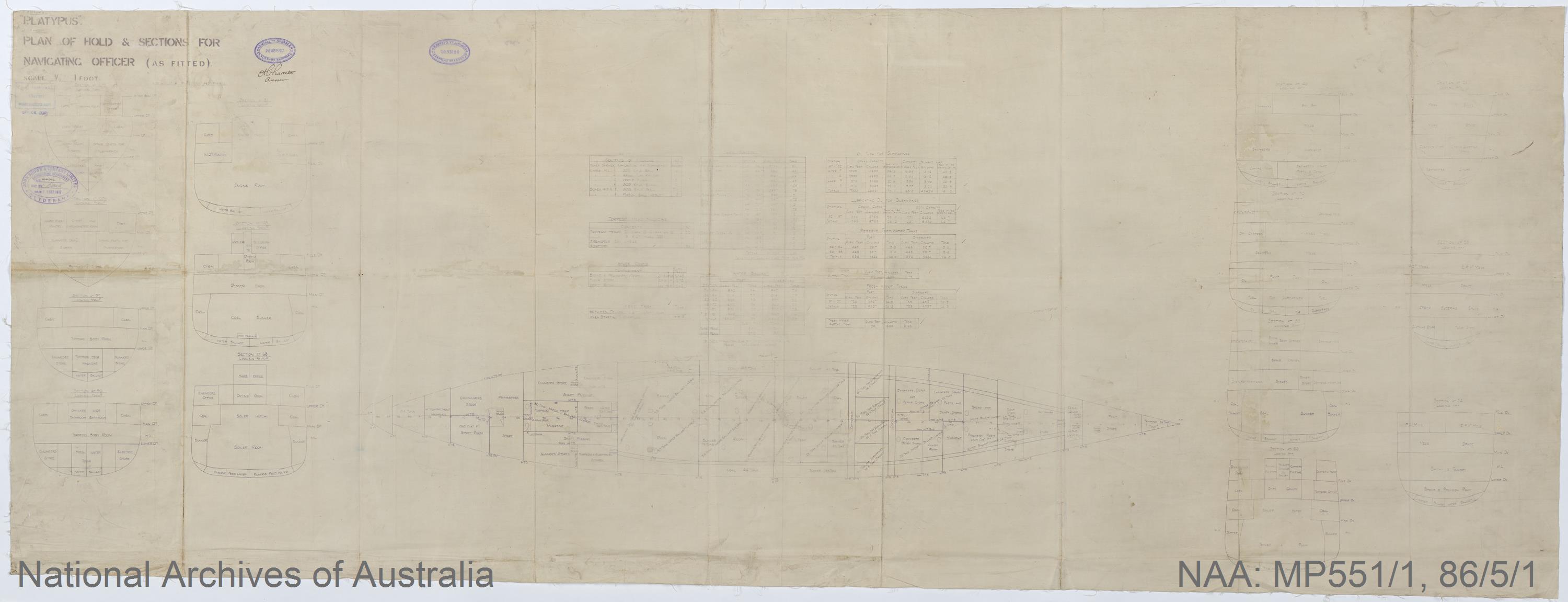
General Arrangement and plans as built:
Sources:
- [86/ Pack - HMAS PLATYPUS (I) - Submarine Depot Ship] HMAS PLATYPUS - Sheer drawing [Blueprint] - NAA: MP551/1, 86/1, 32310413
- [86/ Pack - HMAS PLATYPUS (I) - Submarine Depot Ship] HMAS PLATYPUS - Proposed depot ship for submarines - Australian unit - Profile [Blueprint] - NAA: MP551/1, 86/2, 32310414
- [86/ Pack - HMAS PLATYPUS (I) - Submarine Depot Ship] ‘PLATYPUS’ - Profile & bridges - As fitted [Ink on drafting cloth] - NAA: MP551/1, 86/2A, 32310415
- [86/ Pack - HMAS PLATYPUS (I) - Submarine Depot Ship] ‘PLATYPUS’ - Main & lower decks - As fitted [Blueprint] - NAA: MP551/1, 86/2C, 11200446
- [86/ Pack - HMAS PLATYPUS (I) - Submarine Depot Ship] ‘PLATYPUS’ - Forecastle, boat & upper decks - As fitted [Ink on drafting cloth] - NAA: MP551/1, 86/4, 32310418
- [86/ Pack - HMAS PLATYPUS (I) - Submarine Depot Ship] ‘PLATYPUS’ - Forecastle, boat & upper decks - As fitted. [Blueprint] - NAA: MP551/1, 86/4A, 32310419
- [86/ Pack - HMAS PLATYPUS (I) - Submarine Depot Ship] ‘PLATYPUS’ - Plan of hold & sections for navigating officer - As fitted [Diazotype on linen] [Control symbol is ‘86/5’ - The supplementary numeral ‘1’ imposed by the NAA] - NAA: MP551/1, 86/5/1, 32310420
Sources:
Gillett, R. (1983). Australian and New Zealand Warships 1914-1945 (p.214)
G. H. Gill. (1957). Royal Australian Navy 1939-1942 (pp.588, 650)
National Archives of Australia: MP138/1, 603/221/828: 1192110, HMAS Platypus - Gunnery equipment trials
HMAS Platypus (1917) - Wikipedia
https://seapower.navy.gov.au/history/units/hmas-platypus-i
HMAS Platypus & The Darwin Raid - 1942 - Naval Historical Society of Australia
https://www.dreadnoughtproject.org/tfs/index.php/H.M.S._Platypus_(1916)
Platypus (I 56) 1916 - 1957
https://www.dreadnoughtproject.org/tfs/index.php/Platypus's_Flotilla