- Yes
- No
- Tech Tree Ship
- Premium Ship
- Event Ship
- Battle Pass Ship
- Other (Please comment below)

(Photo Caption: RN Bari seen at Bastia on 11 November 1942, wearing her distinctive camouflage; this is the last known photo of the ship prior to her sinking.)
This is a suggestion for the Italian Light Cruiser Bari, a former Imperial German light cruiser originally designed for the Imperial Russian Navy and allocated to the Italian Regia Marina after the First World War. The cruiser was one of two ships ordered by the Imperial Russian Navy from the German Shipyard of Schichau-Werke in Danzig (now the Polish city of Gdańsk) as part of efforts to replace two older Protected Cruisers. However, at the outbreak of the First World War, the Kaiserliche Marine seized the two incomplete ships and redesigned them for German needs as the Pillau-class. In the aftermath of the First World War, Pillau was transferred to the Regia Marina as part of the war repatriations Germany owed. In Italian service, the ship underwent numerous refits and modernizations to fix many flaws in the original design, allowing her to serve into the 1940s. I feel she would make for a nice addition to the Italian Bluewater tree, as not only is she unique, but she also has decently impressive armament and characteristics for a WWI cruiser, as well as having actual AA firepower. In-game, she would perform similarly to her sister, Elbing, aside from having an increased ability to deal with aircraft.
Background:
Spoiler
Following the disastrous defeat of the Russian 1st Pacific Squadron during the Battle of Tsushima and the heavy losses sustained during the Russo-Japanese War, the Russian navy faced a severe shortage of combat-capable ships. The remaining vessels in the Baltic, Black Sea, and Pacific Fleets were mostly combat-incapable due to their age and general obsolescence. This shortage was further compounded by the 1906 decision to sideline most of the remaining cruisers in the Baltic Fleet. This action spurred the Russian Navy to begin procuring new cruisers. These efforts culminated in 1912, when several new ships were ordered, including four Svetlana-class cruisers for the Baltic and four modified variants for the Black Sea. Furthermore, four Izmail-class Battlecruisers were also ordered. However, during procurement efforts, it was noted that the Russian Navy had no ships capable of training sailors to operate Turbine-equipped ships; immediate replacements were also needed for the obsolescent Protected Cruisers Askold and Zhemchug in the Pacific Fleet.
These considerations led to a design competition in which Russian shipbuilders squared off against European shipbuilders, such as Ansaldo and Schichau-Werke, to design a new cruiser. Ultimately, the Nevsky Plant won the competition, and work was ordered to commence. However, in a twist of fate, the proposed design was the most expensive, and the proposed construction timeframe was deemed unacceptable. Subsequently, the Russian Naval Ministry decided instead to order the cheaper, quicker-to-build Schichau-Werke design. This decision eventually led to the order and construction of the ships that would be known as the Project No 356-class Light Cruisers. However, before either could be completed, the First World War broke out. The two incomplete cruisers were quickly seized and completed to a modified German design as Pillau and Elbing, becoming the Pillau-class.
Both ships saw extensive service during the First World War, with Pillau and Elbing partaking in the Battle of Jutland, where Elbing was sunk. Pillau would survive the war and was transferred in the 1920s to the Italian Regia Marina as part of war repatriations. In Italian service, the ship underwent numerous refits to fix the many flaws it was noted to have. Upon entering Italian service, she was rearmed and initially classified as an Exploratore, though by 1929 she was once again a Light Cruiser. The ship would serve until 1943, when she was sunk while undergoing a refit to convert her into a dedicated Anti-Air Light Cruiser, in an Allied bombing raid. She was subsequently raised and scrapped in 1948.
History
Spoiler
With the conclusion of the Russo-Japanese War in September 1905, the weakened Imperial Russian Navy faced a severe shortage of combat-capable ships. This was compounded by the 1906 decision to sideline most of the remaining cruisers in the Baltic Fleet, spurring the Russian Navy to begin efforts to procure new cruisers. These efforts would culminate in the design and start of the construction of eight new Svetlana-class cruisers and the four Izmail-class Battlecruisers. However, procurement efforts revealed that the Russian Navy had no ships capable of training sailors to operate turbine-equipped ships; furthermore, immediate replacements were needed for the already near-ancient Protected Cruisers Askold and Zhemchug in the Pacific Fleet. These considerations led to a design competition in which Russian shipbuilders squared off against other European shipbuilders like Ansaldo and Schichau-Werke. The Nevsky Plant ultimately won the competition, and work was ordered to commence on the new Light Cruiser. However, in a twist of fate, the proposed design was the most expensive, and the proposed construction time frame was deemed unacceptable. The Russian Naval Ministry subsequently decided to order the Schichau-Werke design instead, reasoning that the ship could be built quickly and cheaply as a modified variant of an existing class (the Kolberg-class) of Light Cruiser. This decision eventually led to the design and construction of what was supposed to become the Project No 356-class Light Cruisers Maraviev Amurskyy and its sister Admiral Nevelskoy.
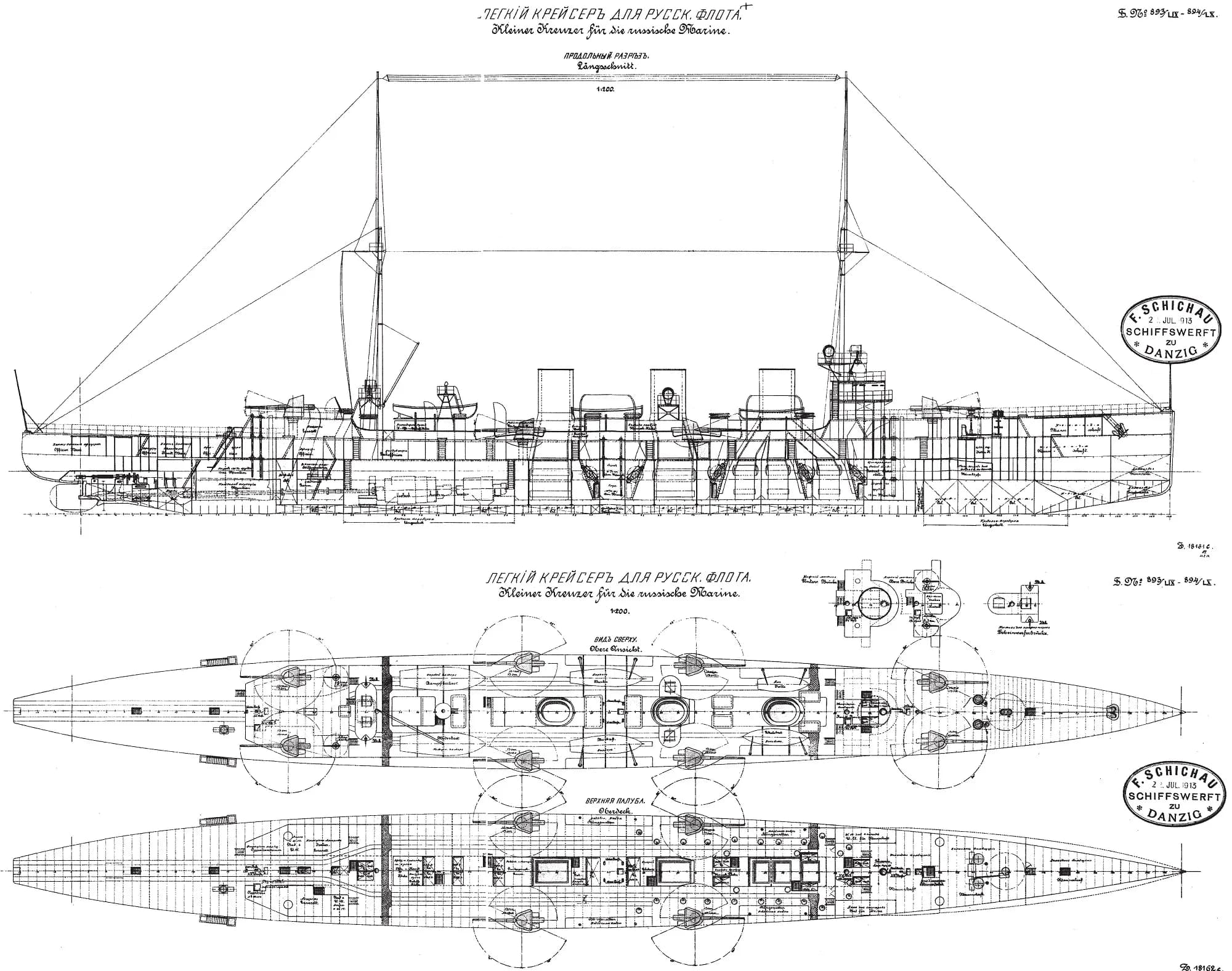
(Photo Caption: The basic design of the Project 356 Class Light Cruiser)
Schichau-Werke’s design called for the Project No 356 Light Cruiser to be 135 meters long, with a beam of 13.60 meters, displacing 4390 tons at average load and 5252 tons maximum. The class was to be powered by ten Yarrow Boilers (four oil, six mixed) and two steam turbines, which drove two screws, propelling the ship to speeds of 28 knots. Armament was to have consisted of eight single 130 mm/55 B7 Pattern 1913 guns and four single 63 mm/36 Obukhov Guns. The ship, as designed, would also have featured 150 mines, allowing the class to perform the role of a fast minelayer. On 11 April 1913, the first of these two cruisers, Maraviev Amurskyy, was laid down at the Schichau-Werke shipyard in Danzig (now known as Gdańsk). Construction of the class’s lead ship progressed quickly, and on 11 April 1914, the class’s lead ship, Maraviev Amurskyy, was launched and sent to be fitted out. However, Work on Admiral Nevelskoy progressed far more slowly and would not be launched until 21 November 1914, when Germany had already seized, redesigned, and renamed the ship SMS Elbing.
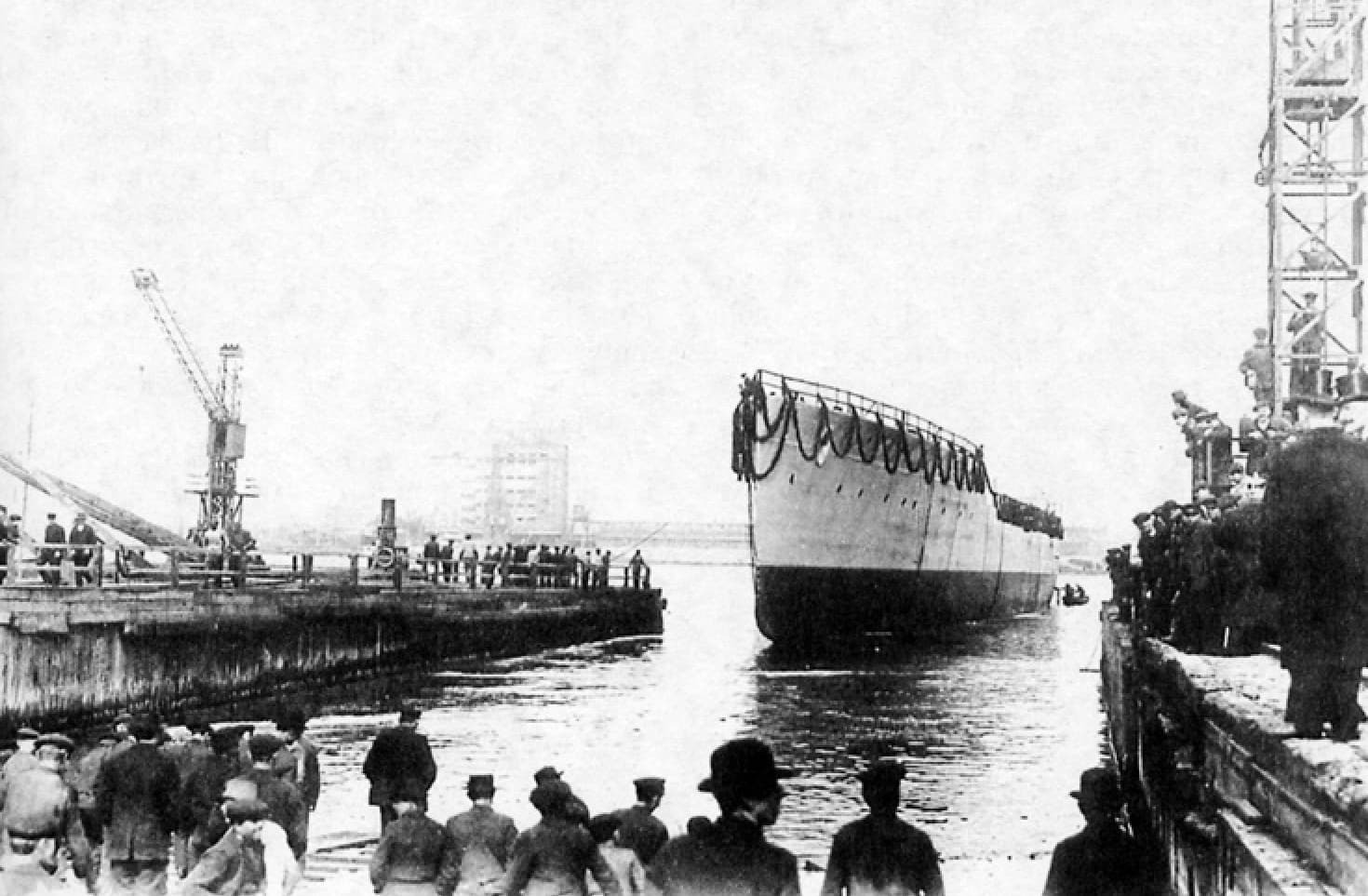
(Photo Caption: The Launch of the then Light Cruiser Maraviev Amurskyy)
Despite the rapid progress on Maraviev Amurskyy, the ship was still undergoing final fitting out in August 1914 when, after months of tension, the German Empire formally declared war on the Russian Empire and ordered the seizure of all Russian property in Germany. Among the property seized were the incomplete hulls of Maraviev Amurskyy and Admiral Nevelskoy. Subsequently, negotiations began with the Schichau-Werke shipyard about potentially purchasing both hulls. To this end, Großadmiral Alfred Von Tirpitz headed negotiations, as he felt that despite not being built to German Standards, both ships could further reinforce the German Fleet. After several negotiation attempts and much tension, they agreed on a price, and both cruisers were sold to the German navy. Following this, both cruisers were added to the German Naval Register and were renamed SMS Pillau and SMS Elbing. The renaming of Elbing occurred only on 9 January 1915, suggesting the ship had been launched earlier without any ceremony. Initially, the Schichau-Werke shipyard chose to continue building the class to its original design; however, owing to supply issues and the inability to procure the 130 mm/55 B7 Pattern 1913 guns for the ships, it was ultimately decided to rearm the class with the 15 cm SK L/45 Naval gun, which would become the standard German Naval gun for Light Cruisers going forward. Furthermore, the German Reichsmarineamt (RMA) ordered several significant design changes that caused further friction with the shipyard and led Schichau-Werke to warn the Kaiserliche Marine that the ships would no longer be able to achieve their designed top speed.
SMS Pillau was finally commissioned on 14 December 1914 but was not released into active service until 16 March 1915, owing to the necessary sea trials. During Trials, Pillau was noted to be very powerful, achieving a maximum power rating of 35,500shp. However, poor-quality fuel that kept clogging her boiler’s oil filter caused that power to drop in the following hours. There is also some anecdotal evidence that a max power rating of 44,900shp was achieved, but no speed records have survived. SMS Elbing’s trials, on the other hand, did not go as well, despite having achieved her designed speed. The trials commission was unimpressed, however. In their criticisms, they referred to the ship as inter-alia, or extremely hard to handle and maneuver. It was also noted that the ship could not use its forward 15cm guns in a mild to heavy sea state as there was no flaring on the bow to protect them from the sea spray. Despite these criticisms, both ships would be accepted into the Kaiserliche Marine as part of the Hochseeflotte.

(Photo Caption: The new SMS Pillau upon entering service in 1915)
Following her commissioning, Pillau primarily operated with the II Scouting Group. Her first significant campaign occurred from 8 August 1915 to 20 August 1915 in what would become known as the Battle of the Gulf of Riga. During this action, the ship took part in several operations against her former Russian owners and was nearly torpedoed. However, operations in the Gulf of Riga would later be suspended due to the presence of extensive Minefields, Torpedo boats, and submarines, which had inflicted major losses on the German Fleet. For the remainder of 1915 and part of 1916, Pillau primarily served in an escort and patrol role in the North Sea. In early 1916, Pillau became the temporary flagship of Johannes Hartog, the Commander of the Kaiserliche Marine Torpedoboat squadrons. In April of 1916, she joined the rest of the I Scouting Group in the inconclusive Bombardment of Yarmouth and Lowestoft as the flagship of the II Scouting Group.
In May 1916, as part of Admiral Reinhard Scheer’s ploy to lure the Royal Navy’s Grand Fleet into a significant fleet action, both Pillau and Elbing were attached to the II Scouting Group under the command of the I Scouting Group in what would become known as the Battle of Jutland. On 31 May 1916, the ships set out from the Jade Roadstead, and by 15:30 that afternoon, had already engaged the British Grand Fleet. By 17:00, the British 5th Battle Squadron arrived and immediately spotted Pillau, Elbing, and Frankfurt. Eight minutes later, the battleships Warspite and Valiant opened fire at Pillau, straddling the cruiser at a range of 17,000 yards (16,000 m), forcing her to turn away at high speed. Around 18:00, the German battlecruisers she was escorting were also attacked by British destroyers. However, Pillau, Frankfurt, and the battlecruisers’ secondary guns drove them off.
Around 18:30, Pillau and the rest of II Scouting Group encountered the cruiser HMS Chester and opened fire, scoring several hits before disengaging. As both sides began to disengage from combat, Rear Admiral Horace Hood’s battlecruisers intervened. His flagship, HMS Invincible, immediately scored a hit on Wiesbaden that exploded in her engine room and disabled the ship. Pillau was later struck by a 305mm shell from HMS Inflexible. The shell exploded below the ship’s chart house, causing severe damage, although most of the blast went overboard. However, the ship’s air supply shaft vented part of the explosion into the second boiler room. All six of the ship’s coal-fired boilers were disabled, though the ship could still make 24 knots on her four oil-fired boilers. This allowed the ship to escape, though she would once again come under fire at around 21:30. Following the Battle, Pillau was ordered to assist the severely damaged Battlecruiser Seydlitz on her desperate return to port. Despite some hurdles, the operation was a success, and the ships made it to port, guided by Pillau.
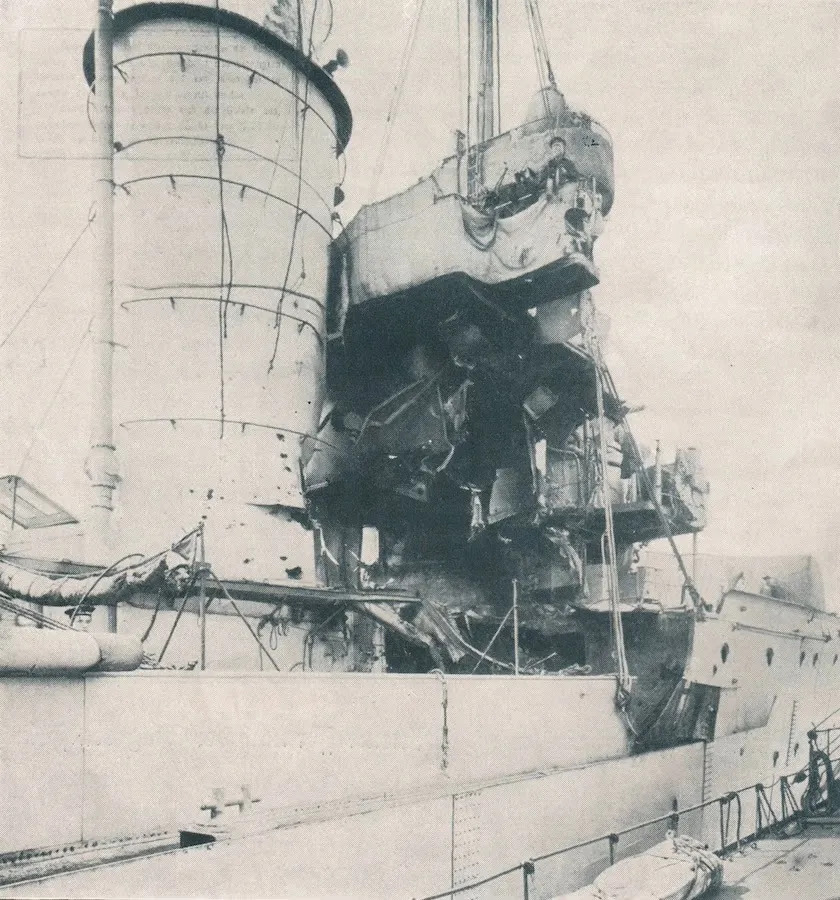
(Photo Caption: The severe damage to Pillau following a hit from HMS Inflexible)
Following the battle, Pillau was sent to the repair yards, where the ship remained from 4 June to 18 July. The rest of 1916 was relatively uneventful for Pillau, with the ship taking part in several failed operations that led the Kaiserliche Marine to abandon its aggressive doctrine and later rescuing the crew of SM U-20. In 1917, Pillau was confined mainly to patrol operations and suffered several crew mutinies due to the worsening war situation and the cancellation of leave on various occasions. The ship’s captain did not take these incidents seriously and ordered the mutineers to receive only light punishment. In October 1917, the ship was ordered into drydock for maintenance, and two 8.8 cm SK L/45 guns replaced her then obsolete 5.2 cm SK L/55 naval guns. Following this drydock period, the ship returned to service in time to partake in the indecisive Second Battle of Heligoland Bight. During 1918, the ship saw several changes, including the appointment of a new commander, FK Adolf Pfeiffer. However, with the war ending, the ship saw little action and was used primarily for patrol duties. On 24 October 1918, the ship was ordered to proceed from Wilhelmshaven to be part of the Fleet that would lead the final attack on the British Grand Fleet. However, before this could be done, the sailors onboard several larger capital ships mutinied in what would become the Kiel Naval Mutiny. Following the Mutiny and the cancellation of the order, the First World War ended on 11 November 1918. Pillau would subsequently be ordered to remain in Wilhelmshaven under the care of a skeleton crew and was formally decommissioned in March 1919.
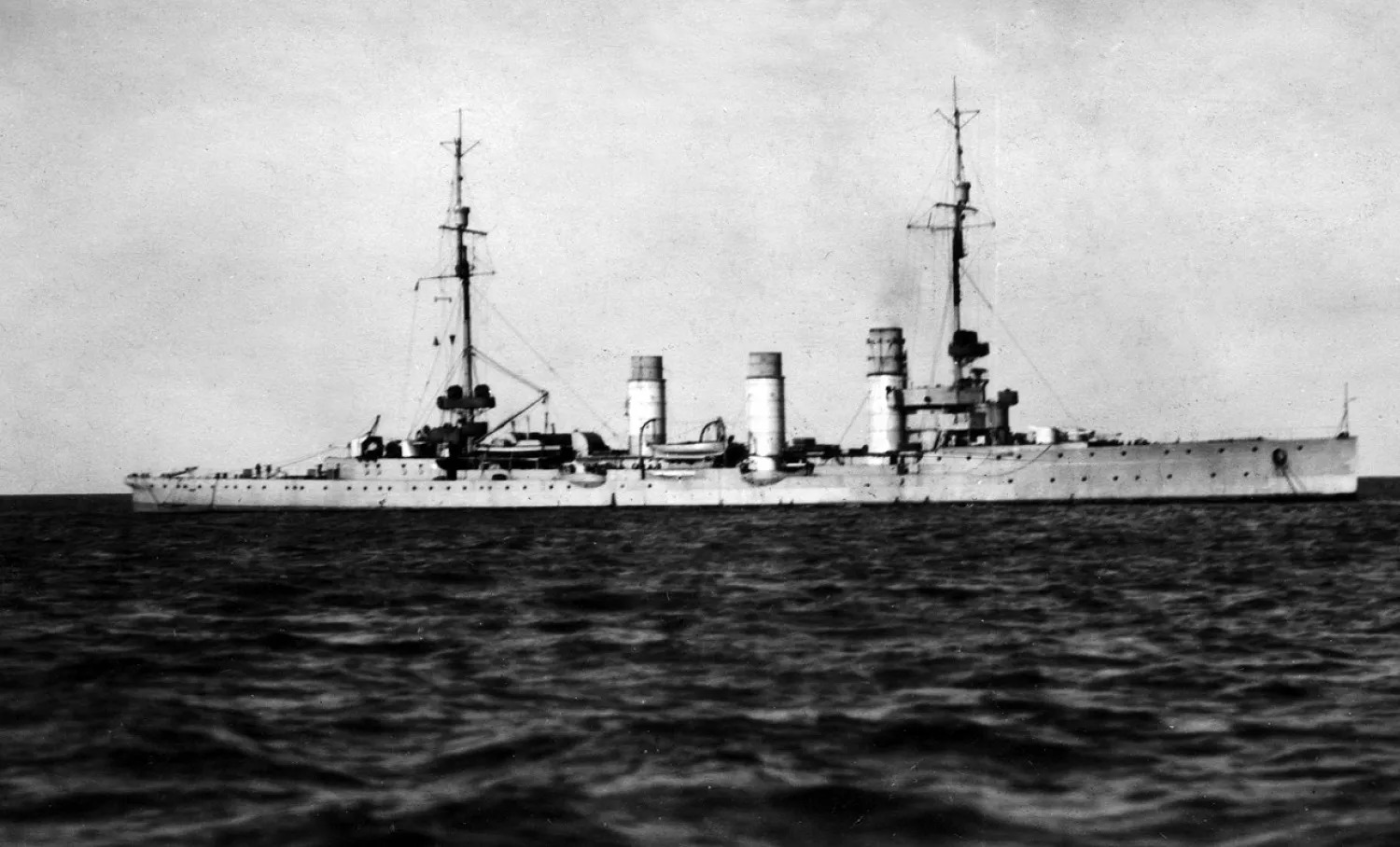
(Photo Caption: SMS Pillau as she appeared in 1918 on patrol in Helgoland Bay)
Originally intended to be one of the few ships the German Navy was allowed to retain, fate dictated otherwise: on 21 June 1919, the ships interned at Scapa Flow took part in what is popularly known as “The Great Scuttle”. This action led the Entente to order Ex-Pillau to be made available as a replacement, in compensation for the ships that were scuttled. On 14 June 1920, she sailed from Germany with the cruisers Königsberg, Stralsund, Strassburg, and several other ships. They arrived in Cherbourg, France, between 19 and 20 July and were subsequently surrendered to the Entente. Ex-Pillau was among the ships selected to be ceded to the Italian Regia Marina, along with Ex-Graudenz and Ex-Strassburg. Pillau was given the provisional name “U” before her transfer to Italy, and upon delivery, the ship was renamed Bari after the Italian City. However, Bari was noted to be in an advanced state of disrepair and needed serious work to bring her to fighting condition. Thus, she was not commissioned into the Regia Marina until 21 January 1924, after four years of repair and refit work. The ship retained most of her German armament, except the 8.8 cm Flak guns, which were replaced with three 76mm/40 guns, deemed superior and easier to maintain. Upon being commissioned, the ship was classified as an Esploratore (Scout Cruiser).
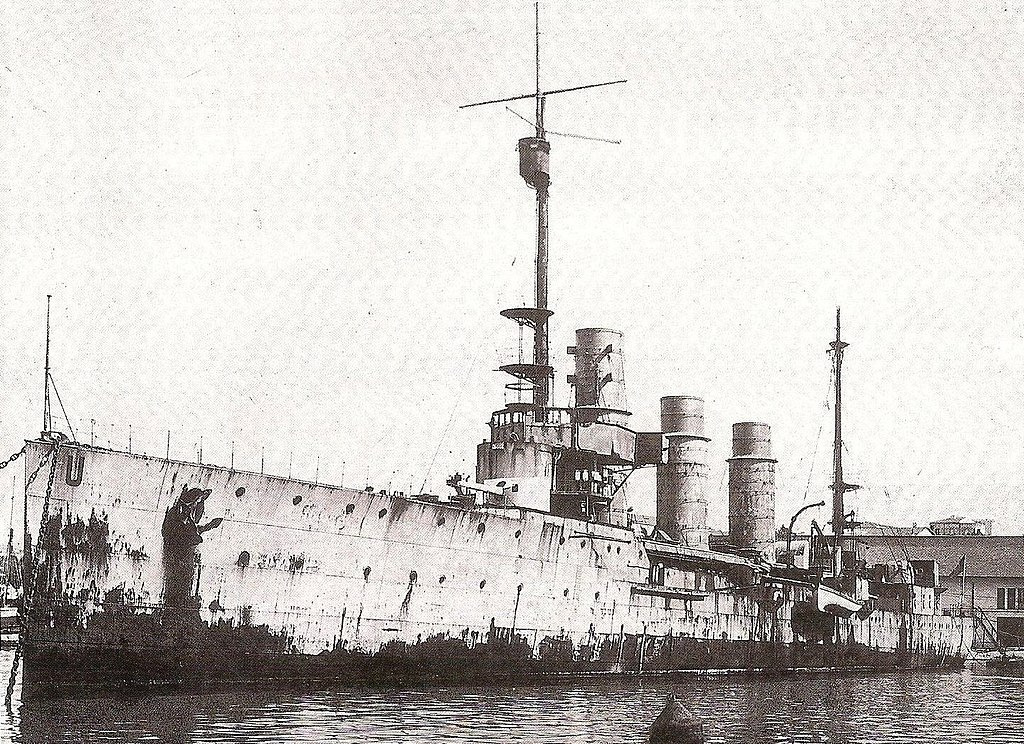
(Photo Caption: The Condition of the Light Cruiser “U” upon her handover to Italy in 1920)
Bari’s early years of service in the Regia Marine were relatively quiet, though the ship did run aground in 1925 only a few months after being assigned to the Light Division. Thus, she would spend most of 1925 under repair. Following the conclusion of repairs, the ship was ordered to undertake various cruises in the Mediterranean, with her most well-known cruise being the 1927 Coast to Coast tour of the Mediterranean. In 1929, she undertook her first Mediterranean-to-Atlantic cruise before returning to Italy, being reclassified as an Incrociatore Leggero (Light Cruiser), and assigned to the Divisione Esploratori of the 1ª Squadra Navale. In 1930, she undertook her first visit to the Adriatic before being ordered to report to Venice in 1931, where the ship was modified to serve as a training ship attached to the Scuola Allievi Meccanici di Venezia. Among the modifications performed were the shortening of the forward funnel and the expansion of her bridge to better serve flag duties, which she undertook when she also became the flagship of the VI Division under the command of Ammiraglio di Divisione (Rear Admiral) Guido Castiglioni from 1933 to 1934.
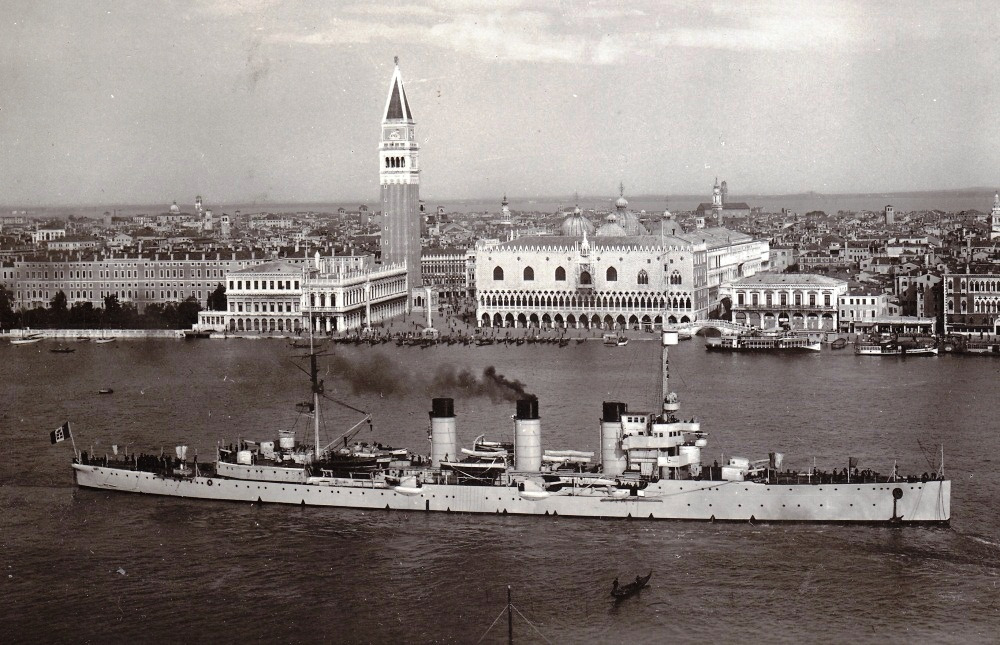
(Photo Caption: Bari as she appeared following her 1931 conversion into a training ship, seen here docked in the Grand Canal of Venice)
By 1933 it was recognized that Bari was growing older and becoming increasingly obsolescent. The previous 20-odd years of hard service had worn the ship down, and she badly needed a refit. Around this time, Italy sought to expand its colonial possessions and found itself in need of a flagship for such duties. Thus, between 1934 and 1935 the ship underwent a radical refit. During this refit, the ship’s six coal-fired boilers were removed and replaced with additional storage space for oil, water, and naphtha. With the removal of the boilers, also came the removal of the forward funnel, which allowed for the expansion of her flag facilities and accommodation spaces. Additionally, the remaining funnels were cut down, and the four remaining boilers were converted to run exclusively on a type of oil known as naphtha. These modifications increased the range to 4000 nautical miles at 12 knots but reduced the ship’s speed to 25 knots. Additionally, the extra space on the bridge deck allowed for the installation of a twin Breda Mod.1931 13.2mm gun. Following the conclusion of the refit, the ship was deployed to the Red Sea, where she assumed the duties of the flagship of Ammiraglio di Divisione Vannutelli, who was the head of Italian Naval Forces in East Africa. She would remain on station until 8 May 1938, when she was relieved by the newly constructed Colonial Sloop Eritrea. She subsequently returned to Italy for an additional refit that saw the final removal of the 500mm torpedo tubes and the addition of three twin Breda 20/65 Mod 1935 guns as well as two additional twin Breda Mod.1931 13.2mm machine guns.
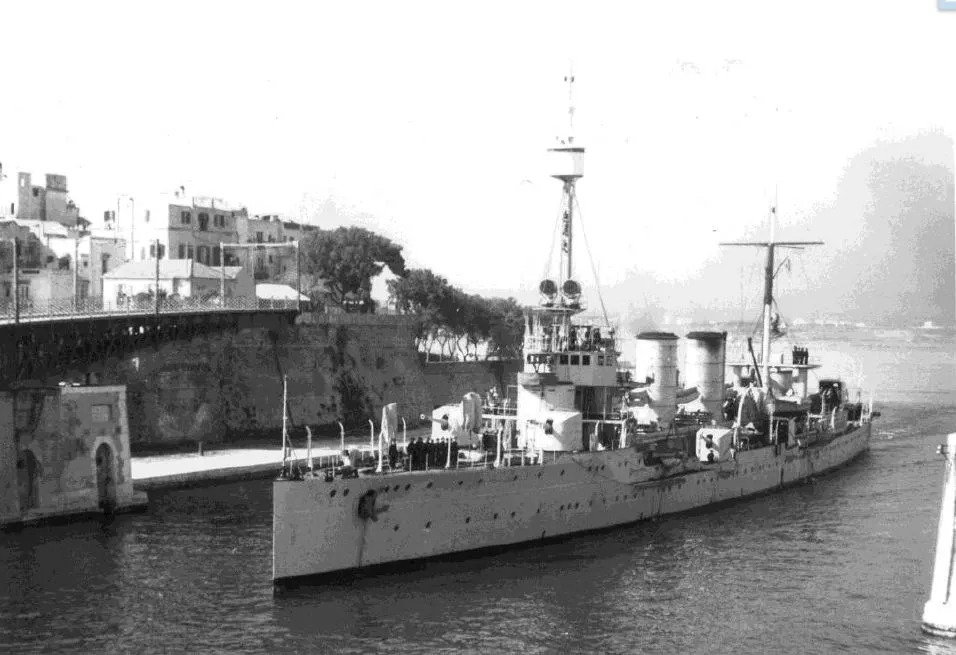
(Photo Caption: Bari in the Taranto ship channel following the major refit of 1934-1935)
On 10 June 1940, Italy formally joined the Second World War by declaring war on France and the United Kingdom. Bari was subsequently ordered to form a Cruiser division with her former fleetmate Taranto (Ex-SMS Strassburg) and was assigned to patrol the Ionian and Lower Adriatic coasts as part of the Dipartimento Militare Marittimo Jonio e Basso Adriatico. On 25 October, Bari was made flagship of the Italian Naval Special Forces and assigned to support and command the Naval Landings on the Island of Corfu. However, after multiple delays and the worsening war situation on the Greek front, the operations were canceled. Instead, Bari and Taranto would spend the Greek Campaign undertaking coastal bombardment and minelaying missions in the Aegean and Adriatic Seas. In April-May 1941, with German support, Bari was finally able to undertake her original mission and assisted in the successful capture and occupation of the Islands of Corfu, Kefalonia, Santa Maura, Ithaca and Zakynthos as well as additional Ionian Islands. For the rest of 1941, the ship continued its service in the Greek Theater and became the flagship of the Comando Militare Marittimo della Morea under Admiral Vittorio Turr and later Admiral Alberto Marenco di Moriondo. The ship would also undergo an additional refit to increase the number of 20mm/65 Breda Mod.40s aboard by an additional 6, bringing the ship’s total complement of 20mm guns to 19 barrels.
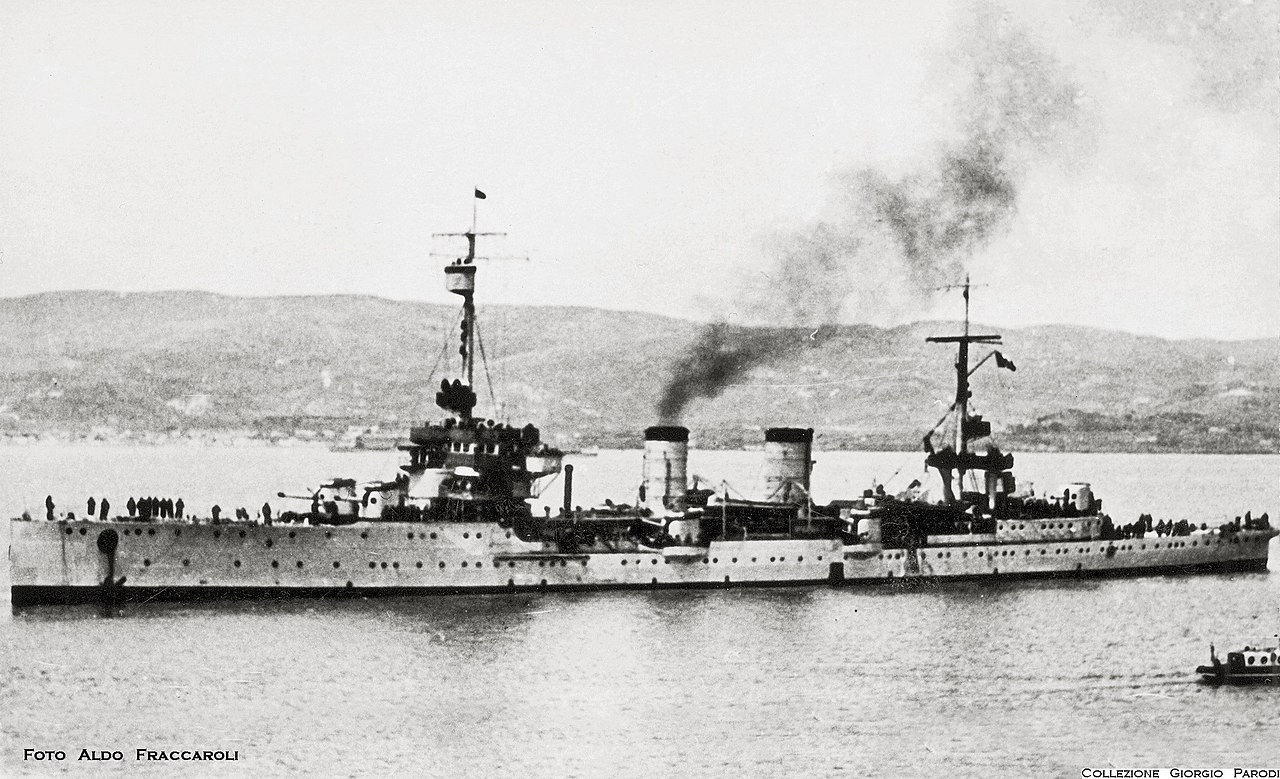
(Photo Caption: Bari in 1941 during her service on the Ionian Front. Note the extensive changes compared to what she looked like as built)
In 1942, the ship was reassigned to the Italian mainland, specifically the port of Livorno, in preparation for Operation C3, the Invasion of Malta. During the Spring and Summer of 1942, the ship took part in various exercises in preparation for the landings, which were ultimately canceled in November due to the Allied landings in Casablanca as part of Operation Torch. While most of the units were reassigned, Bari and Taranto were instead ordered to take part in the Landings and occupation of Corsica, with Bari sailing into the Port of Bastia alone on 11 November 1942 as a show of strength. By January 1943, with the situation turning against the Axis, the Regia Marina disbanded the Special Naval Landing Forces and opted to convert Bari into a dedicated Anti-Aircraft cruiser, as she was no longer deemed useful as a Light Cruiser. Works subsequently began, and the ship was completely disarmed in preparation for re-arming. However, in a twist of fate, Livorno was subjected to a massive Allied air raid on 28 June 1943. The damage to the port was severe, and during the bombing the venerable old Bari was hit by several bombs and sunk in shallow water. Salvage efforts began, and the hulk was moved to shallower waters, but further work was interrupted by the Armistice on 8 September 1943. Following the armistice, Italian engineers sabotaged the ship and detonated scuttling charges, which further damaged the ship. Viewed as obsolete and not worth recovering, the Germans partially demolished the wreck in 1944 and then finally salvaged and scrapped it on 13 January 1948, thus ending the tale of the Cruiser Bari.
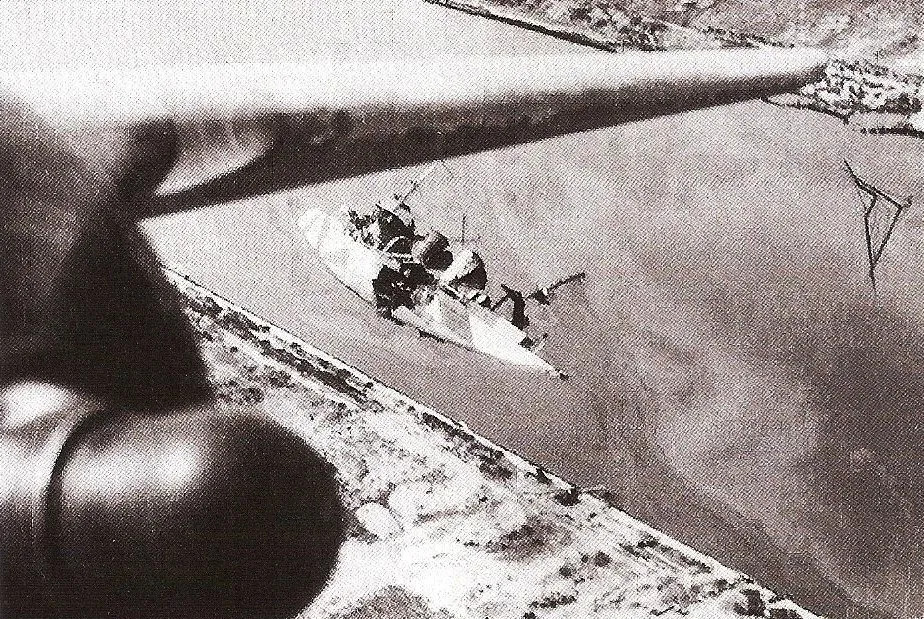
(Photo Caption: The Wreck of the Light Cruiser Bari in the Summer of 1944)
Specifications for RN Bari (1942)
Spoiler
General Specifications
Displacement:
Normal: 4,390 tons/Full load: 5,252 tons
Length: 135.3 meters
Beam: 13.60 meters
Draft: 5.98 meters
Machinery:
Propulsion 4 × water-tube boilers (4 Oil-fired), 2 × Steam Turbines, and 2 × Screw Propellers
Power: 30,000 shp (22,400 kW)
Speed: 25 knots (50.9 km/h)
Complement:
Complement: 21 officers, 421 enlisted men
Armament
Primary Armament:
8 × 1 149mm/43 SK L/45 guns
Secondary/Anti-Aircraft armament
3 × 1 76mm/40 Ansaldo Model 1917 guns
4 x 2 20/65 Breda Mod.35 in Mount RM1935
11 x 1 20/65 Breda Mod.1940
Mines
120 Mines
Armor:
Deck
80-20mm along the traverse sections
Conning tower:
75mm (sides)
50mm (roof)
Gun Shields
50mm:
Deck
80-20mm along the traverse sections
Conning tower:
75mm (sides)
50mm (roof)
Gun Shields
50mm
Text Sources
Spoiler
Books/Magazines
Bargoni, Franco, and Franco Gay. Esploratori Italiani . Ufficio Storico Della Marina Militare, 2019.
Dodson, Aidan, and Nottelmann, Dirk. The Kaiser’s Cruisers, 1871-1918. Seaforth Publishing, 2021.
Giorgerini, Giorgio, and Augosto Nani. Gli Incrociatori Italiani 1861-1975. Ufficio Storico Della Marina Militare, 2017.
McCartney, Innes. 2018. Jutland 1916: The Archaeology of a Naval Battlefield. Oxford: Osprey Publishing LTD.
Toro, Augusto de “Gli Incrociatori Ex Austriaci e Tedeschi di Preda Bellica”. Storia Militare. 1 Giugno 2026, pp. 43-59.
Websites
Britain 12-pdr [3"/40 (7.62 cm)] 12cwt QF Marks I, II and V - NavWeaps
Bari (incrociatore) - Wikipedia
Germany 15 cm/45 (5.9") SK L/45 - NavWeaps
Italy 20 mm/65 Models 1935, 1939 and 1940 - NavWeaps
Pillau-class cruiser - Wikipedia
SI VIS PACEM, PARA BELLUM: 1913 - 1943: the Royal cruiser Bari (formerly the light cruiser SMS Pillau of the Kaiserliche Marine)
SMS Pillau - Wikipedia
Warship Wednesday, June 28, 2023: The Tsar’s Jutland Veteran | laststandonzombieisland
Image Sources