- Yes - In the Tech Tree.
- Yes - Event/BP.
- Yes - Premium.
- No - I would not like to see HMAS Perth in game.
Thank you to @GTP_Paulie-psn for some of the infomation in this suggestion!
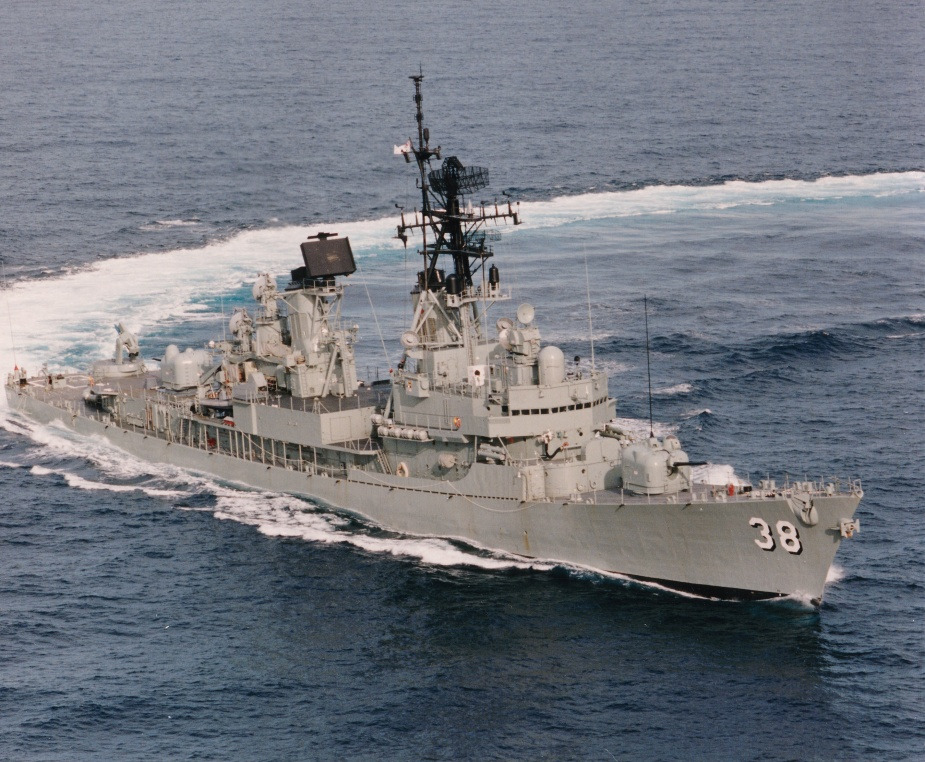
HMAS Perth on sea trials in Jervis Bay, (1980)
Description:
HMAS Perth was the namesake vessel of the three strong Perth-class built for the Royal Australian Navy (RAN). The Perth-class was based on the design of the United States Navies Charles F. Adams-class, albeit with modifications adding local Australian systems.
The RAN would plan for three new vessels to replace the aging Daring-class Destroyers then in service with the RAN with a 1:1 ratio, (including the lost HMAS Voyager). During this time the RAN was standardising on a single AA missile, and from trials had begun to favour the American Tartar missile compared to Britain’s Sea-Slug. Initially the traditional RAN ship builder of Britain was planned to be contracted with a modified County-class Destroyer.
However some modifications to the design, (including a pure steam power plant instead of combined steam and gas, and Tartar missiles instead of Sea Slug) were refused by the British. On the other hand, the American tender of the Charles F. Adams-class were a proven design with the ideal missile system. Small modifications to this design was made, such as replacing the ASROC ASW missile system with the superior Australian designed Ikara ASW missile system, which had double the range.
This is a suggestion as she appeared in 1967.
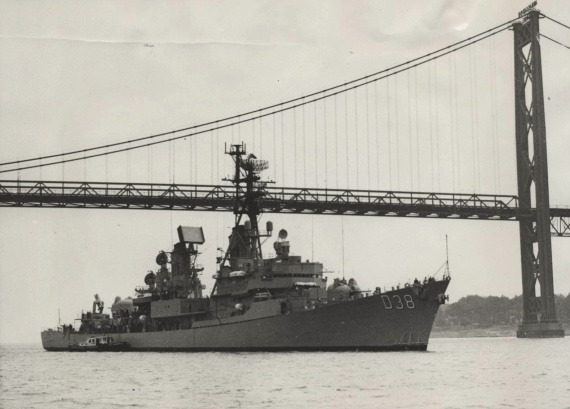
HMAS Perth visiting Canada soon after commissioning, (1965).
History:
Laid down by Defoe Shipbuilding Co, Bay City, Michigan, on the 21st of September 1962, she would launch on the 26th of September 1963, and finally commissioning on the 17th of July 1964. Upon commissioning, she would spend eight months working up in trials around North America, visiting ports in both the US and Canada. She would finally sail for Australia on the 12th of February 1966, arriving at Perth on the 4th of March. The Ikara system would only be fitted in early 1967.
She would deploy to the US Seventh Fleet operating off Vietnam from September 1967 to April 1968, taking over from her sister HMAS Hobart. This would mostly be naval gunfire support missions, and would be mostly incident free. However on the 18th of October while investigating a group of fishing Junks, she would be fired upon by coastal artillery, with a shell deflecting off the aft 5-inch gun into the confidential books vault, which was in the aft superstructure. On the 24th she and the USS Rupertus would fire on six supply craft, sinking five.
Two days later she would sail for Subic for emergency maintenance, finishing work on the 1st of November, however more work would be done from the 7th to the 16th. She would then sail for Singapore on the 17th of November as to allow her sailors shore leave. She would return on the 27th of November. During this time she would be fired upon by two further shore batteries, but no hits would be sustained. This would continue until the 23rd of March, being replaced by the Hobart. For her deployment she would be awarded the United States Navy Unit Commendation.
She would deploy to Vietnam with the US 7th Fleet from September 1968 to April 1969, where again she would mostly be engaged in ship to shore bombardments in support of ground forces. She would also visit Hong Kong and Taiwan during this time. She would not be fired upon by the enemy during this deployment, but would earn the United States Meritorious Navy Unit Commendation.
Her final deployment to Vietnam would be from September 1970 to April 1971, again mostly consisting of shore bombardment duty. This duty would be taken over by the HMAS Brisbane on the 29th of March, with the Australian Government choosing not to redeploy any ships at the end of the year.
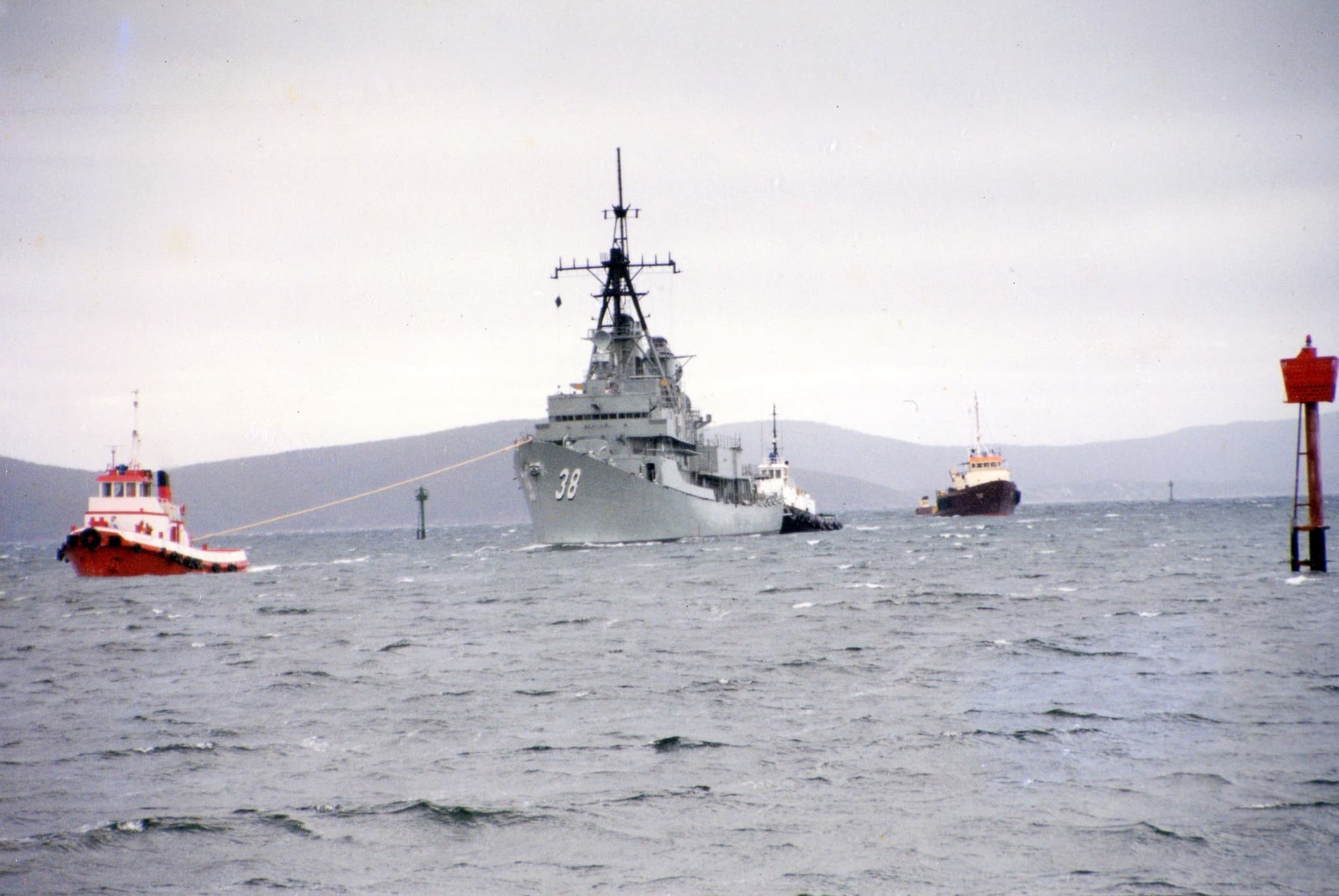
HMAS Perth Being towed out for scuttling in King George Sound (2001)
In February 1973, she would embark the Ethiopian Emperor Haile Selassie while on a goodwill visit to the country. Later in July 1974 she would undergo a modernisation at Long Beach California, fitting a new Naval Combat Data System (NCDS), replacing her gun mounts with new units, due to their unreliability during her deployments to Vietnam, and upgrades to the missile fire control. She would also swap her RIM-24 Tartar missiles for the RIM-66 Standard MR missiles.
She participated in the independence celebrations for the Tuvalu islands in 1978. Then from 1979-1980 she would undergo another refit, as to burn diesel instead of furnace oil. Her next deployment would be to the Middle East and Indian Ocean, sailing the Indian ocean during the 1981 Iran-Iraq war as part of the USS Ranger group, then again in 1982 with the USS John F Kennedy group.
Back home by 1983, she would undergo refit at Sydney, then once that was completed she would undergo trials then be deployed to SEA. In October 1985 she assisted the Singaporean freighter Ho LIen, whose load of ore had shifted, giving her a dangerous list. She would accidentally ram a wharf, causing slight damage to her bow. By 1987 she would again undergo modernisations, upgrading her FCS, missile launcher, and communication systems.
In early 1991 she would undergo another armament refit, removing the Ikara system, and giving her two Phalanx CIWS. Her FCS were also regenerated among other small changes.
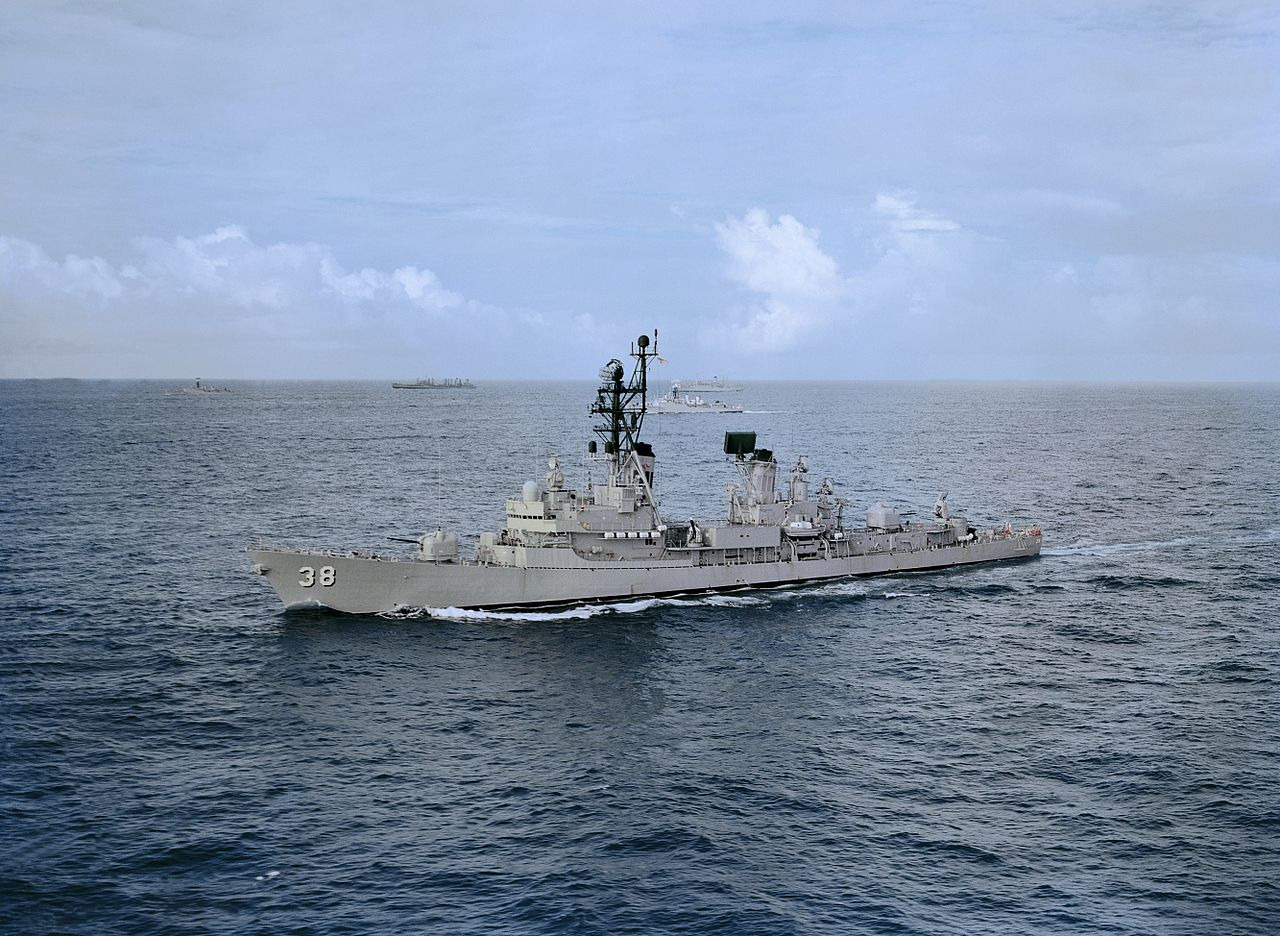
She would visit Egypt and Greece in late 1991, as to commemorate the 50th anniversary of the evacuation of the commonwealth forces from Greece and Crete in 1941 during the Second World War. She would then visit New Zealand in October, as to commemorate the 50th anniversary of the Royal New Zealand Navy (RNZN). She would further operate around SEA and the South China Sea, and would participate in RIMPAC at Hawaii. As the RAN’s senior destroyer, she would visit many nations as to show the flag, including to China, visiting Qingdao in 1997.
She would decommission on the 15th of October 1999, being gifted to the Western Australian Government in December. She would be scuttled as a dive sight off Albany WA on the 24th of November 2001, she still rests there today.
| General Characteristics: | |||||
|---|---|---|---|---|---|
| Name: HMAS Perth | |||||
| Country: Australia | |||||
| Type: Guided Missile Destroyer | |||||
| Class name: Perth | |||||
| Year of commission: 1965 | |||||
| Refit: 1967 | |||||
| ----------------------------------------------------------------------------------------------------------------------------------------- | |||||
| Dimensions: | |||||
| Length: 134 m (440 ft) | |||||
| Beam: 14 m (46 ft) | |||||
| Draught: 6 m (20 ft) | |||||
| Displacement: 4,618t | |||||
| ----------------------------------------------------------------------------------------------------------------------------------------- | |||||
| Propulsion: | |||||
| Powerplant: 4x oil fired boiled driving 2x steam turbines creating 70,000shp (52,199kW) across two shafts | |||||
| Speed: 35kt (65kp/h) | |||||
| Endurance: 6,000nmi @ 15kt | |||||
| ----------------------------------------------------------------------------------------------------------------------------------------- | |||||
| Armament & sensors: | |||||
| Compliment: 333 | |||||
| Primary armament: 2x1 5"/54 Mk.42, | |||||
| Secondary armament: 1x1 Mk.13 Launcher for RIM-24, 2x1 Ikara ASW | |||||
| Tertiary armament: 2x3 Mk.32 12.75" ASW Torpedo tubes, 4x1 .50 M2 | |||||
| Radar: AN/SPS-10, AN/SPS-52C, AN/SPG-51C/D, AN/SPS-40D, Type 975, AN/SPG-53F | |||||
| Sonar: SQS-23KL | |||||
| Other systems: 2x SRBOC Mk.36, AN/SLQ-25 decoys, AN/UPX-22 IFF |
HMAS Perth underway, (1990)
Sources:
V. Cassells, (2000). The Destroyers. Their Battles & Their Badges. (pp.39-40, 81-84)
HMAS Perth (D 38) - Wikipedia
https://seapower.navy.gov.au/history/units/hmas-perth-ii
The Missing DDG - Naval Historical Society of Australia
https://www.hmasperth.asn.au/history