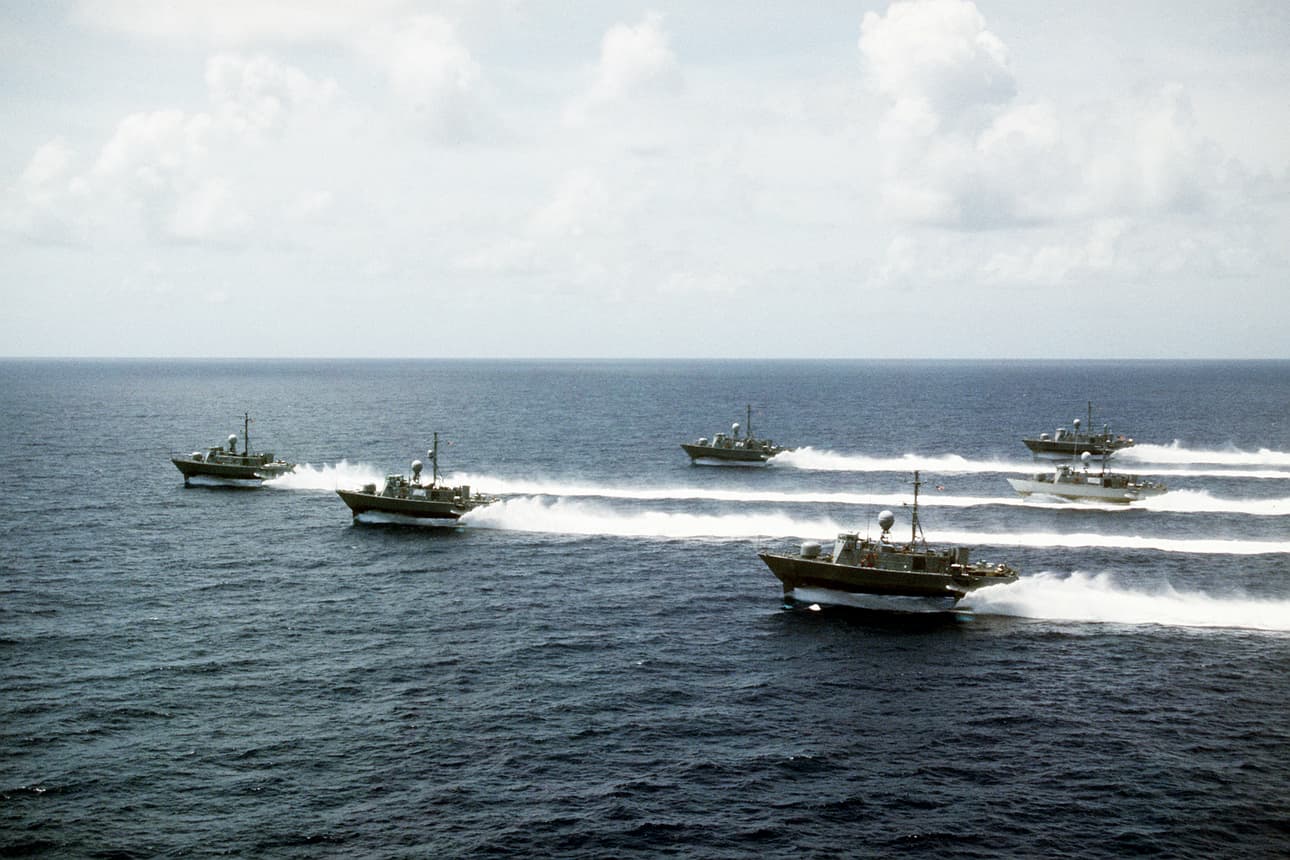
History
Background
The PHM project originated in the late 1960s to early 1970s, when NATO sought a small, fast surface combatant to counter fast Soviet missile boats. Earlier attempts and programs to address this threat had brought little success. That changed when Chief of Naval Operations Admiral Zumwalt led a PHM project that called for a cost-effective hydrofoil boat designed to operate in coastal and littoral waters and utilize the Mk 75 76 mm naval artillery gun and RGM Harpoon anti-ship missiles as its main offensive armament. This PHM project was not solely a US effort, as it also involved Italy, Germany, Canada, and Great Britain. During the early phase of the project, it was envisioned that between 30 and 100 PHM boats would be built for NATO navies.
These boats were to be modeled after the original Tucumcari hydrofoil and reach speeds of up to 48 knots when foil-borne, and could engage fleet-level ships from a range of more than 60 nautical miles with their eight RGM Harpoon anti-ship missiles. However, it became apparent that the project was expensive to implement. Following the retirement of Admiral Zumwalt on July 1, 1974, the Navy reduced funding for the PHM project and redirected some funds into more conventional ship programs. The project struggled to make progress until Congress intervened and mandated the procurement and completion of six vessels.
Because of funding cuts, construction of the lead ship, USS Pegasus (PHM-1), was slowly completed in November 1974, with commissioning in July 1977, while the other five boats were completed and commissioned between 1981 and 1982 with new funds authorized by Congress.
In August 1977, Italy, Germany, Canada, and Great Britain withdrew from the program due to declining interest. No prospective international buyers emerged to acquire the PHM boats, leaving the United States as the sole operator of the class.
Originally, PHM vessels were intended to operate in the Baltic, Mediterranean, and North Seas to establish choke points and counter Warsaw Pact and Soviet missile boats. However, with only six completed, the Navy instead assigned them to the Caribbean Sea, far from most Warsaw Pact naval forces, with the exception of Cuban surface units. They were largely involved in counter-narcotics operations, where they demonstrated success due to their high speed and maneuverability from 1982 to 1992. They saw their only notable combat action during the invasion of Grenada in 1983.
Despite successful deployments, the Pegasus-class PHMs were considered expensive to operate and maintain. The hydrofoil system, combined with the propulsion plant, required intensive maintenance and consumed fuel at a high rate (approximately 1,000 gallons per hour when foil-borne or 100 gallons per hour when hull-borne). The 76 mm gun and Harpoon missiles were also viewed as excessive for typical counter-narcotics missions. Combined with shifting US Navy priorities, it was decided to retire all PHMs in 1993, causing them to miss major operations such as Operation Desert Shield and Operation Desert Storm. All six vessels were decommissioned on July 30, 1993.
Armament, Sensors, and Countermeasures
All six vessels were armed with a single Mk 75 76 mm/62 OTO Melara gun. It was designed by OTO Melara in La Spezia, Italy, and first delivered in August 1978 under the American designation Mk 75. The gun was described as lightweight, fully automated, remote-controlled, and capable of rapid fire. With an 80-round ready magazine, it could fire 80–85 rounds per minute in automatic mode at a maximum range of 10 nautical miles (18.5 kilometers). The gun was controlled by the Mk 92 Fire Control System. According to some sources, the lead vessel, PHM-1, used the Mk 94 FCS instead.
Depending on mission requirements, all vessels had provisions to carry two lightweight Harpoon launchers, each capable of holding one, two, three, or four canisters. When equipped with two quadruple anti-ship Harpoon launchers, the vessel became a heavily armed small combatant capable of inflicting serious damage on larger ships. However, because the Harpoon’s range exceeded the vessel’s sensor capabilities, its standoff effectiveness was limited during independent operations. To compensate, the vessel relied on off-board targeting data from allied assets. Otherwise, it needed to close the distance to the target, increasing its risk. For surface detection and targeting, the vessel used the LN-66 surface search and navigation radar. In many counter-narcotics deployments, Harpoon launchers were sometimes omitted entirely, leaving the 76 mm gun as the primary weapon.
According to available photos, the vessels also had provisions for light M60 machine guns, typically mounted on either side of the deckhouse and used during counter-narcotics missions involving close-range interdiction. Two triple Mk 33 chaff launchers were mounted just aft of the fire-control radar atop the deckhouse and were used to defend against incoming anti-ship missiles.