- Yes - In the Tech Tree.
- Yes - Event/BP.
- Yes - Premium.
- No - I would not like to see HMS Philomel in game.
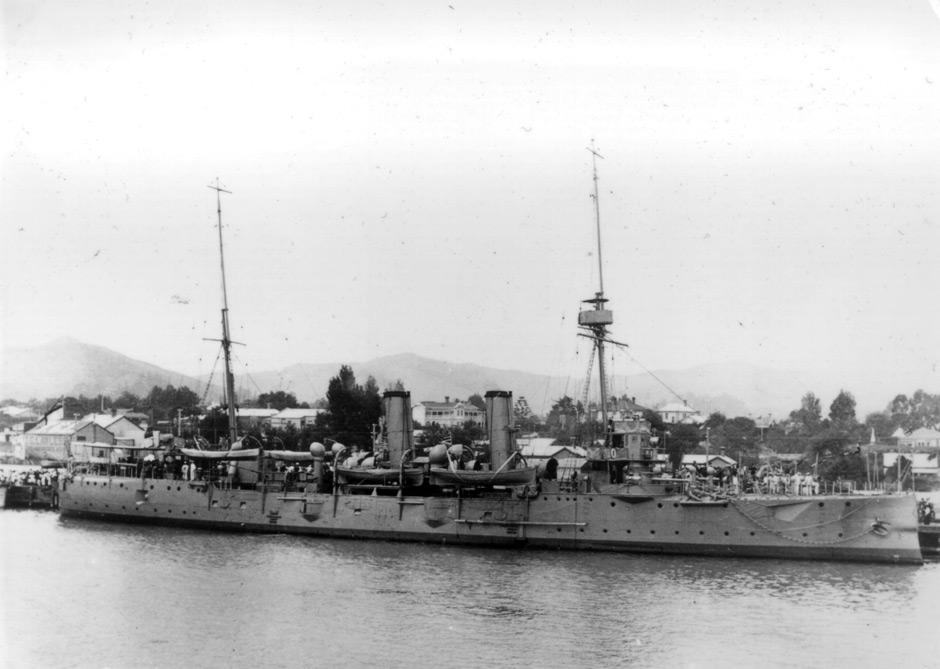
Description:
HMS Philomel was the sixth Pearl-class cruiser to be built for the Royal Navy, and the longest lasting, being fifty-nine years old when she was scuttled. She served most of her career in the New Zealand Division of the Royal Navy as the first NZ warship. She fought in the First World War, and served non-combat duties during the Second World War.
This suggestion is for her 1914 fit as she transferred into the New Zealand Naval Forces (soon to be the New Zealand Division) of the Royal Navy.
History:
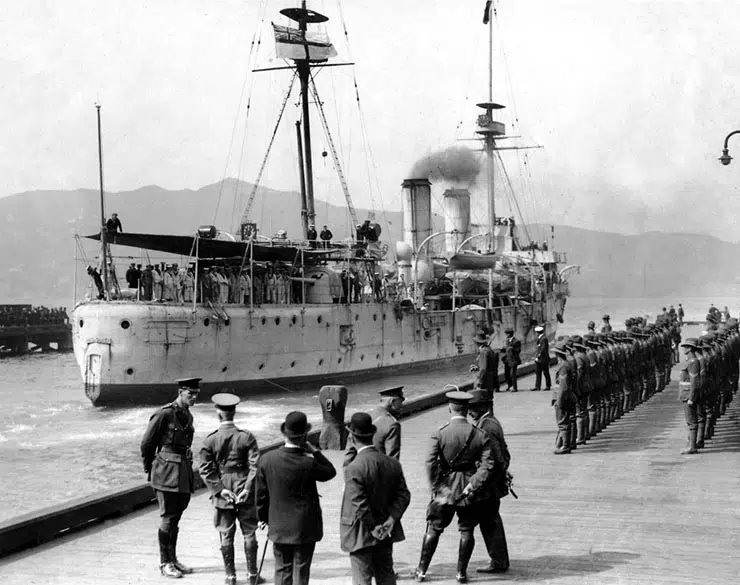
Built by HM Dockyards Devonport, Plymouth, she was laid down on the 9th of May 1889, launching on the 28th of June 1890, and commissioning after sea trials on the 10th of November 1891. She joined the Cape of Good Hope Squadron, but due to more fitting out and trials she only arrived in South Africa in June 1892.
She would be very active during this time, participating in intercepting slave traders and general patrols along the African Coast. In 1896, she participated in the Anglo-Zanzibar war, where she operated for the entire duration of the war, surviving the agonising thirty-eight minutes the war lasted. During this war, she landed 150 Marines, and participated in the destruction of the Royal Yacht Glasgow. The next year she participated in the Benin Expedition under Admiral Sir Harry Rawson.
She received a minor refit in 1898, which included the replacement of her boilers. She would serve during the Second Boer War. She would dispatch two of her 4.7" guns on land carriages, with some of her compliments serving with the Naval Brigade during the battle of Colenso. After the wars end she was laid up and paid off in the Firth of Forth on the 22nd of March 1902.
She spent five years laid up before yet another refit occurred in 1907, with work being carried out in Haulbowline Dock, Ireland. During transportation to this dock for the refit, she broke free from her tow and spent a night adrift in the North Sea. After this refit, she recommissioned and joined the Mediterranean Fleet. She provided aid to Messina, Italy, during this time, due to a large earthquake in the area. The next year, in 1908, she served in the East Indies squadron, patrolling the Persian Gulf and participating in operations off Somaliland. She would remain in this role until 1910, when she was decommissioned into reserve.
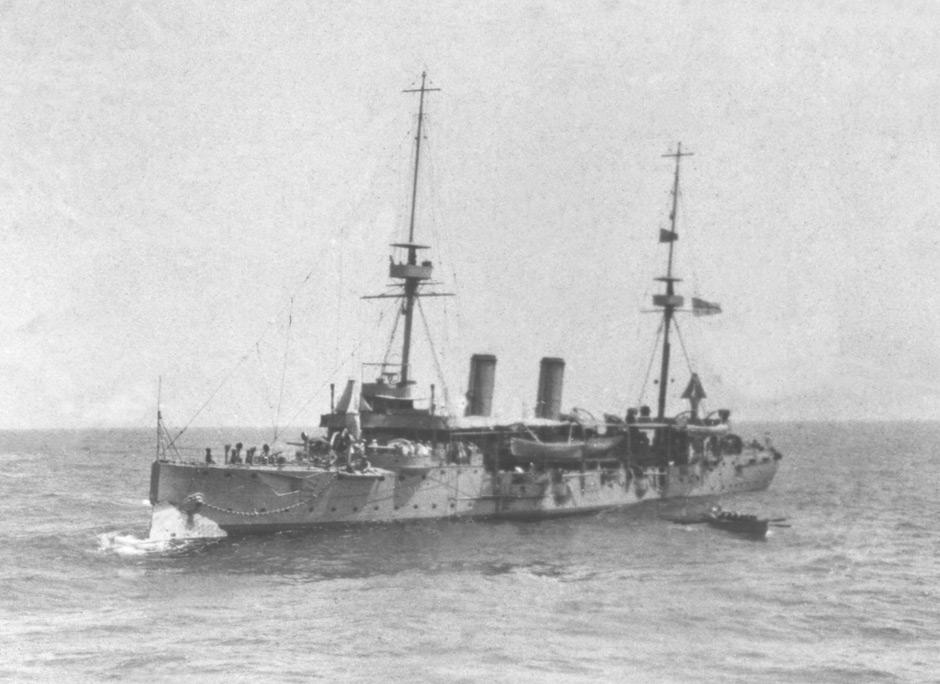
It was at this time that the New Zealand government decided that they wanted greater control in local defence affairs. Unlike the Australian Government, which had established its own independent naval fighting force, the Royal Australian Navy, in 1911 (1903 effective). The New Zealand Government wanted to create a Division within the Royal Navy, meaning they fell under NZ operational control during peace, but Admiralty operational control during times of war. This allowed the crew of the assigned vessels to be New Zealanders, paid by the New Zealand Government, to be used for New Zealand’s own local defence. At the time, this Division was called the ‘New Zealand Force’.
As the NZ Government felt it needed a sea-going training vessel to help train future recruits. It was chosen that HMS Philomel was to be recommissioned to fill this need, as at that time, although she was severely outdated, she was still seagoing and her boilers were in good condition. As such HMS Philomel became the first New Zealand Navy ship.
She recommissioned in October 1913 at Singapore, sailing for Wellington Habour, being handed over to the NZ government in early 1914. This period of NZ control would not last for long, as on the first day of her Shakedown cruise she would have to return to Wellington early to prepare for war.
Upon the declaration of the First World War, it was decided that NZ would have to occupy German Samoa, as troopships for this invasion had already been acquired, only an escort was needed. For this task, New Zealand’s cruiser, HMS Philomel, as well as Australia’s HMAS Pysche and Pyramus were selected. The Samoan Expeditionary Force landed on the 30th of August 1914, with the German garrison choosing not to resist.
Upon returning from Samoa, Philomel joined the escort for the New Zealand Expeditionary Force. She remained part of this escort until Western Australia, where she independently sailed to Singapore, then on to the Middle East. In early 1915 she was operating in the eastern Mediterranean, where one of her shore parties suffered the first NZ Naval rating killed in action. By mid 1915, she was patrolling around Aden, patrolling for arms smugglers, and landing parties to defend the port against the Turks. Three men during this time died of heatstroke while returning to Aden.
By late 1915, she was patrolling the Persian Gulf, where she would remain until late 1916, by which point she was severely worn out and in need of refit. However, as she was twenty-seven, this was seen as uneconomical, and she was to return to Wellington with only care and maintenance duties being done.
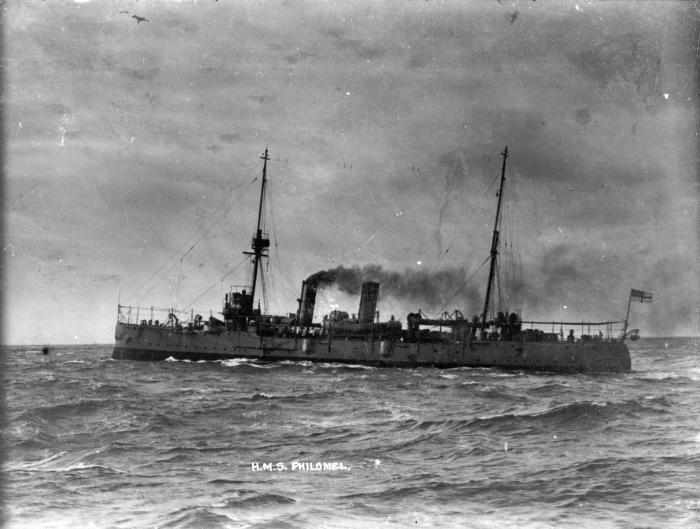
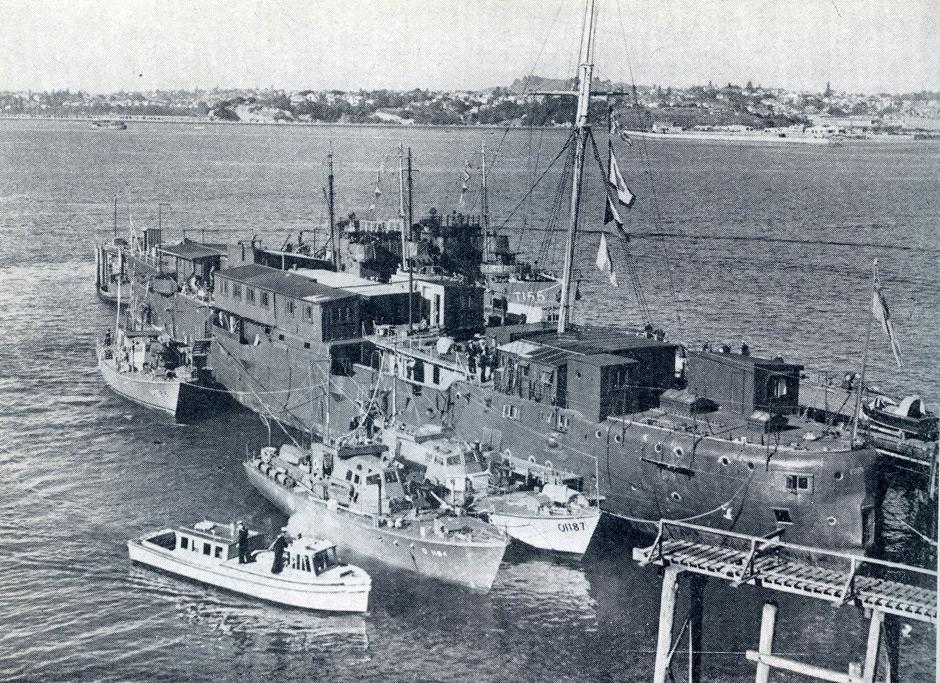
However, she would not be scrapped. Instead, she would become a training and depot ship in a supporting role to the rest of the NZ division. With the assistance of her replacement, HMS Chatham, she would move up to Auckland Naval Base Devonport. To make better use of her for training, her engines were stripped in early 1920 to make room for classes and her guns removed, replaced by a single 6", a single 4", and two single 12pdrs for training purposes.
Almost as soon as she was allocated for training, she was in the middle of a struggle between the Navy and the Government over an argument about where housing facilities should be located. The navy argued that Philomel did not provide enough room for all the trainees and that land facilities were also needed, but the government hesitated to expand land facilities due to cost. This argument took a few years for the government to concede, and some huts were built in ~1925 on what was to be called Monowai hill. These huts would only be replaced in 2000.
Upon the succession of the New Zealand Navy from division to the independent Royal New Zealand Navy in 1941, HMS Philomel became HMNZS Philomel to recognise this change. However, the fifty-one-year-old cruiser would be seen as outdated even for training, and most of the facilities were moved to the base, HMNZS Tamaki, as well as her mainmast. Philomel would not be sold until the end of the war in 1945.
Philomel was sold and on the 17th of January 1946, the White Ensign was hoisted upon the new base, HMNZS Philomel, located at her old mooring. It was named after the old cruiser in recognition of the fifty-six years of service that she had under her belt. During her time as a training vessel, Philomel trained the majority of NZ Naval service personnel during the interwar and Second World War periods.
After she was sold, she was moved to the Coromandel and stripped. Some of the wood stripped off her was used to create the coaster Coromel. In August 1949, her hulk was scuttled by 4kg of explosives off the Cuvier Islands at the entrance to the Hauraki Gulf.
In 2000, as part of major reform, HMNZS Tamaki was integrated into HMNZS Philomel, and as such Philomel was once again responsible for the training of the Royal New Zealand Navy.
| General Characteristics: | |||||
|---|---|---|---|---|---|
| Name: HMS Philomel | |||||
| Type: Protected Cruiser | |||||
| Class name: Pearl | |||||
| Year of commission: 1890 | |||||
| Refit: 1914 | |||||
| ----------------------------------------------------------------------------------------------------------------------------------------- | |||||
| Dimensions: | |||||
| Length: 278ft ( 84.7m) | |||||
| Beam: 41ft (12,8m) | |||||
| Draught: 16ft 1in (4.9m) | |||||
| Displacement: 2,575 | |||||
| ----------------------------------------------------------------------------------------------------------------------------------------- | |||||
| Propulsion: | |||||
| Powerplant: Coal fired reciprocating steam engines, driving two shafts @ 4,000ihp | |||||
| Speed: 19kt | |||||
| Endurance: unknown | |||||
| ----------------------------------------------------------------------------------------------------------------------------------------- | |||||
| Armament & sensors: | |||||
| Compliment: 217 | |||||
| Primary armament: 8x1 QF 4.7-inch Mk.III | |||||
| Secondary armament: 8x1 QF 3pdr | |||||
| Tertiary armament: 4x1 .303 Vickers, 2x14" torpedoes | |||||
| Sensors:nil | |||||
| ----------------------------------------------------------------------------------------------------------------------------------------- | |||||
| Armour: | |||||
| Deck: 1-2" (50.8-25.4mm) | |||||
| Gun turrets: 1" (25.4mm) |

Sources
https://nzhistory.govt.nz/war/hms-philomel
HMS Philomel - Pearl-class Cruiser — National Museum of the Royal New Zealand Navy
https://navyhistory.au/hmnzs-philomel/
HMS Philomel (1890) - Wikipedia
https://www.aucklandmuseum.com/war-memorial/online-cenotaph/features/the-birth-of-the-royal-new-zealand-navy
Gillett, R. (1983). Australian and New Zealand Warships 1914-1945 (pp. 274–275, 308)
McDougall, R. J. (1989). New Zealand Naval Vessels (pp. 11–13)
Thompson, C. H. (1923). The War Effort of New Zealand (pp.63-87)
Wynd, M. (2001). Small Steps from Empire to Independence: The Royal New Zealand Navy, 1910-2010 (pp. 106–110).