- Yes - In the Tech Tree.
- Yes - Event/BP.
- Yes - Premium.
- No - I would not like to see HMNZS Taranaki in game.
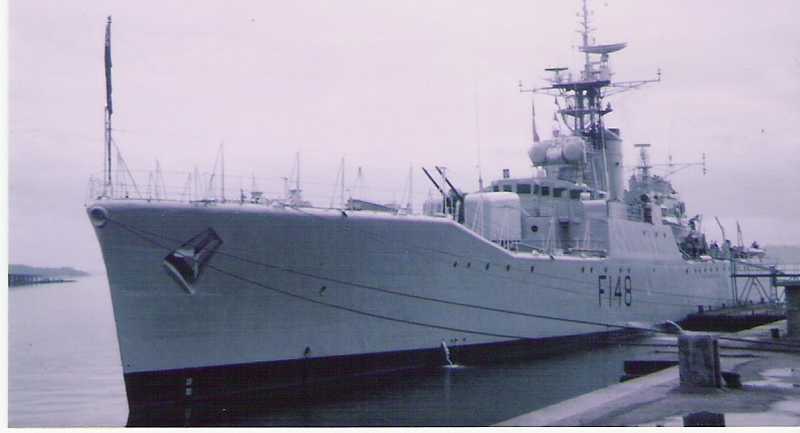
Description:
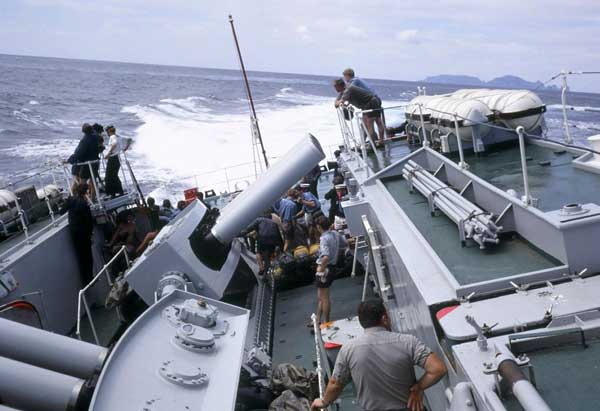
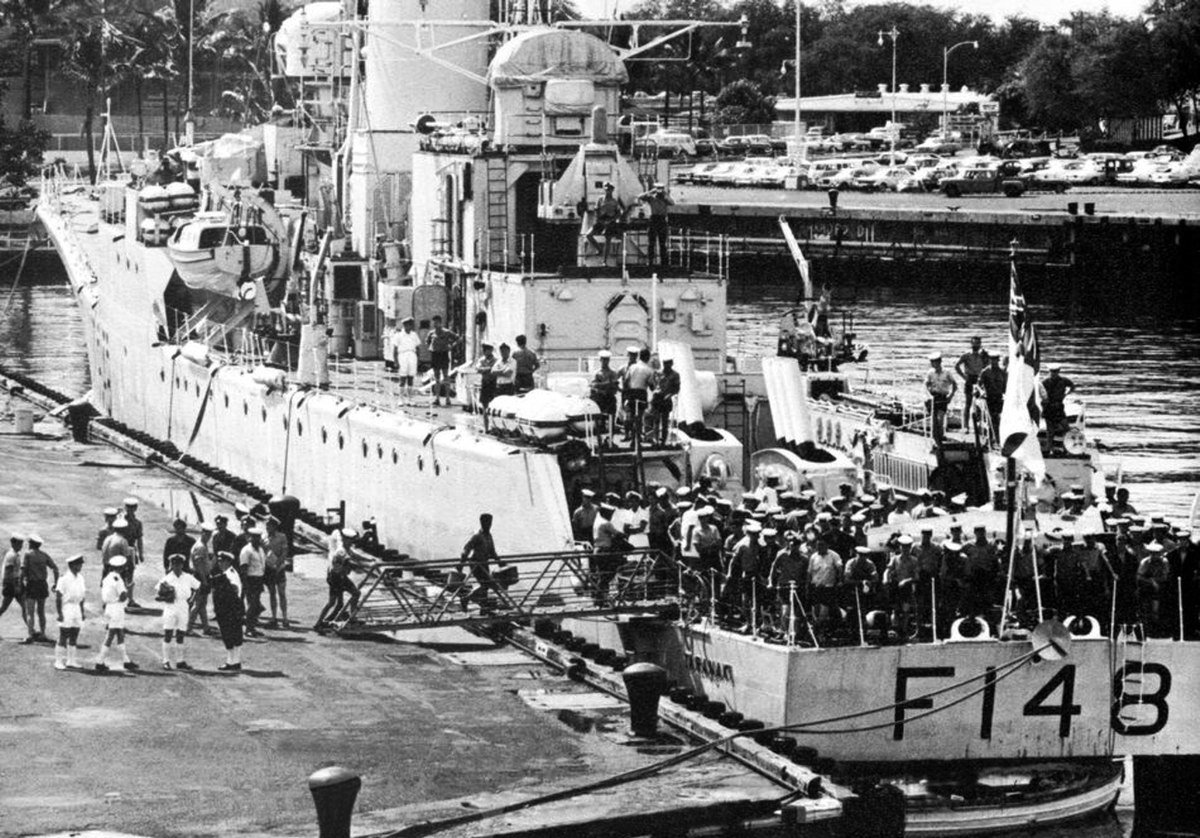
HMNZS Taranaki was the second Otago-class Frigate built for the RNZN. She and her sister, Otago, were built to a modified Rothesay-class (Type 12M) standard, specific for RNZN service. She would serve the RNZN’s Cold War fleet, mostly serving as fleet escort and fisheries protection.
Following the naming protocol for other RNZN frigates, she was named after the Taranaki area of the North Island of New Zealand. This suggestion is for her 1970 mid-life refit.
History:
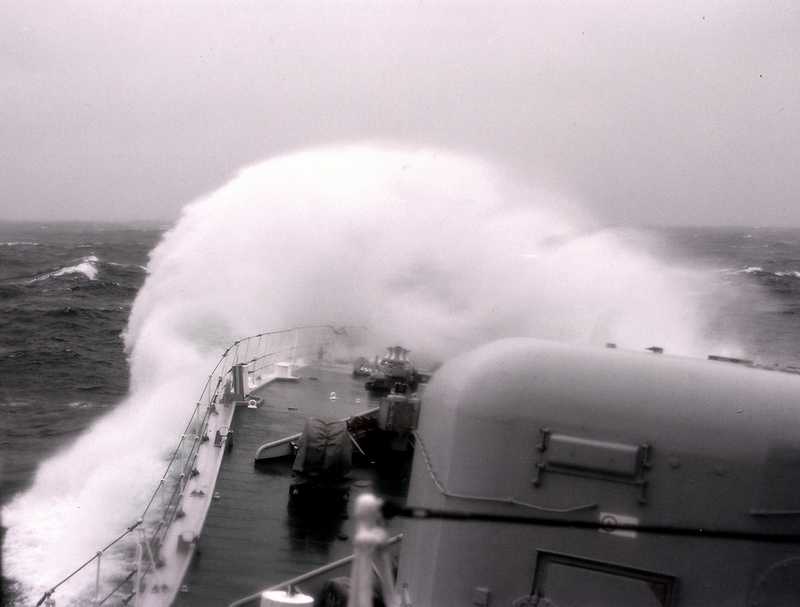
By 1957, the RNZN’s six Loch-class frigates were starting to show their age, and as such, a pair of modern frigates were to replace them. The Royal Navies Rothesay-class (Type 12M) was chosen for this purpose. To speed up acquisition, HMS Hastings, then being built, was purchased and renamed Otago. To better suit NZ needs, her living quarters and internal layout were heavily modified. The revisions from the standard RN Rothesay-class led to the NZ ships being called the Otago-class. A new ship was ordered to this revised specification, this being Taranaki.
HMNZS Taranaki was laid down on the 27th June 1958 by J. Samuel White & Co, at Cowes, England. She was launched on the 19th August 1959 by Lady Freyberg. Completing on the 28th of March 1961, commissioning the next day. However, she immediately had to go back into dry dock for repairs to her machinery, which had been damaged during the working up.
By July, she was repaired, and took part in ASW exercises with the Royal Navy and Royal Netherlands Navy in both British and Irish waters. She departed for New Zealand on the 28th of August, carrying out exercises with the US navy off San Diego and Hawaii on route. Arriving in New Plymouth on the 28th of October, then moving on to HMNZS Philomel by the 2nd of November.
She was present off Waitangi with Governor General Lord Cobham, and First Sea Lord Admiral Sir Casper John for the 1962 Waitangi day celebrations, when on her way back to Auckland, she passed through the 500m gap between Cape Brett and Piercy Island at 25kt. Later she was sent to Wellington, searching for a missing Ketch in the Cook Strait.
From March 1962 until March 1963, she visited many Pacific nations, including Australia, Singapore, Hong Kong, and Japan. While sailing, she participated in many exercises with the RAN, RN, and USN units in these areas. Participating in exercises; LONGEX, RAWFISH, FOTEX 62, AWKWARD, and DINKUM One, Two, Three and Four. Arriving home at HMNZS Philomel on the 1st of April 1963.
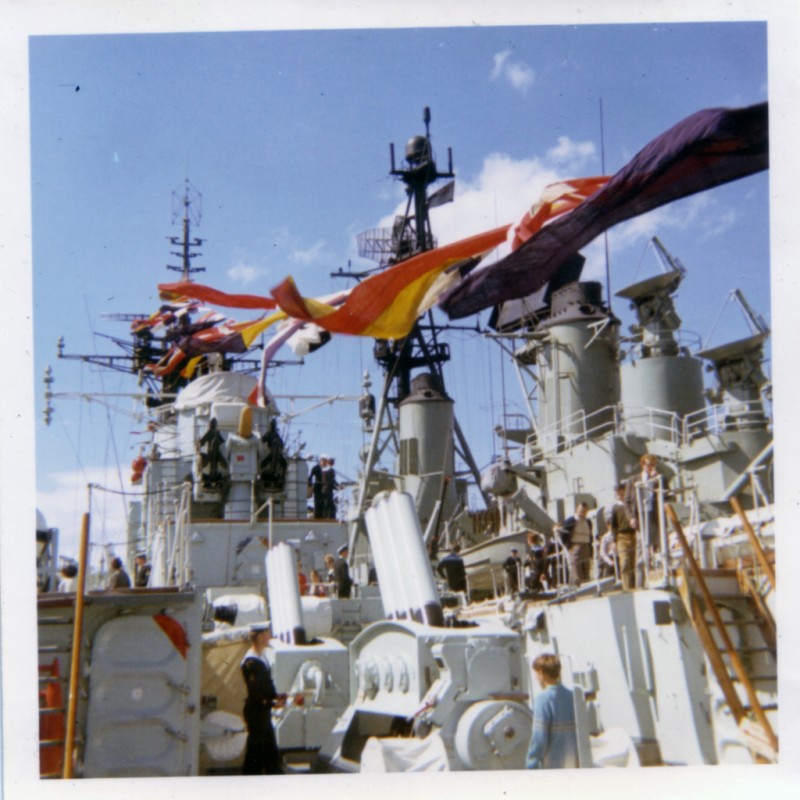
This is when her first major modification was made, replacing the single 40mm Bofors she had completed with, with a quad Sea-Cat missile system and its associated systems. This gave her the title of the first RNZN ship to fit a missile system. The first test firings of this missile were completed in September 1963. Upon the completion of which she set out for another Far East deployment.
She visited Pearl Harbour via Suva. However, during her US visit she had to return to Suva to help the grounded HMS Cook. Once this was complete, she returned to exercise with the US navy at Pearl Harbour from October through to November. In December, she visited Guam for repairs after a collision with a fuel lighter. These ended quickly, and she was in Hong Kong for Christmas, departing in January 1964 for Singapore, where she would be fitted with a new radar. She would continue in the Pacific until returning home in 1968.
Upon returning, she received a major mid-life refit, replacing the worn out boilers, removing the old 21" heavy torpedo tubes for six twin 12.75" ASW tubes, adding two single 20mm Oerlikon mounts, and had her internal arrangement changed again to accommodate 240 personnel instead of the 219 she commissioned with. This refit would be completed in mid 1969.
She returned to service and continued her Pacific voyages. However, she was laid up in 1974 through to 1977, due to manning shortages. This resulted in a significant deterioration of her systems. With NZ’s EEZ expanding to 200 miles in 1978, both Otago-class frigates were to be refitted for fisheries protection as to protect the significantly larger area the Navy now had to patrol.
This saw the removal of Taranaki’s Sea-Cat system, to repair and provide spares for Otago’s mount. It was replaced by a twin 40mm Bofors gun. The Limbo mortar system and the height finding radar were also removed. She however regained the two single 20mm Oerlikon mounts, which had been removed in 1971.
In 1980, it was planned to replace her twin 4.5" guns with a single 76mm OTO Merlara and associated fire control equipment, add a helicopter deck and hangar for a single Wasp Helicopter, (hence the plating over of the Limbo mortars), and finally to replace her worn steam machinery with new gas turbines. The Navy, however, refused to switch guns, but were stuck with fire control equipment for the OTO gun. The whole program would be canned in 1981 with no reconstruction work being done, due to an extreme cost of NZ£ 72 million compared to the cost of two ex-RN broad beam Leander-class frigates (Type 12I). These were the HMS Dido and Bacchante.
By 1982 the Dido and Bacchante’s sale had been confirmed and Taranaki was decommissioned. She was sold to Pacific Steel Ldt in August 1987 and finished breaking up in March 1988
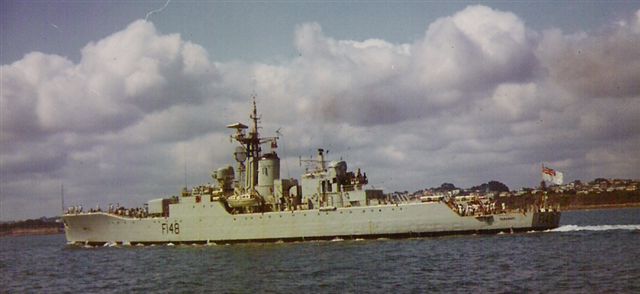
| General Characteristics: | |||||
|---|---|---|---|---|---|
| Name: HMNZS Taranaki | |||||
| Country: New Zealand | |||||
| Type: Frigate | |||||
| Class name: Otago | |||||
| Year of commission: 1961 | |||||
| Refit: 1974 | |||||
| ----------------------------------------------------------------------------------------------------------------------------------------- | |||||
| Dimensions: | |||||
| Length: 367 ft (112m) | |||||
| Beam: 39 ft (12m) | |||||
| Draught:16 ft (5m) | |||||
| Displacement: 2,557t | |||||
| ----------------------------------------------------------------------------------------------------------------------------------------- | |||||
| Propulsion: | |||||
| Powerplant: 2x oil fired double reduction geared steam turbines @ 15,000 hp (11185 kW) overall | |||||
| Speed: 30kt | |||||
| Endurance: 5,200 nmi @ 12kt | |||||
| ----------------------------------------------------------------------------------------------------------------------------------------- | |||||
| Armament & sensors: | |||||
| Compliment: 240 | |||||
| Primary armament: 1x2 QF 4.5-inch L45 on mount Mk 6 | |||||
| Secondary armament: 1x4 Sea-Cat GWS-20, 2x1 20mm Oerlikon | |||||
| Tertiary armament:2x3 12.75" ASW Mk.44 Torpedoes, 2x3 Limbo ASW Mortar | |||||
| Sensors: Type 193Q Surface/Air search radar, Type 277 height finding radar | |||||
| Type 162 target classification sonar, Type 170 attack sonar, Type 275 radar fire control | |||||
| Type 174 search sonar, Type 974 nav radar |
Sources
HMNZS Taranaki - Wikipedia
HMNZS Taranaki — National Museum of the Royal New Zealand Navy
https://ndhadeliver.natlib.govt.nz/webarchive/20100406195430/http://www.hmnzstaranaki.org/
https://archive.today/20130414232830/http://www.hmnzstaranaki.org/
https://nzhistory.govt.nz/war/royal-new-zealand-navy/post-war-operations
McDougall, R. J. (1989). New Zealand Naval Vessels (pp. 41-44)
Marriott, Leo (1983). Royal Navy Frigates 1948-1983 (pp. 55-64)