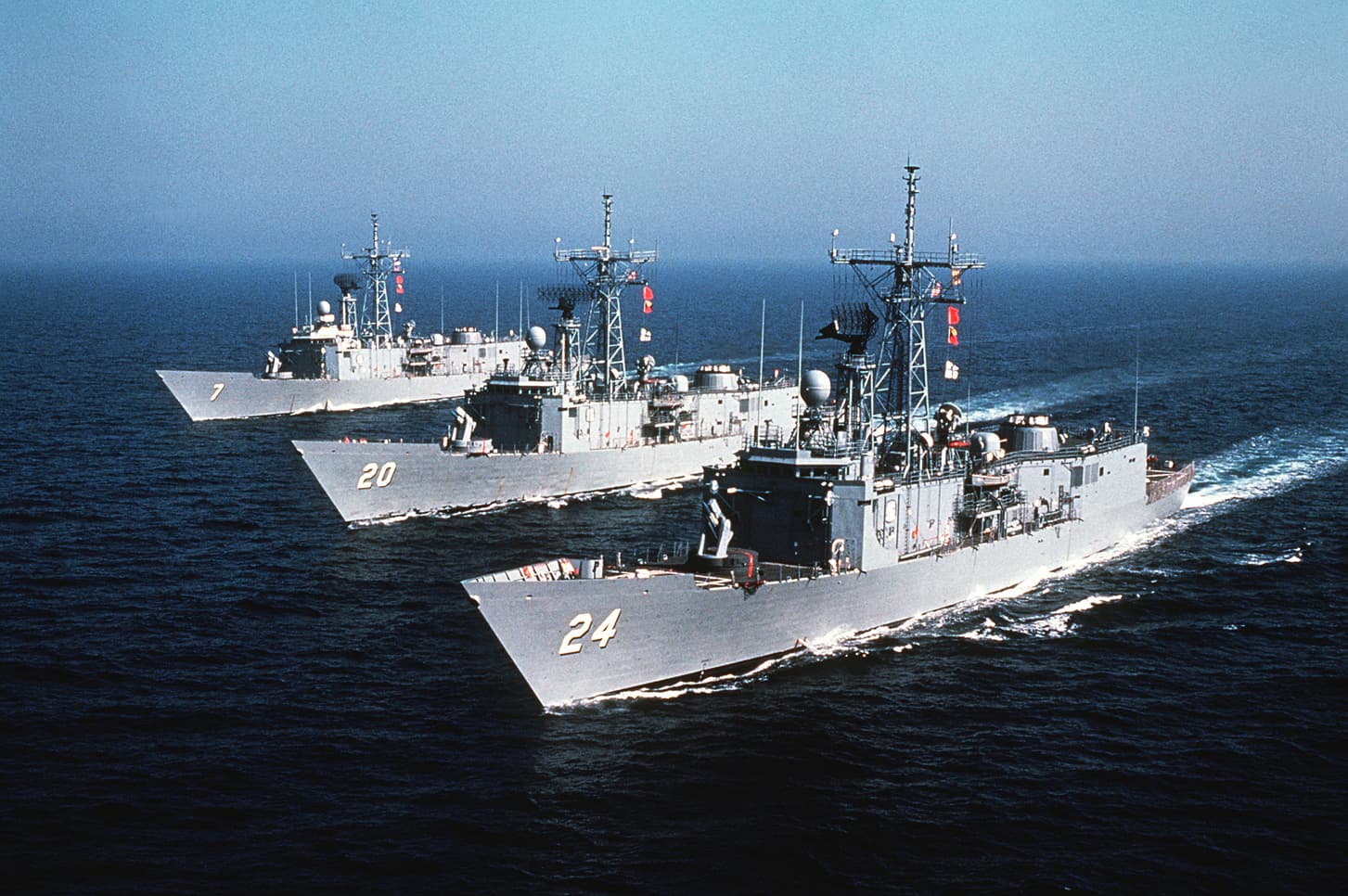
Description
Background
The US Navy guided missile frigate USS Oliver Hazard Perry (FFG-7) underway during trials in late 1977
The Oliver Hazard Perry class was designed and introduced during the 1970s and entered service beginning in the late 1970s and early 1980s. The class was intended to replace the aging Knox-class frigates and numerous World War II-era destroyers that remained in service with the US Navy. The ships were named after Commodore Oliver Hazard Perry (1785–1819), best known for leading the American victory over the Royal Navy during the Battle of Lake Erie on September 10, 1813.
The Perry-class frigates were conceived as low-cost, general-purpose escort vessels that could be produced in large numbers. They were designed to complement the larger and more expensive Spruance-class destroyers. Their primary missions were anti-submarine warfare (ASW) and anti-air warfare (AAW), providing open-ocean escort for amphibious task forces, carrier groups, and merchant convoys.
Schematics of the “long-hull” design
The class was initially built as short-hull (Flight I) ships measuring 445 feet (136 m) in length and later as long-hull (Flight III) ships measuring 453 feet (138 m). The lead ship, USS Oliver Hazard Perry (FFG-7), was commissioned on December 17, 1977, while the first long-hull example, USS McInerney (FFG-8), entered service shortly afterward.
A total of 51 Oliver Hazard Perry-class frigates were constructed for the US Navy, consisting of 21 short-hull and 30 long-hull vessels. Their superstructures were built primarily from aluminum to reduce weight and construction costs. However, this later led to structural cracking issues on several ships, some of which were severe before corrective measures were implemented.
Short-hull ships operated two SH-2F Seasprite helicopters as part of the LAMPS I program, while long-hull ships were equipped with two larger and more capable SH-60B Seahawk helicopters under the LAMPS III program.
Oliver Hazard Perry-class frigates made worldwide news during the 1980s, when most ships went on to serve with the US Navy fleet. They would see some significant actions primarily in the Middle East.
Scheme of the combat systems of the Oliver Hazard Perry-class frigate
At the heart of the Perry-class was the Mk 92 Guided Missile Fire Control System, integrating the AN/SPS-49 air-search radar, AN/SPS-55 surface-search radar, AN/SLQ-32(V) electronic warfare suite, and AN/SQQ-89 undersea warfare combat system. Together, these systems allowed the frigate to detect, track, and engage multiple air, surface, and subsurface threats simultaneously.
The Oliver Hazard Perry class gained worldwide recognition during the 1980s as one of the most active classes of warships in the US Navy. Perry-class frigates participated extensively in operations throughout the Middle East, including convoy escort missions during the Iran-Iraq War and subsequent operations in the Persian Gulf.
Because these frigates were designed to be compact, economical, and durable, there was unfortunately little room for future growth and modernization. The US Navy managed to implement several meaningful upgrades throughout their service lives. These included upgrading the Phalanx CIWS to the Block 1B standard and introducing the Mk 53 Nulka Decoy Launching System, an active off-board countermeasure that proved more effective than traditional SRBOC (Super Rapid Blooming Offboard Chaff) and flare systems.
During the mid-2000s, most frigates had their Mk 13 single-arm missile launchers and associated magazines removed, as the system had become increasingly obsolete and costly to maintain. This also eliminated the ships’ ability to fire RGM-84 Harpoon anti-ship missiles. To partially compensate for this loss, the SH-60B Seahawk helicopters aboard long-hull ships were equipped to carry AGM-119 Penguin and AGM-114 Hellfire anti-ship missiles.
USS Ford (FFG-54) with Mk 38 Mod 2 MGS
The final nine ships of the class received a Mk 38 Mod 2 25 mm Machine Gun System, mounted on a platform above the former Mk 13 magazine space. As a result, the class effectively lost its area air-defense capability. With limited room for further upgrades and increasing maintenance costs, the Navy began retiring the Perry-class frigates in the late 1990s. The last ship in active US Navy service, USS Simpson (FFG-56), was decommissioned on September 29, 2015.
Many retired vessels were placed in reserve fleets, while others were transferred to allied navies, including those of Australia, Turkey, Taiwan, and Poland. Several were also expended as live-fire targets during weapons testing exercises.
Propulsion
The LM2500 engine is typically installed within a metal enclosure to isolate sound and thermal from personnel and adjacent machinery spaces
As designed, the OHP-class frigate was powered by two gas-turbine General Electric LM2500 engines. These engines powered one shaft and one propeller, providing the ship with a total of 41,000 shp and a top speed of 30 knots. The LM2500 propulsion system was so reliable and successful that it was also used on the earlier Spruance-class and Arleigh Burke-class destroyers and Ticonderoga-class cruisers and has remained in service on most subsequent US warships through later iterations of the LM2500 family.
Mark 92 Guided Missile Fire Control System & Sensors
Modern Naval Combat by David Miller and Chris Miller, published in 1986
As built, each Oliver Hazard Perry-class frigate was equipped with the long-range AN/SPS-49 two-dimensional air-search radar. Surface-search and navigation duties were handled by the AN/SPS-55 radar. Electronic warfare capabilities were provided by the AN/SLQ-32 electronic warfare suite, which could detect, identify, and provide warning of hostile radar emissions and targeting systems.
Mk 92 Mod 2 Functional Diagram
For anti-submarine warfare, the ships carried an AN/SQS-56 hull-mounted sonar installed in the bow below the waterline. Operating in both active and passive modes, it served as a primary sensor for submarine detection and weapon guidance. The frigates could also employ the AN/SQR-19 Tactical Towed Array Sonar (TACTAS), which significantly enhanced long-range passive submarine detection capability.
Left: Cross-section of a Mk 92’s Combined Antenna System. Right: Mk 92 STIR Illumination Radar.
The centerpiece of the combat system was the Mk 92 Guided Missile Fire Control System, which utilized a set of its own sensors collectively known as the Combined Antenna System (CAS). The CAS housed both a track-while-scan search radar and a dedicated tracking radar within its distinctive egg-shaped radome. An external Separate Target Illumination Radar (STIR) was mounted externally and provided target illumination for missile engagements. Together, these systems provided one gun engagement channel, two missile engagement channels, and multiple surface-search and track-while-scan functions.
Armament
A Mark 13 GMLS seen launching RIM-66 Standard missile from a US Navy Oliver Hazard Perry class frigate (US Navy)
The primary armament of the class was the Mk 13 Guided Missile Launching System, a single-arm launcher fed by a 40-round magazine. Typical loadouts consisted of 36 SM-1MR Standard surface-to-air missiles and 4 RGM-84 Harpoon anti-ship missiles. The launcher could engage both air and surface targets and had a firing rate of approximately one missile every eight seconds. On late-service frigates, the Mk 13 launcher was removed and replaced with the Mk 38 Mod 2 25 mm gun system.
76 mm (3") Mark 75 aboard USS Curts (FFG-38) in July 2003 (US Navy)
The frigate’s secondary armament consisted of the Mk 75 76 mm/62-caliber gun, an American-produced version of the Italian OTO Melara 76 mm naval gun. Mounted forward of the superstructure, it could fire high-explosive and proximity-fuzed ammunition at a rate of up to 85 rounds per minute.
CIWS aboard USS Taylor (FFG 50) “in action”
Close-in defense was provided by a 20 mm Phalanx CIWS mounted aft. It was a last line of defense against anti-ship missiles and aircraft, and the system was later upgraded to the Block 1B standard, improving its effectiveness against both air and surface threats.
Mk 32 triple torpedo tubes aboard USS John L. Hall (FFG 32)
Anti-submarine armament included two triple Mk 32 torpedo tube launchers mounted amidships, one on each side of the vessel. These launchers fired Mk 46 or later Mk 50 lightweight torpedoes, and the ship carried up to 24 torpedoes in total.
Left: SH-2G Super Seasprite onbard USS Copeland (FFG-25), September 18, 1990. Right: SH-60B Seahawk onbard USS Copeland (FFG-25), September 18, 1990
Short-hull frigates were equipped with the LAMPS I system and operated two SH-2F Seasprite helicopters for anti-submarine warfare. Long-hull frigates utilized the more advanced LAMPS III system with two SH-60B Seahawk helicopters. These aircraft were housed in onboard hangars and could deploy torpedoes, sonobuoys, and other sensors to locate and track submarines. The Seahawk also possessed an anti-surface warfare capability through the carriage of AGM-119 Penguin and AGM-114 Hellfire missiles.
Countermeasures
Left: Mk 36 SRBOC firing a chaff decoy from Flight I USS Stout (DDG-55), April 7, 2016. Right: Mk 53 launching system firing a Nulka decoy from Flight IIA USS Dewey (DDG-105), July 11, 2018.
For countermeasures, the ships were equipped with Mk 36 SRBOC chaff decoy launchers, used to defend against anti-ship missiles by generating false targets and disrupting enemy guidance systems. The frigates typically carried between four launchers, each with six 130 mm tubes arranged in two rows at 45 and 60 degrees to disperse decoys at 75 m/s. Through modernization, the Mk 53 Decoy Launching System was added in place of the Mk 36 SRBOC, incorporating up to six Nulka launchers used alongside the Mk 36 system. The Nulka decoy emits a large radar signature while flying a programmed trajectory to lure incoming missiles away, with a flight duration of approximately 10 minutes.
AN/SQL-25 Torpedo Protection Concept.
The Torpedo Countermeasures Transmitting Set AN/SLQ-25, known as Nixie, was a towed decoy system used to confuse and divert acoustic- and wake-homing torpedoes by emitting simulated ship noise, drawing threats away from the vessel.