- Yes
- No
 OKB-1 EF 131 - A Soviet Supervised Prototype
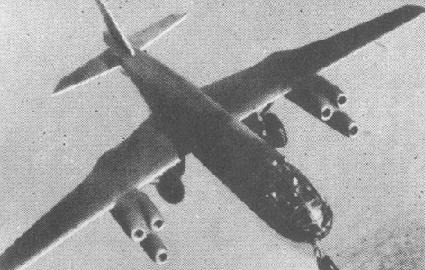
OKB-1 EF 131 during flight testing over Ramenskoye
History
The aircraft that became the EF-131 began life in Germany during the final years of World War II. In 1943, Junkers designer Dr. Hans Wocke proposed an experimental jet bomber featuring forward-swept wings (FSW). Sweeping wings forward by 23 degrees solved a major aerodynamic problem of early jet flight: it delayed shockwave formation at high subsonic speeds while ensuring that airflow traveled inward toward the fuselage rather than outward toward the wingtips. This preserved full aileron control near stall speeds and allowed the heavy wing spar to pass through the airframe behind the bomb bay rather than through it, freeing up internal volume for ordnance.
Junkers built a crude technology demonstrator, the Ju 287 V1, which flew in August 1944. Assembled from salvaged parts including a Heinkel He 177 fuselage, Junkers Ju 388 tail, and fixed landing gear taken from captured American B-24 Liberators it proved that forward-swept wings could fly successfully. Work immediately began on two operational prototypes, the Ju 287 V2 and V3, which were designed to carry six Junkers Jumo 004 turbojets. However, Allied bombing and fuel shortages halted development before either aircraft could take to the air.
Soviet Capture and OKB-1
In April 1945, advancing Red Army forces captured the Junkers factory at Dessau, seizing intact subassemblies, tooling, design documentation, and senior technical staff. Recognizing the value of German high-speed flight data, Soviet aviation commissars ordered the captured engineers to rebuild the Ju 287 project under NKVD oversight.
The Junkers team, now led by Dr. Brunolf Baade, reorganized the design under the project designation Entwicklungsflugzeug 131 (Development Aircraft 131, or EF-131). The Soviet military required major modifications to the original design:
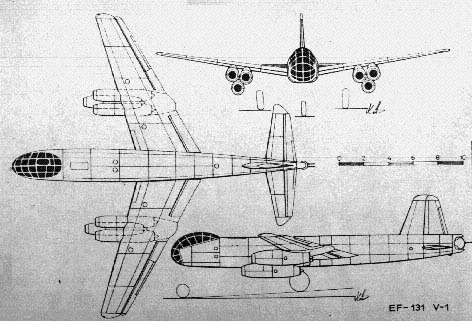
- All six Jumo 004B turbojets were moved from the forward fuselage into two massive triple-engine pods mounted under each wing to clean up airflow along the fuselage and make room for radar and optical bomb sights.
- A pressurized crew cabin was built for three aircrew (pilot, co-pilot/bombardier, and radio operator/gunner).
- A remotely operated tail barbette mounting twin 13 mm MG 131 machine guns was integrated for rearward defense.
Flight Testing at Ramenskoye
By early 1947, the first flight-ready EF-131 prototype was completed at Podberezye. Because the airfield at Podberezye was too short for a heavy jet bomber, the aircraft was disassembled, shipped by barge and rail to the Gromov Flight Research Institute (LII) at Ramenskoye airfield near Zhukovsky, and reassembled.
On May 23, 1947, German test pilot Paul Julge took the EF-131 on its maiden flight. Over the next year, the aircraft completed 15 test flights, reaching top speeds around 860 km/h (534 mph). While pilot feedback praised the low-speed handling and landing characteristics, severe structural and aerodynamic defects quickly emerged:
- Aeroelastic Divergence: At high speeds, aerodynamic lift twisted the leading edges of the forward-swept wings upward. Without modern composite materials to provide directional stiffness, the aluminum wing structure flexed violently under load, threatening structural failure.
- Tail Buffeting: The large triple-engine pods generated severe wake turbulence and shockwaves that battered the rear fuselage and horizontal tail surfaces, causing severe vibration and skin cracking.
- Obsolete Powerplants: The Jumo 004 turbojets (and their Soviet copy, the RD-10) were unreliable, short-lived, and underpowered for a 23-ton aircraft.
Evolution Across Variants
- Ju 287 V1 (Wartime German Testbed): 4 engines - two mounted on the sides of the forward fuselage and two under the wings in individual nacelles.
- Ju 287 V2 (Unfinished German Prototype): 6 engines - designed as the near-production prototype intended to evaluate full six-engine power. It moved to a 6 x Jumo 004B configuration arranged into two triple underwing pods. It was roughly 80-90% complete at Dessau/Brandis when destroyed by retreating German forces; its surviving wing and tail assemblies were salvaged by Soviet forces to build the EF 131.
- OKB-1 EF 131 (Soviet-Supervised Prototype): 6 engines - all six engines were moved beneath the wings in triple pods to clean up airflow along the fuselage sides and make room for nose avionics.
- OKB-1 140 / EF 140 (Follow-on Soviet Design): 2 engines - replaced the low-thrust six-engine cluster with two high-thrust Mikulin AM-TKrd-01 turbojets mounted in individual underwing nacelles.
Cancellation
Testing was suspended during the harsh winter of 1947–1948. By the time weather cleared in mid-1948, rapid advancements in Soviet jet propulsion had rendered the EF-131 obsolete. The Soviet Union had successfully acquired and reverse-engineered British Rolls-Royce Nene and Derwent centrifugal turbojets (producing the RD-45 and Klimov VK-1 engines), whichyielded far higher thrust than the German axial Jumo 004s.
Furthermore, Soviet aerodynamicists at TsAGI concluded that conventional swept-back wings offered high subsonic performance without the dangerous structural twisting inherent to metal forward-swept wings.
On August 23, 1948, the Soviet Council of Ministers issued Decree 3206-1301, officially cancelling the EF-131 program. The partially built second prototype was broken down, and its structural components were repurposed for the swept-wing OKB-1 140 bomber testbed.
Specifications
General Characteristics
- Design Bureau: OKB-1 in Podberezye, USSR
- Lead Designers: Dr. Brunolf Baade and former Junkers engineering team
- Crew: 3 Pilot, Co-pilot / Bombardier, Radio Operator / Gunner
- Length: 20.47 meters / 67.1 feet
- Wingspan: 19.40 meters / 63.6 feet
- Height: 5.70 meters / 18.7 feet
- Wing Design: 23 degree forward sweep
- Empty Weight: 11,900 kg / 26,235 lbs
- Max Takeoff Weight: 22,955 kg / 50,607 lbs
Powerplant
- Engines: 6 Junkers Jumo 004B or Soviet RD-10 axial-flow turbojets
- Engine Placement: 2 underwing triple pods with 3 engines grouped per side
- Engine Thrust: 8.83 kN / 1,985 lbf per engine
- Total Thrust: 53 kN / 11,910 lbf combined static thrust
- Top Speed: 860 km/h / 534 mph at altitude
- Service Ceiling: 12,500 meters / 41,000 feet
- Maximum Range: 1,710 km / 1,063 miles
Armament and Payload
- Tail Defense: 2x 13mm MG 131 machine guns in a remotely operated rear turret
- Bomb Payload: Up to 2,000 kg / 4,410 lbs of conventional bombs in an internal bomb bay
- x8 FAB-250
- x4 FAB-500
- x2 FAB-1000
- x8 SC / SD 250
- x4 SC / SD 500
- x2 SC 1000 / SD 1000 (“Hermann”)
- x1 PC 1400 / SD 1400
The OKB-1 EF 131 was designed around an internal bomb bay located in the central fuselage. Because the project originated from the German Junkers Ju 287 V3 and was later constructed and tested in the Soviet Union (at Podberezye / OKB-1), its bomb capacity and loadout specs reflect both its German design roots and Soviet flight-testing requirements.
Spoiler
Early Soviet Jet Bombers by Yefim Gordon (Midland Publishing, 2004)
Junkers Ju 287: The World’s First Swept-Wing Jet Aircraft by Horst Lommel (Schiffer Publishing, 2004)
The Osprey Encyclopaedia of Russian Aircraft 1875–1995 by Bill Gunston (Osprey, 1995)
OKB-1 EF 131 - Wikipedia
OKB-1 EF-131 Jet-Powered Tactical Bomber Prototype
OKB-1 EF 131 - WarHistory.org
https://www.secretprojects.co.uk/threads/okb-1-military-aircraft-and-projects.21769/