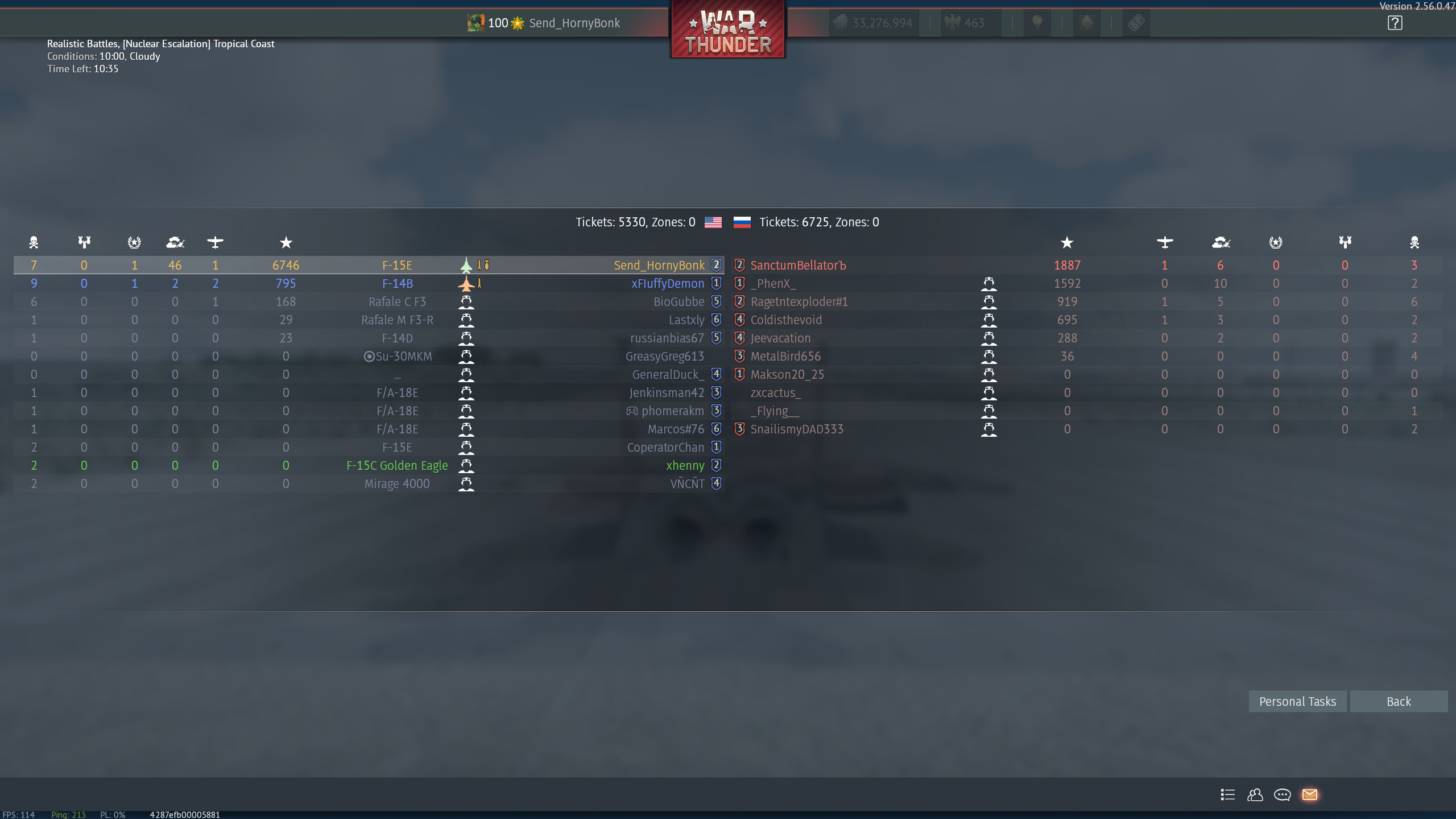
SPAAs in War Thunder’s Nuclear Escalation mode are currently operating at a level that makes meaningful air gameplay almost impossible, and it comes down to two core issues.
1. Engagement Through Multipathing
Multipathing is a core defensive mechanic in War Thunder — flying low to exploit ground interference and cause radar-guided missiles to lose tracking. It exists in the game to give aircraft a fighting chance against high-tier SAM systems. Top-tier SACLOS-guided systems like the Pantsir are already considered stronger than many ARH counterparts in standard gameplay, and in Nuclear Escalation this problem is dramatically amplified. SPAAs are able to score hits on aircraft that are actively multipathing, stripping away one of the only reliable defensive tools available to pilots. This fundamentally breaks the intended counterplay.
2. Near-Perfect Munition Interception
SPAAs in this mode intercept incoming ordnance with a consistency that goes far beyond what balanced gameplay should allow. Whether you’re dropping bombs, firing AGMs, or employing standoff weapons, the SPAA coverage is so comprehensive that it neutralises almost any approach vector. The anti-aircraft guns can engage players from up to 20 km away, leaving aircraft with virtually no viable attack window.
The Combined Effect
These two issues together create a lose-lose scenario for any air player engaging ground targets: you can’t fly low to multpath safely, and you can’t attack from range or altitude either. Following the recent reward nerf for player kills, this has made meaningful participation in the mode feel near-impossible for aircraft.
A reasonable fix would be to reduce SPAA engagement range, cap their interception rate against air-launched munitions, and ensure multipathing works as intended against them — the same way it does in standard matches. The mode should feel challenging, not impenetrable.
I’m a bit conflicted about this, but people would definitely farm more SL and RP if SPAA were weaker I also think a nerf is needed, because whenever you spawn a nuke plane, enemy aircraft and SPAAs start coming after you from every direction. There’s about a 90% chance you’ll either get taken out by a missile or end up hitting a tree, haha but there is have option for top tiers already 13.0+ has FOX-3 and means for top tier nuke battles not need strong SPAA bc already there is have missile spammer…
Through pure chance, I was able to get 3 consecutive nukes, however this was after the entire team had been pounding the same sector for an entire hour. Some level 100 players had 20 deaths, yet no kills. Do correct me if I am wrong, but can the "BUK"s datalink their missiles? After tossing 56 chaff for the missile to bite yet it still hit.
The SACLOS AA accuracy needs to be tuned down a bit…NOT so that they are not a threat though, also the AGM 88 and Kh31 not detecting certain radar bands that it says they can is a BIG problem atm. The iTO 90M is E band…Kh31 if it was working properly could shoot at them from 2X or 3X the iTOs range!!! Same with the AGM 88!
For the Eurofighter, we only get two HARMs (at least on the German version; I haven’t checked the others). That is not nearly enough to overwhelm most SPAAs. The Brimstones have the 14-20km (based on the situation). This makes it near impossible for a Eurofighter to defeat any kind of defences.
further on from that point because the HE filler of the BUK ignores multipath and also the BUKs for some reason launch at WAY longer ranges than their NATO counterpart
Still hard to get in 30km to use Aimming point but it is possible to rely on skills to approach BUK camp
when they no longer tracking u as soon as u spawn lol
Of course, this is quite difficult for casual players with such requirements (remember the map, perform quick maneuvers, notching, intercept incoming missiles, choose a route to avoid enemy positions, …) on the other hand, the RU side still comfortably destroys everything :/