History
The exact origins of the “Tiger IV” designation remain somewhat unclear, but it started somewhere in broader F-5 modernization efforts that began in the late 1980s.
To understand how the Tiger IV emerged, we must go back to 1964, when the F-5 formally entered service. Northrop achieved tremendous export success with the F-5A and later the F-5E/F variants, which served dozens of US allies as affordable, lightweight multirole fighters. Production officially ended in 1987.
By that time, however, the aircraft’s analog avionics were clearly outdated. The non-Doppler AN/APQ-159 radar in the F-5E was increasingly inadequate compared to modern pulse-Doppler systems entering service worldwide.
Meanwhile, Northrop had failed to secure production contracts for the F-20A Tigershark and the YF-23. With no major military contracts on the horizon, the company turned its attention toward modernizing the large global F-5 fleet still in service.
In 1989, Northrop partnered with Westinghouse to market an upgraded F-5 featuring the APG-66T radar, a smaller, lighter variant of the F-16’s APG-66 designed specifically for retrofit installations.
The APG-66T was advertised in July 1989 for the international retrofit market. However, there is no clear evidence that any operational F-5 fleet ultimately received the APG-66T. The radar instead found use in Taiwan’s AIDC AT-3 fighter trainer modernization program.
Regardless, the company recognized that many F-5 operators were transitioning to the F-16, so Northrop shifted focus toward transforming the F-5 into a cost-effective lead-in trainer.
Nearly half of the 26 F-5 operating nations also operated the F-16. Instead of pushing the more expensive F-20 Tigershark, Northrop devised a modular digital package that would streamline pilot transition from F-5 to F-16 by incorporating the F-16 avionics suite.
This modernization concept consisted of four levels of upgrades, applicable across F-5 variants and built around a standardized digital cockpit architecture. All configurations incorporated software derived from the F-20 Operational Flight Program and some degree of MIL-STD-1553B data bus integration.
Complete package included:
- Modified Westington APG-66 multi pulse-Doppler radar
- one or two multifunction displays
- GEC-Marconi HUD from the F-16
- Litton mission computer from the F-16.
- Honeywell H-423 ring laser gyro inertial navigation system (INS) used in some F-16 models.
- Mason Electric hands-on throttle and stick (HOTAS) controls modified from the McDonnell Douglas F/A-18.
Installing the APG-66 into the F-5 required meaningful structural changes. The radar antenna was reduced to roughly half its original area. The mounting bulkhead was moved aft approximately twenty inches to accommodate installation. The radome base was extended by about twenty inches to preserve aerodynamic stability.
To make space for the radar, the left M39 20 mm cannon had to be removed.
With the new radar installed and integrated into the HUD, the aircraft gained CCIP and CCRP capability, significantly improving strike accuracy and multirole performance compared to legacy F-5E systems.
Northrop marketed the four levels of the modular upgrade system at varying costs. A Level One configuration without radar was estimated between 1.5 and 2 million USD. The radar itself was estimated to add about 1 million USD to the total cost. A complete Level Four upgrade, including radar and a full digital cockpit conversion, was estimated at approximately 4 to 5 million USD.
Before receiving the full Level Four upgrade, operators were required to complete and certify a comprehensive structural inspection. This inspection was estimated to cost another 4 to 5 million USD per airframe, bringing the total projected cost for inspection and full modernization to approximately 8 to 10 million USD per aircraft.
At the time, around 1,100 F-5E/F aircraft and approximately 500 F-5A/B aircraft remained in service worldwide. Northrop projected that up to 500 E/F models and 250 earlier A/B models could receive modernization packages.
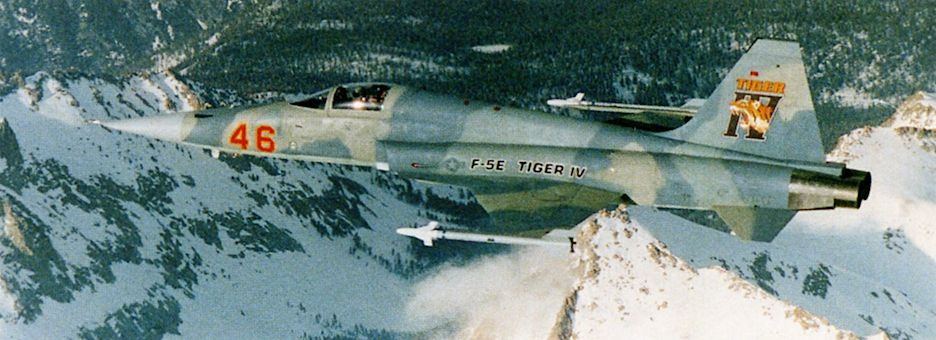
To validate those upgrades, Northrop obtained a US Navy-operated F-5E, Bureau Number 741568, formerly USAF serial number 74-1568 with construction number R.1261, on loan as part of a cooperative effort with the US Air Force and Navy. They would determine whether modern digital avionics can extend the life of F-5s in service worldwide. The US government expressed interest in seeing if F-5s flown by many of its allies can be upgraded with modern digital avionics.
The aircraft had previously served with the USAF 64th Aggressor Squadron and the 57th Tactical Fighter Wing at Nellis AFB. It was later transferred to the 527th Aggressor Squadron before being handed over to the US Navy in July 1988. Under Navy service, it flew with VFA-127 “Cylons” and later with VFC-13 “Fighting Saints” before its eventual retirement in 2003.
Initial radar-only testing took place at NAS Fallon in 1991 and proved successful. In June 1994, the aircraft was transferred to Northrop’s El Segundo facility for full Level Four cockpit conversion.
The fully modified aircraft made its first flight on April 20, 1995, from Los Angeles International Airport to Edwards AFB. It subsequently completed a thirty-one-flight test program. During this period, the aircraft carried the inscription “Tiger IV” on its fuselage. It is believed that the designation referred directly to the Level Four configuration.
Following flight testing, the aircraft was displayed at the US Air Force’s San Antonio Air Logistics Center at Kelly AFB in late October or early November 1995 during the annual worldwide F-5 operators meeting.
However, the story of the Tiger IV package mysteriously ended within that meeting. It’s believed that no customers elected to pursue the Tiger IV package, likely due to the high cost and competition from foreign F-5 upgrade programs. While it failed to attract any customers’ interest, the program quietly concluded shortly thereafter.
We can assume that following the closure of the Tiger IV effort, Northrop Grumman had swayed toward structural life-extension programs and cost-effective avionics subsystem upgrades rather than pursuing full F-16-style cockpit conversions.
According to Northrop Grumman’s official website, in 1995, the US Air Force appointed Northrop Grumman as a primary manufacturer of major structural elements and affordable replacement parts for F-5 aircraft. In 1999, it received a contract from the US Navy to perform depot-level maintenance for Navy F-5E/F aircraft.
To this day, Northrop Grumman continues to provide parts, structural support, and sustainment services for F-5 operators and private users worldwide.