History
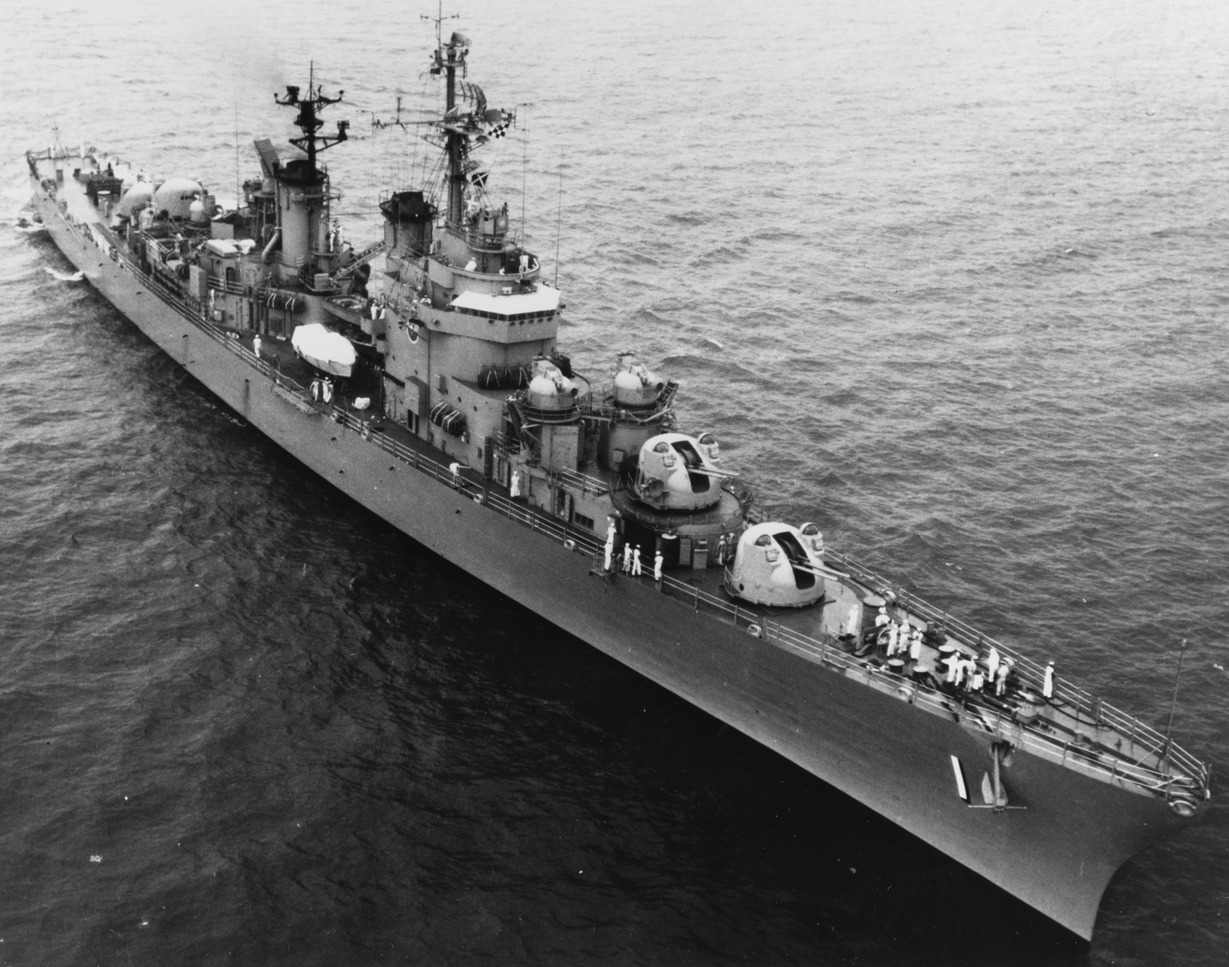
USS Norfolk (Destroyer Leader 1) represented the first generation of large Cold War destroyers following the Gearing-class destroyers that entered service during the final stages of World War II. Ordered under the Fiscal Year 1948 Shipbuilding Program, Norfolk was conceived as a larger antisubmarine vessel and was authorized in 1947 as CLK-1, an antisubmarine hunter-killer ship. She was to be built on a light cruiser-sized hull, allowing her to carry a far greater variety of detection equipment than a conventional destroyer. The design featured a high freeboard and a deep hull intended to enable high speeds of over 30 knots while maintaining excellent seakeeping and sufficient endurance to escort aircraft carriers in all weather conditions.
Norfolk served as the Navy’s first serious attempt at creating an ocean escort specifically optimized for antisubmarine warfare. Her design also became the first project assigned by the Ship Characteristics Board under the designation SCB-1, beginning a long series of SCB design studies for future US warships.
A second ship, USS New Haven (CLK-2), was authorized, but construction was deferred in 1949 before being cancelled outright in 1951. The Navy ultimately concluded that vessels of this size and cost could not be built in sufficient numbers to justify the mission of the class. As a result, USS Norfolk remained a one-ship experimental class for her entire career and served primarily as a test platform for new Cold War antisubmarine weapons, sensors, and operational concepts.
She was laid down on 1 September 1949 by the New York Shipbuilding Corporation at Camden, New Jersey, launched on 29 December 1951, and redesignated DL-1 (Destroyer Leader) before commissioning on 4 March 1953.
Norfolk was originally intended to carry four enclosed twin 3-inch/70 caliber gun mounts. However, because these weapons were not yet ready for service, she instead commissioned eight twin 3-inch/50 caliber open mounts as an interim armament. Her original weapon suite also included sixteen 20 mm anti-aircraft guns, four Weapon Alpha antisubmarine rocket launchers, and eight fixed torpedo tubes arranged as four per side.
Following her Caribbean shakedown cruise in February 1954, Norfolk demonstrated excellent performance, reaching speeds of 33 knots while possessing a cruising range of approximately 6,000 nautical miles at 20 knots. She joined the Atlantic Fleet and, between 1955 and 1957, successively served as flagship for Commander Destroyer Flotillas 2, 4, and 6. During 1956 and 1957, she also served as flagship for Commander Destroyer Force, Atlantic Fleet.
In 1956, the Navy officially changed the meaning of the DL designation from Destroyer Leader to Frigate.
In June 1957, Norfolk participated in the International Fleet Review as flagship, flying the flag of Admiral Jerauld Wright, Commander in Chief, Atlantic Fleet, and Supreme Allied Commander Atlantic (SACLANT) for NATO.
Around 1958, Norfolk became the first operational ship fitted with the AN/SQS-23 sonar. She also conducted trials of the experimental AN/SPS-26 three-dimensional air-search radar, the ancestor of the AN/SPS-48 and AN/SPS-52 radar families.
In 1959, her interim 3-inch/50 gun mounts were finally replaced by the intended enclosed 3-inch/70 Mark 37 dual-purpose gun mounts. At the same time, her sixteen 20 mm anti-aircraft guns were removed, having become obsolete by contemporary standards.
A further modernization in 1960 replaced the two aft Weapon Alpha launchers with a new ASROC (Anti-Submarine Rocket) launcher. This significantly improved Norfolk’s antisubmarine capability by allowing her to launch RUR-5 ASROC missiles carrying homing torpedoes. Norfolk became the first US Navy ship to operationally employ the ASROC weapon system.
On 10 May 1960, while patrolling the Florida Straits with USS The Sullivans, Norfolk was harassed by an 83-foot Cuban patrol vessel operating off Cuban waters.
During the autumn of 1961, she participated in Exercise UNITAS II as flagship for Commander Cruiser Destroyer Flotilla 2. Throughout the exercise, she conducted extensive antisubmarine warfare training with the navies of Venezuela, Colombia, Ecuador, Peru, Chile, Argentina, Uruguay, and Brazil. Norfolk repeated these UNITAS deployments for several years, continuing through 1965.
In 1966, Norfolk again served as flagship during LANTFLEX 66, held between 28 November and 16 December. During the exercise, she monitored and shadowed two Soviet intelligence trawlers, Repiter and Teodolit.
During the autumn of 1967, Norfolk once again demonstrated her value as an antisubmarine warfare flagship while serving as Commander South Atlantic Forces during Exercise UNITAS VIII.
Her final major deployment came in 1968, when she served as flagship for Commander Middle East Force between 17 April and 15 October. During this lengthy cruise she visited Bahrain, Somaliland, Saudi Arabia, Ethiopia, Kenya, transited the Suez Canal, and continued on to the Seychelles, Mauritius, Madagascar, India, Pakistan, Australia, New Zealand, Tahiti, Mexico, and the Panama Canal Zone before returning to the Atlantic, the longest operational cruise of her career.
Having completed her role as an Operational Test and Evaluation Force vessel and with few new systems remaining to evaluate, Norfolk returned to Norfolk in late 1968 for deactivation preparations. She was officially decommissioned on 15 January 1970 and placed into the Atlantic Reserve Fleet.
On 1 September 1974, USS Norfolk was stricken from the Naval Vessel Register and subsequently sold for scrap, and concluded her career as one of the US Navy’s most influential experimental ASW warships.