Would you like to see this in-game?
- Yes
- No
0
voters
Where would you like to see this vehicle?
- BeNeLux subtree (in France)
- Independent BeNeLux naval tree
- Other
- No/negative
0
voters
What versions would you like to see?
- Initial fit (Standard SM-1MR SAM + Sea Sparrow + Harpoon + Goalkeeper + no helicopter)
- Mid-life modernised fit (SMART radar upgrade + updated electronics)
- Both versions (as separate vessels)
- Premium/Event variant (for one or both configurations)
- No/negative
0
voters
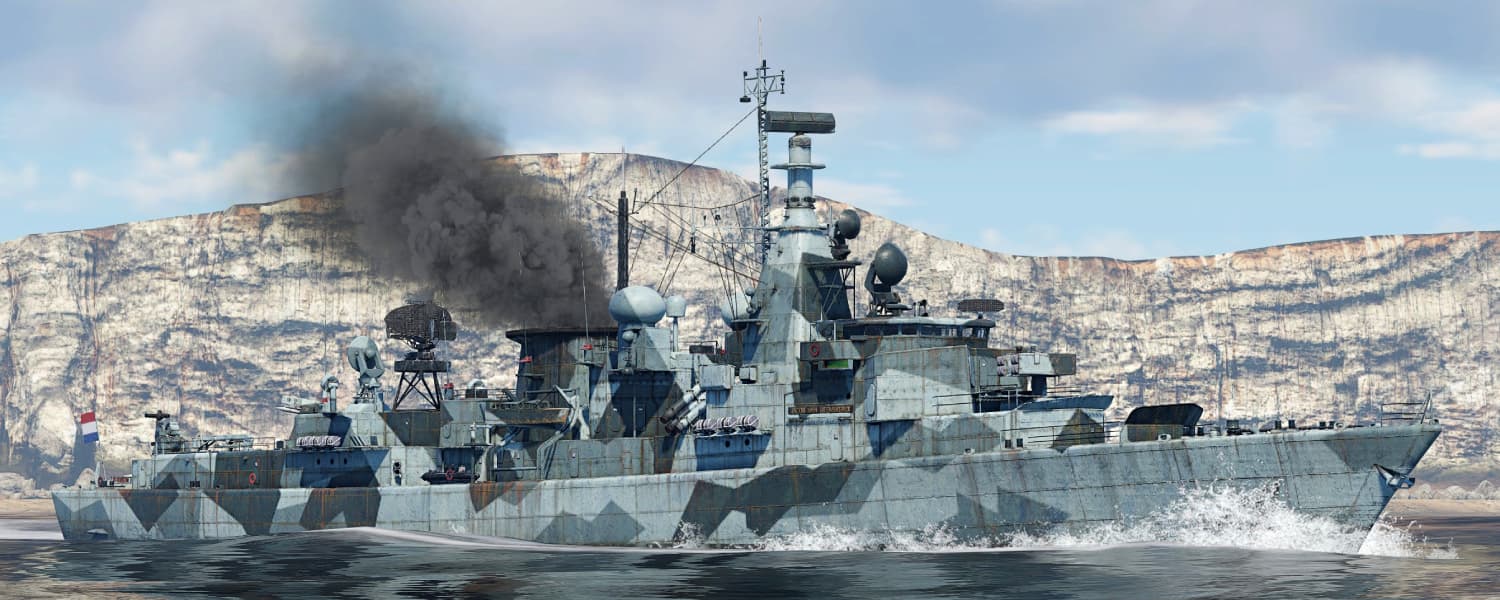
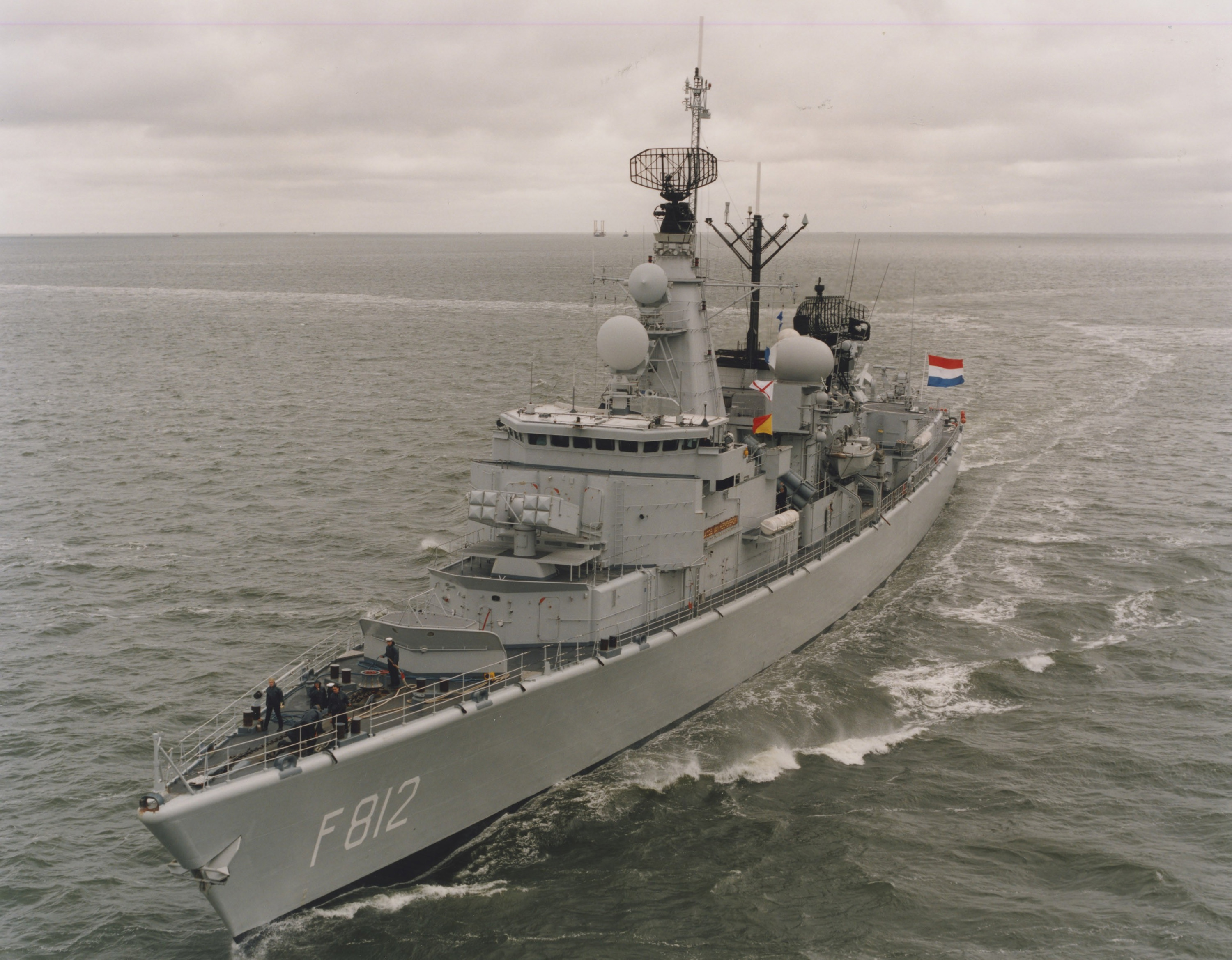
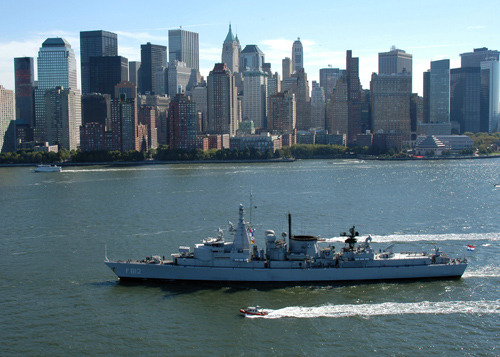
The Jacob van Heemskerck-class (L-class) frigates (not to be confused with the Tromp-class flotilla leader, HNLMS Jacob van Heemskerck (1939)) were specialised air-defence ships of the Royal Netherlands Navy, designed during the Cold War to provide fleet-wide missile protection. Derived from the Kortenaer-class (S-class) hull, they sacrificed anti-submarine features like the helicopter hangar in favour of powerful radar, missiles, and electronic systems, turning them into compact but potent anti-air warfare (AAW) platforms.
Only two ships were built, HNLMS Jacob van Heemskerck (F812) and HNLMS Witte de With (F813), both constructed by Koninklijke Maatschappij De Schelde at Vlissingen and commissioned in 1986. Serving as the Royal Netherlands Navy’s primary AAW escorts for two decades, they provided critical fleet defence within NATO task forces until their decommissioning in the mid-2000s.
TL;DR: Dedicated Dutch fleet air-defence frigate.

HNLMS Jacob van Heemskerck underway during NATO exercises in the North Atlantic.
Dutch Naval Suggestion, Jacob van Heemskerck-class (L-class) Frigate
History
Spoiler
During the late 1970s, the Royal Netherlands Navy (Koninklijke Marine) was in the midst of a major fleet renewal. The older Van Speijk-class frigates were nearing the end of their service lives, while the newer Kortenaer-class (also known as the S-class or Standard Frigate) were coming into service. The S-class frigates were optimised for anti-submarine warfare (ASW), featuring a helicopter hangar and torpedo armament, but they lacked a modern area air-defence capability.
At the time, only two large Tromp-class guided missile frigates, Tromp and De Ruyter, were capable of employing the RIM-66 Standard Missile (SM-1MR) for long-range air defence. These ships often served as task group flagships, leaving the rest of the fleet without adequate air cover when deployed independently. This gap became increasingly concerning as the Cold War entered a period of rapid technological advancement in missile and air attack capabilities. The proliferation of high-speed sea-skimming anti-ship missiles such as the Exocet and Soviet Styx further highlighted the need for improved fleet protection.
The Netherlands had originally planned for twelve S-class frigates, but when Greece purchased two of the hulls under construction, this opened an opportunity. The Dutch Navy decided that the two replacements would be built to a new air-defence configuration, converting the proven S-class hull into a dedicated Luchtverdedigingsfregat (L-class, or “air-defence frigate”). This decision leveraged the existing design experience and shipbuilding infrastructure, allowing the Navy to obtain two high-capability air-defence frigates at a fraction of the cost of designing a completely new vessel.
Conceptual model of the L-class frigate, published in “Alle Hens”, November 1983.
Design work began in 1979 under the supervision of Koninklijke Maatschappij De Schelde, with support from Hollandse Signaalapparaten (Signaal), the Dutch radar and electronics manufacturer later known as Thales Nederland. The designers retained the S-class’ hull form, propulsion system, and much of its internal layout, but completely restructured the superstructure to accommodate advanced radar and missile systems. The helicopter hangar and 76 mm gun were deleted, replaced with a Mk 13 launcher for Standard Missile-1 (SM-1MR), a long-range fire control suite, and expanded command spaces.
This reconfiguration effectively transformed the ship’s mission profile: instead of pursuing submarines, it would now coordinate and execute air-defence operations for an entire task group. The resulting vessels: HNLMS Jacob van Heemskerck (F812) and HNLMS Witte de With (F813), became the Netherlands’ first true air-defence frigates.
Construction and Entry into Service
The keel of Jacob van Heemskerck was laid down in 1981, followed by Witte de With shortly after. Both were launched in 1983 and commissioned into service in 1986. Upon entering the fleet, they formed the Guided Missile Frigate Squadron (Smaldeel 5) and were tasked primarily with NATO air-defence missions and fleet escort duties.
Throughout their service, these frigates participated in a wide range of operations, from Cold War patrols to multinational exercises. In 1991, Witte de With deployed to the Persian Gulf as part of Operation Desert Storm, providing air-defence and escort functions to coalition naval forces. Both ships also served in NATO’s Operation Sharp Guard in the Adriatic Sea (1993–1996), enforcing embargoes during the Yugoslav conflicts, and later in Operation Active Endeavour (2001–2003), supporting counterterrorism operations in the Mediterranean.
HNLMS Witte de With operating in the Persian Gulf, 1991.Design and Capabilities
The L-class displaced around 3,750 tons full load and measured 130.5 meters in length, with a beam of 14.6 meters. Power came from a COGOG (Combined Gas or Gas) propulsion system identical to that of the S-class: two Rolls-Royce Olympus TM3B gas turbines for high speed and two Rolls-Royce Tyne RM1C turbines for cruising. This arrangement gave a top speed of 32 knots and a range of over 4,500 nautical miles.
The most distinctive feature of the class was its Mk 13 launcher located forward, capable of firing RIM-66E Standard Missiles (SM-1MR Block VI). These provided a maximum effective range of approximately 38 km and could engage high-speed aircraft or incoming missiles. For short-range engagements, the ships carried an 8-cell NATO Sea Sparrow launcher (RIM-7M/P) and two Goalkeeper 30 mm CIWS, offering layered air-defence coverage.
The anti-ship component was equally strong: eight RGM-84C Harpoon missiles gave the vessels a powerful strike capability, allowing them to serve as versatile fleet escorts. While lacking a main gun, the class compensated with superior electronic warfare and radar systems. Sensors included the LW-08 long-range radar, DA-08 surface search radar, multiple STIR (Signal Tracking and Illumination Radar) systems for missile guidance, and a SQS-509 hull-mounted sonar for basic underwater detection.
Mid-Life Modernisation
By the late 1990s, new advances in radar and electronic systems led to a comprehensive modernisation of both L-class frigates. The refit focused on improving situational awareness, data processing, and interoperability within NATO command networks.
The outdated DA-08 radar was replaced with the new SMART-S 3D radar, significantly improving range, tracking accuracy, and multi-target capability. The SEWACO VII combat management system was upgraded to handle the increased data load, while the electronic warfare suite, including the Ramses ECM and RPZO ESM systems, was modernised for better threat detection and countermeasures.
These upgrades allowed the ships to remain fully combat-relevant well into the 2000s, ensuring their continued service alongside the newer Karel Doorman-class frigates. Despite the advent of more advanced air-defence designs, the L-class remained among the most capable medium-range AAW platforms in NATO during their operational lifetime.
Both ships were finally decommissioned from Dutch service in 2005–2006, marking the end of nearly twenty years of frontline duty. They represented the peak of Dutch Cold War naval engineering, powerful, reliable, and remarkably efficient in design.
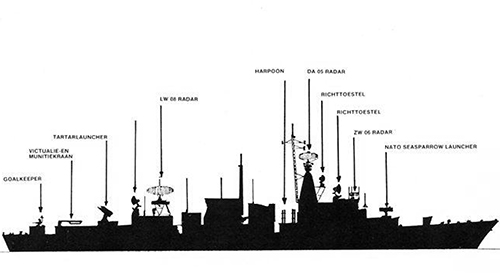
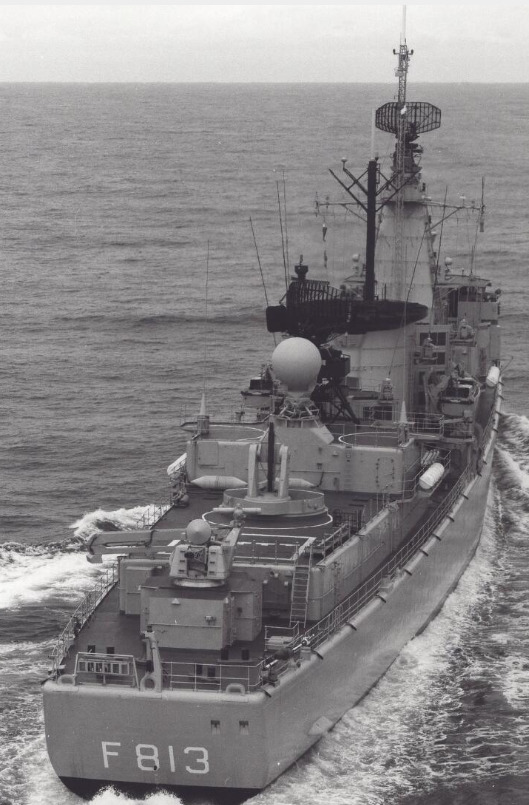
Specifications
Initial Fit (1986)
Characteristic Detail Displacement 3,750 tons (full load) Length 130.5 m Beam 14.6 m Draft 6.2 m Speed 32 knots Range 4,500+ nautical miles Crew ~200 Propulsion 2 × Rolls-Royce Olympus TM3B + 2 × Rolls-Royce Tyne RM1C (COGOG) Radar LW-08 air search, DA-08 surface search, STIR fire-control Sonar SQS-509 hull-mounted Combat System SEWACO IV Armament:
- 1 × Mk 13 launcher (40 × RIM-66E SM-1MR Block VI)
- 1 × 8-cell NATO Sea Sparrow launcher (RIM-7M/P)
- 8 × RGM-84C Harpoon anti-ship missiles
- 2 × Goalkeeper 30 mm CIWS
- 2 × Mk 32 triple torpedo tubes (Mk 46 torpedoes)
- 2 × .50 cal Browning MGs
Modernised Fit (1998–2005)
Characteristic Detail Displacement 3,750 tons (unchanged) Speed 32 knots Crew ~190 Propulsion Unchanged (COGOG system) Radar SMART-S 3D radar (replaced DA-08) Fire Control 2 × STIR 2.4 + 1 × STIR 1.8 EW Suite Updated Ramses ECM + RPZO ESM Combat System SEWACO VII Armament:
- 1 × Mk 13 launcher (RIM-66E SM-1MR Block VIA)
- 1 × 8-cell NATO Sea Sparrow (RIM-7P)
- 8 × RGM-84C Harpoon missiles
- 2 × Goalkeeper 30 mm CIWS
- 2 × Mk 32 torpedo launchers (Mk 46 Mod 5)
HNLMS Witte de With serving as flagship during NATO Operation Fairwind ’88.

Place in War Thunder
The Jacob van Heemskerck-class would fill a unique air-defence escort role within the upper blue/coastal-water ranks (Rank V–VI). Its exceptional radar coverage, layered missile systems, and CIWS armament make it ideal for protecting allied ships against aerial and missile threats.
Possible Configurations:
- Initial Fit (1986): Rank V: Original DA-08 radar, SM-1MR and Sea Sparrow missiles.
- Modernised Fit (1998–2005): Rank VI: SMART radar, improved fire control, upgraded EW.
Gameplay Role:
- Long-range missile support and fleet air-defence escort.
- Capable of intercepting aircraft and incoming missiles.
- Anti-ship strike capability with Harpoon missiles.
Strengths:
- Excellent radar and missile suite.
- Layered air-defence system (SM-1MR + Sea Sparrow + Goalkeeper).
- High speed and good handling.
Weaknesses:
- No main gun for surface engagements.
- No helicopter facilities.
- Relies heavily on missiles and radar systems.
A compact yet powerful air-defence platform — ideal for high-tier naval gameplay.
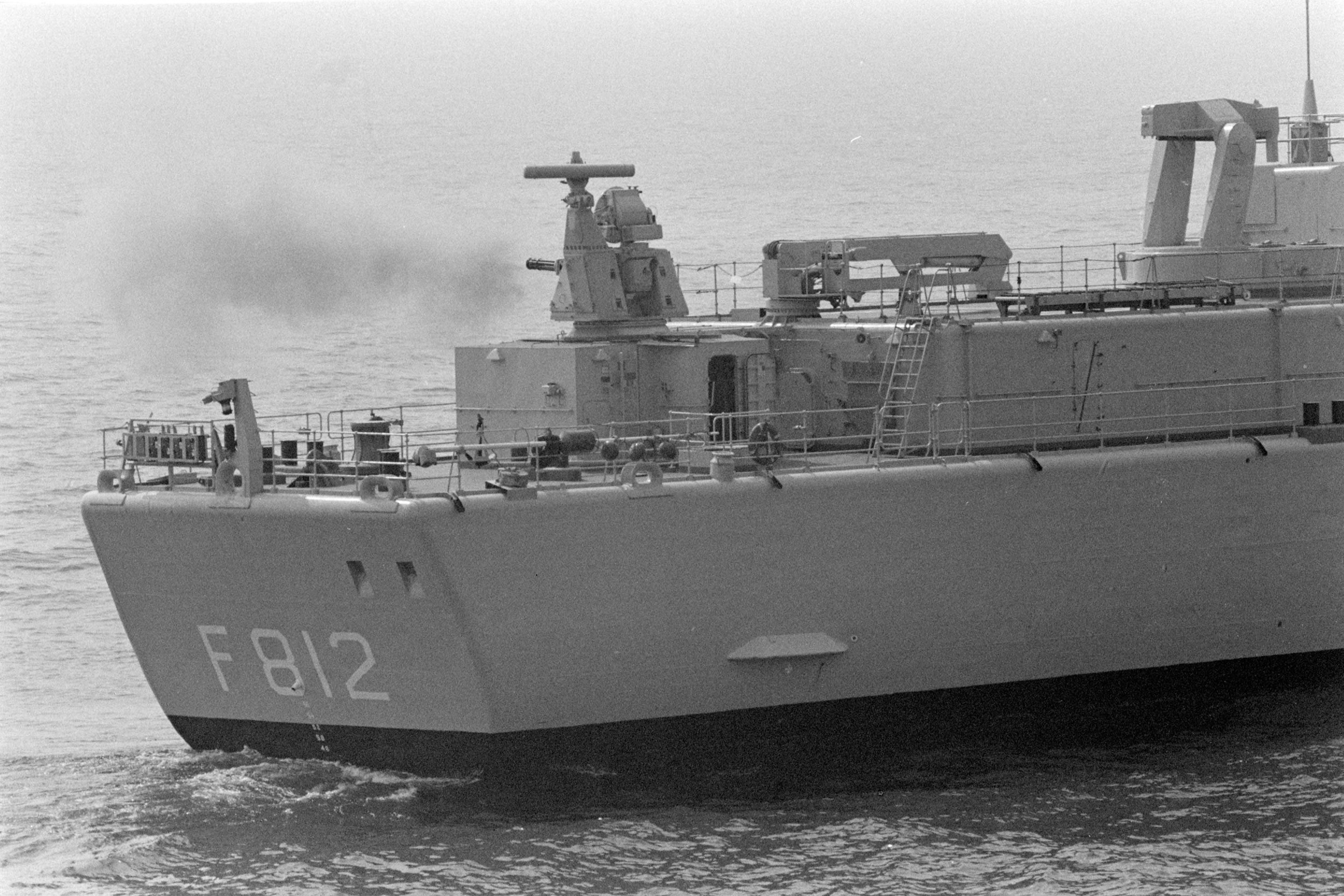
Pictures

Sources
References
- Karremann, J. (2020). Jacob van Heemskerckklasse fregatten (L-fregatten). Marineschepen.nl
- Navypedia – “Jacob van Heemskerck class”
- Naval Encyclopedia – Kortenaer & Jacob van Heemskerck class
- Wikipedia – Jacob van Heemskerck-class frigate
- Van Norden, C.H.J. (1992). TD-ervaringen in de Perzische Golf. Marineblad, 92(5), pp. 205–210.
- Dutch Ministry of Defence archives – Defensie.nl