- Yes
- No
- (independent) BeNeLux tree
- France: BeNeLux subtree
- Dutch (sub)tree
- Other
- I voted “No” in the previous poll
Hello everyone! Today I’d like to suggest the Humber Mk.IV Armoured Car in Dutch service, one of the most widely used armoured cars of the Koninklijke Landmacht during the immediate post-war period and the Indonesian War of Independence.
TL;DR: A fast British reconnaissance vehicle armed with a 37 mm M6 cannon, used extensively by the Dutch Army from 1944 until around 1950, including during the Politionele Acties in the Dutch East Indies.

History
History
British Development
The Humber Armoured Car originated during one of the most difficult periods of the Second World War. Following the evacuation at Dunkirk in 1940, Britain had lost enormous quantities of military equipment and urgently required new reconnaissance vehicles. Guy Motors had already developed a successful armoured car, but its production capacity was insufficient to satisfy the rapidly expanding demands of the British Army.
To solve this problem, the British government approached the Rootes Group, which adapted the existing Guy design to the chassis of the Karrier KT4 artillery tractor. Because both the chassis and the armoured body were already proven designs, development progressed exceptionally quickly. The resulting vehicle entered production in 1941 as the Humber Armoured Car and soon became one of the most numerous British armoured cars of the war.
Although the earliest variants proved reliable and mobile, their armament gradually became inadequate as the conflict evolved. The Mk.I, Mk.II and Mk.III were all often equipped with a 15 mm Besa heavy machine gun paired with a coaxial 7.92 mm Besa.
The final production variant, the Humber Mk.IV, entered service in 1943. It retained the improved hull and enlarged turret of the Mk.III but replaced the 15 mm Besa with the American-designed 37 mm M6 cannon. The installation of the larger gun required the removal of the dedicated wireless operator, reducing the crew from four men to three. Despite this compromise, the increase in firepower transformed the Humber into a much more capable reconnaissance vehicle, allowing it to engage enemy armoured cars and light tanks on more equal terms.
By the end of the Second World War, approximately 5,400 Humber Armoured Cars of all variants had been produced, making it one of the most widely used British armoured cars of the conflict.
Dutch Acquisition
The liberation of the Netherlands left the Koninklijke Landmacht in the difficult position of having to rebuild almost its entire inventory of military equipment. Like many Western European nations, the Netherlands relied heavily on British surplus equipment supplied after the war. Among the vehicles received were significant numbers of Humber Mk.IV armoured cars, which quickly became the standard reconnaissance vehicle of the newly re-established Dutch cavalry units.
The Humber entered Dutch service in 1944 and remained one of the army’s principal armoured reconnaissance vehicles until approximately 1950. Documentation from 1948 records that the Dutch Army possessed sixty Humber Mk.IVs, although only thirty-five of these were immediately operational. Since the vehicles had been collected from British and Canadian storage depots across Europe, many required extensive maintenance before they could be issued to frontline units.
Recognising the continuing need for armoured reconnaissance vehicles, the Ministry of Defence purchased a further seventy-three Humber Mk.IVs from the United Kingdom during 1948. This significantly expanded the available fleet and allowed several additional reconnaissance squadrons to be equipped.
Service in the Dutch East Indies
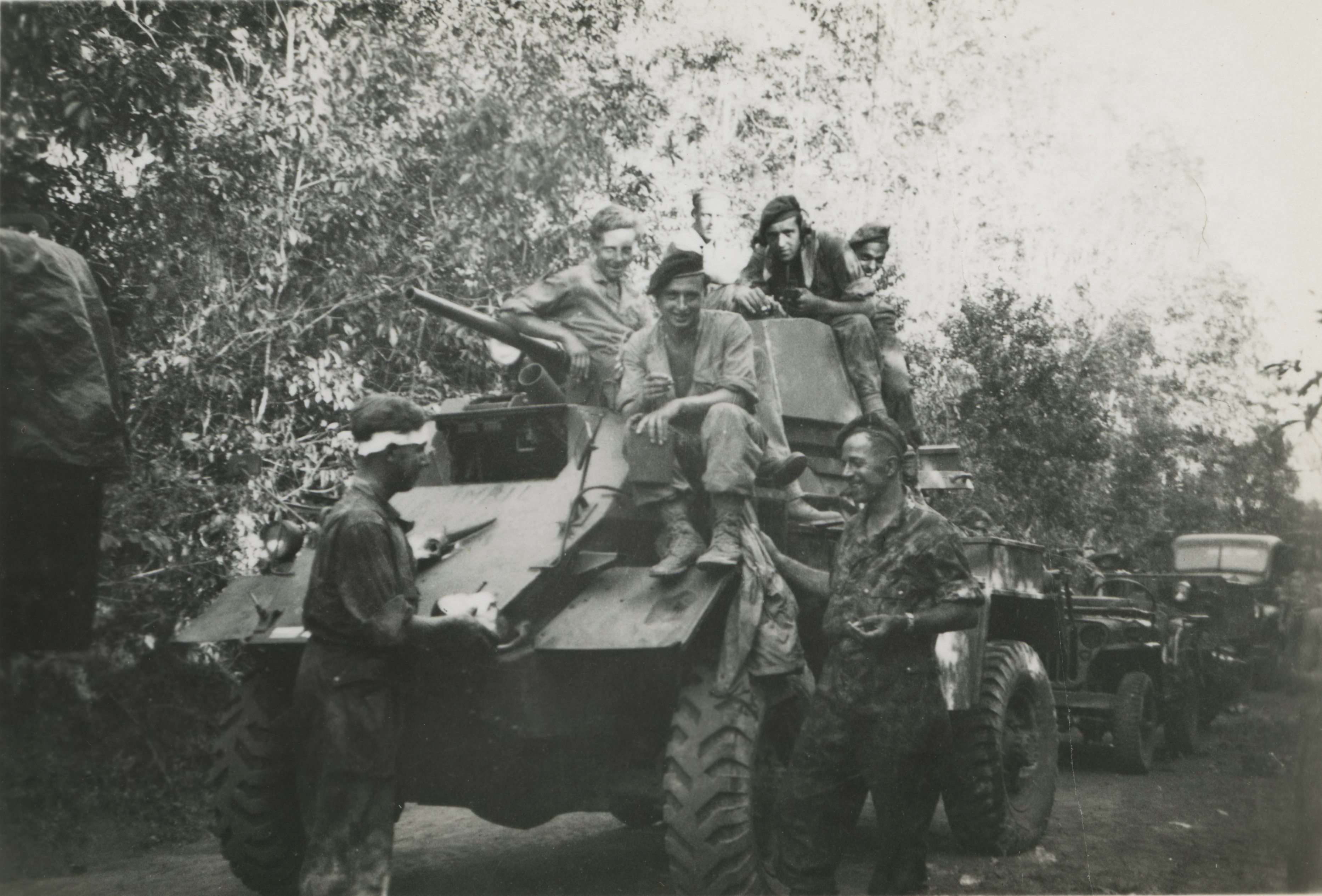
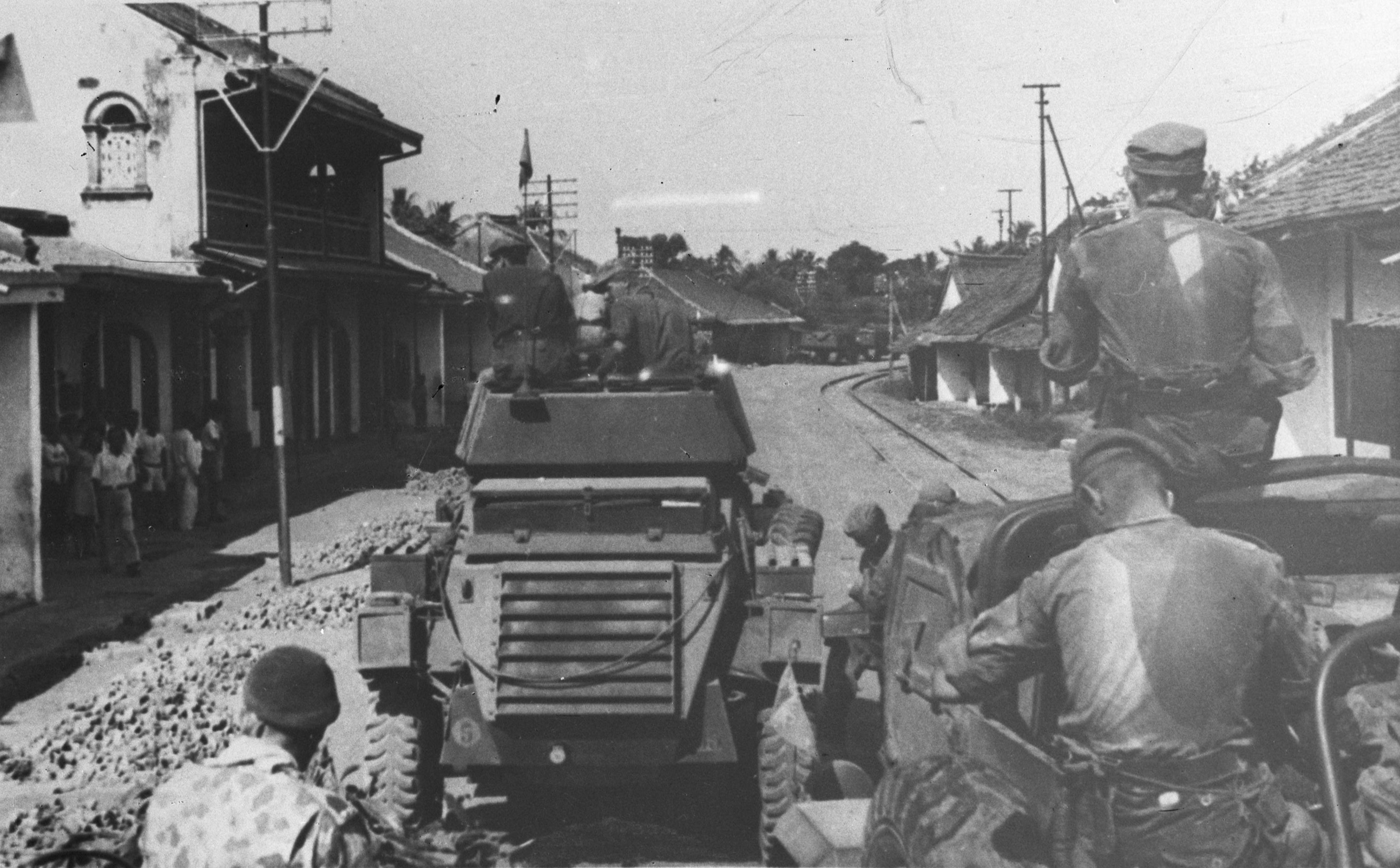
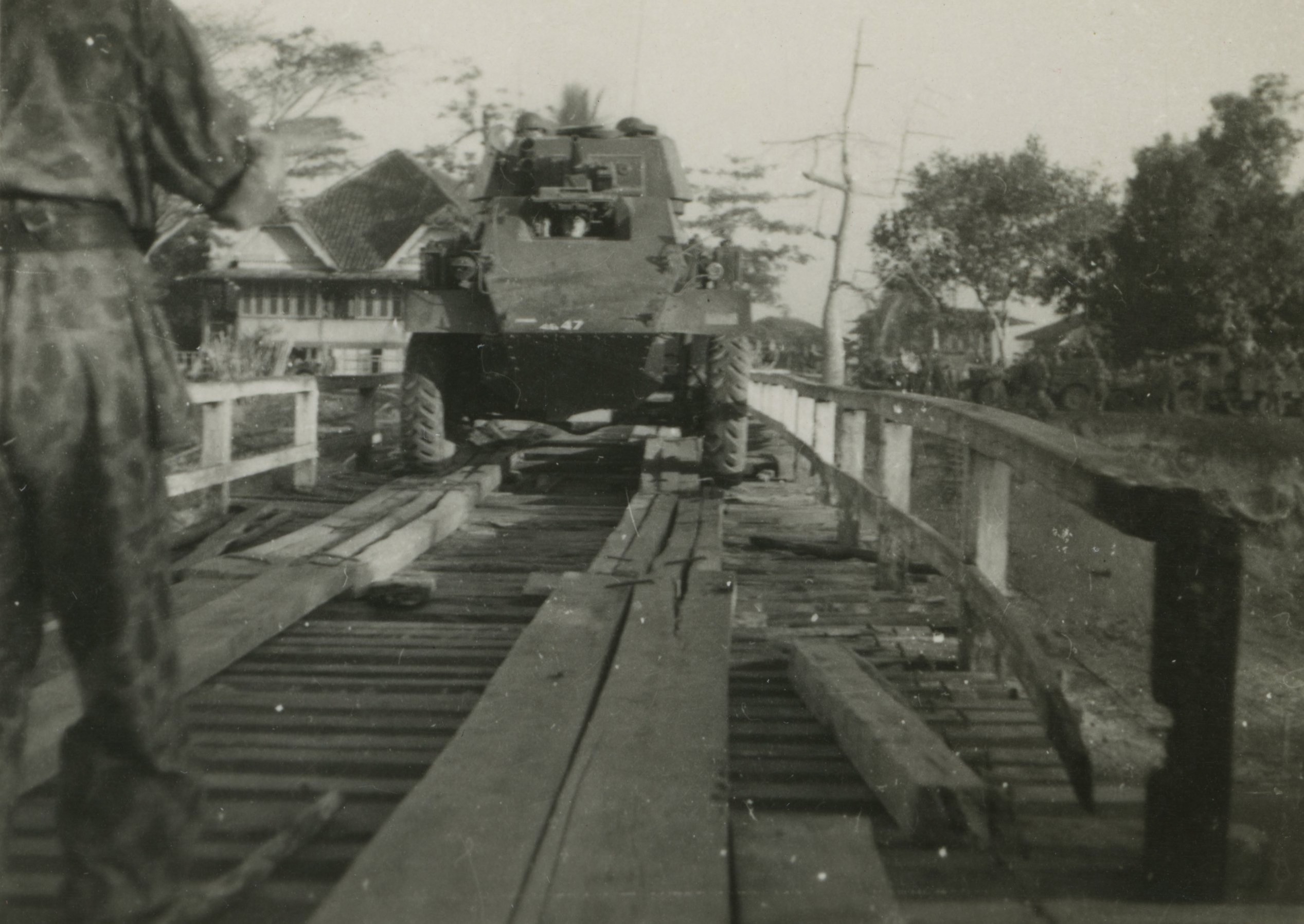
The outbreak of the Indonesian War of Independence dramatically altered the role of the Humber within Dutch service. Rather than remaining solely in Europe, a substantial number of the newly acquired vehicles were transported to the Dutch East Indies, where they accompanied units of the Regiment Huzaren van Boreel and other formations participating in the Politionele Acties.
The armoured cars were loaded aboard the SS Kota Inten in Southampton together with personnel and equipment destined for Java. Once deployed, they became one of the most frequently encountered Dutch armoured vehicles during the conflict.
Unlike the large-scale armoured warfare of Europe, operations in Indonesia consisted primarily of patrols, convoy escort, road security and infantry support. The Humber’s relatively light weight, high road speed and mechanical reliability proved ideally suited to these tasks. Its 37 mm cannon was capable of engaging bunkers, roadblocks and fortified positions, while the coaxial Besa machine gun provided effective suppressive fire against infantry.
Photographic evidence preserved by the Netherlands Institute of Military History shows Humber Mk.IVs operating throughout Java, Sumatra and Bangka between 1946 and 1949. They served alongside Stuart light tanks, Bren Carriers and various improvised armoured vehicles, forming an important part of Dutch mobile operations during the conflict.
Following the conclusion of the Indonesian campaign and the arrival of more modern armoured vehicles, the Humber was gradually withdrawn from Dutch service. By the early 1950s, it had disappeared from frontline units, bringing to an end approximately six years of operational service with the Koninklijke Landmacht.
Specifications
Category Details Crew 3 Weight 5.2 tonnes Length 4.61 m Width 2.21 m Height 2.39 m Engine Rootes 6-cylinder water-cooled petrol engine Power 90 hp (67 kW) Power-to-weight 17.3 hp/t Transmission 4×4 transmission with selectable front-wheel drive Maximum speed 80 km/h Operational range 320 km Main armament 37 mm M6 cannon Secondary armament 1 × 7.92 mm Besa coaxial machine gun Additional armament 2 × .303 Vickers K machine guns (stowed) Smoke launchers 2 × 4 smoke dischargers Maximum armour 15 mm
Place in War Thunder
The Dutch Humber Mk.IV would fit as an early Rank I-II reconnaissance vehicle.
Compared to existing British and Commonwealth vehicles, it combines excellent mobility with a respectable 37 mm cannon while remaining lightly armoured. It would play similarly to vehicles such as the Daimler Armoured Car or SARC Mk.VI, relying on speed and flanking rather than protection.
Pictures
Sources
Sources
Main Sources
Stichting Twenot. (1986, August). De Humber Mk IV pantserwagen. In De Tank, de Tank (Vol. 61). Orgaan van de Twenot.
Ruys, S. (2021). Wiel en rups: Voertuigen van de Landmacht 1945–2015 (2nd ed.). Walburg Pers.
Sleutelspoor. (n.d.). Humber Mk IV pantserwagen 4×4. https://sleutelspoor.nl/humber-mkiv-pantserwagen-4-x-4/
WarWheels. (n.d.). Humber Armoured Car Mk IV. WarWheels.Net-Humber Mark 4 Armored Car Index
Supporting Sources
D-Day Overlord. (n.d.). Humber pantserwagen. Humber Armoured Car Mk IV: geschiedenis en gegevens
Leger Film- en Fotodienst. (ca. 1940s). Een Humber Mk IV pantserauto (Objectnummer 2001_157-47-G214a). Nederlands Instituut voor Militaire Historie. Foto's
Nederlands Instituut voor Militaire Historie. (1946). Pantserwagens bij de opmars van Muntok naar Pangalpingang (Objectnummer 2002-291-2). https://beeldbank.nimh.nl/
Nederlands Instituut voor Militaire Historie. (1947). Nederlandse militairen patrouilleren met pantserwagens in Nederlands-Indië (Objectnummer 2001_N0000169-29). https://beeldbank.nimh.nl/
Nederlands Instituut voor Militaire Historie. (1948–1949). Een Humber pantserwagen bij de inzet van de 6e Batterij Luchtdoelartillerie in Midden-Sumatra tijdens de Tweede Politionele Actie (Objectnummer 2053-001-065). https://beeldbank.nimh.nl/
Wikipedia contributors. (n.d.). Humber Armoured Car. Wikipedia. Humber armoured car - Wikipedia