- Yes, as a tech tree vehicle
- Yes, as a premium vehicle
- Yes, as an event vehicle
- Yes, as a squadron vehicle
- No, I would not like to see the Nilgiri-class in game.
- Nilgiri (F33) as built (Fully British equipment)
- Himgiri (F34), Udaygiri (F35), and Dunagiri (F36) as built (Dutch radars + extra SeaCat launcher)
- Nilgiri - Dunagiri (F33-F36) refit (as above + AK-230 anti-aircraft guns replacing SeaCat)
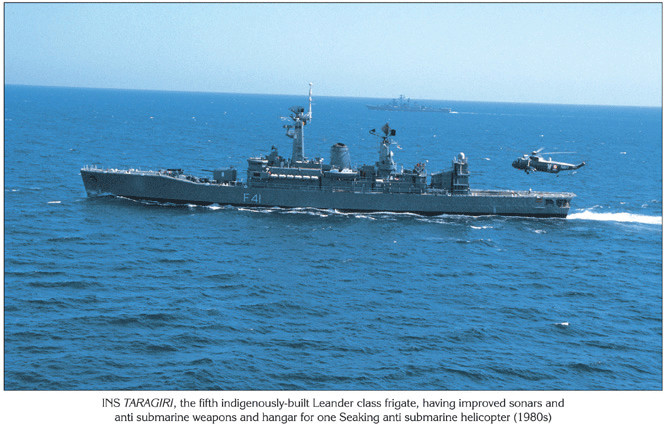
- Taragiri (F41) and Vindhyagiri (F42) (as above + 12.75" AS torpedos replacing Limbo + 375mm AS rockets + rear hangar)
- I said no to the first question
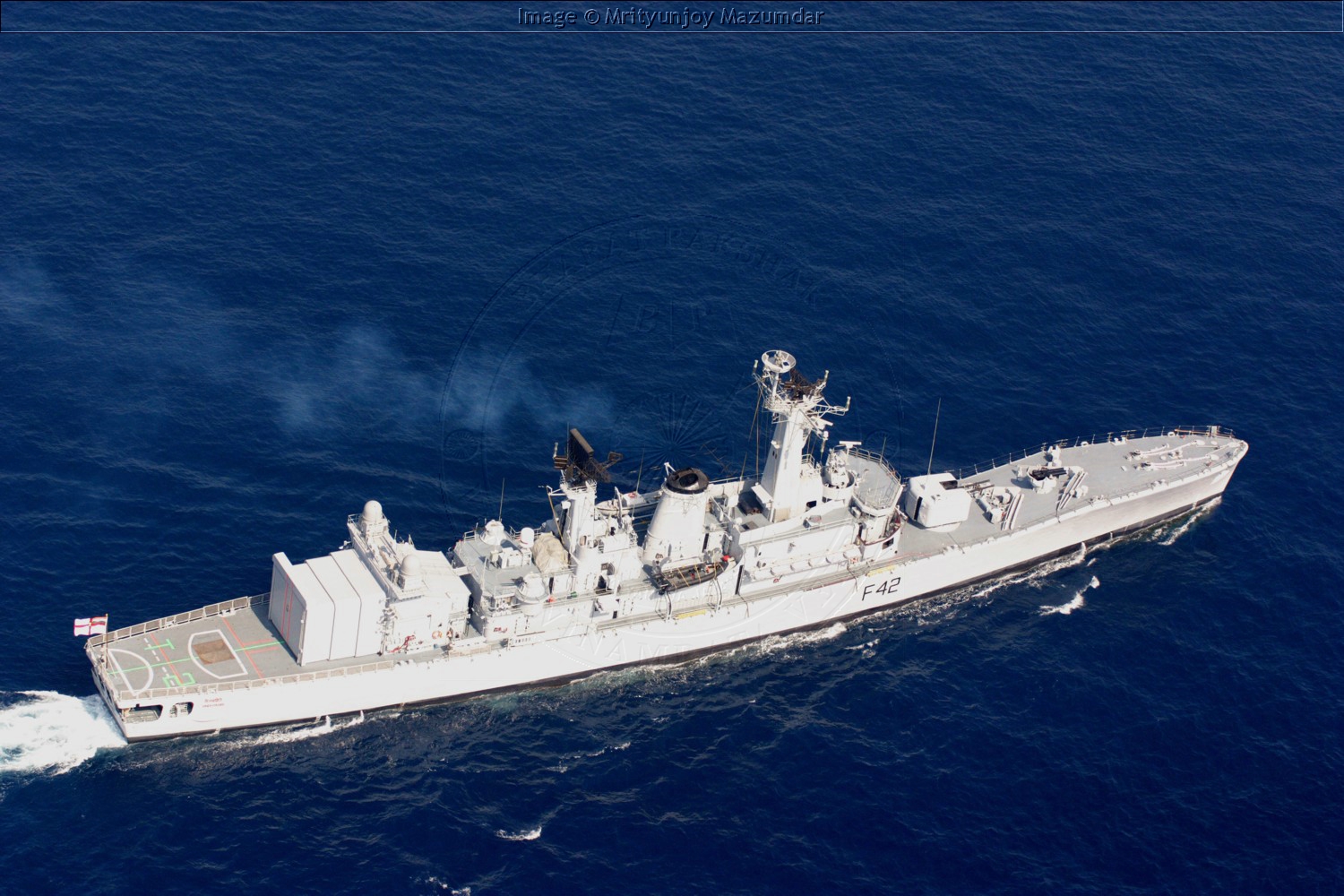
Vindhyagiri (F42) underway with her retractable helicopter hangar clearly visible. F41 and F42 would be the most extensively modified designs compared to the base Leander-class.
TL;DR
- Modified Type 12I Leander-class which served as a mainstay frigate
- New facilities, radar, anti-aircraft armament and anti-submarine weapons
- About the same size as the Whitby-class, albeit with a taller profile
- Anti-surface potential somewhat limited
Why it should be in the game: I feel that the Nilgiri-class would be excellent representation for India’s naval forces in the British coastal tree. As a modified British design, the Nilgiris would be far more palatable for many players than contemporary modified Soviet designs also used by India. At the same time, these ships provide tangibly unique gameplay compared to their British cousins with their rapid-firing 30mm cannons for close-in defense. Overall, the Nilgiri-class would be an excellent companion to the domestic Leander-class variants and would provide an extremely effective anti-aircraft vessel for Britain’s coastal tree.
History
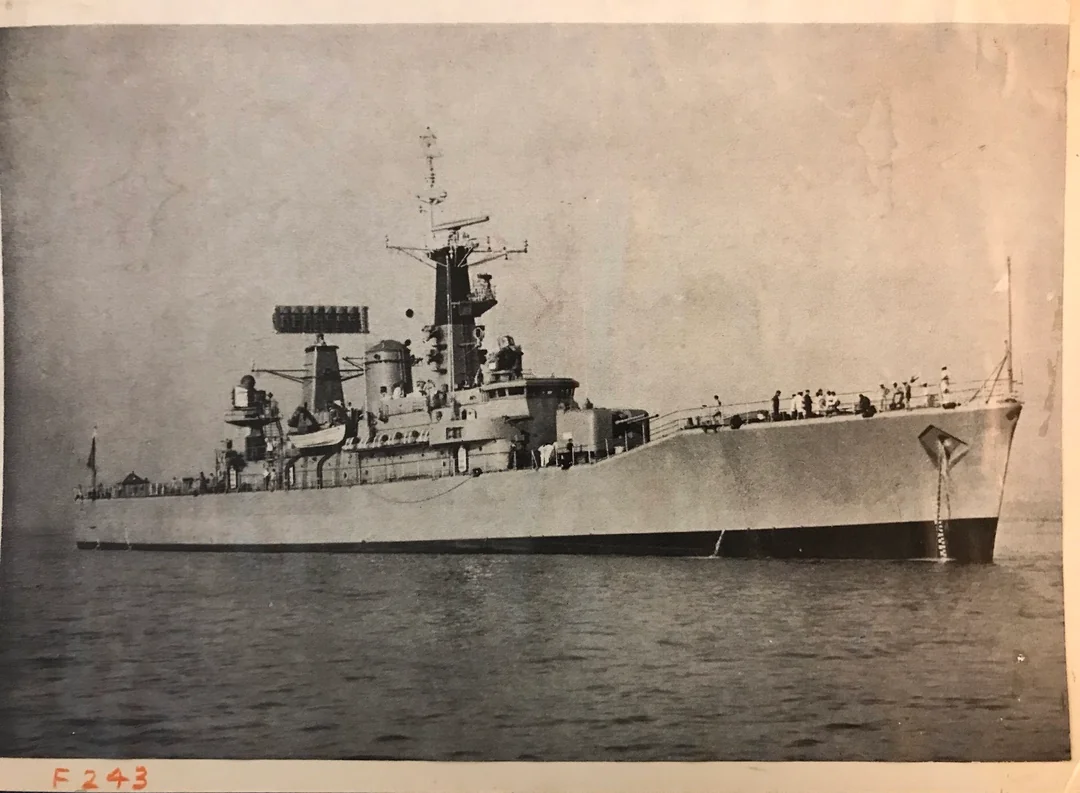
Nilgiri (F33) as built. The Nilgiri-class would originally be armed entirely with British equipment. However, the radar sets were not able to be license-built, so the later ships were fit with Dutch systems instead.
The need for an evolved general-purpose frigate in the Indian Navy was recognized around the late 50’s, relatively early in the nation’s independent history. At that time, India was still sourcing most of its weapons acquisitions from Britain. As such the Indian Navy was paying attention to new developments and were an early adopter of the Type 12I Leander-class frigate. Construction of three frigates would be approved in November 1960, just seven months after the Leander was announced to the British public. However, it took until 1965 for the first frigate to actually be ordered. Two more would be ordered in 1967, with another three following in 1970. Indian shipbuilder MDSL would collaborate with the British Yarrow Shipbuilders to gain the necessary experience in constructing major warships. The Nilgiri-class would be the first major warship to be fully constructed in India from the keel up. This domestic production would prove to be important to the Navy. Once Nilgiri (F33) was commissioned in 1972, it was made known that the British radar equipment furnishing the vessel would not be able to produced in India. Because of this, the decision was made to license-build radar sets designed by the Dutch company Signaal. The following five vessels of the class would be equipped with these, as well as Nilgiri after her refit. The last two vessels of the class, Taragiri (F41) and Vindhyagiri (F42) spent a couple extra years in development due to changing needs. The Sea King helicopter was desired to be fielded, but the helicopter deck on the standard Nilgiri-class could not accommodate the new vessel. Therefore an extended deck was devised with a collapsible hangar to house the Sea King as well as a new sonar installation underneath the extended deck. NTS 58 torpedo tubes and Bofors anti-submarine rockets would replace the existing anti-submarine weaponry. It is claimed by some sources that these last two vessels had more powerful engines, but these claims may be unsubstantiated. Regardless, the new vessels could have been considered a subclass with how extensively they were changed.
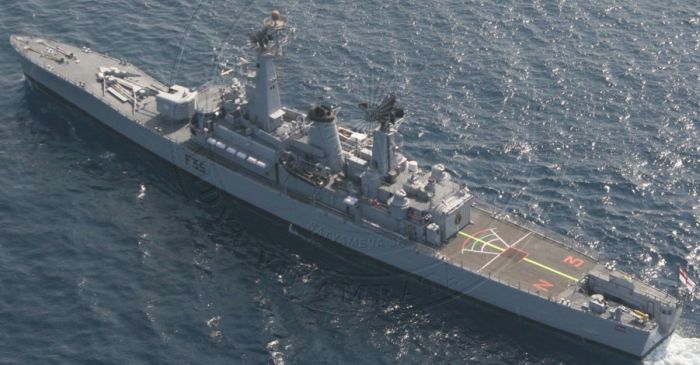
Udaygiri (F35) after being refit with AK-230 cannons in place of the original SeaCat SAMs. SeaCat was showing its age and ties with British manufacturers had by this point evaporated, so it was a pragmatic change.
The Nilgiri-class frigates never fired shots in anger, having been commissioned after the Indo-Pakistani War of 1971. However, Vindhyagiri did participate in Operation Flowers are Blooming, an Indian Navy operation to avert a coup. Despite being modern and potent frigates, there was still room for improvement during service. One such modification was the removal of the aging SeaCat SAM installations, which were replaced by Soviet AK-230 cannons of a relatively similar effective range. This refit seems to have taken place in the late 70’s or early 80’s. The first series of ships (F33-F36) would also receive new Westinghouse SQS-505 sonars, while the second (F41-F42) had Thomson Sintra sonars. If this caused logistical issues, they didn’t seem to be strongly felt, as the Nilgiris would last very long in service. The lead ship, Nilgiri (F33), was the first to go, while Taragiri (F41) survived until 2013. Of the six ships, all but Vindhyagiri (F42) were retired normally. Vindhyagiri suffered a collision at Mumbai Harbor in 2011 and sunk, but was raised and properly retired afterwards. The Nilgiri-class frigates have been replaced in service by the identically named but much more modern Project-17A Nilgiri-class.
Specifications
Nilgiri-class Frigate
Dimensions:
- Length: 371 ft (113 m)
- Beam: 43 ft (13 m)
- Draught: 14 ft (4.3 m)
Displacement:
- 2,682 tons standard (F33-F36)
- 2,962 tons full load (F33-F36)
- 3,039 tons full load (F41-F42)
Propulsion: 2 x 30,000 hp motors
Maximum speed:
- 28 kt (52 km/h)
Armament:
- As built (Nilgiri):
- 1 x 2 4.5" QF Mark 6 cannon
- 1 x 4 SeaCat SAM
- 1 x 3 Limbo depth charge
- As built (F34-F36):
- 1 x 2 4.5" QF Mark 6 cannon
- 2 x 4 SeaCat SAM
- 1 x 3 Limbo depth charge
- As refit (F33-F36):
- 1 x 2 4.5" QF Mark 6 cannon
- 2 x 2 NN-30 autocannon (AK-230)
- 2 x 3 12.75" torpedo tube (ILAS 3)
- As built (F41-F42):
- 1 x 2 4.5" QF Mark 6 cannon
- 2 x 2 NN-30 autocannon (AK-230)
- 2 x 3 12.75" torpedo tube (ILAS 3)
- 1 x 2 375mm Bofors anti-submarine rocket
Complement: 267
Radar:
- As built (Nilgiri):
- Type 965 air warning radar
- Type 992Q target designation radar
- Type 903 tracking radar
- Type 974 navigation radar
- As built (F34-F36, F41-F42):
- Signaal DA 05 target tracking radar
- Signaal LW 08 surface radar
- Signaal ZW 06 navigation radar
- Signaal M-45 navigation radar
- Type 903 tracking radar
F41 and F42 have additional radars on the hangar, however I cannot identify them. Type 903s were removed with the removal of SeaCat.
Sonar:
- As built (F33-F36):
- Type 170 sonar
- Refit (F33-F36):
- Westinghouse SQS-505 sonar
- As built (F41-F42):
- Thomson Sintra sonar
Helicopters:
- 1 x HAL Chetak (F33-F36)
- 1 x Sea King (F41-F42)
Gallery
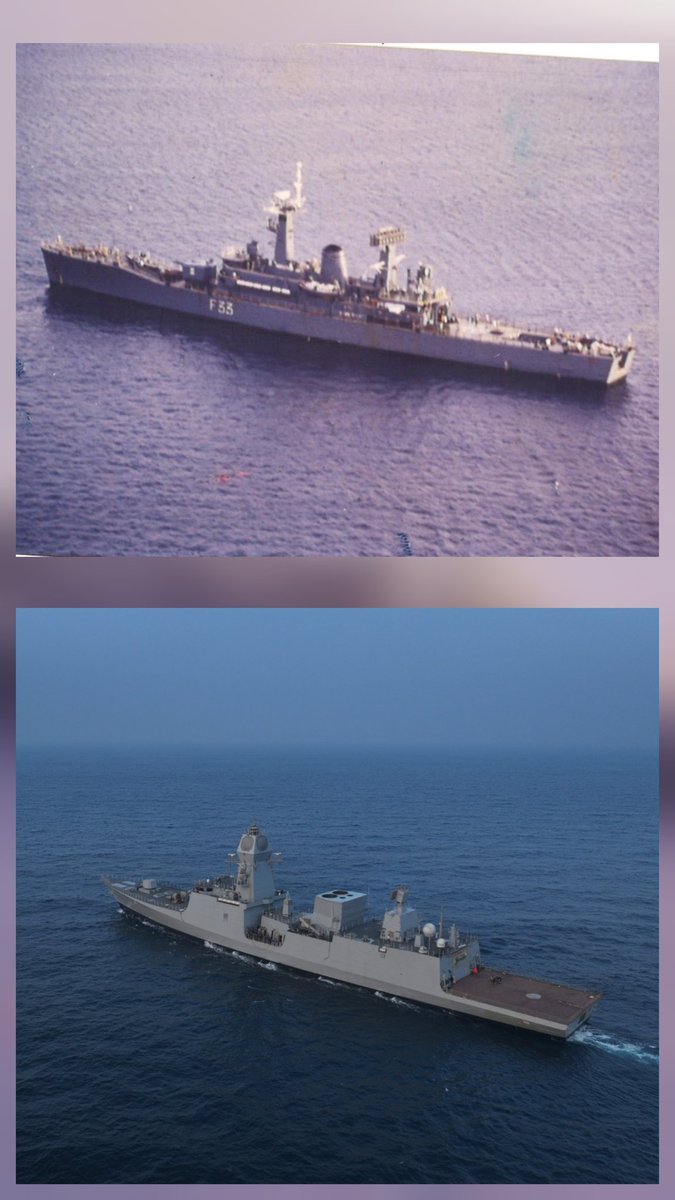
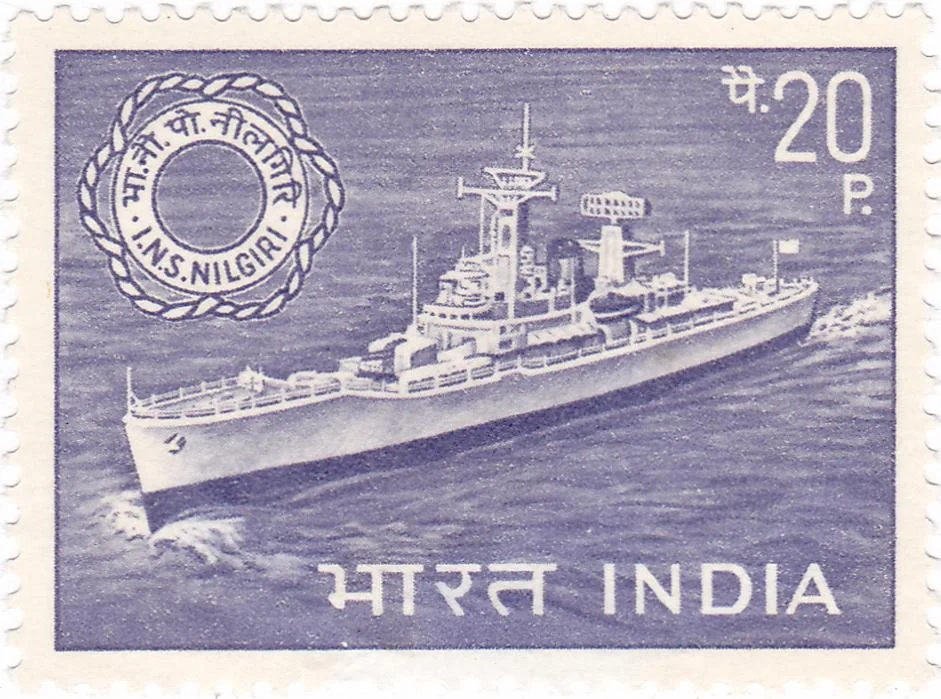
The old Nilgiri-class (above, the class being suggested here) and the new Nilgiri-class (below.)
Sources
- Transition to Triumph: History of the Indian Navy 1965-1975 by G. M. Hiranandani (2000)
- Nilgiri (Leander) Class – Indian Navy
- Nilgiri