- Yes
- No
Nakajima Ki-84.01 (中島 キ84.01)
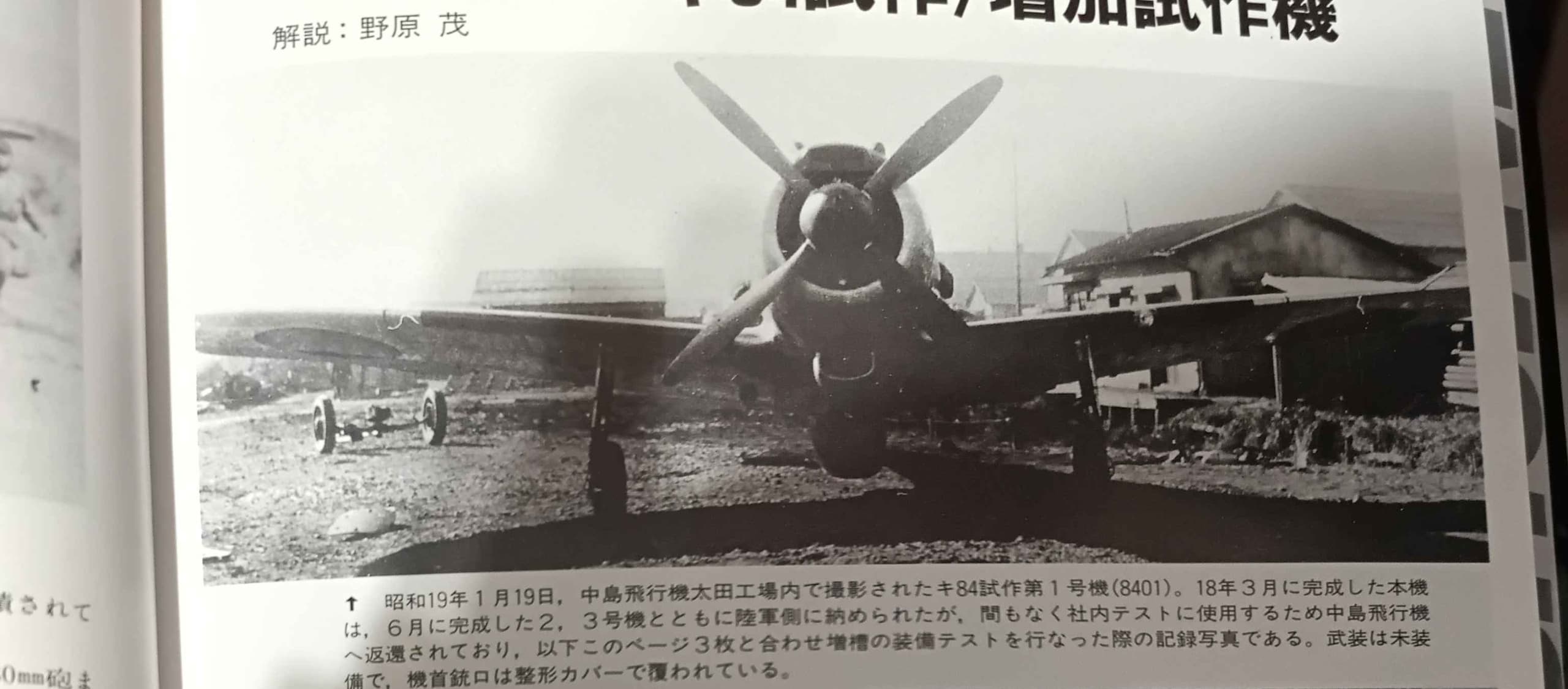
The Nakajima Ki-84.01 was the first prototype of the Nakajima Ki-84 fighter, which was completed on March 20, 1943. In total, three Ki-84 prototypes were made, but this description focuses on the unique first prototype.
History
In 1941, even before the outbreak of the war in the Pacific, the Japanese army headquarters came to the (correct) conclusion that the light fighters Ki-43 and the heavy fighters Ki-44 would need a successor in the near future. In 1940, they were looking for a replacement for the Ki-43 and Ki-44, which resulted in development work on the Kawasaki Ki-60, Ki-61, and partially the Ki-64, Nakajima Ki-62 and Ki-63, as well as the Mitsubishi Ki-65. Only three Kawasaki aircraft made it to the prototype stage ready in 1941 (Ki-60 and later the prototype Ki-64) and the Ki-61, which was adopted in 1942. After this stage of new projects, the Japanese army command knew that a new army fighter was needed that would combine the features of the Ki-43 (agility) and Ki-44 (huge firepower and high performance); additionally, the new aircraft was supposed to be easy to produce. On December 29, 1941, the Japanese Army Command issued requirements for a new heavy fighter for the army. The design requirements included, among other things:
- It was recommended to use the new prototype Nakajima Ha-45 engine
- The maximum speed was defined in the range between 640-680 km/h
- Tactical range of 400 km + 1.5 hours of combat operations
- The plane was supposed to reach an altitude of 5000 meters in 4.5 minutes
- Protection was required for the pilot’s head and back, as well as self-sealing fuel tanks
- The plane was supposed to be armed with two Ho-5 20mm cannons and two Ho-102 12.7mm machine guns
- The wing loading was not supposed to exceed 170 kg/m², and their surface area was supposed to be between 19 and 20 m²
- It was required that the plane would need fewer production man-hours than the Ki-43 (25,000 man-hours) or Ki-44 (24,000 man-hours); by April 1942, it was determined that production should not require more than 14,000 man-hours.
These design requirements were very demanding, but at the Nakajima factories there were very experienced fighter designers, led by Tei Koyama, the creator of the Nakajima Type 91, Ki-11, Ki-27, Ki-43, and Ki-44 fighters. Tei became the chief engineer of the aircraft design section for the Japanese army at Nakajima and selected the best Nakajima employees for the project. The head of the project was Shigenobu Mori, with Setsuro Nishimura as the lead designer. Yoshio Kondo and Muni Saito were responsible for the aerodynamics of the airframe, Kunihiro Aoki for structural strength, Toshiro Suganuma for the wings, Kiouyuki Kawabata for the fuselage, Toshihiko Kato and Kensaku Mikata for the control system, Masura Iino for the hydraulic system, Hisatoshi Kimura and Seiichi Furutachi for the armament, Hitoshi Kawamura for the powerplant, and Kazuo (Toshio?) Kimura and Yuiha Okuma for the electrical system. The preliminary design of the future Ki-84 was ready in the spring of 1942, and on May 27, the Japanese Army command approved it for further work. Work on the detailed design continued all summer until November 1942, when it was completed and work began on three Ki-84 prototypes. The first prototype was completed on March 20, 1943, at the Nakajima factory in Ota. Then, at the end of April, the first prototype was secretly transported to the factory airfield in Ojima, where it flew for the first time. Shortly after, the Ki-84.01 was sent to the test center in Fussa near Tokyo for flight tests conducted by the Experimental Aviation Department of the Imperial Army. Very promising news came from there, so in August, the Ki-84.01 was sent to the aviation school in Akeno. There, a flying ace from the Battle of Khalkhin Gol, Major Jyozo Iwahashi, took the controls. He gave a good review of the new fighter, praising it as easy to fly even for poorly trained pilots. (In June, the improved Nakajima Ki-84.02 with a larger wing area was also completed). During tests of the Ki-84.01, Iwahashi performed various aerobatics and, in the end, showcased the new plane’s capabilities by doing a very short landing (400 meters), which boosted the morale of young aviation cadets and impressed the observers. The Ki-84.01, Ki-84.02, and Ki-84.03 planes (completed in the fall of 1943) received very good reviews, but it turned out that the Ha-45 engine did not meet expectations, and the planes didn’t reach the required maximum speed, achieving only 624 km/h. The Japanese army command saw this as a big problem, but since a new fighter was needed, the decision was made to build pre-production Ki-84s to troubleshoot engine issues and potential hidden defects in the fighter. At the beginning, the Japanese army ordered 83 Increased Prototype of Ki-84 (pre-production planes), and later an additional 42 Increased Prototype of Ki-84 were ordered. (More information about the Nakajima Ki-84 Increased Prototype). Unfortunately, the further fate of Ki-84.01 is not known.

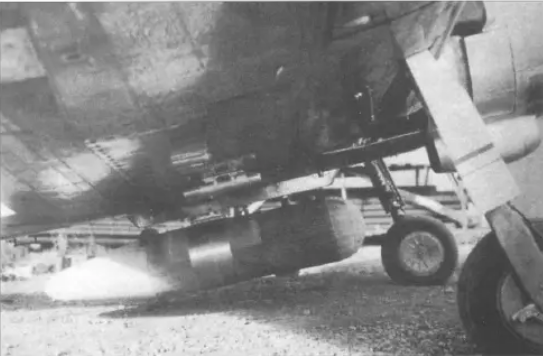
Construction description
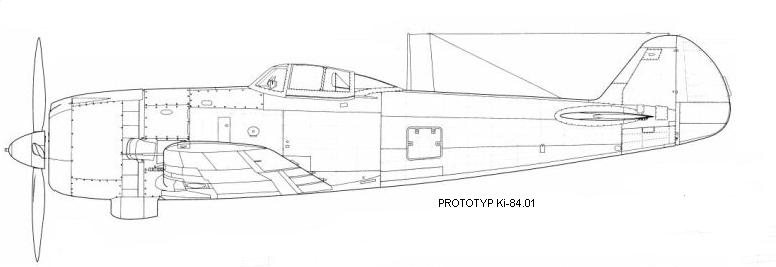
The Nakajima Ki-84.01 has many differences compared to the Ki-84 Ko from the game. I’ll try to present them here.
- The plane is equipped with a Nakajima Ha-45 model 11 (Ha-45-11) air-cooled, two-row, 18-cylinder engine with a takeoff power of 1,324 kW (1,800 HP) instead of a Nakajima Ha-45 model 21 (Ha-45-21) air-cooled, two-row, 18-cylinder engine with a takeoff power of 1,464 kW (1,990 HP)
- Collective exhaust pipe instead of single exhaust pipe.
- The rudder has a different shape, with the lower part protruding more aft.
- No mounts for bombs and fuel pods under the wings
- The headrest has a different shape
- The wing area is 19m² instead of 21m²
- The propeller has a diameter of 3000 mm instead of 3100 mm
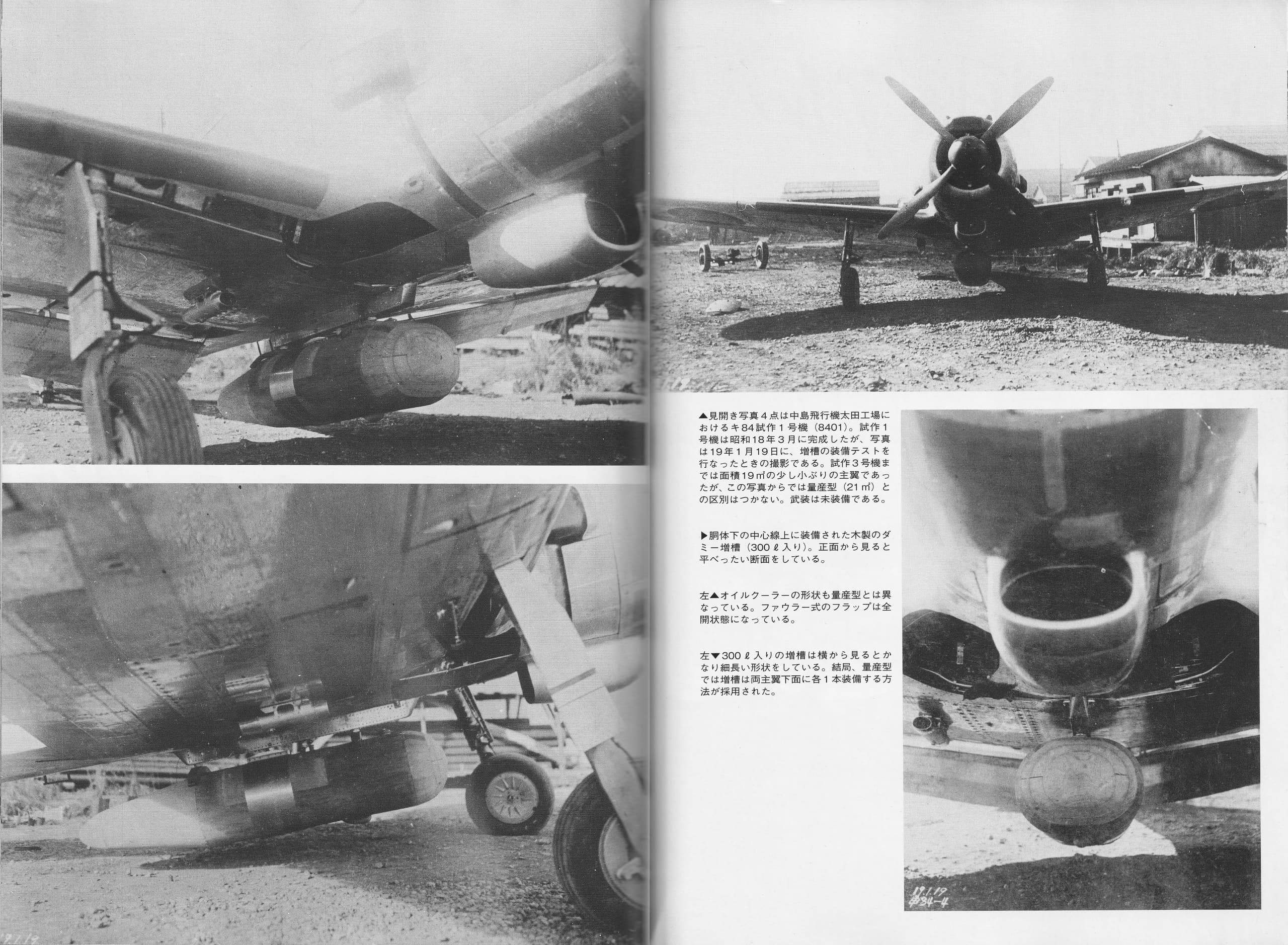
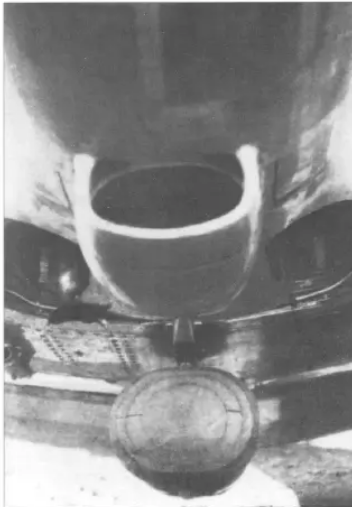
- Under the hull, an additional 200-300 L fuel tank can be installed
(I’m not sure if that’s everything, there were probably a lot of small changes too)
technical sketches
General characteristics
- Crew: 1
- Length: 9,92 m
- Wingspan: 11,24 m
- Height: 3,38 m
- Wing area: 19,00 m2
- Empty weight: 2,830 kg (?)
- Gross weight: 3250 kg
- Powerplant: 1 × Nakajima Ha-45 model 11 (Ha-45-11) air-cooled, two-row, 18-cylinder engine with a takeoff power of 1,324 kW (1,800 HP)
- Propellers: Four-blade metal propeller with variable pitch with a diameter of 3000 mm.
Performance
- Maximum speed: 624 km/h
- Cruise speed: 380
- Range: 1400 km (?)
- Maximum Range: ?
- Service ceiling: 12,400 m (?)
- Time to Climb to: 6,24 minutes to 5,000 m (?)
Armament
- Guns:
- 2 x 12.7mm Ho-103 Machine Gun in the nose (250-350 rounds per gun)
- 2 x 20mm Ho-5 Cannon in the wings (120-150 rounds per cannon)
- Fuel dump tanks:
- 1 x 200-300 L dump tanks under the hull
Armour
- 13 mm pilot seat and headrest
- Self-sealing fuel tanks
- 70mm bulletproof glass (?)
Special thanks
Summary
The Nakajima Ki-84.01 is an interesting fighter for Japan. This plane, although it has smaller wings, is lighter than the standard Ki-84-I Ko, which gives it a better wing loading (Ki-84.01 - 171.1 kg/m², Ki-84-I Ko - 185.24 kg/m²). Of course, the Ki-84.01 has a weaker engine, no access to bombs, and probably didn’t have bulletproof glass in the cockpit, which requires new tactics for it, making it a lot of fun for players. The Nakajima Ki-84.01 is great as an addition to the regular tech tree and can also be an event plane or a premium one. I encourage you to discuss in the comments and to share your own knowledge on this subject.
Finally, I apologize for the linguistic and logical errors because unfortunately English is not my main language and I had to use google translator.
Internet sources
四式戦闘機 - Wikipedia
Nakajima Ki-84 Hayate - Wikipedia
Nakadžima Ki 84-Ia (předsériové) : NakadžimaУголок неба ¦ Nakajima Ki.84 Hayate
【キ84】 四式戦闘機『疾風』/中島Nakajima Ki-84 | 大日本帝国軍 主要兵器
Book sources
- 日本航空機辞典 1910年(明治43年)~1945年(昭和20年) 上巻 (Encyclopedia of Japanese Aircraft 1910 (Meiji 43) – 1945 (Showa 20), Volume 1) page 118-119
- 野沢正『日本航空機総集 中島篇』(Masaru Nozawa ‘Comprehensive Collection of Japanese Aircraft: Nakajima Volume’) page 125-131
*『日本軍用機写真集』1 (ファイター) ,文林堂, (“Japanese Military Aircraft Photo Collection 1 (Fighters)”, Bunrindo) page 59-67 - Bunrindo - Famous Airplanes of The World 20 (1971) - Nakajima Hayate
- Bunrindo - Famous Airplanes of The World 19 (1989) - Army Type 4 Fighter “Hayate”
- Lotnictwo 9 - Samolot myśliwski Nakajima Ki-84 Hayate Frank (Aviation 9 - Nakajima Ki-84 Fighter Plane Hayate Frank)
- Technika wojskowa historia numer specjalny 4/2019 (Military Technology: History Special Issue 4/2019) page 25-40
- Lotnictwo wojskowe numer 1/2001 (Military Aviation No. 1/2001), page 27-41
- Nakajima Ki-84 Hayate (PDFDrive) | PDF

Thank you for reading the suggestion, see you in the next one. Good luck pilots