- Yes
- No
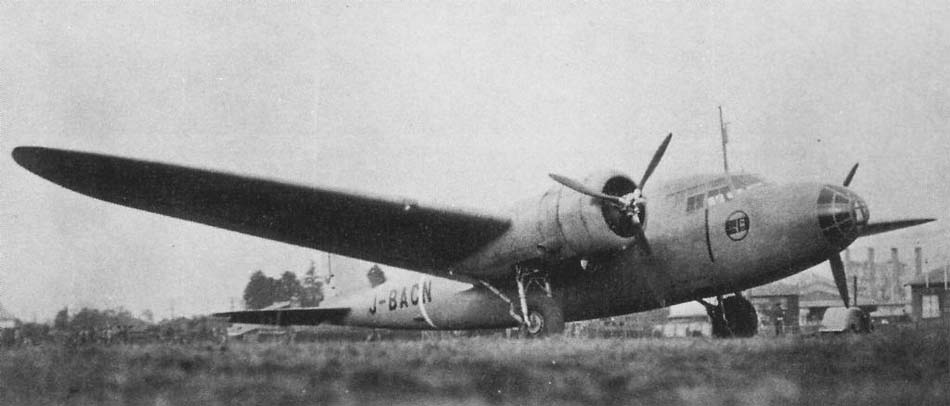
Nakajima Ki-19 (中島 キ19)
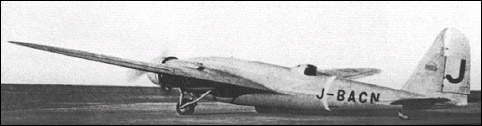
The Nakajima Ki-19 is a prototype bomber. This plane was first flown in March 1937. Probably four Ki-19 prototypes were built, which competed in the army’s contest for a new heavy bomber against the Mitsubishi Ki-21. Some Ki-19s were converted into long-range civilian transport planes with the designation N-19.
History
In 1935, the Japanese army was fully aware that the heavy bomber Ki-1 was already quite outdated, so they decided to announce a competition for its replacement. In September 1935, the competition was announced. The companies that decided to participate in this competition were Nakajima (the future Ki-19), Mitsubishi (the future Ki-21), and Kawasaki (the future Ki-22). The Japanese army’s requirements for the new heavy bomber were set in February 1936 and were as follows:
- A twin-engine monoplane, equipped with Nakajima Ha-5 or Mitsubishi Ha-6 engines
- The top speed exceeds 400 km/h
- The flight time is over 5 hours
- The bomb load is 750 kg (maximum 1,000 kg)
- Two prototypes were completed by October 1936
After the projects were created and submitted by the companies to the Japanese Army command, Kawasaki withdrew from the competition. Nakajima and Mitsubishi were given permission to build their Ki-19 and Ki-21 planes. The Ki-21 prototypes were ready by December 1936, while the Ki-19 prototypes were only ready in March 1937. Right after the Ki-19 prototypes were delivered, comparative tests of this plane against the Ki-21 began, and it turned out that both designs were very good. The Japanese Army really had a big problem deciding which plane would become the successor to the Ki-1. They decided to swap the engines in the bombers to see how the planes would perform in that case. For this purpose, a prototype Ki-19 was built equipped with Mitsubishi Ha-6 engines instead of the Nakajima Ha-5 Ko engine. When the second round of tests came, the modified Ki-21 (the nose shape was changed to look like the Ki-19 and a few other modifications were made) with Nakajima Ha-5 Ko engines turned out to be better than the Ki-19 and was accepted into service. The fate of the prototype Ki-19s with Nakajima Ha-5 Ko engines is unknown. However, the prototype Ki-19 with a Mitsubishi Ha-6 engine was sent to Dōmei Tsushin in 1939 as a civilian transport plane.
Construction description
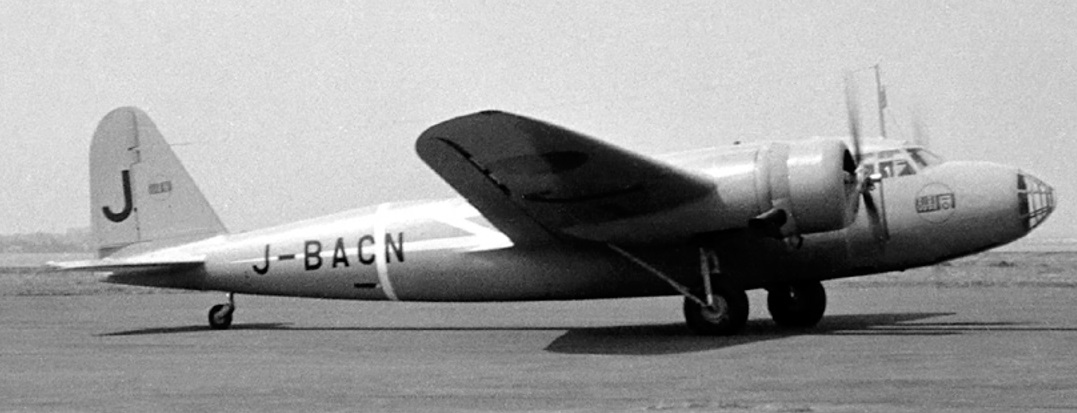
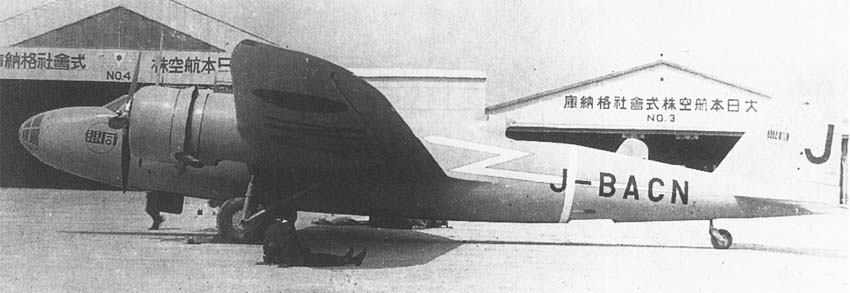
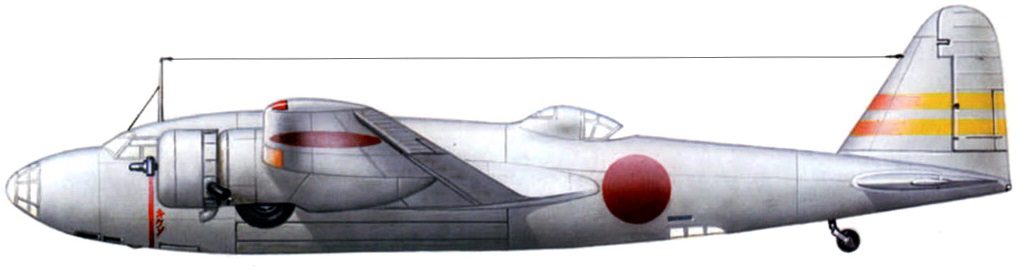
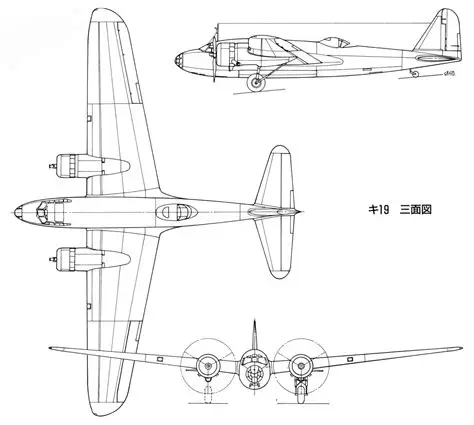
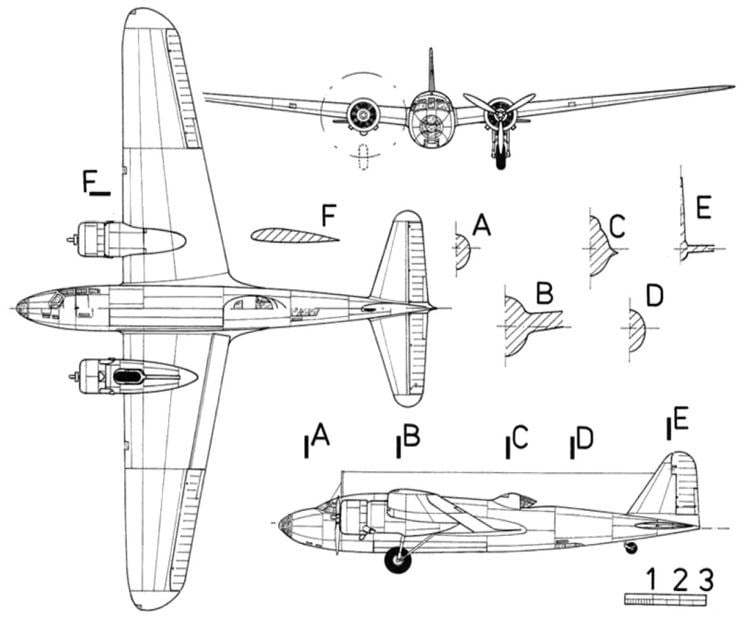
The Nakajima Ki-19 is a bomber with an all-metal construction and a mid-wing design. The plane has a conventional landing gear layout. Inside the fuselage, there is a bomb bay that can hold 750 kg of bombs or 1000 kg if the fuel load is reduced. The aircraft was powered by two Nakajima Ha-5 Ko engines, air-cooled, two-row, fourteen-cylinder engines with a takeoff power of 655 kW (890 hp). The engines drove three-blade propellers with a diameter of 3,300 mm. The crew consists of five people – the pilot, a second pilot/navigator, a bombardier/front gunner, a radio operator/gunner, and a gunner. The plane’s defensive armament includes three Type 89 7.7 mm machine guns mounted in the nose, the belly, and the top of the aircraft.
Technical sketches
General characteristics
- Crew: 5
- Length: 16,22 m
- Wingspan: 21,90 m
- Height: 4,06 m
- Wing area: 62,694 m2
- Empty weight: 4987 kg
- Gross weight: 7150 kg
- Maximum Take-off Weight: 7360 kg
- Powerplant: 2 x Nakajima Ha-5 Ko engines, air-cooled, two-row, fourteen-cylinder engines with a takeoff power of 655 kW (890-950 hp)
- Propellers: Three-blade metal propeller with a diameter of 3,300 mm
Performance
- Maximum speed: 426,2 km/h
- Cruising speed: 300 km/h
- Range: 1641 km
- Maximum Range: ?
- Service ceiling: 8600m
- Climb Rate: ?
- Rate of climb: 13,24 min to 5000 m
Armament
- Guns:
- 1 x Type 89 7.7 mm machine gun in the nose (500 rounds)
- 1 x Type 89 7.7 mm machine gun on the back (720 rounds)
- 1 x Type 89 7.7 mm machine gun on the belly (360 rounds)
- Bombs:
- 1 x 1000 kg bomb (in the bomb bay)
- 2 x 500 kg bomb (in the bomb bay)
- 3 x 250 kg bomb (in the bomb bay)
- 4 x 250 kg bomb (in the bomb bay)
- 7 x 100 kg bomb (in the bomb bay)
- 10 x 100 kg bomb (in the bomb bay)
- 15 x 50 kg bomb (in the bomb bay)
- 20 x 50 kg bomb (in the bomb bay)
- 50 x 15 kg bomb (in the bomb bay)
- 35 kg flar
Summary
The Nakajima Ki-19 is an interesting bomber for Japan in War Thunder. In terms of design, this plane would make a good complement to the Mitsubishi Ki-21. It offers decent performance with good defensive and bomb armament. The Nakajima Ki-19, along with its brother the Nakajima LB-2, is perfect for event planes with an interesting history or premium planes. They could also end up in regular TT. I encourage you to discuss in the comments and to share your own knowledge on this subject.
Finally, I apologize for the linguistic and logical errors because unfortunately English is not my main language and I had to use google translator.
Internet sources
キ19 (航空機) - Wikipedia
Nakajima Ki-19 - Wikipedia
Nakajima Ki.19 Info
Nakadžima Ki 19 : Nakadžima
Уголок неба ¦ Nakajima Ki-19
Book sources
- 日本航空機辞典 1910年(明治43年)~1945年(昭和20年) 上巻 (Encyclopedia of Japanese Aircraft 1910 (Meiji 43) – 1945 (Showa 20), Volume 1) page 84
- 野沢正『日本航空機総集 中島篇』(Masaru Nozawa ‘Comprehensive Collection of Japanese Aircraft: Nakajima Volume’) page 84-86
*『日本軍用機写真集』2 (爆撃機),文林堂, (“Japanese Military Aircraft Photo Collection 2 (Bombers)”, Bunrindo) page 44 - The Xplanes of Imperial Japanese Army and Navy 1924-45 page 28
The Xplanes of Imperial Japanese Army and Navy 1924-45 | PDF

Thank you for reading the suggestion, see you in the next one. Good luck pilots