- Yes
- No
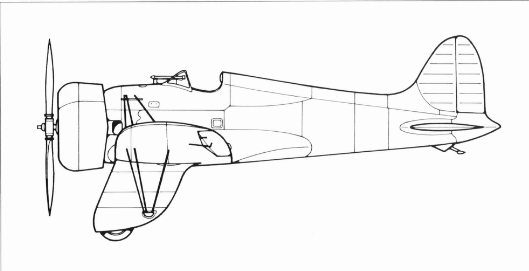
Nakajima A5N (九試単座戦闘機)
The Nakajima A5N is a prototype Japanese Navy fighter that was developed in 1935. This plane was based on the Nakajima Ki-11 fighter design and was meant to compete with the Mitsubishi Ka-14 (prototype of the Mitsubishi A5M1) in a Navy aircraft competition. Only one prototype of the Nakajima A5N was built.
History
In 1934, the Japanese Navy was looking for a successor to the Nakajima A4N1 fighter, which was already obsolete at the time of its introduction. In order to replace the A4N1 fighters, the Shi-9 specification was prepared, which was as follows:
- Maximum speed: > 352 km/h at an altitude of 3000 m above sea level.
- Climbing force: Up to 5000m altitude in 6 minutes and 30 seconds
- Fuel tank capacity: >200 liters
- Armament: 7.7mm ×2 machine gun
- Dimensional limitations: up to 11 m wide and 8 m long
Mitsubishi and Nakajima took part in the competition. The Nakajima plane received the in-house designation Nakajima PA Kai (Kai meaning modified), which perfectly reflects a design that was a modification of the Nakajima Ki-11 fighter for the navy. The project was led by engineers Tei Koyama and Shinroku Inoue, who were also working on the Nakajima Ki-11. Changes to the design included replacing the Nakajima Kotobuki 3 engine with a Nakajima Kotobuki 5 engine. Additionally, the cockpit equipment was modified to meet navy requirements, and the machine guns were changed from Type 89 to Type 92. The Nakajima A5N was probably ready by April 1935 and was sent for comparative tests against the competing Mitsubishi Ka-14 (prototype of the Mitsubishi A5M1). In tests, the Nakajima A5N reached a top speed of 407 km/h and turned out to be inferior to the Mitsubishi plane in every way. This led to the rejection of the Nakajima A5N and the continuation of work on the promising Mitsubishi Ka-14. In the autumn of 1936, the Mitsubishi Ka-14 was accepted into service as the Mitsubishi A5M1 or Mitsubishi Navy Type 96 Carrier-based Fighter.
Construction description
The Nakajima A5N is a low-wing fighter with a wood-metal construction made of duralumin, with ailerons and flaps covered in fabric. The fighter’s wings are reinforced with steel wires (three on top and three on the bottom). The landing gear was fixed and equipped with aerodynamic covers. The Nakajima A5N had an open cockpit. The plane was powered by a Nakajima Kotobuki 5 air-cooled, radial, nine-cylinder engine with a takeoff power of 405 kW (550 hp) and was equipped with a two-blade metal propeller with a diameter of 2.9 meters. The fighter’s armament consisted of two 7.7mm Type 92 machine guns in the nose of the aircraft.
Technical sketches
General characteristics
- Crew: 1
- Length: 7,45 m
- Wingspan: 10,80 m
- Height: 3,37 m
- Wing area: 18,0 m2
- Empty weight: 1,200 kg
- Gross weight: 1,500 kg
- Maximum Take-off Weight: ?
- Powerplant: 1 x Nakajima Kotobuki 5 air-cooled, radial, nine-cylinder engine with a takeoff power of 405 kW (550 hp)
- Propellers: Two-bladed metal propeller with a diameter of 2,900 mm
Performance
- Maximum speed: 407 km/h
- Cruising speed: 350 km/h
- Range: ?
- Maximum Range: ?
- Service ceiling: 7000 m
- Climb Rate: ?
- Rate of climb: 6,09 min to 5000 m
Armament
- 2 x Type 92 7.7mm Machine Guns in the nose
Special thanks
Summary
The Nakajima A5N is an interesting plane for Japan in War Thunder. This aircraft is a good candidate for a naval fighter that can take on enemy fighters. It could be added to the game along with its competitor, the Mitsubishi A5M1. The Nakajima A5N could be added to regular TT or as a premium or event plane. I encourage you to discuss in the comments and to share your own knowledge on this subject.
Finally, I apologize for the linguistic and logical errors because unfortunately English is not my main language and I had to use google translator.
Internet sources
Book sources
- Mikesh, Robert C.; Abe, Shorzoe (1990).Japanese Aircraft, 1910-1941 page 234
- 野沢正『日本航空機総集 中島篇』(Masaru Nozawa ‘Comprehensive Collection of Japanese Aircraft: Nakajima Volume’) page 185
- Japońskie Samoloty Marynarki 1912-45 część I (Japanese naval aircraft 1912-45 part I) page 68-69
Japonskie Samoloty Marynarki 1912-45 | PDF

Thank you for reading the suggestion, see you in the next one. Good luck pilots