- Yes
- No
- (independent) BeNeLux tree
- France: BeNeLux subtree
- South Korea (ROKN tree)
- other
- no/negative
- 1x twin 12.7 mm Browning
- 1x twin 20 mm Oerlikon
- both versions
- other (please comment)
- no/negative
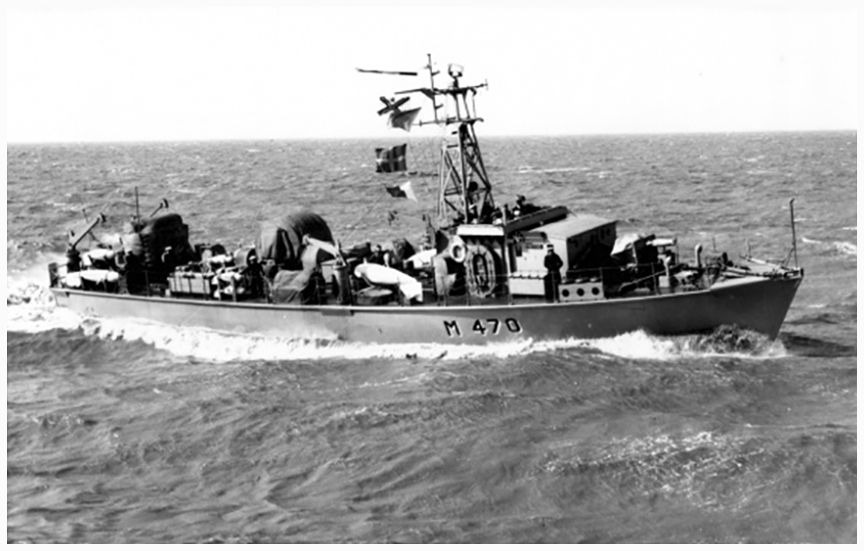
TL;DR: MSI-class Belgian inshore minesweeper M470 Temse, served 1958–1970Armed with twin 12.7 mm or 20 mm, specialized for shallow-water mine warfare.
History
History
The Belgian Navy in the post-WWII era relied heavily on Allied-built minesweepers. By the mid-1950s, replacements were required for inshore service, leading to the construction of the MSI-class (dragueurs de mines de petit fond) at the Mercantile Marine Yard in Kruibeke.
The M470 Temse was laid down on 6 August 1956 and commissioned in January 1958. She was sponsored by the city of Temse and bore the callsign ORHG. Equipped with Decca 707 navigation radar and acoustic/magnetic sweeping gear, she was optimized for mine warfare in shallow waters (Van Beylen et al., 1972).
Temse served with the Belgian Naval Force until 26 March 1970, when she was decommissioned and transferred to South Korea under the name SURO (Anrys, De Decker de Brandeken, & Eygenraam, 1992). In South Korea, she most likely was turned into a private vessel or dismantled, extending the MSI-class legacy abroad slightly. (Note: Sources on what happened after March of 1970 are rare and often secondary accounts, no pictures after 1970 exist anywhere)
Commanding Officers (Belgium)
- Lemaire, Walter L.M.
- Pope, William H.

Specifications (M470 Temse)
Displacement:
- 173.12 t (freshwater, full load)
- 177.55 t (saltwater, full load)
Dimensions:
- Length overall: 34.44 m
- Length between P/P: 32.46 m
- Beam: 6.65 m (max) / 6.58 m (waterline)
- Depth: 3.65 m
- Draught: 1.80 m (2.10 m max)
- Waterline length: 12.20 m
Propulsion:
- 2 × Nuove Reggiane diesels, 2 shafts
- 1260 hp total (2 × 260 rated engines)
- Fuel: 18 t diesel
Speed: 15 knots
Range: 2,300 nm @ 10 knotsCrew: 18 (2 officers, 7 petty officers, 9 sailors)
Electronics: Radar Decca 707 (navigation)
Armament Variants:
Version Weapons Standard 1 × twin 12.7 mm Browning HMG Alternate 1 × twin 20 mm Oerlikon AA gun Mine Warfare Gear: Acoustic, magnetic, and mechanical sweeps
Construction: Wooden hull with non-magnetic fittings
Place in War Thunder
Regarding nations
BeNeLux
In a future BeNeLux coastal fleet, Temse would serve as an early Cold War mine warfare ship with modest armament but significant historical value.
France (BeNeLux subtree)
Alternatively, she could be included in France as part of the BeNeLux subtree.
South Korea
Since she later served as SURO with the Republic of Korea Navy, she could also be introduced into a future South Korean tree. This makes her unique as a cross-national asset.
Pictures
Pictures
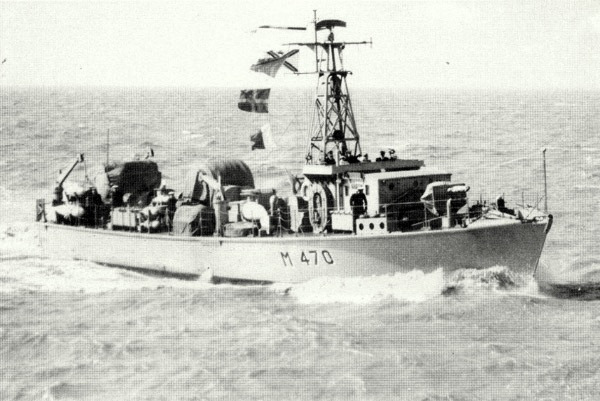
M470 Temse in Belgian service.
Sources
Sources
Anrys, H., De Decker de Brandeken, J.-M., & Eygenraam, P. (1992). De zeemacht: van de admiraliteit van Vlaanderen tot de Belgische zeemacht. Tielt.
Dragueurs de mines belges de type MSI. (2023). Wikipedia. Retrieved September 27, 2023, from https://fr.wikipedia.org/wiki/Dragueurs_de_mines_belges_de_type_MSI
Hofkens, L. (2021). Officiële eigendomsoverdracht van de mijnenveger M477 Oudenaarde. Ruimschoots, 22(1).
Jalon, R. (2010). De MSI 477 “Oudenaarde” in de watten gelegd door een enthousiaste ploeg vrijwilligers. Ruimschoots, 10(4).
Masset, F., & Grimbergs, E. (2015). MSI M477 Oudenaarde. Ruimschoots, 15(3), 21–23.
NavSource Naval History. (2023). Mine Warfare Vessel Photo Archive. Retrieved September 27, 2023, from http://www.navsource.org/archives/11/0583.htm
Van Beylen, J., et al. (1972). Maritieme Encyclopedie (Vol. 5). Bussum.
Belgian Navy Forum. (n.d.). MSI mine sweeper inshore. Archived at: https://archive.wikiwix.com/cache/?url=http%3A%2F%2Fwww.belgian-navy.be%2Ff13-msi-mine-sweeper-inshore
Belgian MSC/MSI Archive. (n.d.). Retrieved from https://archive.wikiwix.com/cache/?url=http%3A%2F%2Fbelgian-msc-msi.doomby.com%2F