- Yes
- No

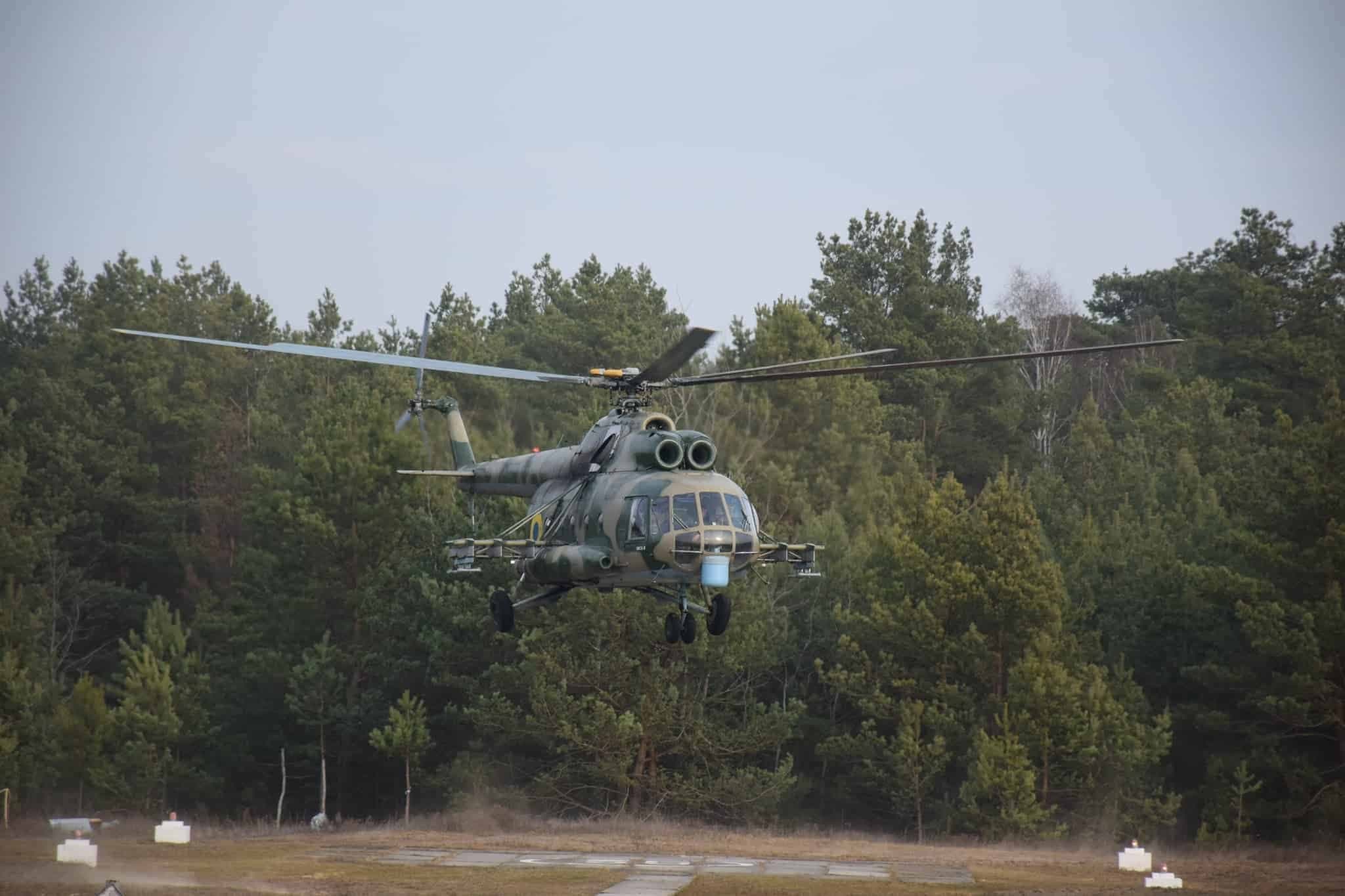
- BASIC DESCRIPTION -
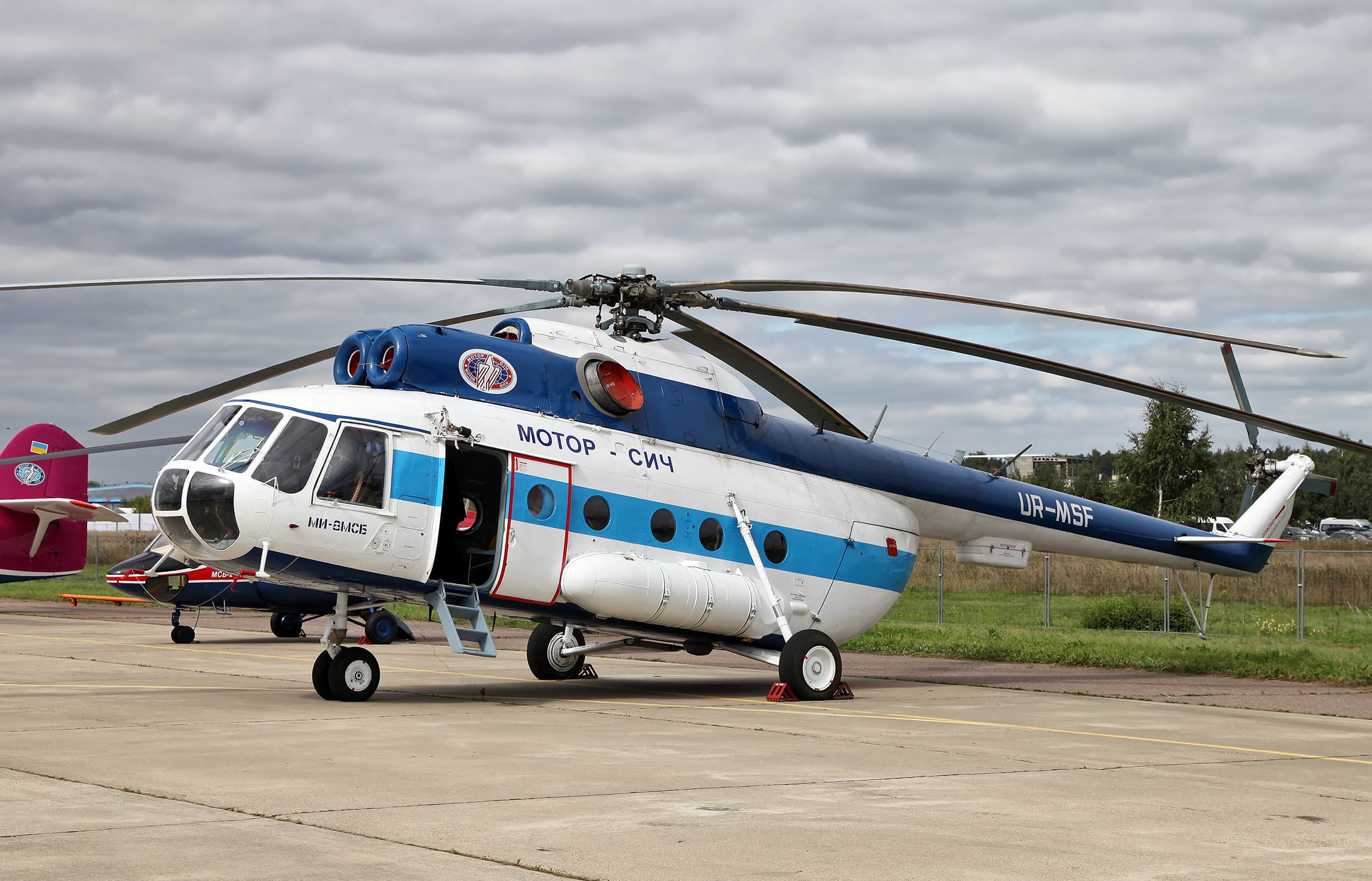
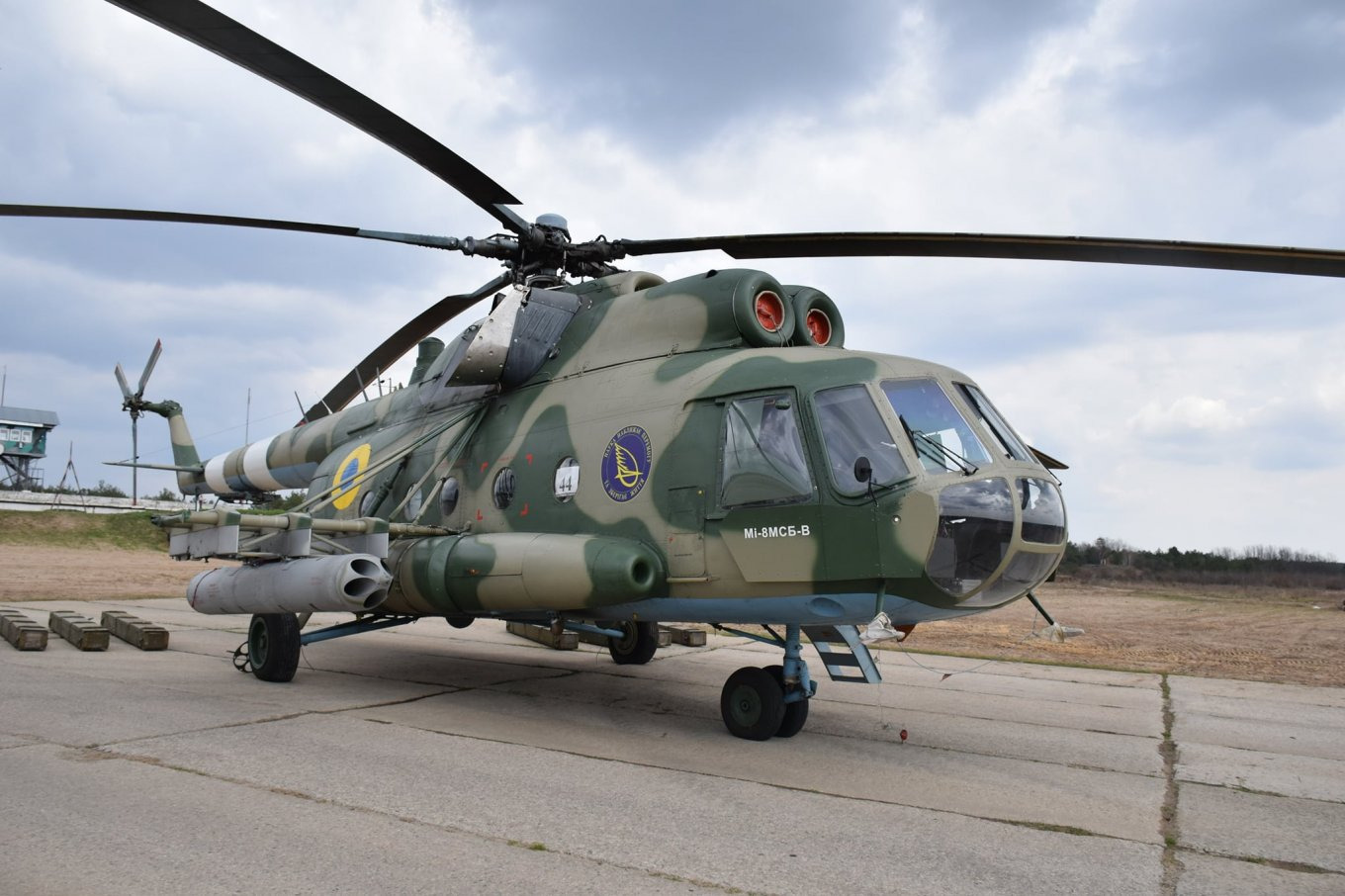
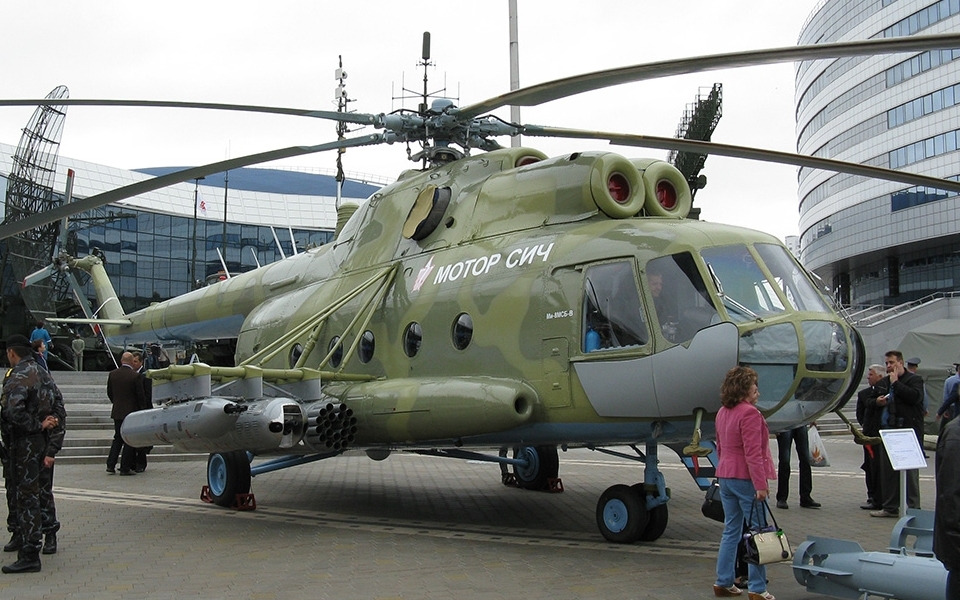
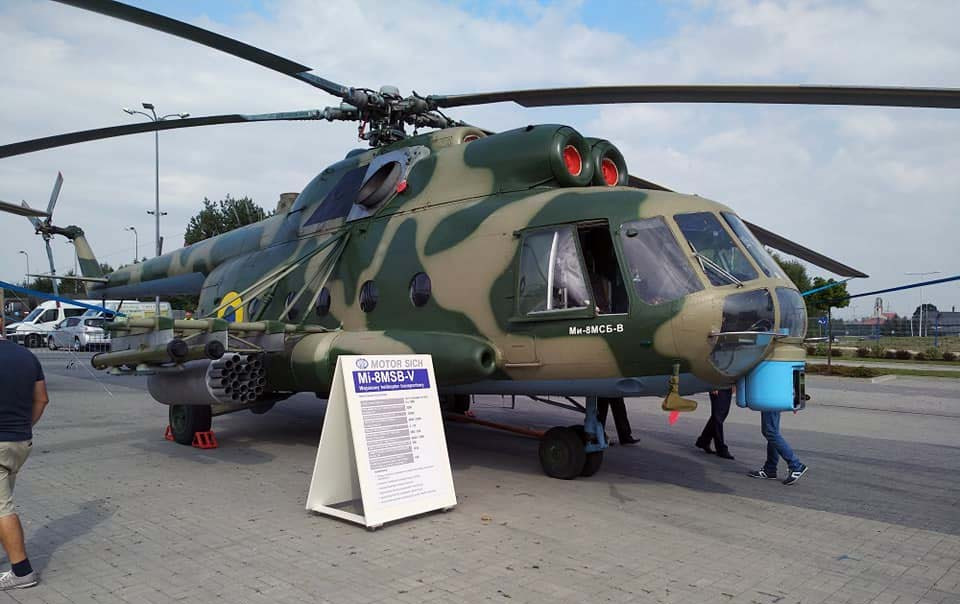
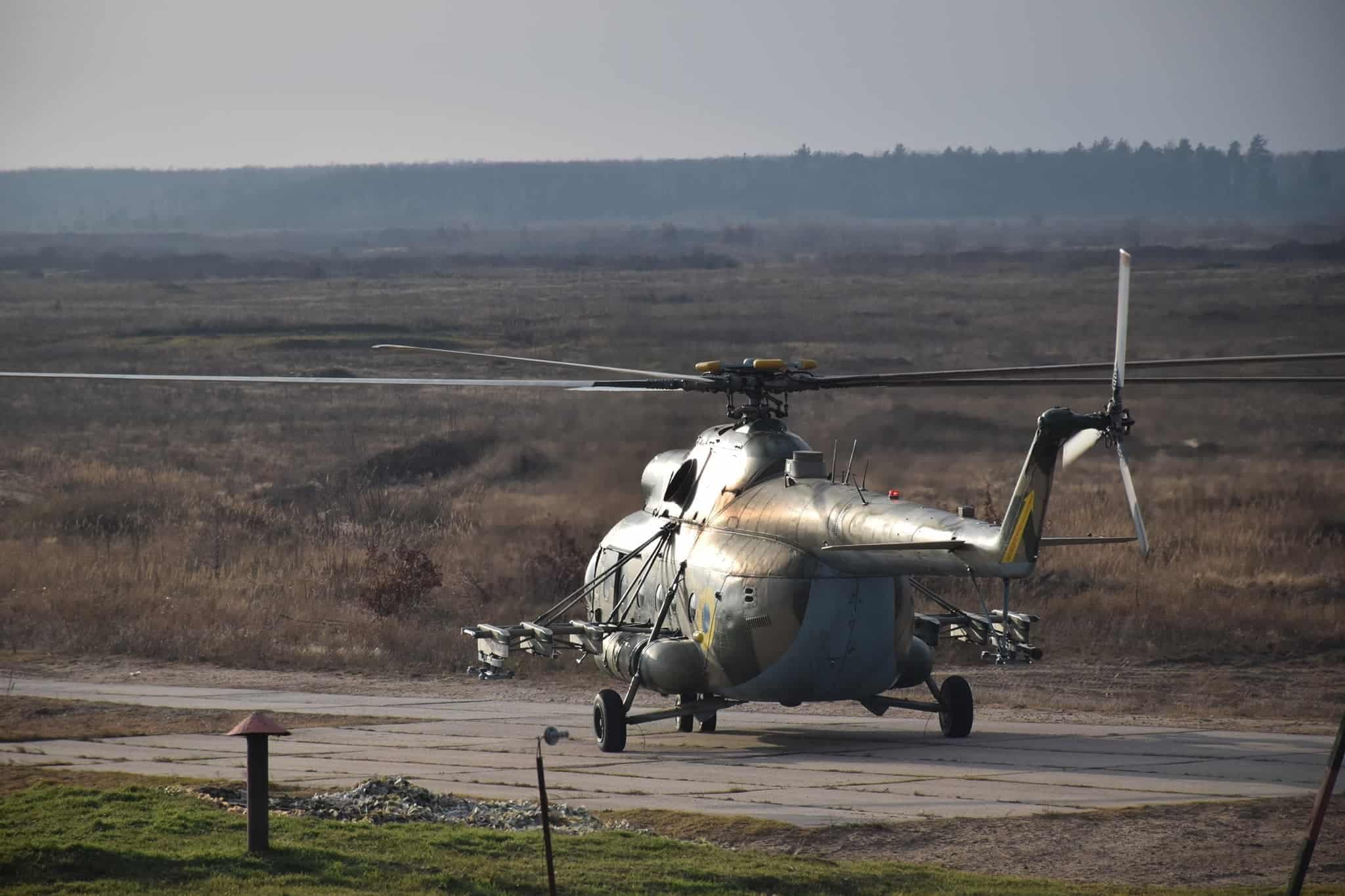
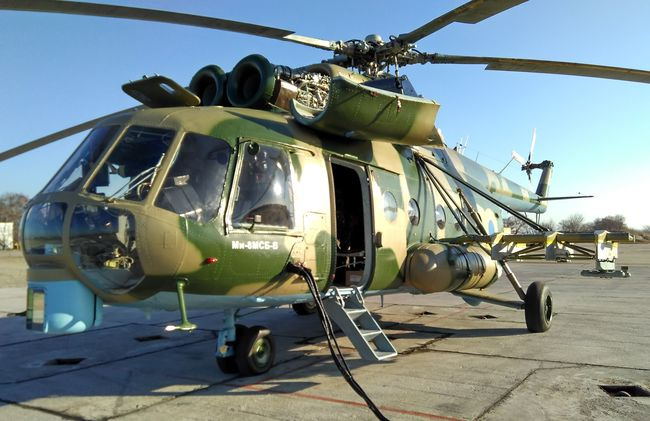
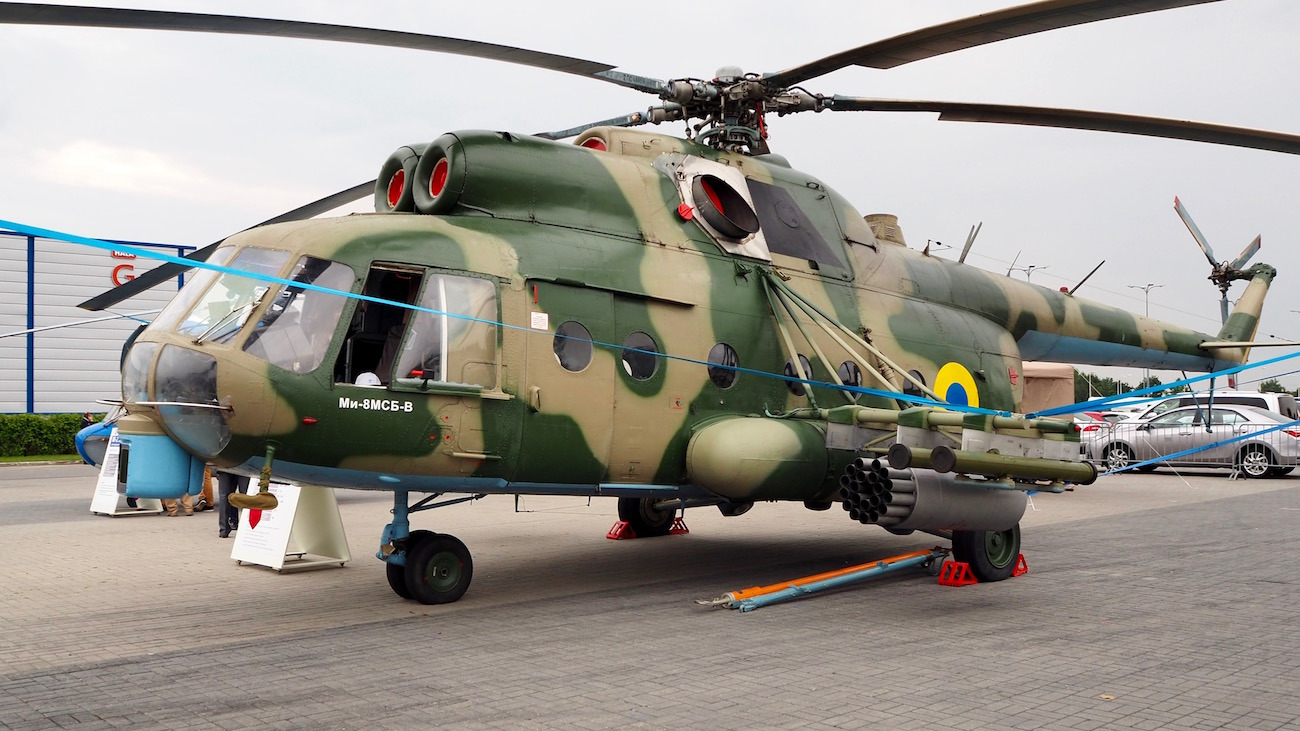
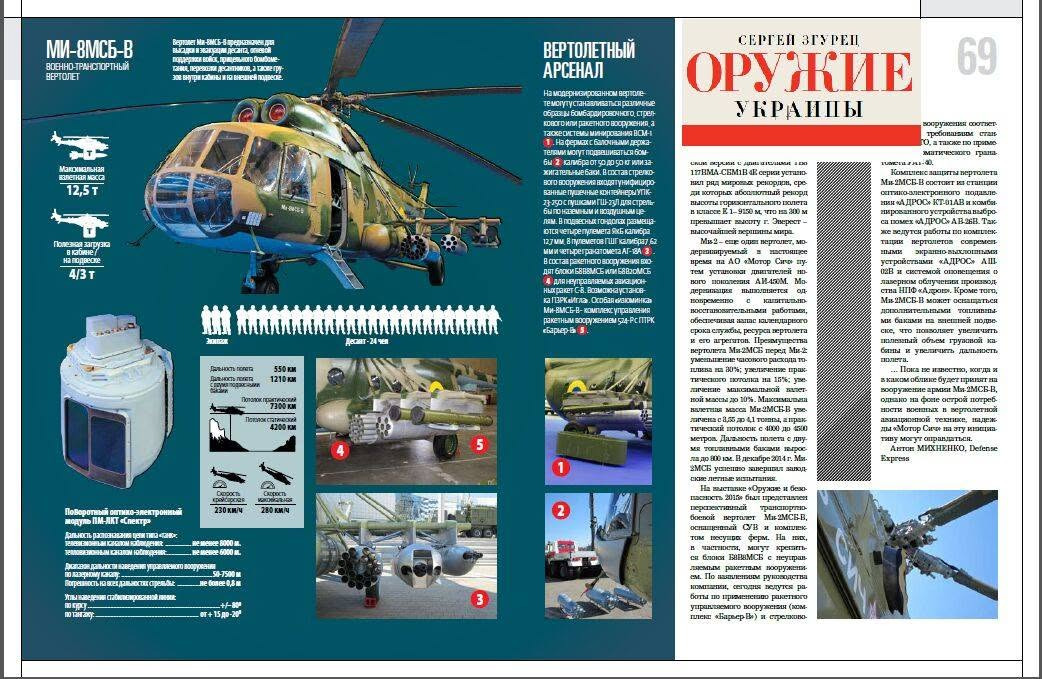
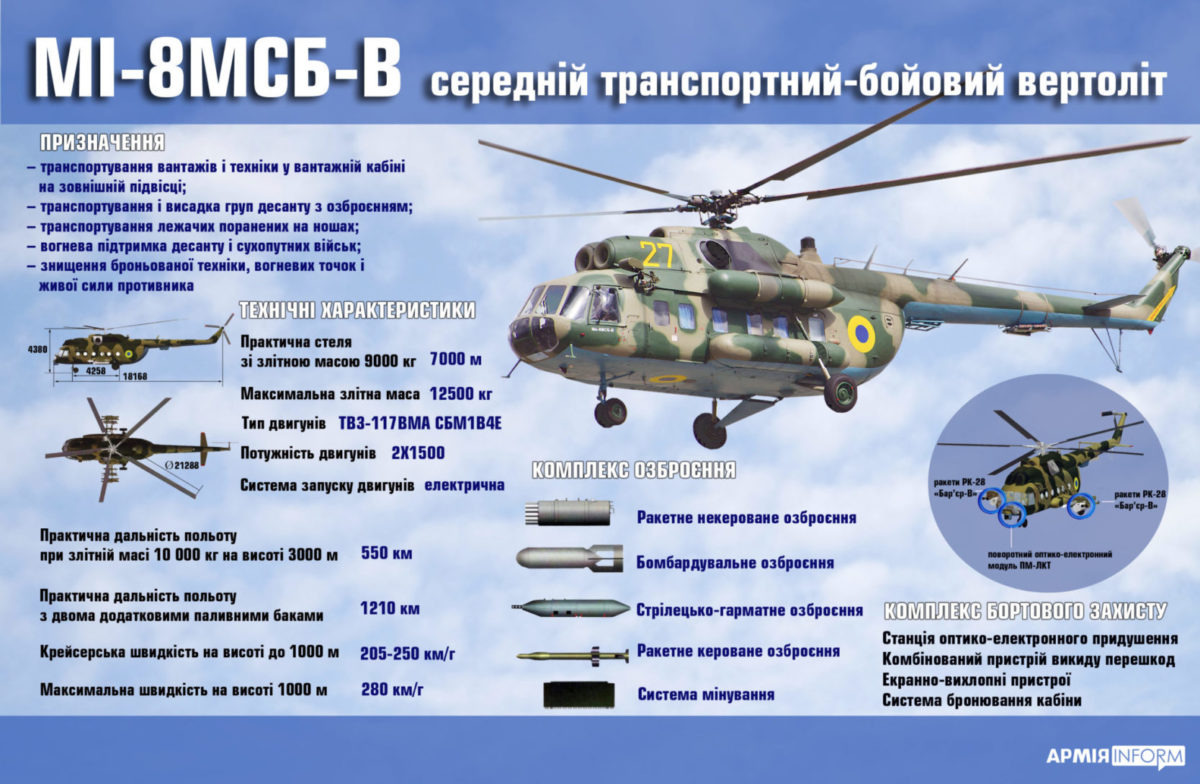
Mi-8MSB-V (524R) (since 2021, renamed by the company as 8MSB-V) - is a deep modernization based on the Soviet Mil Mi-8T helicopter, designed and produced by the Ukrainian manufacturer Motor Sich. It is part of a larger MSB helicopter family with various versions for civilian and military use. MSB in the name stands for “Motor Sich Bohuslayev” [Bohuslayev being a former chief engineer of the company], and V stands for “Viysʹkovyy” [Eng.: Military].ㅤThe upgrade involved completely replacing the old engines with new, more powerful TV3-117VMA-SBM1V series 4E turboshaft engines manufactured by Motor Sich, featuring an electronic start. The new engines reduce fuel consumption, increase the flight range, raise the static ceiling and the dynamic ceiling, concurrently extending the helicopter’s service life.
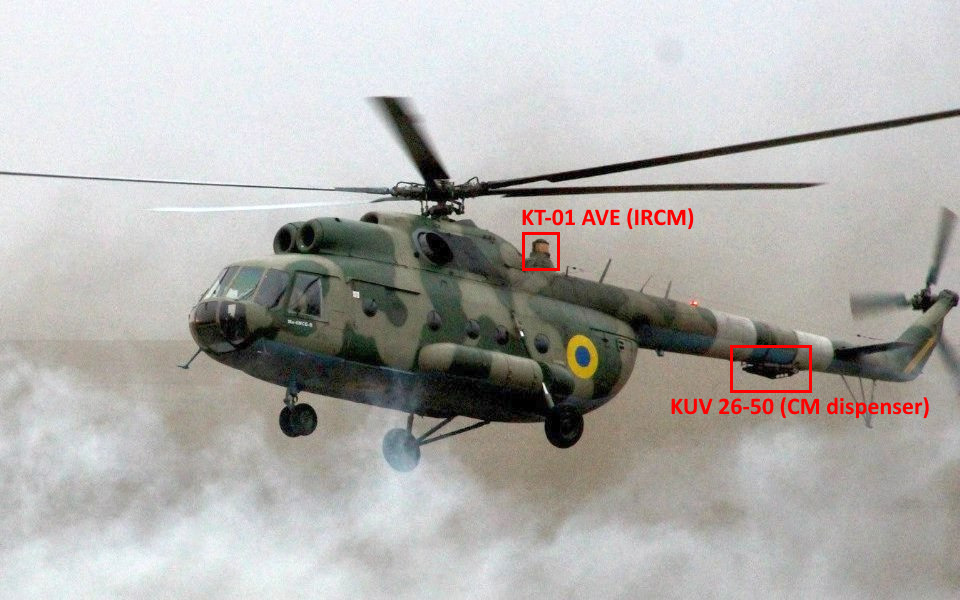
ㅤIn its military configuration, the Mi-8MSB-V is equipped with new flight data systems, a laser aiming mark generation system (FPM-01KV), an “Adros” KT-01 AVE infrared countermeasure (IRCM) system, “Adros” KUV 26-50 countermeasure dispensers, and ASh-01V exhaust screen devices to reduce its heat signature.
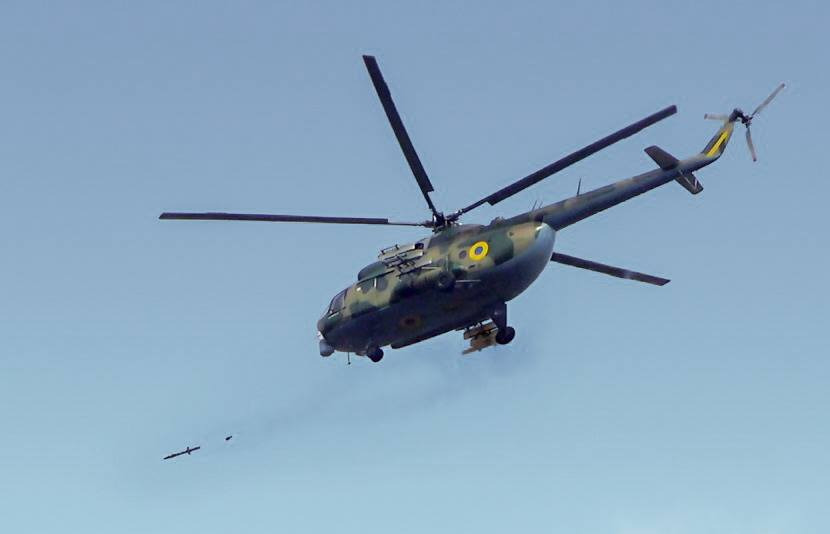
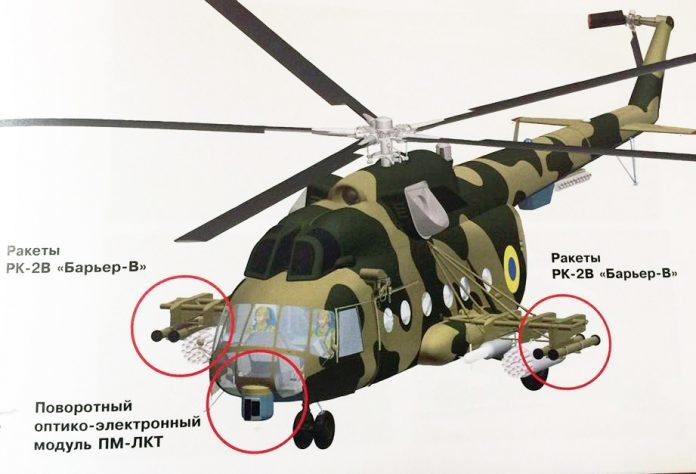
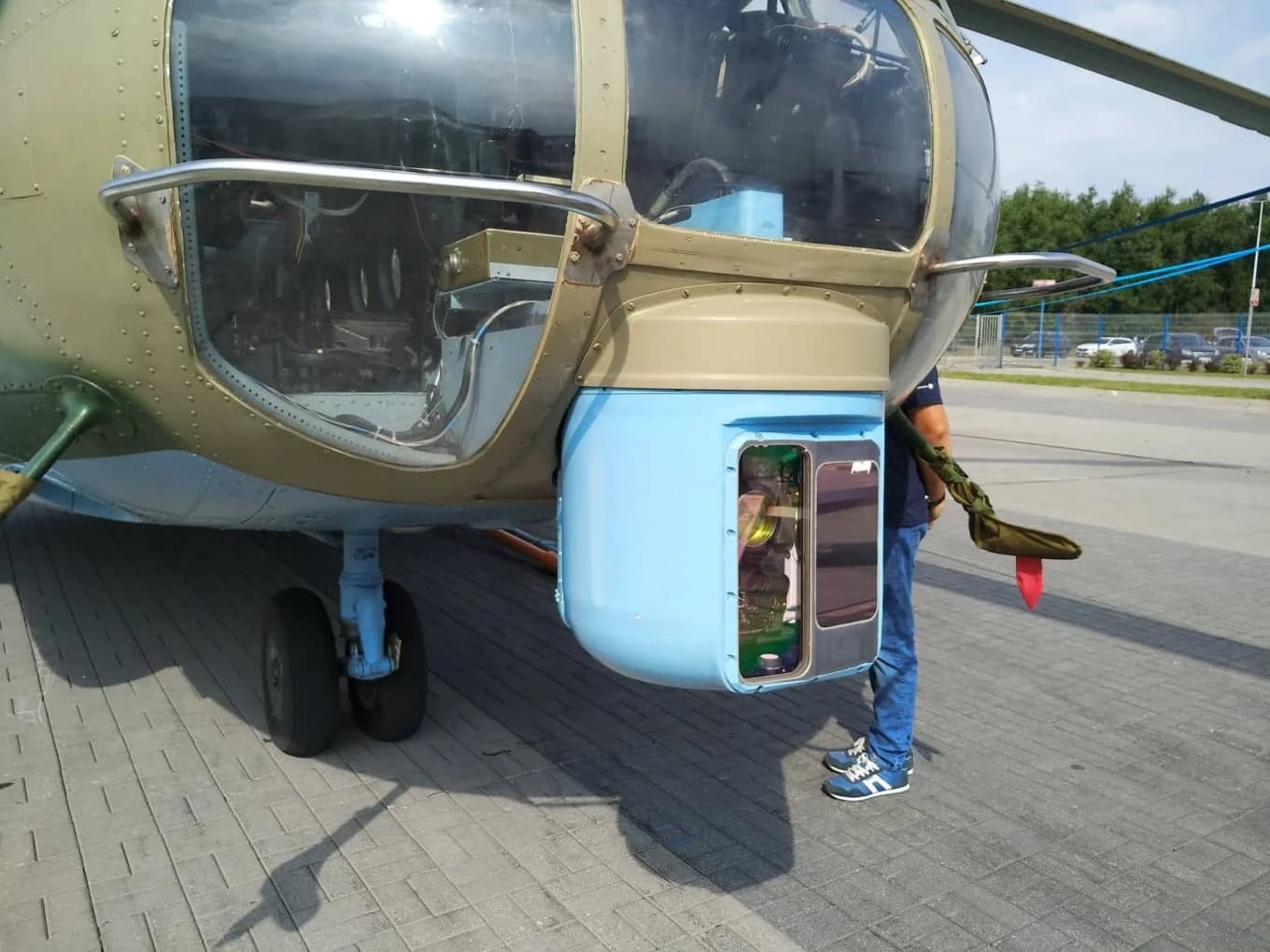
ㅤThe Mi-8MSB-V was formally accepted into service in 2014. Armed only with unguided armaments (such as rockets, bombs, and gun pods), it initially lacked a precision weapon suite. Therefore, in parallel with MSB-V introduction, a collaborative project code-named “Jmil” began in 2013 to develop the 524R guided weapon system, led by State Design Bureau “Luch” alongside “Ramzai” and other domestic enterprises. Delayed by a lack of state funding, a prototype based on the Mi-8MSB-V only began flight testing in November 2018. It was outfitted with a PM-LKT electro-optical sight featuring day/night target detection up to 16 km (identification at 10 km) and the ability to fire RK-2V “Barrier-V” anti-tank guided missiles at ranges up to 7.5 km, penetrating up to 800 mm of armor behind ERA. Over the following years, after numerous firing trials and system adjustments to overcome the aerodynamic and vibration challenges inherent to the transport airframe, the modified prototype successfully concluded joint state firing trials on February 17, 2022, just a week before Russia started its full-scale invasion of Ukraine. The fate of the prototype thereafter remains unknown.
Spoiler
- Origins -
ㅤDesigned in the 1960s by the Soviet Mil Design Bureau, the Mil Mi-8 became the most produced twin-engine helicopter in aviation history, with more than 12,000 units produced in different variations, serving across dozens of nations in military and civil roles. Following the collapse of the Soviet Union in 1991, Ukraine inherited a massive military helicopter fleet, including an estimated 500+ Mi-8 variants out of roughly 900 total military helicopters across all service branches. However, throughout the 1990s and 2000s, this fleet drastically shrank. Severe defense budget cuts, lack of routine overhaul, aging airframes, cannibalization for spare parts, and extensive foreign arms sales aimed at generating state revenue left only a small fraction of the original Mi-8 fleet operational by the late 2000s.- Development of Mi-8MSB -
ㅤTo solve the critical shortage of airworthy transport helicopters and replace the obsolete Soviet TV2-117 powerplants, the Zaporizhzhia-based enterprise Motor Sich initiated a deep remotorization and modernization project for Mi-8s in the late 2000s. The core concept was replacing the old powerplants with modern, domestically manufactured engines. In May 2010, flight testing of the newly developed TV3-117VMA-SBM1V series 4E turboshaft engine commenced in Konotop, receiving official certification shortly thereafter. The first civilian prototype, designated Mi-8MSB, conducted its maiden flight on November 10, 2010. This engine replacement reduced fuel consumption by 10% to 20%, increased overall range, raised the static ceiling to 2,400 meters and the dynamic ceiling to 7,300 meters, and extended service life by 2,000 flight hours or 8 years.
Mi-8MSB at MAKS airshow, 2013
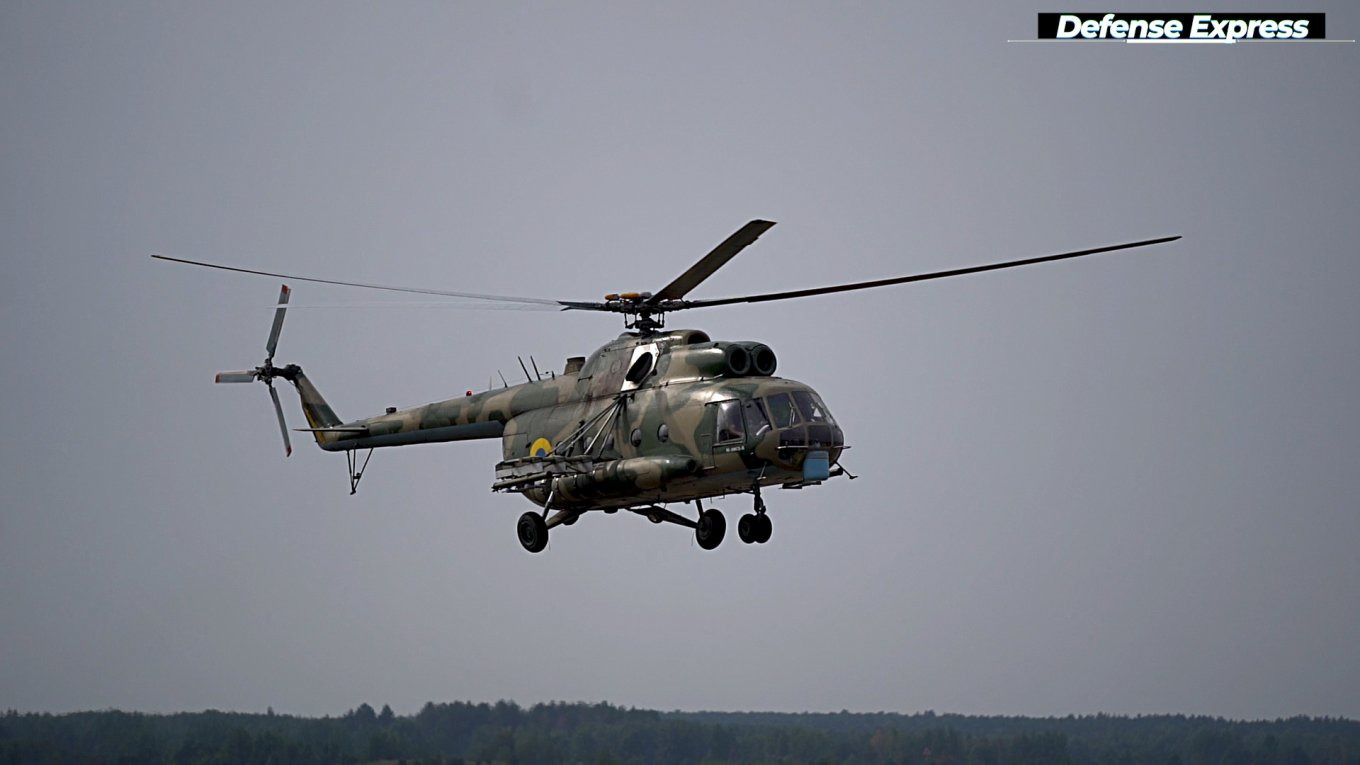
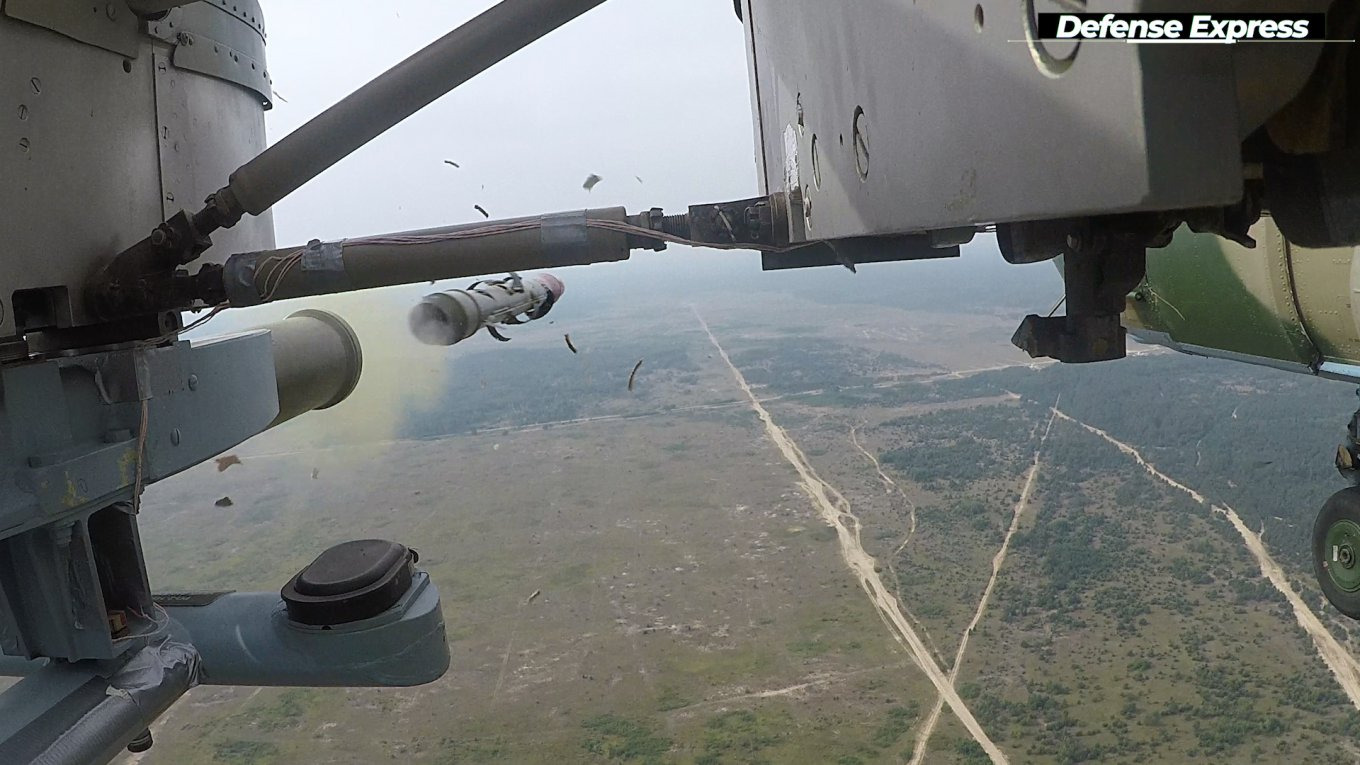
- Development of Mi-8MSB-V and Service Within The Ukrainian Armed Forces -ㅤRecognizing the defense sector’s needs, Motor Sich developed a specialized military variant, the Mi-8MSB-V, which underwent state testing and was formally accepted into service by the Ukrainian Armed Forces in 2014. In addition to the above-mentioned upgrades, the helicopter in this configuration received new flight data recording systems, an emergency radio beacon, an FPM-01KV laser aiming mark generator, an “Adros” KT-01 AVE infrared countermeasure (IRCM) system, “Adros” KUV 26-50 flare/chaff dispensers, and ASh-01V exhaust heat screen devices to suppress its infrared signature. For strike missions, it was modified to deploy bomb loads up to 600 kg, gun pods, 80 mm S-8 rocket pods, or the VSM-1 aerial minelaying system. Later in October 2017, test launches of 122 mm S-13 unguided aircraft rockets were conducted from the Mi-8MSB-V, further expanding the airframe’s strike arsenal.
ㅤBetween 2014 and 2018, the Armed Forces of Ukraine received 23 modernized Mi-8MSB-V helicopters, with the modernization of another 18 planned for 2019-2021. The majority of the Mi-8MSB-V helicopters were delivered to the aviation units of the Ukrainian Ground Forces. By the end of 2021, the 11th, 12th, 16th, and 18th Army Aviation Brigades operated a total of 20 Mi-8MSB-V helicopters. The Ukrainian Air Force operated 9 such helicopters within the 456th and 15th Transport Aviation Brigades, while the Ukrainian Navy operated 4 within the 10th Naval Aviation Brigade.
Mi-8MSB-V demonstrator at “Defense and Security 2015”, Kyiv- A Prototype With 524R Weapon System -
ㅤ Parallel to the introduction of the Mi-8MSB-V, in 2013, a collaborative project code-named “Jmil” (Bumblebee / “Джміль”) led by State Design Bureau “Luch”, alongside “Ramzai”, “Fotoprilad”, and the Izyum Instrument-Making Plant, began developing the 524R guided weapon system. It was developed following delays in domestic Mi-24 attack helicopter modernization programs (Mi-24PU1 and Mi-24PU2) and built upon experience gained from collaboration with South African Mi-24 “Super Hind” modernizations. Its ultimate goal was to equip transport-assault helicopters with a domestically produced precision weapon suite.ㅤThe 524R system is built around the nose-mounted PM-LKT electro-optical targeting sight (featuring thermal, TV, and laser guidance channels), allowing day/night tank-sized target detection at a distance of up to 16 km, identification at 10 km, and guided firing of RK-2V “Barrier-V” ATGMs at distances up to 7.5 km, capable of penetrating no less than 800 mm of armor including explosive reactive armor.
ㅤ However, the development span took nearly a decade due to a complete lack of state funding, forcing the participating enterprises to self-finance the project. Therefore, only in November 2018 did testing begin on a prototype based on the Mi-8MSB-V equipped with the 524R system. Live-fire testing of the prototype took place over the next several years, during which engineers had to redesign the RK-2V Barrier-V missile’s launch parameters, ejection mechanisms, and guidance algorithms to overcome the severe rotor downwash, heavy vibration, and aerodynamic instability inherent to the larger transport airframe. Finally, joint state firing trials formally concluded on February 17, 2022, just a week before Russia launched its full-scale invasion of Ukraine. The fate of the prototype thereafter remains unknown.
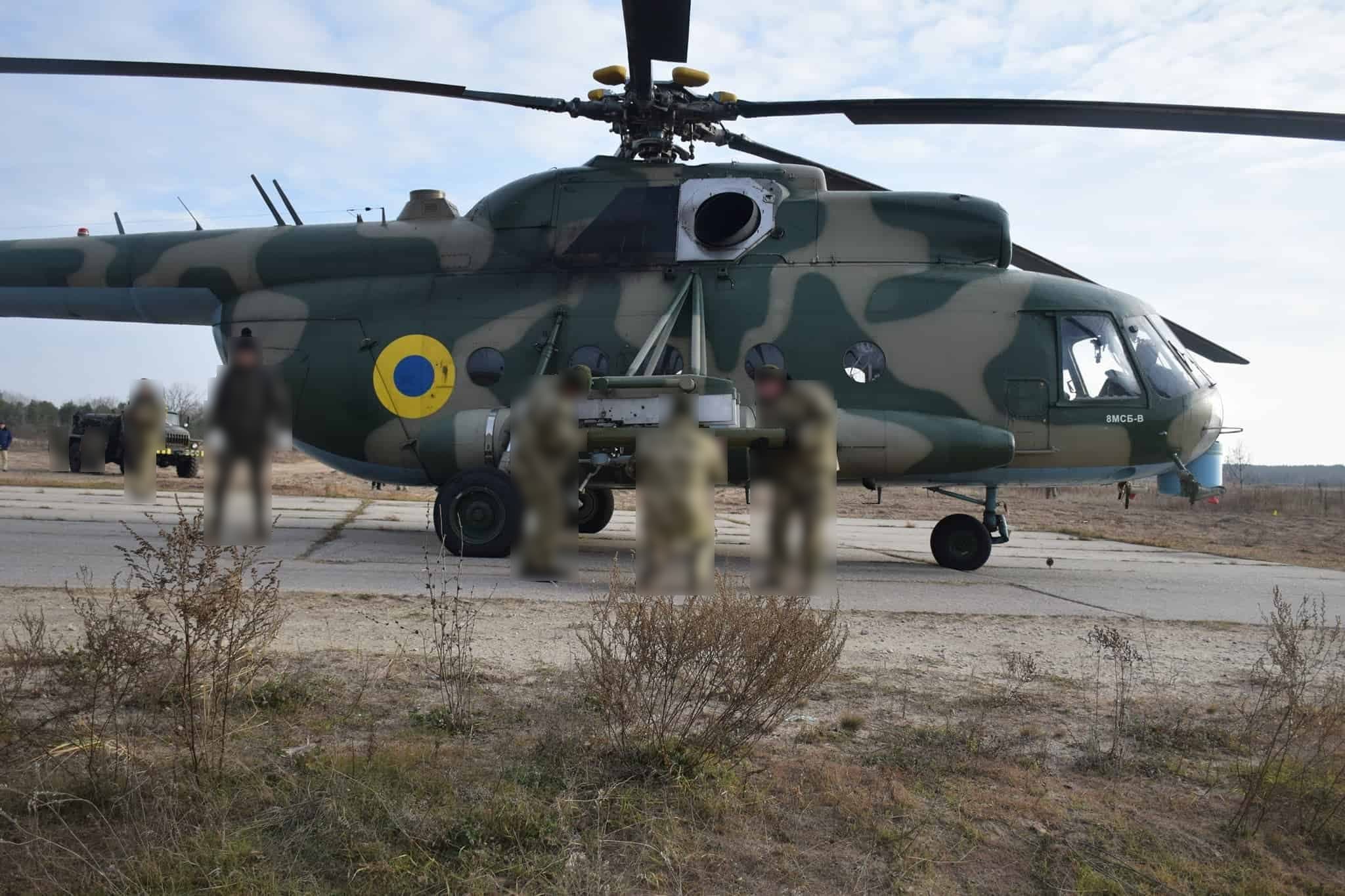
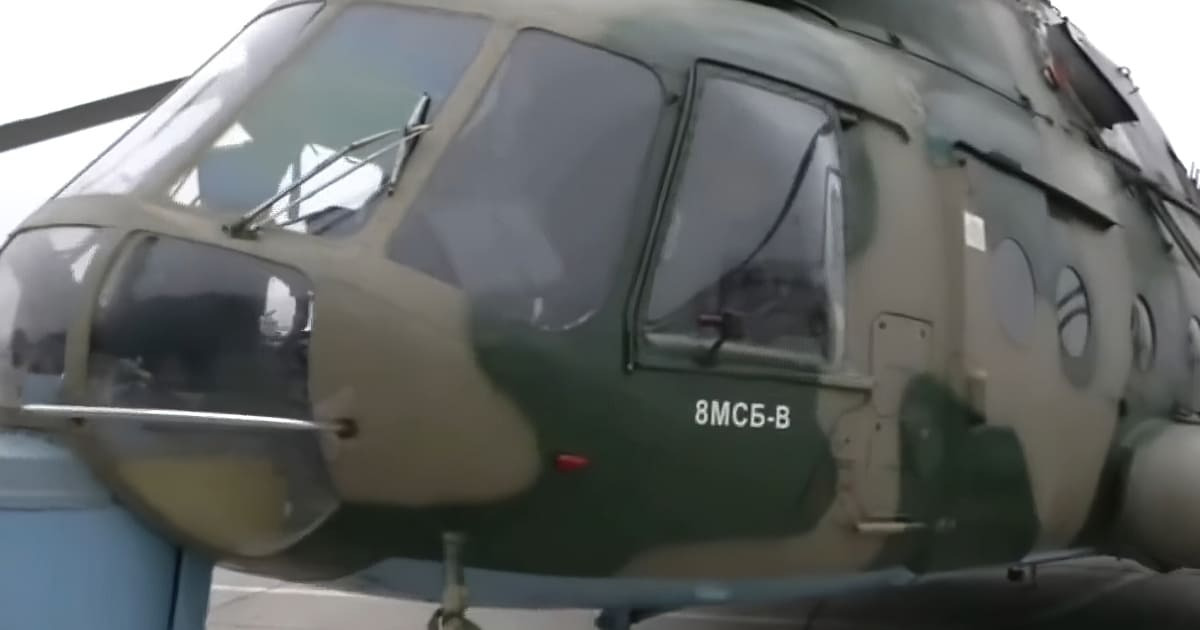
Mi-8MSB-V (524R) prototype loaded with RK-2V Barrier-V, 2022 (pre-war)- “8MSB-V” Renaming and Scandals Surrounding Motor Sich -ㅤInterestingly, in 2021, Motor Sich officially dropped the “Mi” prefix from its product line, renaming the helicopter from Mi-8MSB-V to 8MSB-V. This redesignation was triggered by a Russian court ruling in favor of the Mil Helicopter Plant regarding trademark rights to the “Mi” brand. The new “8MSB-V” designation was subsequently painted directly onto helicopter fuselages, including the 524R test prototype. However, the Ukrainian military ignored the Russian legal ruling and continued officially referring to the helicopters as the Mi-8MSB-V.
ㅤFollowing the full-scale invasion, Motor Sich and its long-time leadership (notably Vyacheslav Bohuslayev, after whom the MSB acronym was partially named) faced severe criminal prosecution when Ukrainian security services arrested company executives for illegal collaboration and supplying aircraft engine components to Russian forces during the war.

TL;DR: The principal features of the Mi-8MSB-V (with 524R) are:
- New TV3-117VMA-SBM1V series 4E turboshaft engines.
- Reinforcement of the helicopter’s fuselage to accommodate the new engines.
- Updated avionics, including new flight data systems and the FPM-01KV laser aiming mark generation system.
- Countermeasure suite with “Adros” KT-01 AVE IRCM station and “Adros” KUV 26-50 chaff/flare dispensers.
- ASh-01V exhaust heat screen devices.
- The 524R system with PM-LKT electro-optical targeting sight, enabling day/night target detection up to 10 km away and the ability to fire RK-2V “Barrier-V” ATGMs with a maximum range of 7.5 km and penetration of no less than 800 mm of armor behind explosive reactive armor (ERA).
- Ability to carry bomb loads up to 600 kg, gun pods, 80 mm S-8 rocket pods, and 122 mm S-13 rocket pods.
Spoiler
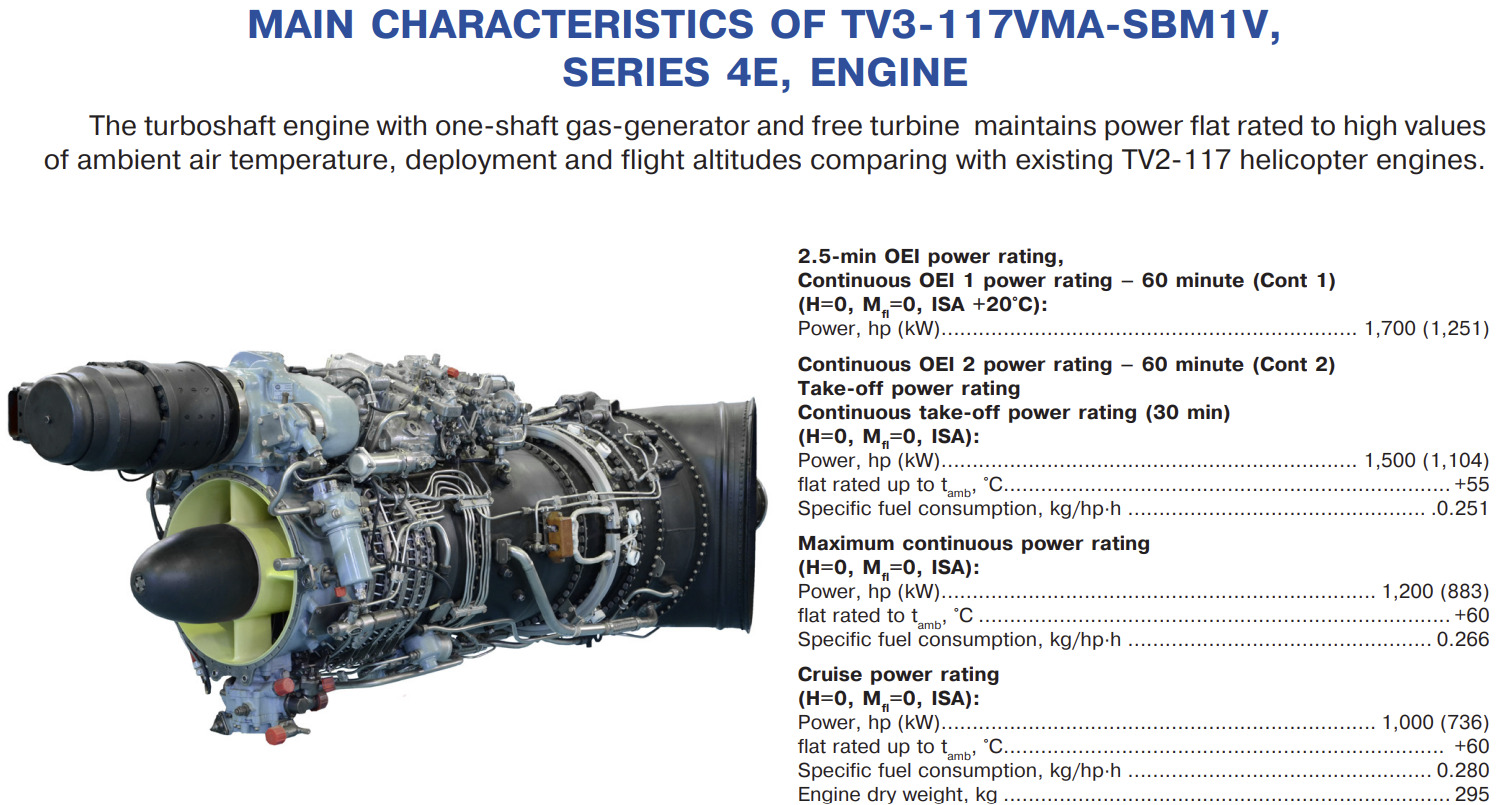
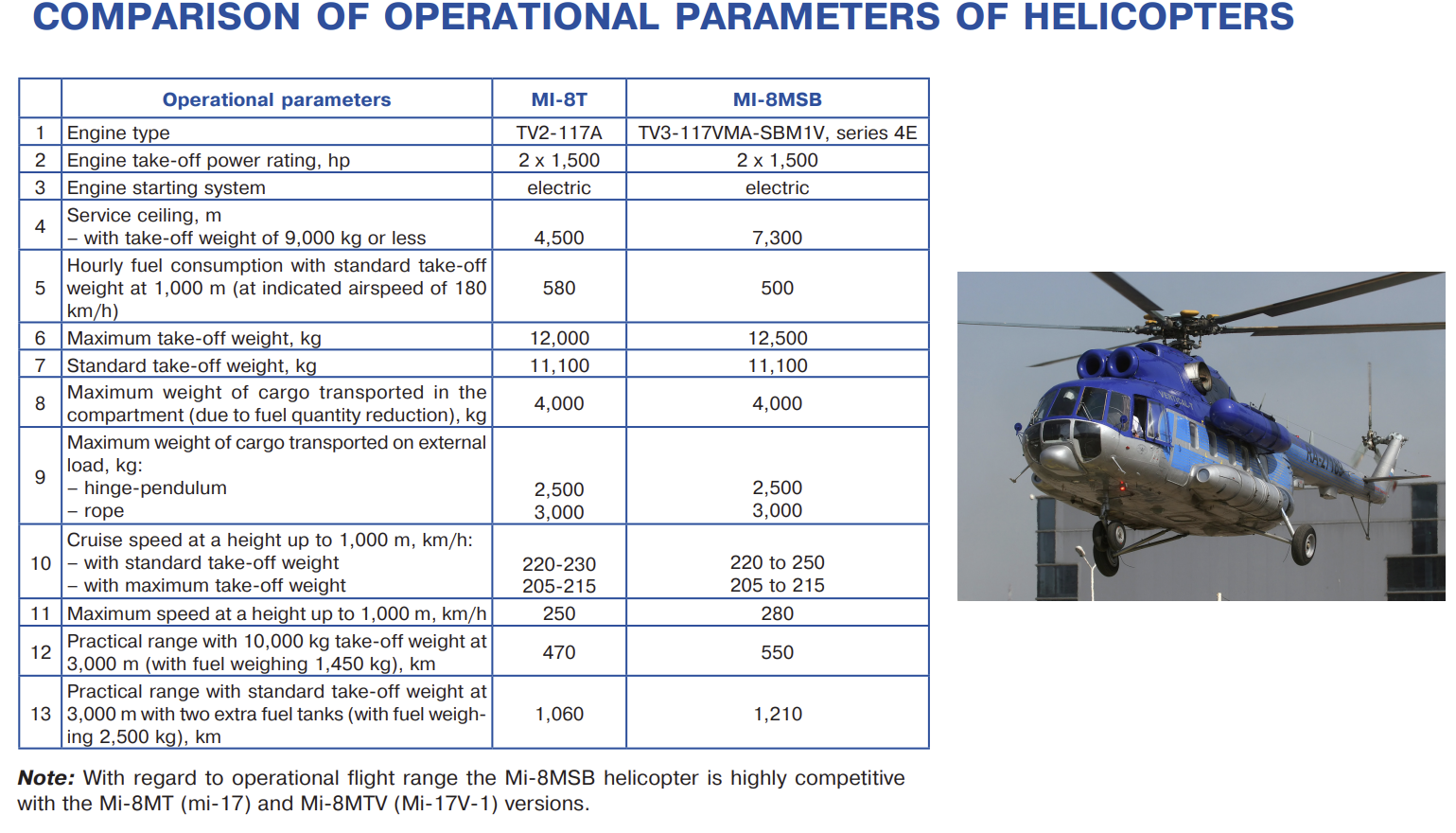
The main feature of the MSB upgrade is the replacement of the old TV2-117 engines with new TV3-117VMA-SBM1V series 4E engines manufactured by Motor Sich. This engine replacement reduces fuel consumption by 10% to 20%, increases overall range, raises the static ceiling to 2,400 meters and the dynamic ceiling to 7,300 meters, and extends service life by 2,000 flight hours or 8 years. The engines maintain their power output even at high ambient temperatures and high operational altitudes. Additionally, specific emergency power modes have been implemented to ensure safe takeoff, continued flight, and landing with one engine inoperative. To accommodate these powerful engines, the fuselage’s load-bearing elements were strengthened and the engine starting system was replaced, while the engine gearbox was retained.
Engine Specifications & Flight Performance Comparison between Mi-8T and Mi-8MSB:
Spoiler
Note: All of these components were removed on the prototype that was armed with 524R guidance system, reason for that remains unknown, but all of these components can be easily equipped or removed from any other Mi-8MSB-V as their installation does not require any special structural changes.
- Components Of The Full Mi-8MSB-V Package -
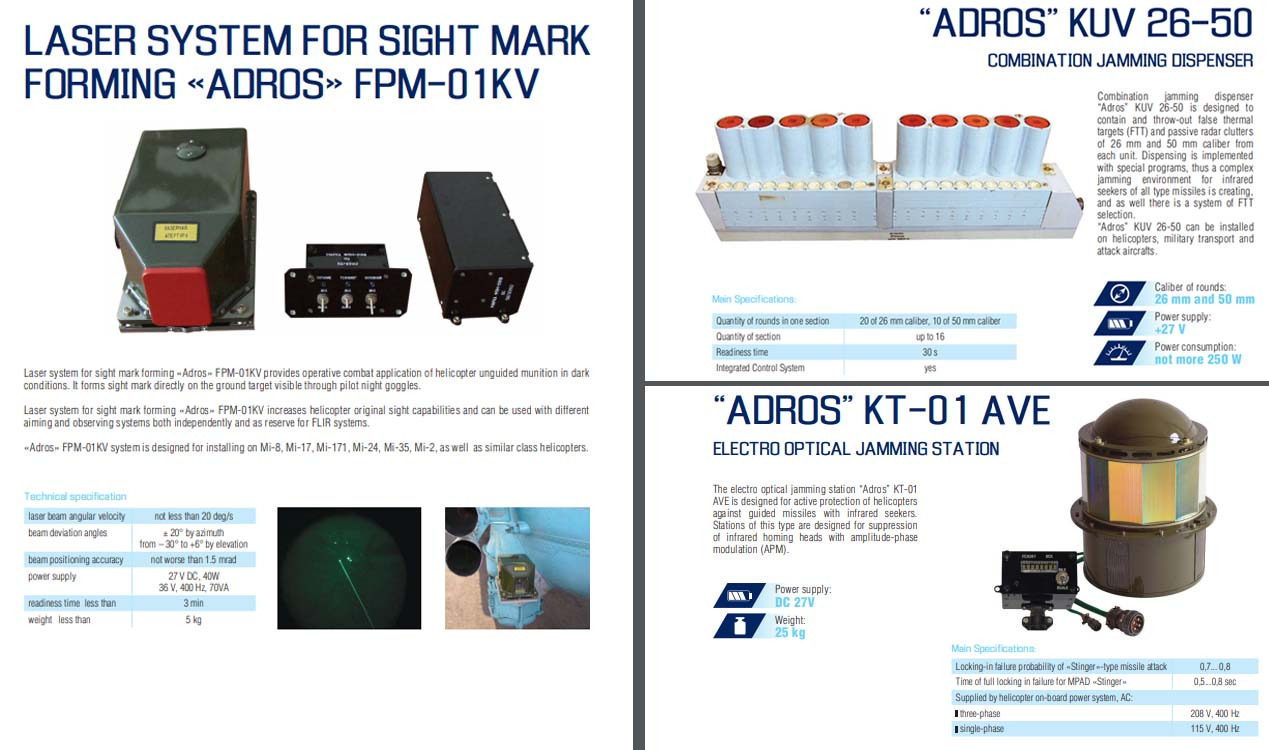
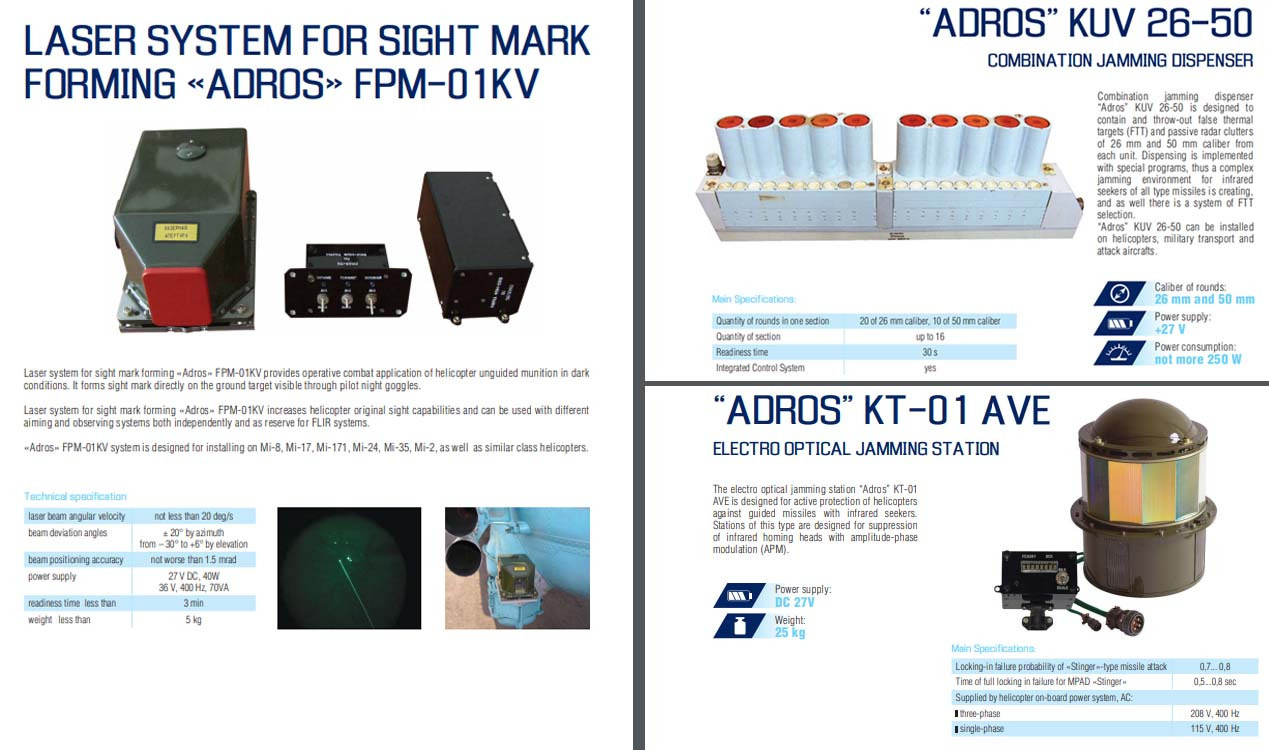
“Adros” FPM-01KV laser aiming mark generation system:
- Enables operational combat employment of unguided helicopter munitions in low-light and nighttime conditions. It projects a sighting mark directly onto the ground target, visible through the pilot’s night vision goggles. The “Adros” FPM-01KV laser sighting system enhances the helicopter’s targeting capabilities and can be used with various aiming and observation systems, either independently or as a backup for FLIR systems.
“Adros” KT-01 AVE infrared countermeasures (IRCM):
- Provides protection against infrared (IR) homing seekers, including those with advanced countermeasure resistance. It does not require the jamming signal to significantly exceed the target’s thermal signature. The system operates using an electro-optical (EO) jammer driven by a specialized, electronically controlled microcontroller modulator. It functions independently, requiring no data on the missile’s seeker type/frequency or input from a missile launch detection system.
- Specifications (KT-01 AVE):
- Type: Electro-optical jamming station
- Disruption probability against “Stinger”-type threat: 70% - 80%
- Time to break lock against “Stinger”-type threat: 0.5 - 0.8 sec
- Spectral emission range: 1.8 - 5.5 µm
- Coverage angle: 180°
- Weight: 27 - 35 kg
“Adros” KUV 26-50 countermeasure dispenser:
- Provides protection against infrared (IR) and radar-homing missile seekers using chaff and flares. It uses a combination of ten 50 mm large-caliber charges and twenty 26 mm small-caliber charges per dispenser. The Mi-8MSB-V utilizes the KUV 26-50-02 variant, equipped with mounting hardware for installation under the tail boom. Fitted with two units (one on each side), the helicopter carries a total of twenty 50 mm and forty 26 mm charges.
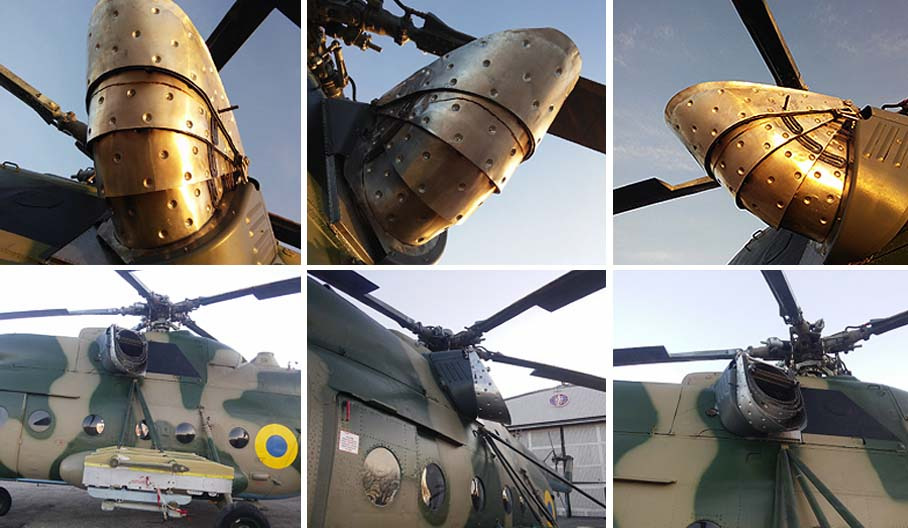
ASh-01V exhaust heat screen (HIRSS):
- When deployed, reduces infrared signature by a factor of 8-10 within the operating band of guided missile infrared seekers. At the same time, its impact on engine performance, even in the deployed position, is less than 3%. Additionally, the seeker lock-on range is reduced 3-fold, and the detection range using thermal imagers is reduced by half.
Spreadsheet with technical information for “Adros” components used on Mi-8MSB-V: FPM-01KV, KT-1 AVE and KUV 26-50
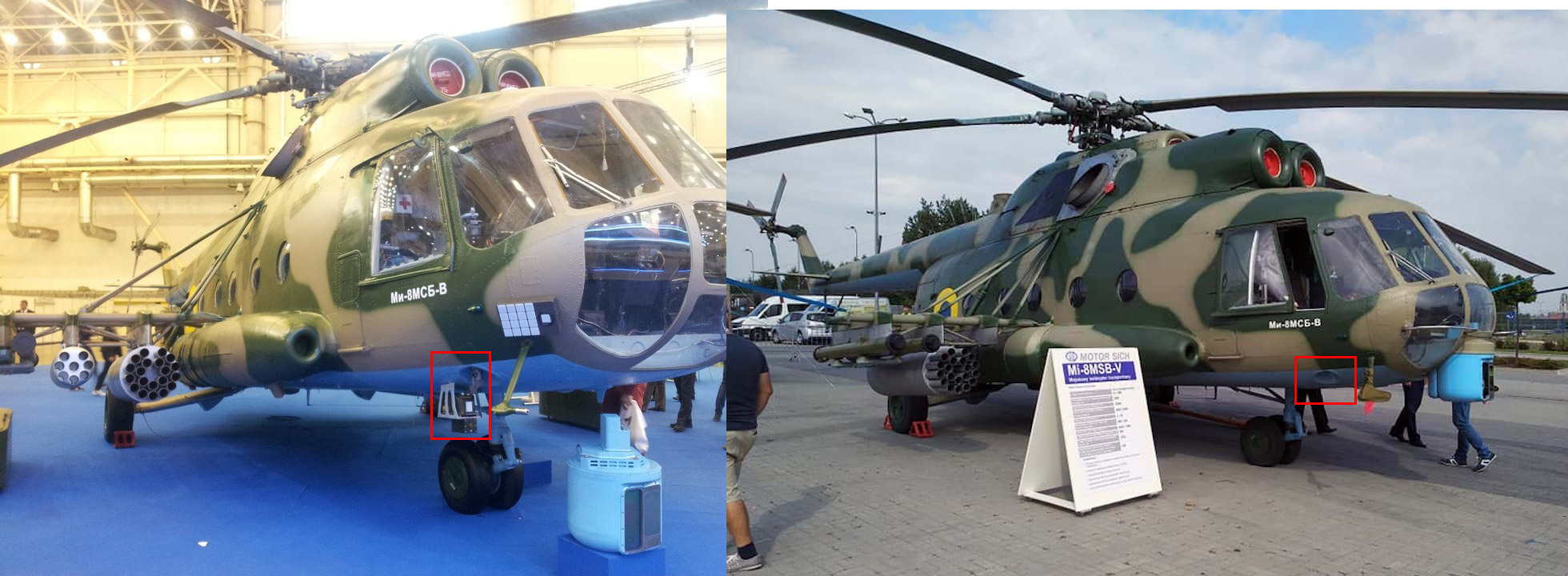
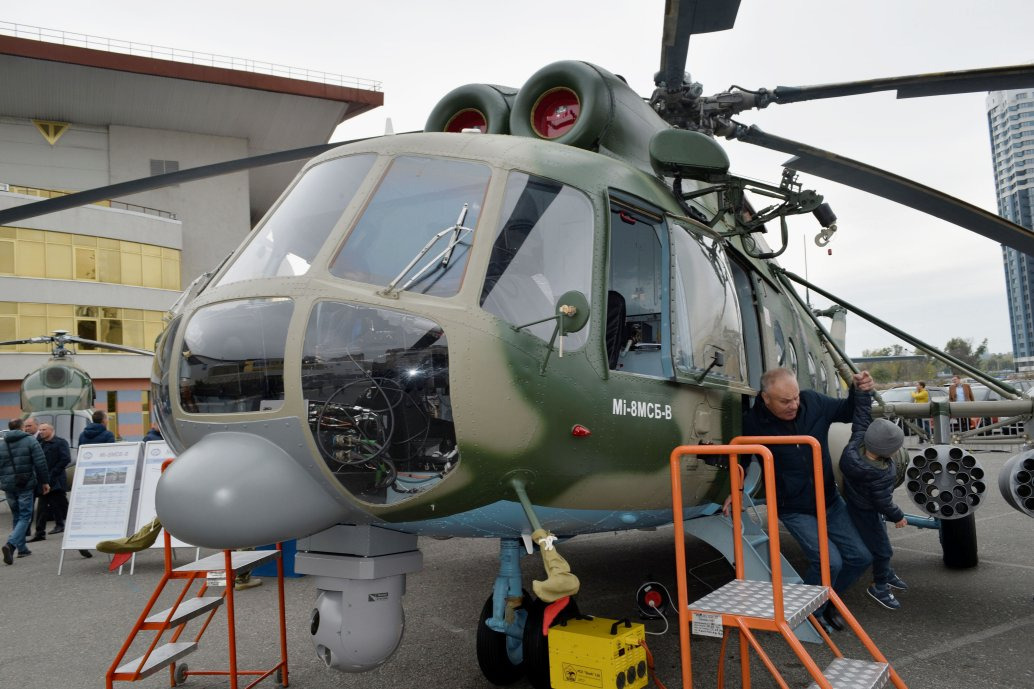
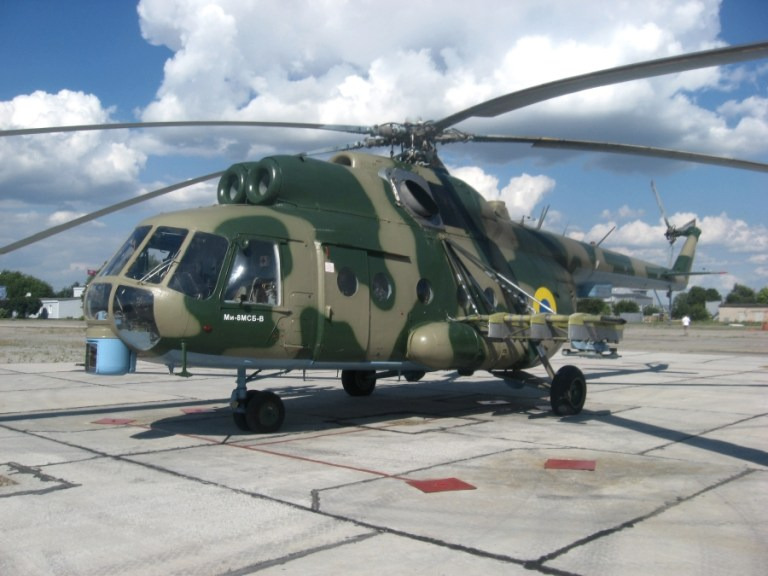
Picture 1 (Left): Mi-8MSB-V demonstrator at “Defense and Security 2015”, we can see how the FPM-01KV is installed;
Picture 2 (Right): Mi-8MSB-V (524R) prototype at “MSPO 2018” without FPM-01KV
Mi-8MSB-V with KT-1 AVE IRCM and KUV 26-50 dispensers, once again, the prototype with 524R system had all of these elements removed
Ash-01V exhaust heat screen, rarely seen installed, but is a part of full Mi-8MSB-V package
Spoiler
With the addition of 524R guided weapon system, the helicopter receives day/night tank-sized target detection at a distance of up to 16 km, identification at 10 km, and guided firing of RK-2V “Barrier-V” ATGMs at distances up to 7.5 km, capable of penetrating no less than 800 mm of armor including explosive reactive armor.
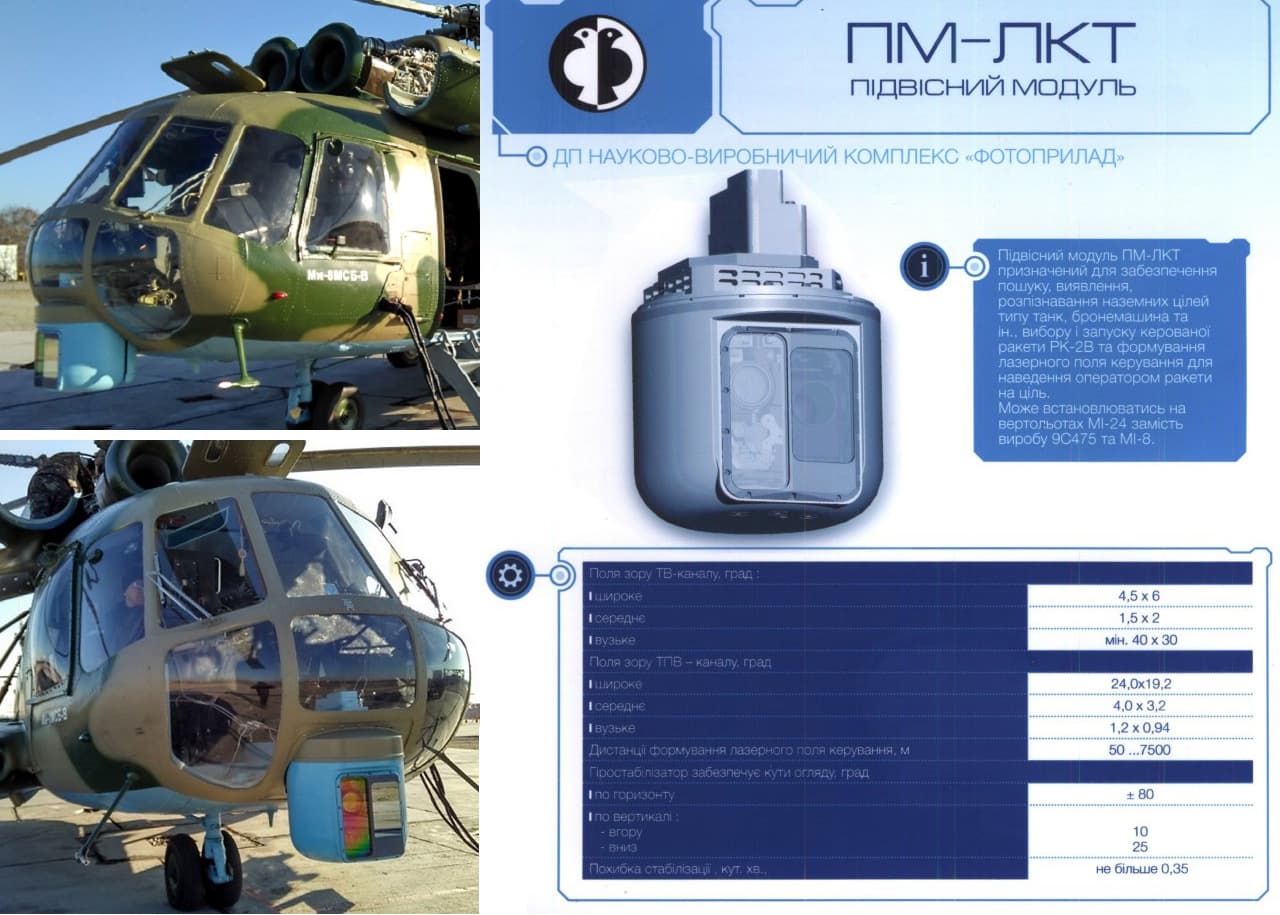
- PM-LKT electro-optical targeting sight:
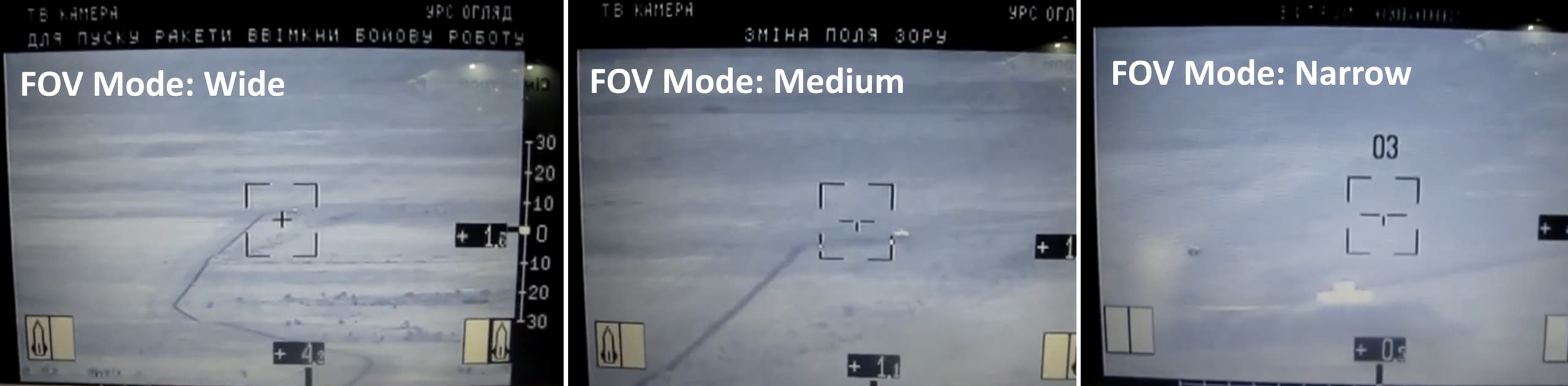
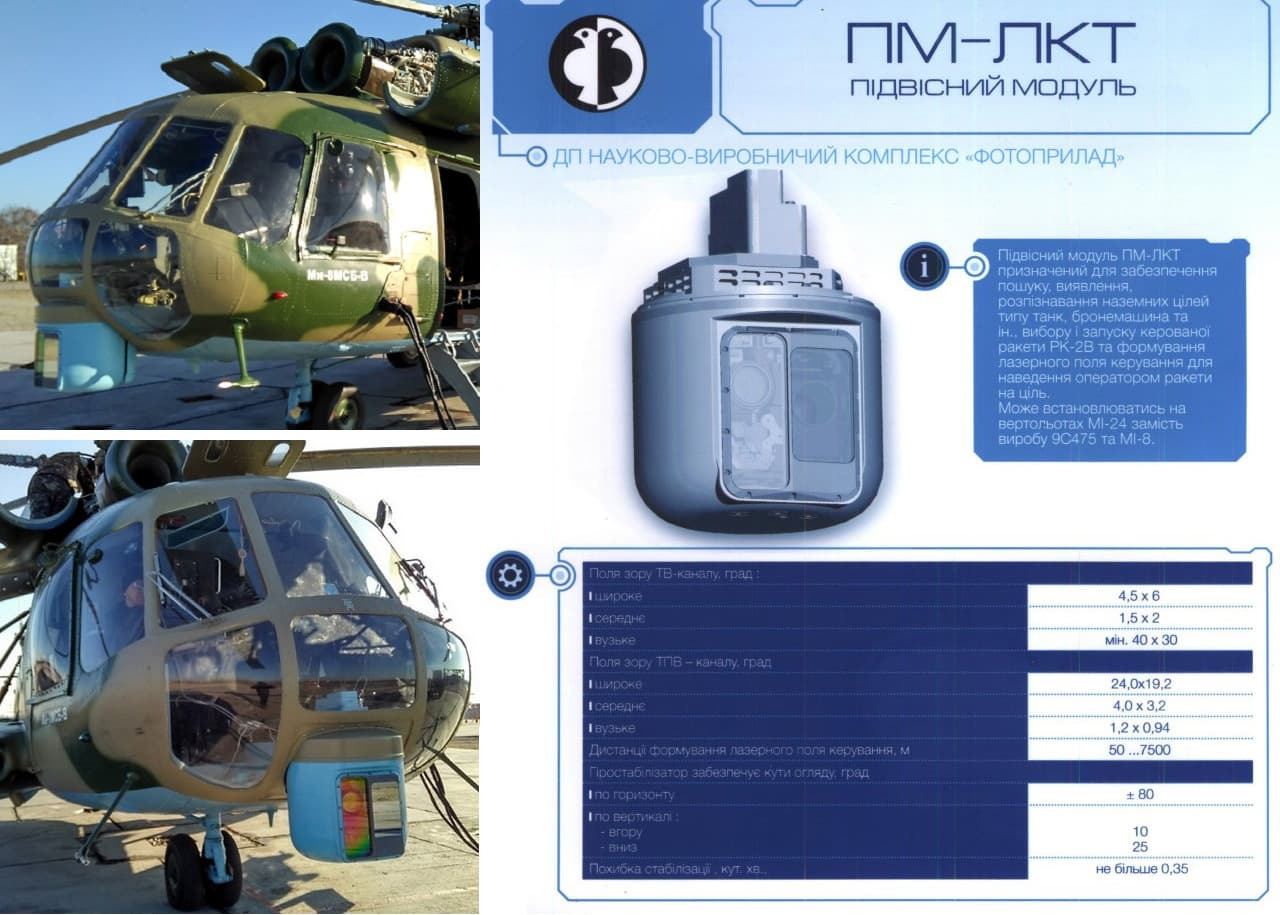
- Developed by the Ukrainian enterprise “Fotoprilad”, the sight features thermal, TV, and laser targeting channels. Interestingly, it is based of PNK-6 panoramic sight, used on BM Oplot-M. PM-LKT is capable of identifying tank-sized targets at distances up to 10 km in day/night conditions. Equipped with dual-axis stabilization, its stabilization error is rated at ≤0.35′ (angular minutes), providing the fine beam-riding stability necessary to keep the laser guidance beam locked onto a target at ranges up to 7.5 km. The gimbal viewing limits of the sight are +10° / -25° vertically and ±80° horizontally. There are three field of view (FOV) options for the TV and Thermal channels: wide, medium, and narrow. Official sources do not disclose the exact generation and resolution of the thermal sensor, however, based on available onboard footage, it is widely assessed to fall into the 2nd-generation category.
- TL;DR: Specifications.
- Type: electro-optical targeting sight
- Channels: TV, Thermal (est. 2nd Gen), Laser targeting
- Field of View of TV channel:
- Wide: 4.5° x 6°
- Medium: 1.5° x 2°
- Narrow: min. 40° x 30°
- Field of View of Thermal channel:
- Wide: 24.0° x 19.2°
- Medium: 4.0° x 3.2°
- Narrow: 1.2° x 0.94°
- Gimbal Limits:
- Vertical: +10° / -25°
- horizontal: ± 80°
- Stabilization: Dual-Axis
- stabilization error, (angular minutes): ≤0.35′
PM-LKT Brochure
PM-LKT field of view modes, left to right: Wide, Medium, Narrow.
Source: YouTube Video https://youtu.be/cgIqpdp91Dw
- Cockpit of 524R Prototype:
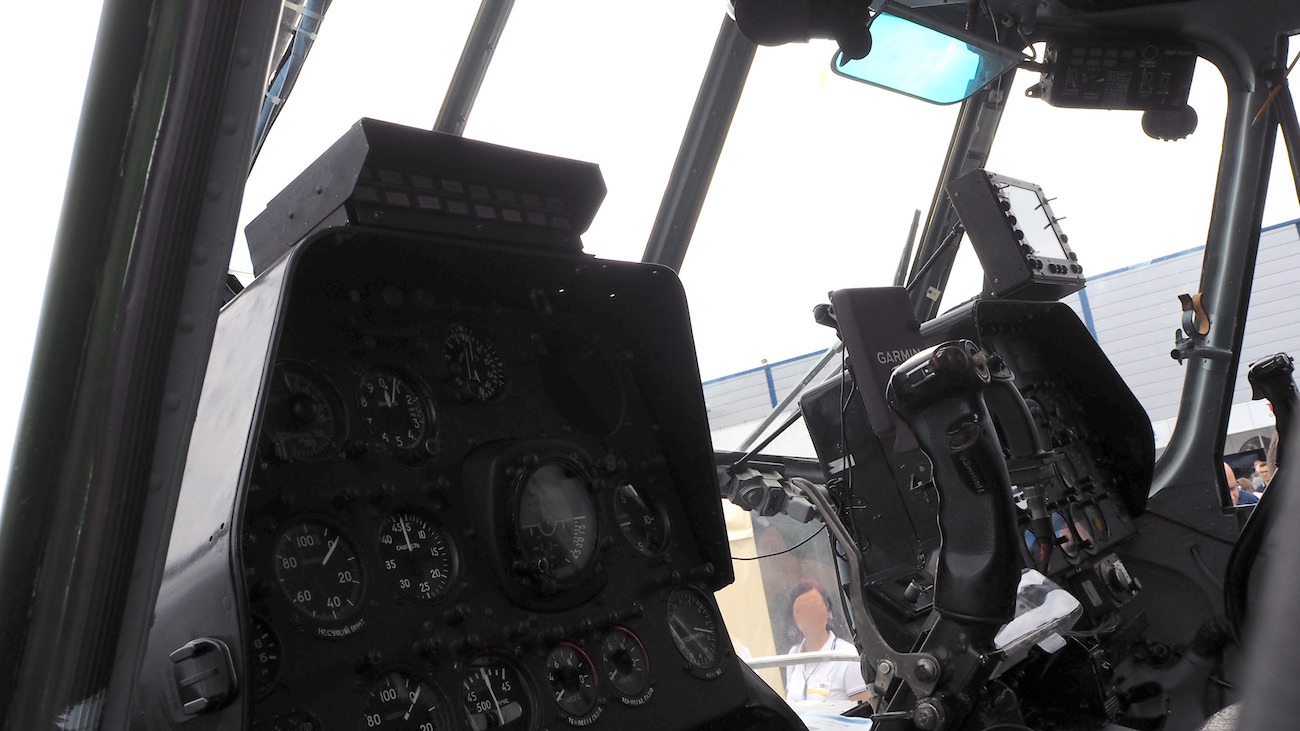
- Based on footage from “MSPO 2018” in Kielce, Poland, we can see that the cockpit avionics of the 524R prototype did not undergo as extensive an upgrade as its armament. Consequently, the crew cannot fully utilize the electro-optical targeting sight’s capabilities, as the avionics remain almost entirely analog. The integration of the 524R guidance system in the cockpit is achieved via a simple targeting head-up display (HUD) and guidance system components, which include a targeting joystick on the co-pilot’s side. Other additions to the cockpit include a Garmin GPSMAP-695 satellite navigation unit, radar transponders, radio altimeters, and modern radios. The cockpit is also compatible with night-vision goggles (NVG). In the Ukrainian Armed Forces, the Polish-made PCO PNL-3M “Orlik” goggles are most commonly used for this purpose.
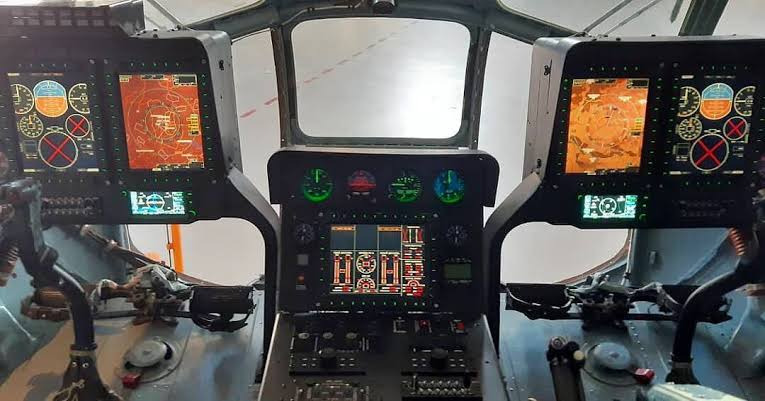
The cockpit of the Mi-8MSB-V (524R) Prototype, 2018ㅤInterestingly, there is a separate Mi-8MSB-V prototype that did receive a full “glass cockpit” and even underwent state trials. First revealed at “Defense and Security 2019” in Kyiv, it featured a full avionics upgrade to modern standards, with all analog equipment replaced by five multifunction displays, alongside full NVG compatibility. It was also displayed with Barrier-V ATGMs attached to the outer wing stations, however, their installation was purely for display purposes, as they could not actually be fired. This was due to the lack of a proper guidance system. The “glass cockpit” prototype was demonstrated with a civilian-grade optronic sensor (primarily used by law enforcement), the TrakkaCam TC-300. While it features high-resolution TV and thermal channels, it lacks the laser guidance integration necessary for ATGM operations.
ㅤSadly, it remains unknown if the prototype armed with the 524R guidance system received a similar cockpit upgrade in the later stages of its development, but it remains a strong possibility for the future development of the Mi-8MSB-V.
Separate prototype based on Mi-8MSB-V with “glass cockpit”
“glass cockpit” prototype, 2019, here we can see the TrakkaCam TC-300
Spoiler
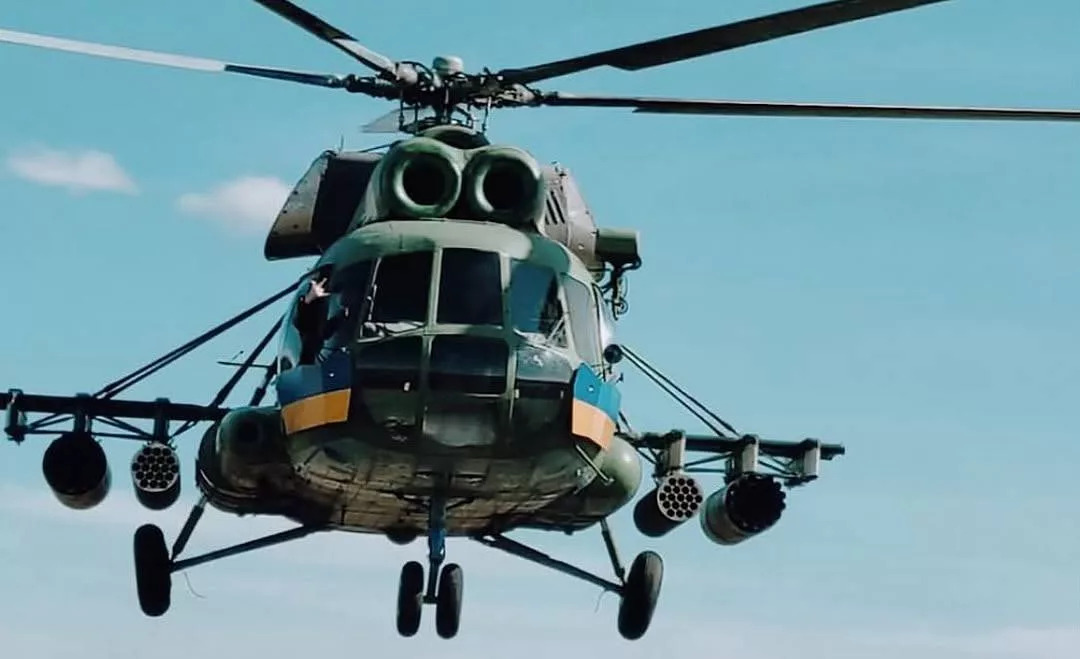
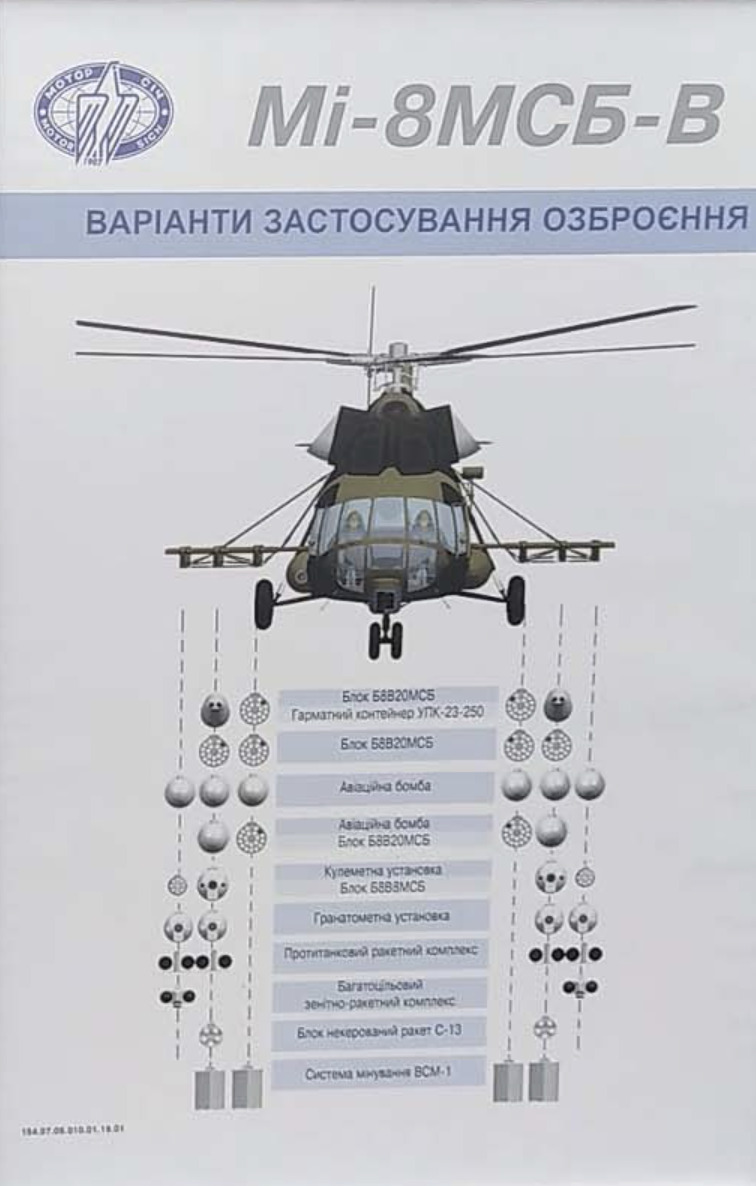
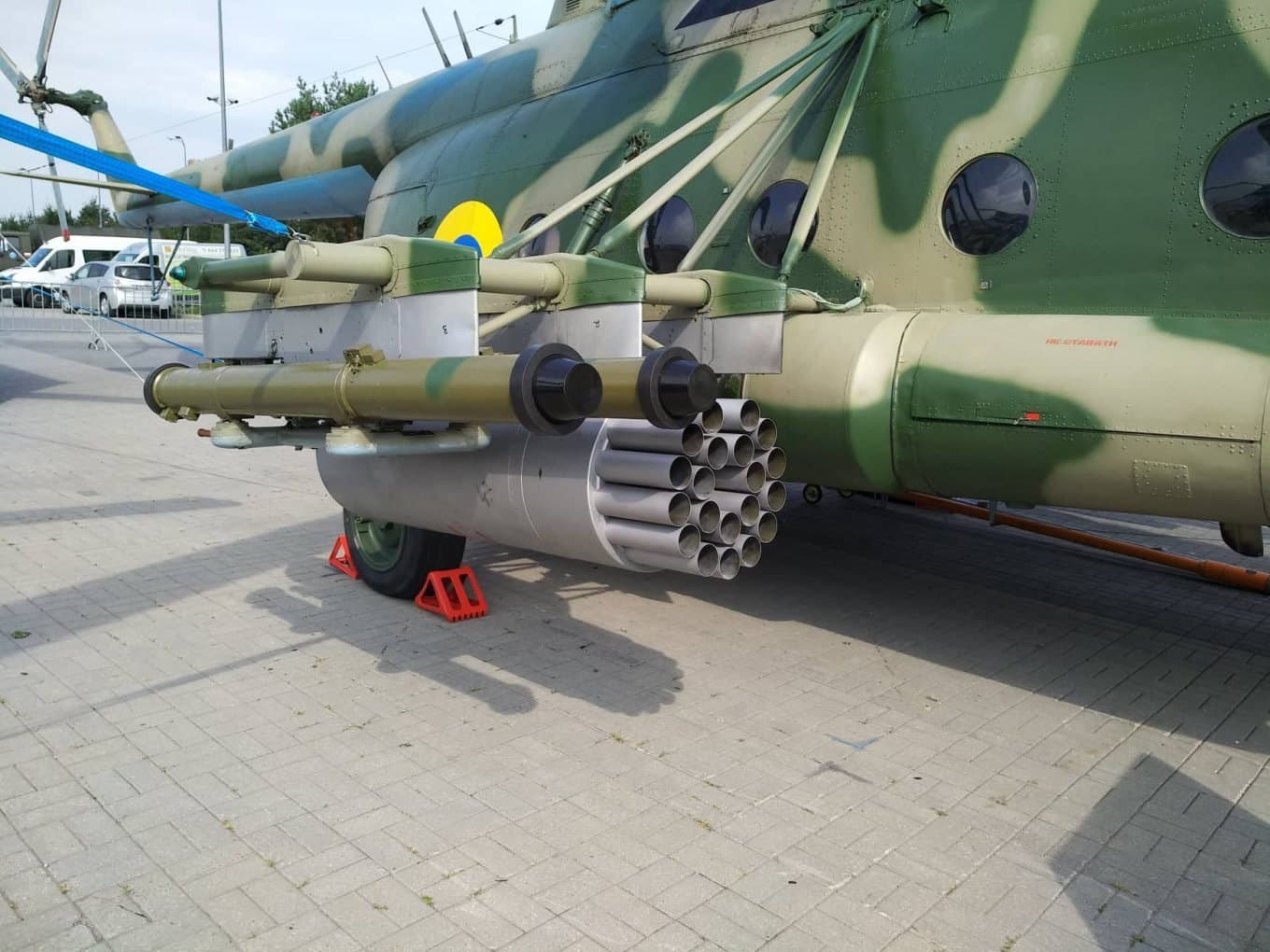
ㅤThe Mi-8MSB-V is capable of carrying a wide range of suspended armaments. It features a standard Mi-8 configuration utilizing removable weapon trusses mounted on the sides of the fuselage, providing a total of six hardpoints. It can carry bomb loads of up to 600 kg, various gun pods, 80 mm S-8 rocket pods, 122 mm S-13 rocket pods, and the VSM-1 aerial minelaying system. With the installation of the 524R system, it gains the ability to fire RK-2V “Barrier-V” ATGMs. Lastly, based on information provided in promotional brochures, the helicopter is also compatible with 9K38 “Igla” air-to-air missiles, though in practice, these have not been seen in operational use.
ㅤAdditionally, following the 2022 full-scale Russian invasion of Ukraine, some Mi-8MSB-V helicopters, along with other Mi-8 variants, were modified to carry US-made 70 mm Hydra-70 rocket pods.
🞈 - Symbol for armament/equipment produced in Ukraine
▧ - Symbol for overall unique armaments for Mi-8 platform
Bombs:
- 100 kg OFAB-100-120 bomb
- 250 kg OFAB-250-270 fragmentation bomb
- 250 kg FAB-250 bomb
- 500 kg FAB-500 bomb
Rocket Pods:
80 mm:
- 🞈 B-8V8MSB pod, 8x 80 mm rockets:
- B-8V20A pod, 20x 80 mm rockets:
- 🞈 B-8V20MSB pod, 20x 80 mm rockets:
- 80 mm S-8KO, HEAT rocket. Weight: 11.3 kg, 400 mm RHA pen, 3.6 kg warhead weight, velocity 610 m/s.
- 80 mm S-8KOM, HEAT rocket. Weight: 11.3 kg, 400 mm RHA pen, 3.6 kg warhead weight, velocity 700 m/s.
- 80 mm 🞈 AR-8, HEAT rocket. Weight: 12.9 kg, 400 mm RHA pen, 4.3 kg warhead weight, velocity ~610 m/s.
- 80 mm 🞈 RS-80, HEAT rocket. Weight: 12.1 kg, 420 mm RHA pen, 4.7 kg warhead weight, velocity ~625 m/s.
▧ 70 mm: (Post-2022)
- M261 (Hydra-70) pod, 19x 70 mm rockets:
- 70 mm M247, HEAT rocket. Weight: 10.2 kg, ~300 mm RHA pen, 4 kg warhead weight, velocity 700 m/s.
▧ 122 mm:
- B-13L pod, 5x 122 mm rockets:
- B-13L1 pod, 5x 122 mm rockets:
- 122 mm S-13OF, FRAG rocket. Weight: 69 kg, 33 kg warhead weight, velocity 530 m/s.
Mi-8MSB-V post-2022, with a pair of Hydra-70 (M261) and S-8 (B-8V20MSB) pods.
Mi-8MSB-V in 2021, with a pair of S-13 (B-13L) pods.
Gun Pods:
- UPK-23-250
- 1x 23 mm GSh-23L twin-barrel cannon (250 rounds).
- GUV-8700 (9A624)
- 1x 12.7 mm YakB-12.7 four-barrel machine gun (750 rounds).
- 2x 7.62 mm GShG-7.62 four-barrel machine gun (900 rounds per gun).
- GUV-8700 (9A669)
- 1x 30 mm AGS-17 grenade launcher (300 rounds).
Mi-8MSB-V in 2014, with UPK-23-250 and GUV-8700 (9A669) gun pods.
▧ Anti-Tank Guided Missiles (ATGM):
- 🞈 RK-2V “Barrier-V” missile, specs:
- Max. Armor Pentration: 800 mm (AoA 0°, behind ERA)
- Caliber: 130 mm
- Projectile Mass: 16 kg
- Type: Tandem HEAT
- Guidance: Beam riding
- Launch range: 7.5 km
- Maximum speed: 280 m/s
- Flight time for maximum range: less then 30 s
- Explosive Type: OKFOL
- Explosive Mass: 2 kg
- TNT equivalent: 3.2 kg
- Weight with container: 47 kg
Mi-8MSB-V with 524R complex
- ▧ Air-to-Air Missiles (AAM):
Operationally none, but compatible with the 9M39 “Igla” according to manufacturer brochures
- 9M39 “Igla” missile, specs:
- Projectile Mass: 10.6 kg
- Guidance: IR
- Aspect: All-aspects
- Lock range
- in rear-aspect: 11 km
- in all-aspect: 6 km
- IRCCM: ✓
- Launch range: 5.2 km
- Maximum speed: 1.7 M (583.44 m/s)
- Maximum overload: 10 G
- Missile guidance time: 14 s
- Explosive Type: OKFOL-20
- Explosive Mass: 400 g
- TNT equivalent: 530 g
Manufacturer’s loadout specifications for the Mi-8MSB-V, notable configurations include the capability to carry up to 8x RK-2V “Barrier-V” ATGMs or 4x unspecified air-to-air missiles, which were later identified as 9K38 “Igla” variants

General Info:
- Name: Mi-8MSB-V (524R) - (Мі-8МСБ-В (524Р))
- Origin: Ukraine
- Manufacturer: Motor Sich
- Year: 2018-2022(?)
- Class: Multirole Helicopter
- Crew: 3 (+24 paratroopers)
Dimensions:
- Length: 18.42 m
- Height: 5.34 m
- Main rotor diameter: 21.30 m
- Tail rotor diameter: 3.91 m
- Weight
- Empty weight: 11,100 kg
- Max. Takeoff weight: 12,500 kg
Engine + Performance:
- Engine type: 2× Motor Sich TV3-117VMA-SBM1V series 4E turboshaft engines
- Horsepower: 2 х 1,500 hp
- Speed
- Maximum: 280 km/h
- Cruise: ~230 km/h
- Range: ~550 km
- Max. rate of climb: 11.5 m/s
- Service ceiling: 7,300 m
- Static ceiling: 2,400 m
Subsystems:
- Ballistic Computer: CCIP.
- NVD: ✓
- IRCM: ✓ (“Adros” KT-01 AVE)
- HIRSS: ✓ (ASh-01V)
- Targeting Sight: ✓ (PM-LKT; TV and 2nd Gen Thermal channels)
- Chaff/Flare dispensers: “Adros” KUV 26-50-02 (2x external dispenser modules with ability to carry in total 20 large caliber and 40 small caliber chaff/flare charges)
Armaments:
-
Combat Load: 6 hardpoints (all on weapon trusses), 2,500 kg max weight.
-
Suspended Armament:
-
Air-to-Air:
- 9K38 “Igla” air-to-air missile (2x) (Compatible, but not used in Ukrainian service)
-
Air-to-Ground - Unguided Bombs:
- 100kg OFAB-100-120 bomb
- 250kg OFAB-250-270 fragmentation bomb
- 250kg FAB-250 bomb
- 500kg FAB-500 bomb
-
Air-to-Ground - Unguided Rockets:
- 80mm S-8KO rockets (8x or 20x)
- 80mm S-8KOM rockets (8x or 20x)
- 80mm AR-8 rockets (8x or 20x)
- 80mm RS-80 rockets (8x or 20x)
- 70mm Hydra-70 M247 rockets (19x) - Post-2022
- 122mm S-13OF rockets (5x)
-
Air-to-Ground - Gun Pods:
- UPK-23-250
- GUV-8700 (9A624)
- GUV-8700 (9A669)
-
Air-to-Ground - ATGM:
- RK-2V “Barrier-V” missile (2x)
-
-
Loadout possibilities (as they could look like in WT):
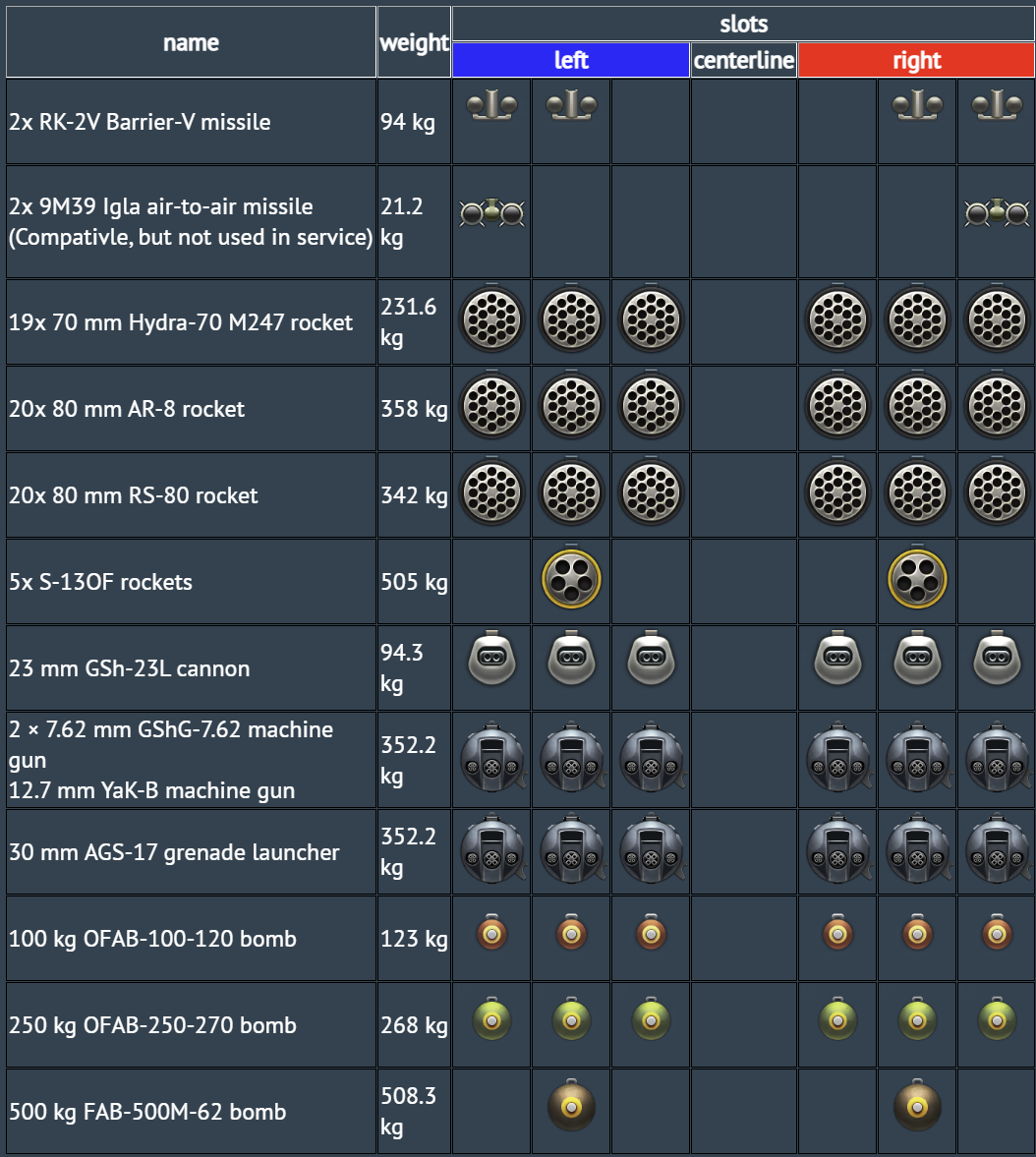
Image gallery:
Sources:
Spoiler
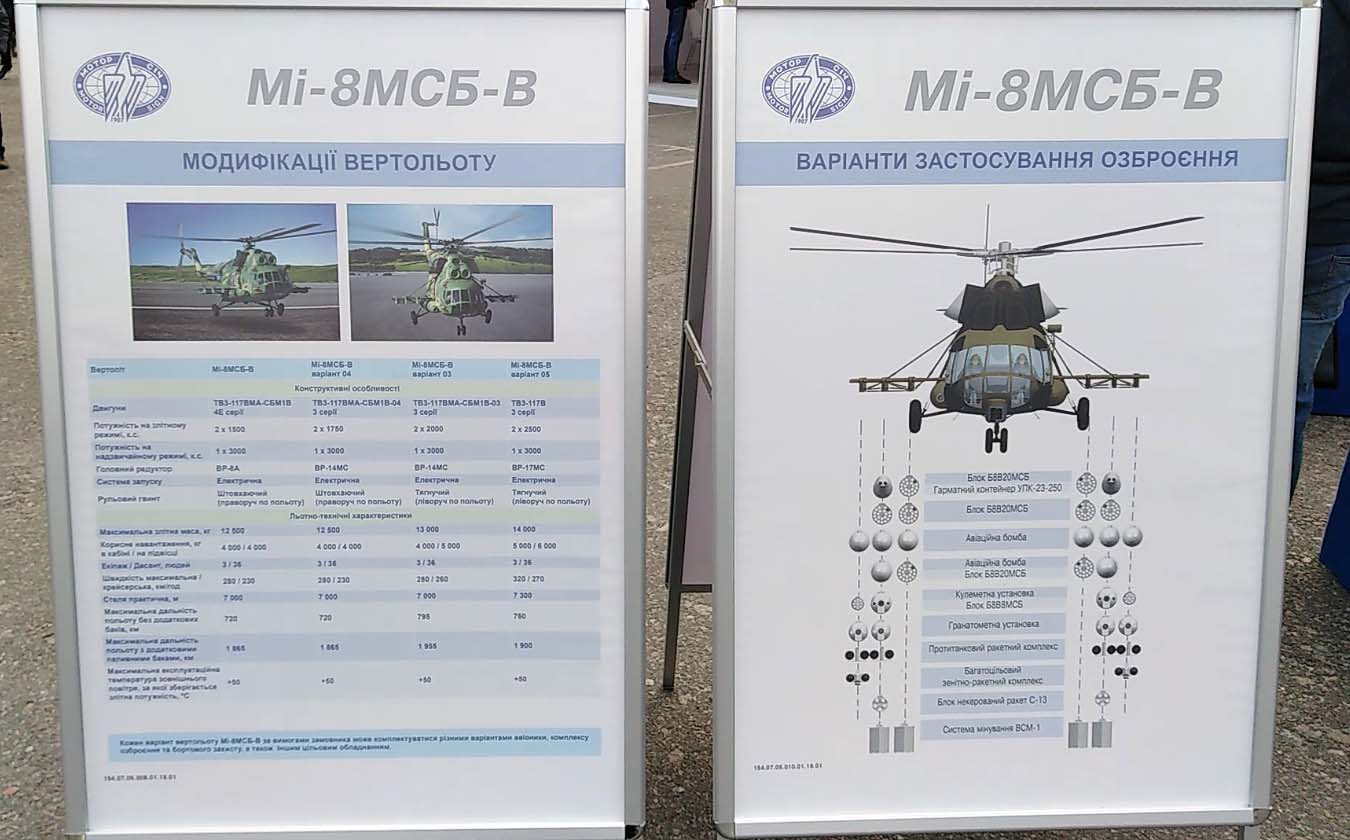
Brochures:
Websites:
https://militarnyi.com/en/news/firing-tests-of-the-barrier-atgm-with-the-mi-8msb-v-helicopter-have-been-completed/
https://day.kyiv.ua/ru/article/podrobnosti/ukrainskiy-vintokrylyy-okhotnik
Óãîëîê íåáà ¦ Ìèëü Ìè-8ÀÒÌØ Òåðìèíàòîð
Мі-8МСБ — ВУЕ
Захист неба України. Як посилити армійську авіацію
https://militarnyi.com/uk/news/v-ukrayini-stvoryly-novu-optyko-prytsilnu-stantsiyu/
https://www.wing.com.ua/content/view/21890/55/
"Мотор Січ" прибрало написи "Ми" з вертольотів - Мілітарний
Ukraińskie śmigłowce w Kielcach. Mocniejsze silniki i uzbrojenie przeciwpancerne
https://spetstechnoexport.com/product/barer-b
Balkan Novoteh | Arms and defense industry
https://tw.aircraft24.com/images/aircraftpics/09/attach_131709_1.pdf
TV3-117VMA-SBM1V, Series 4E - Motor Sich
«АДРОН» — СТРАЖ ОТЕЧЕСТВЕННОЙ АВИАЦИИ: andrei_bt — LiveJournal
Вогневі випробування повітряного "Бар’єр-В" від КБ "Луч" - черговий етап завершено | Defense Express
ДАХК "Артем" показав випробування РС-80 з новою бойовою частиною | Defense Express
https://militarnyi.com/uk/news/zamovlennya-na-rakety-rs-80-dlya-zsu-zbilshyly-u-p-yat-raziv/
АR-8 aircraft rocket
Ukrainian Navy to receive two Mi-8MSB-V helicopters | TURDEF
Ukraine’s Mi-8 Apply Heavy S-13 Missiles (Video) | Defense Express
Ukrainian Military Helicopters - Modernization And Development Plans
Videos:
https://www.youtube.com/watch?v=cgIqpdp91Dw
https://www.youtube.com/watch?v=FNCZalSF1xY
https://www.youtube.com/watch?v=LSgcqmPKvUQ&t=3s
Final Words:
The Mi-8MSB-V, if added to the game, would be a great example of unique Ukrainian equipment. It possesses distinct flight performance, a protection suite, and a wider variety of armaments compared to existing Mi-8 variants. While its gameplay style would be largely similar to the Mi-8AMTSh, the Mi-8MSB-V holds several advantages over it, primarily in its guided armaments, unguided rocket selection, defensive countermeasures, and access to the 2nd-generation thermals.
Pros:
- High service ceiling
- Advanced protection suite (IRCM and HIRSS heat screens)
- PM-LKT targeting sight with 2nd-generation thermal channel and high zoom
- Access to RK-2V “Barrier-V” ATGMs (800 mm penetration behind ERA, 7.5 km range)
- Large variety of weapons (70 mm, 80 mm, and 122 mm rockets, gun pods, bombs)
Cons:
- Poor maneuverability and sluggish roll rate
- Large silhouette
- Lacks operational Air-to-Air missiles (though compatible with “Igla” missiles, and could be given access to them in-game)
- Carrying a full load of ATGMs comes at the cost of other ordnance (and vice versa)
Based on its overall capabilities, it would fit well at a Battle Rating (BR) of 10.0–10.3 in Realistic Battles. And Finally as always, I hope you enjoyed reading my suggestion and let me know if there are any errors.
Comparison between Mi-8MSB-V 524R with Mi-8AMTSh
■ - green stands for advantage in certain area
| Parameter | Mi-8MSB-V (524R) | Mi-8AMTSh |
|---|---|---|
| Flight Performance | ||
| Engine Model | 2× Motor Sich TV3-117VMA-SBM1V (Series 4E) | 2× Klimov TV3-117VM |
| Takeoff Power (per engine) | 1,500 hp (limited by main gearbox capacity) | 2,200 hp |
| Maximum Speed | 280 km/h | 285 km/h |
| Cruise Speed | ~230km/h | ~230km/h |
| Service Ceiling | 7,300 m | 4,950 m |
| Max. rate of climb | 11.5 m/s | 11.5 m/s |
| Subsystems | ||
| Ballistic Computer | ✓ (CCIP) | ✓ (CCIP) |
| NVD | ✓ | ✓ |
| IRCM | “Adros” KT-01 AVE | ✗ |
| HIRSS | ✓ | ✗ |
| Targeting Sight | PM-LKT (TV and 2nd Gen Thermal) | Raduga-Sh (panoramic sight) |
| Chaff/Flare dispensers | 2x “Adros” KUV 26-50 (20x 50 mm, 40x 26 mm charges) | 4x OMI-PPI-26 (128x 26 mm charges) |
| Armaments | ||
| Offensive Armament | ✗ | ✓(7.62 mm PKT mg, 1750 rounds) |
| Bombs | ✓ (100 kg, 250 kg, 500 kg) | ✓ (100 kg, 250 kg, 500 kg) |
| Unguided Rockets | ✓ (70 mm Hydra-70, 80 mm S-8/AR-8/RS-80, 122 mm S-13) | ✓ (80 mm S-8) |
| Gun Pods | ✓ (UPK-23-250, GUV-8700 series) | ✓ (UPK-23-250, GUV-8700 series) |
| Air-to-Air Missiles | ✗ (None operationally, but compatible to carry 2x 9M39 per pylon) | ✓ (up to 4x 9M39 per pylon) |
| Anti-Tank Guided Missiles | ✓ (RK-2V Barrier-V: Tandem HEAT penetration 800 mm (RHA behind ERA), velocity 280 m/s, range 7.5 km) | ✓ (9M114 Shturm: HEAT penetration 600 mm (RHA), velocity 550 m/s, range 5 km ) |