In short: Mogami-Class / Suzuya-Class with radars and enhanced AA-battery, like Aoba, Haguro, Tone
- Yes, regular tree
- Yes, event
- No
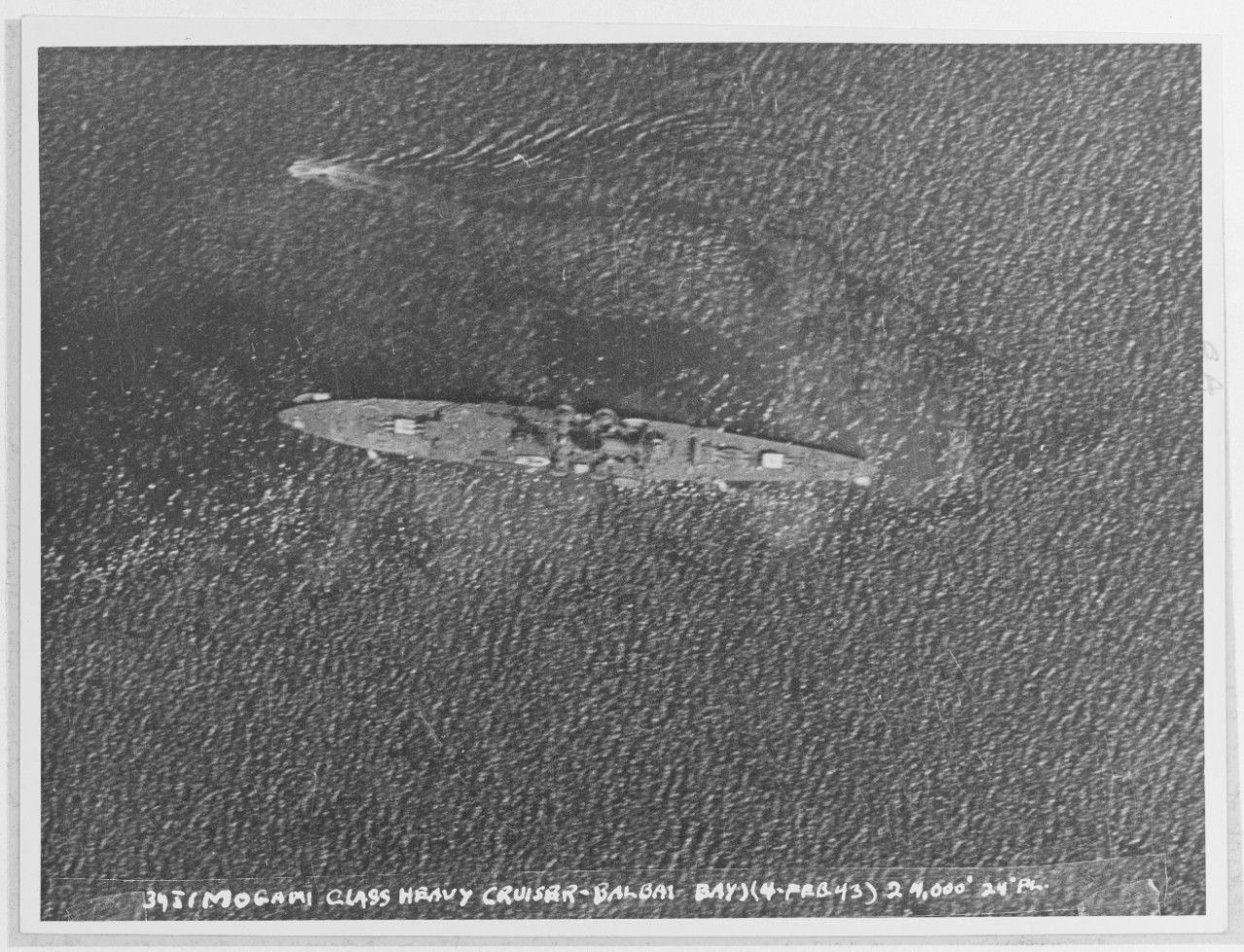
The last ship of her class to be laid down and the last to sink, the heavy cruiser IJN Kumano with her final June 1944 loadout would bring the only still missing Mogami into the game and represent the late-war configuration of this iconic class.
History
Spoiler
Named after the Kumano river, the ship was laid down 5 April 1934, to be constructed by Kawasaki Shipbuilding in Kobe. Launched 15 October 1936 and entering service 31 October 1937, Kumano was along the other ships of the Mogami-Class placed in reserve as Sentai 7, being active in the Indian Ocean and around Java. After Japans entry into the war participated in the Solomon Islands Campaign.
In April 1943 the first wartime modification took place. In July 1943 Kumano was damaged by Guadalcanal-based bombers, being repaired only in November and afterwards stationed in Micronesia and Palau, then transferred to Lingga near Singapore. In April 1944 undergoing the second wartime modification in Singapore and in June 1944 the third wartime modification in Kure.
In late October 1944 her bow was heavily damaged by a torpedo hit in the Battle off Samar, limiting her maximum speed to 1/3 of her performance. Subsequently attacked several times by aircraft and submarines near the Philippines over the next month, undergoing multiple repairs and relocations. On the 25th November 1944 Kumano was heavily damaged by bombers from USS Ticonderoga and sank here between the Islands Hermana Major and Hermana Minor off the west coast of Luzon.
Apparently there was a rumor that Kumano carried a large shipment of gold when she sank (Lacroix, E., & Wells, L. (1997), p. 501), the wreck was already stripped 6 months after sinking and also later damaged by local salvage operations using explosives. While only at a depth of around 33 meters, it is not a worthwhile diving spot. Further reading: 1 2
Today a memorial for the ship stands alongside others at Nagasako Park in Kure.
Design
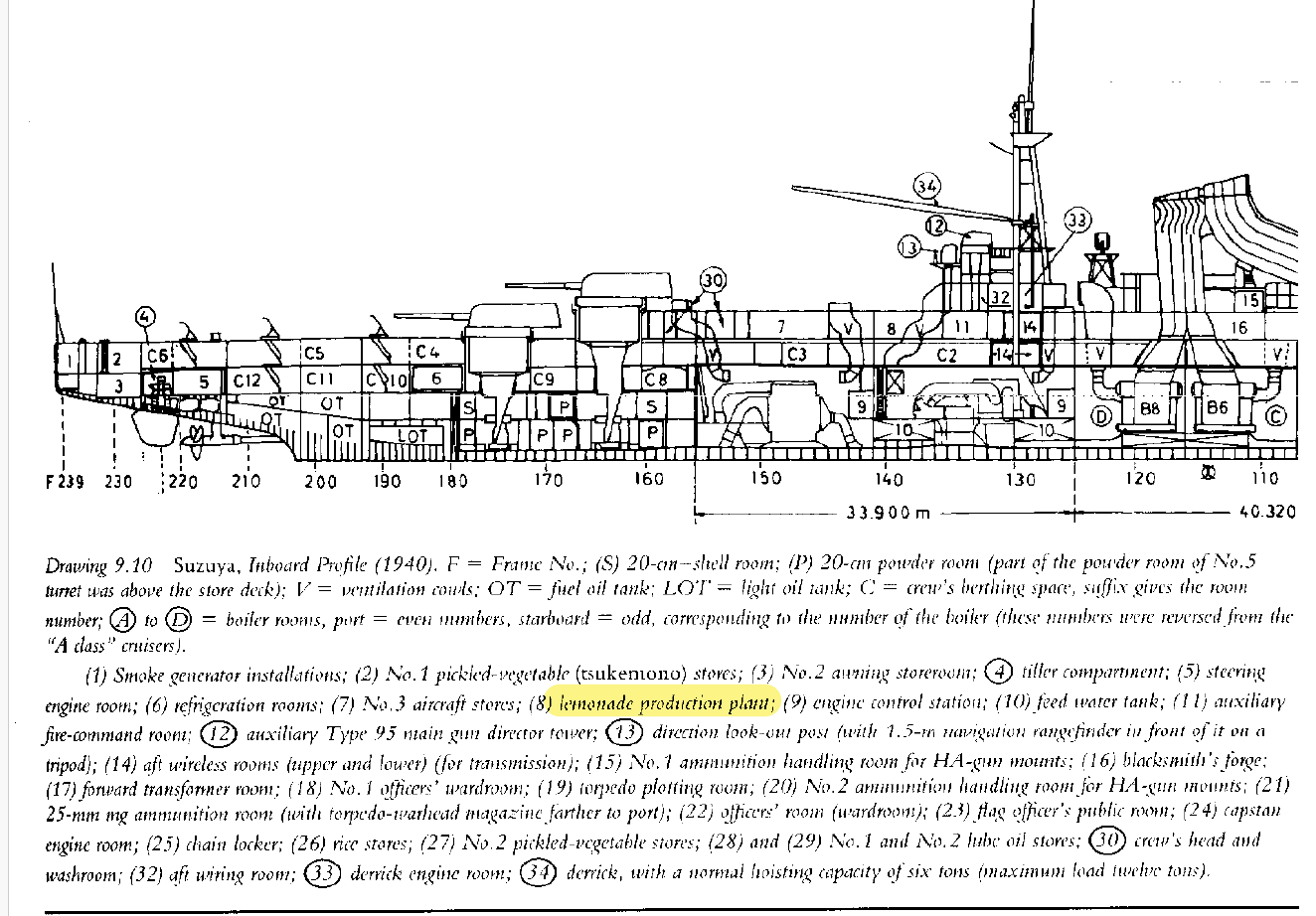
Kumano and Suzuya slightly differed from Mogami and Mikuma, when the initial planned design had shown some flaws that became apparent in 1934 and 1936 (Kumano was laid down after Mogami was launched): modified hull design to improve stability, using 8 boilers instead of 10, and a different funnel configuration, as well as missing the large air intake between the third turret and bridge. These are also shown in-game for Suzuya.
1934 first design modification (Capsizing of Chidori-Class Tomozuru):
- Revising the bridge
- Reducing deck heights
1936 second design modification (Fourth fleet Incident - ships damaged by typhoon):
- Replacement of welded steel plates with riveted plates
- Expanded bulges → increasing the maximum beam to 20.20m for Kumano
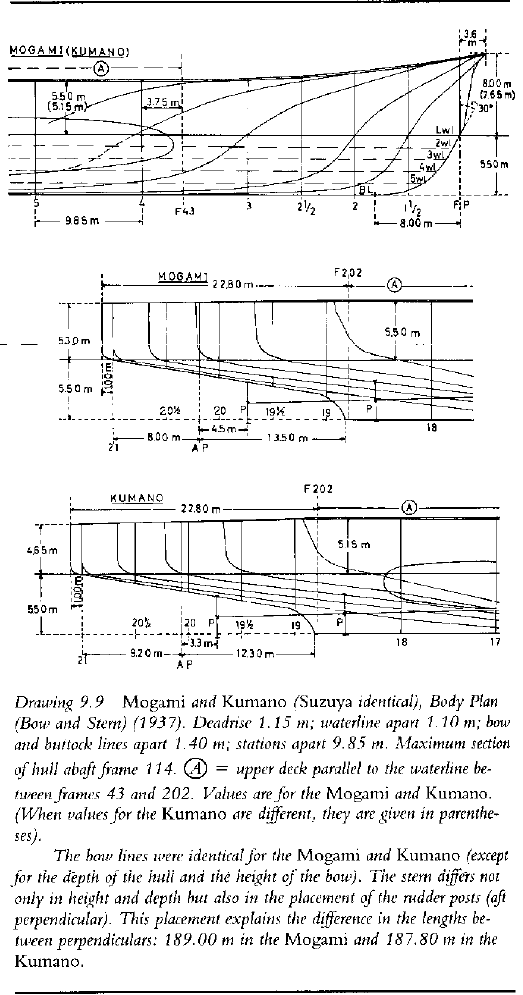
Precise and more specific hull details such as bow and stern are in the source material.
Spoiler
For example Lacroix, E., & Wells, L. (1997), p. 448:
Initial Armament:
- 5x3 6-inch guns
- 4x2 12.7 cm guns
- 4x2 25 mm and 4x2 13 mm guns
- 12 torpedo tubes in triple mounts for 24 Type 90 Torpedoes
- 2x Type 2 Mod. 3 catapults
- 1x Type 94 No. 2 seaplane
- 2x Type 95 seaplane
1939 third design modification:
- Replacing the 6-inch guns with 8-inch guns
- Replacing Type 90 torpedoes with Type 93s
- Replacing Type 2 Mod. 3 catapults with Type 2 Mod. 5 catapults
First wartime modification April 1943:
- Replacing the pair of 13 mm twin mounts with triple 25 mm guns
- Adding a second pair of triple 25 mm guns
- Adding a No. 21-A6 air search radar installation (5 kw, 1000 pps, 10 μs)
- Adding an AA-command platform at the compass bridge
- Removing triangular antenna masts from turrets 3 and 4
Second wartime modification April 1944:
- Adding 8 single 25 mm guns
Third wartime modification June 1944:
- Adding 4x3 and 16x1 AA-guns. The final AA-Armament was therefore:
8x3 - 4x2 - 24x1 Type 96 25 mm
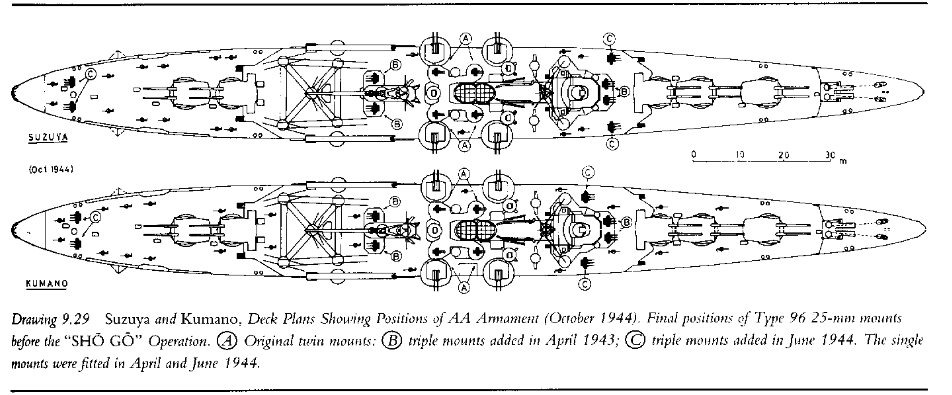
(Lacroix, E., & Wells, L. (1997), p. 495)
To utilize these, the magazines were expanded and the complement increased to around 1000.
- Adding two No. 22 4S surface radars
- Adding one No.13 air search radar
Radar details
Spoiler
-
No. 22 4S → 4S (s = shageki = firing). Used for both surface search and fire control.
Range error +/- 100 m, bearing error +/- 2°.
Effective detection range: 25 km battleships, 12 km cruisers, 10 km destroyers. -
No. 13 / Type 3: originally for land search, but more effective as an air search radar.
2 m wavelength, 500 pps, pulse length 10 μs.
(Lacroix, E., & Wells, L. (1997), p. 434 f.)
Armor layout
Spoiler
This is a partially abbreviated description, see Lacroix, E., & Wells, L. (1997), p. 449f. for finer details and schematics.
Boiler and engine rooms side armor
20° inward slope, 100 mm at the top, tapering to 25 mm, connected with armored middle deck.
Magazine side armor
20° inward slope, 140 mm tapering to 30 mm, connected with armored lower deck.
Transverse Bulkheads
Enclosing machinery front and aft, 105 mm above lower deck and 65 mm below the lower deck.
Magazines enclosed by bulkheads aft 95 mm, forward 140 mm.
Armored decks
Over machinery space 35 mm, outer strake, 4.2 m wide, 60 mm thick, sloped downwards at 20°, connecting to the machinery side armor.
Over magazines 40 mm, entirely flat, connecting to magazine side armor.
Steering gear and rudder room
Contained in armored box, sides 100 mm, ends 35 mm, top 30 mm.
Superstructure
Conning tower: 100 mm side, 50 mm top.
Steel plates for protection against machine-gun-fire around: main director tower, tripod support tubes below director tower, compass bridge and fire command station, transmission room, wiring room, telegraphic and radio telephone rooms, communication tubes between the wireless rooms and between wheelhouse and middle deck (Lacroix, E., & Wells, L. (1997), p. 470).
Other armored sections
Funnel uptakes of boiler rooms 5-8 protected by two sets of plates, 70 mm and 95 mm thick, ventilation cowls covered with 60 mm plates.
Gun barbettes above lower deck up to turret rings armored with 25 mm plating.
Turret rings contain cylindrical plating of 75-100 mm, 2.5 m high for turrets 3 and 4.
Turrets 1/2/5: 75 mm - 1.5 m high.
The 4 ammuntion hoists for the secondaries had for about 1m above the armored lower deck 75-100 mm armor plating.
Engines
Spoiler
Four sets of Kanpon turbines powered by 8 “large” fuel oil boilers (unlike the 8 “large” + 2 “small” layout on Mogami and Mikuma).
Designed for a full-power output of 152.000 SHP. In her 1937 trials Kumano was recorded at 35.36 kts and 153.689 SHP.
Summary
Displacement: 14.791 t (Full Load) - 11.259 t (Light Condition)
Length: 200.6 m
Beam: 20.2 m
Draft: 6.33 m (Full Load) - 5.07 m (Light Condition)
5x2 20 cm/50 3rd Year Type naval gun
4x2 12.7 cm/40 Type 89 naval gun
8x3 - 4x2 - 24x1 Type 96 25 mm gun (56 total)
2x3 torpedo tubes on each side
24x Type 93 torpedoes
2x Type 2 Mod.5 catapults
2x F1M2 seaplane (Type 0 No.1) - Introduced late 1941
1x No. 21-A6 air search radar
2x No. 22 4S surface radars
1x No.13 air search radar
Complement: ca. 1000
(1094 ?) See: 熊野 (重巡洋艦) - Wikipedia
Armor: up to 140 mm angled at 20°.
8 oil boilers, 4 engines: <152.000 SHP, ca. 65.5 kph
Place in the game
I suppose Kumano could be easily foldered behind Mogami or implemented otherwise. But personally I would heavily favour that she is added as one of the monthly events, since then we would also get a loading screen/wallpaper with it as well - hopefully a really pretty one, like these: 1 2 3 4 5 6 7 8 9 10
Sources text
Spoiler
- Lacroix, E., & Wells, L. (1997). Japanese cruisers of the Pacific War. p. 434 - 501
- Whitley, M. J. (1999). Cruisers of World War Two: An International Encyclopedia. Brockhampton Press. p. 181 - 185
- Patton, W., Greer, D., Gebhardt, D., & Glenn, D. (2006). Japanese Heavy Cruisers of World War II in Action. Squadron/Signal Publications. p.45-52
- 熊野 (重巡洋艦) - Wikipedia
Bonus: