- Yes - In the Tech Tree.
- Yes - Event/BP.
- Yes - Premium.
- No - I would not like to see HMAS Kookaburra in game.
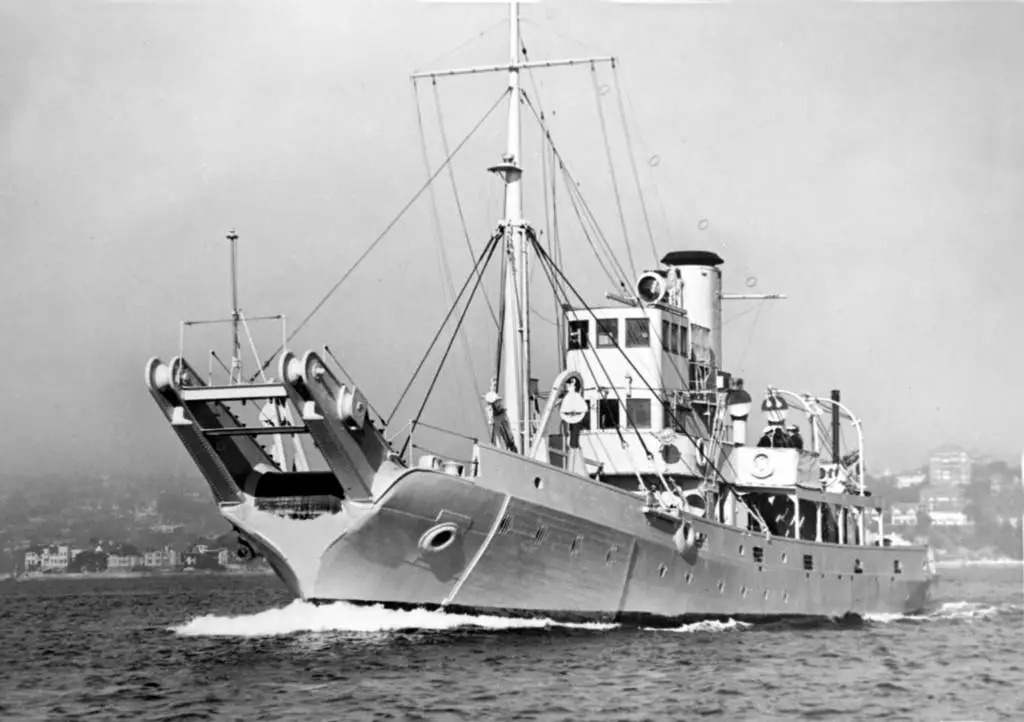
Description:
HMAS Kookaburra was the only Net-class Boom Defense Vessel (BDV) operated by the Royal Australian Navy during the Second World War. Compared to the Net-class operated by the Royal Navy, the Kookaburra would be constructed to a modified design.
She would be the RAN’s first dedicated Boom Defense Vessel, with all previous A/T and A/S nets being laid by minesweepers or other craft not designed for the task. Compared to the other RAN BDVs, which were of the Bar-class, the Net-class HMAS Kookaburra was smaller and slower.
The standard Net-class in service with the Royal Navy would have been more or less equal to the Bar-class vessels, however, the Kookaburra was ordered with altered dimensions, becoming slightly longer, and having less beam, but increasing in draught compared to the standard ships. In addition to these changes which already altered her hydrodynamic profile, she completed with weaker engines, losing over 400hp of power.
This was done as no other engines could be procured at this time, and it was very important that she complete as soon as possible. This led to her dropping top speed to only 9.5kt, compared to the standard 11.5kt.
This suggestion is for as she commissioned into the RAN in 1939.
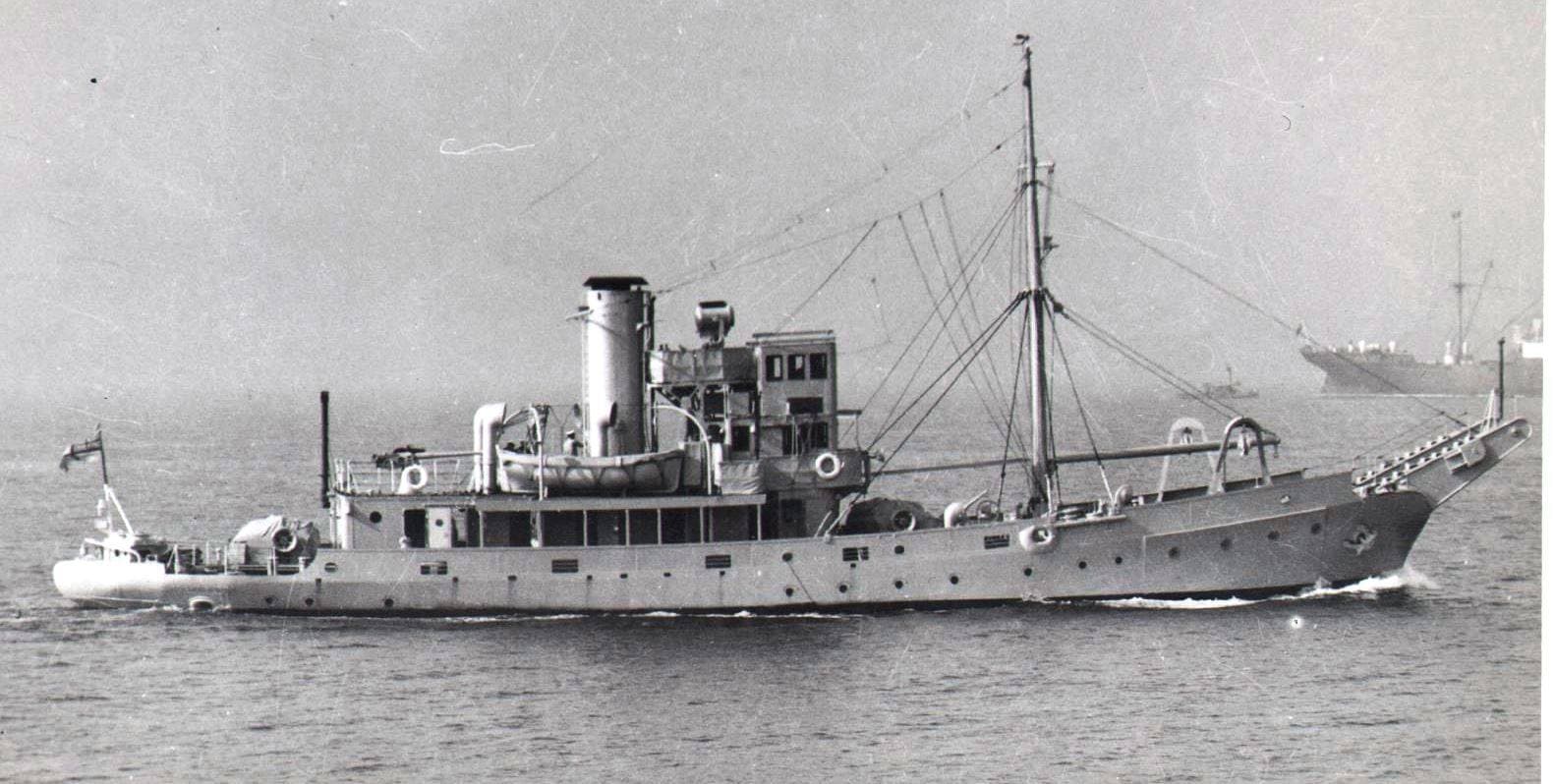
History:
HMAS Kookaburra was laid down by Cockatoo Docks & Engineering Company at Sydney, Australia, on the 4th of July 1938, launching on the 29th of October 1939. Her launch was filmed by Pathe News at Cockatoo Island. She would fit out and commission on the 28th of February 1939.
Upon commissioning she would operate as the training tender to the ASW school at Sydney, while also performing A/T and A/S net laying operations at that port. However, in November 1939, she would sail to Darwin, as to lay nets at that port. As she was the only commissioned RAN DBV during this time, with the Bar-class ships under construction, she would have to operate between these ports to cover these needs, she would return to Sydney on the 9th of January 1940.
She would again sail for Dawin on the 9th of April 1940. She would also perform examination duties, taking away the pressure for commandeered pleasure craft, which were unsuitable for the task due to their small size and armament, often being slower than 8kt, and only armed with a single MG.
She would be joined at Darwin with the Bar-class HMAS Kangaroo in early 1941 when that ship finished working up. By late 1941 all three Bar-class vessels were online, allowing for at least one BDV to be active in Sydney and Darwin, with two vessels per port on average, however the vessels would often be together in a single port. Their service would be long but uninteresting in this role.
However, on the 19th February 1942, Japanese naval aircraft executed an air raid on the Port of Darwin. This raid would result in over 11 vessels sunk, and 25 further ships damaged. Unfortunately, the HMAS Kangaroo was damaged in this attack, leaving the two other Bar-class and Kookaburra as the only BDVs at Darwin for the time being. Due to their strong winches for picking up heavy A/S nets, they would prove useful for salvaging both the sunk vessels, and those which had beached themselves.
Between September 1942, and February 1943, she was in a large refit at Garden Island. During this refit she would swap out her 3 inch gun for a 12pdr, as well as general boiler maintenance and cleaning. After completing this refit she would return to Darwin, where she would serve out the rest of the War without incident, paying off into the reserve on the 15th of January 1946.
She would recommission on the 27th of November 1950, and would sail for Sydney for refit, as her systems had deteriorated, after this was completed, she would return to being tied up in reserve. On the 11th of May 1956, she would recommission from reserve as a “Special Service Ship”, being engaged in oceanographic surveying in addition to general duties, such as vessel examination. During her time in this role, two of her ratings would rescue a paper boy which had fallen off a gangway while the Kookaburra was visiting Brisbane.
She would pay off 3rd of December 1958 into the reserve, being removed from the Navy List and cleared for disposal on the 24th of June 1965, being scuttled in March 1970.
| General Characteristics: | |||||
|---|---|---|---|---|---|
| Name: HMAS Kookaburra | |||||
| Country: Australia | |||||
| Type: Boom Defense | |||||
| Class name: Net (modified) | |||||
| Year of commission: 1939 | |||||
| Refit: 1939 | |||||
| ----------------------------------------------------------------------------------------------------------------------------------------- | |||||
| Dimensions: | |||||
| Length: 160ft (49m) | |||||
| Beam: 26ft 6in (8.08m) | |||||
| Draught: 10ft 3in (3.12m) | |||||
| Displacement: 533t standard | |||||
| ----------------------------------------------------------------------------------------------------------------------------------------- | |||||
| Propulsion: | |||||
| Powerplant: Coal fired triple expansion steam, creating 450ihp (335.5kW) across one screw | |||||
| Speed: 9.5kt | |||||
| Endurance: unknown | |||||
| ----------------------------------------------------------------------------------------------------------------------------------------- | |||||
| Armament & sensors: | |||||
| Compliment: 32 | |||||
| Primary armament: 1x1 QF 3-Inch 20cwt (High Angle) | |||||
| Secondary armament: 2x1 .303 Vickers | |||||
| Tertiary armament: - nil | |||||
| Radar: -nil | |||||
| Sonar: -nil |
Sources:
Gillett, R. (1983). Australian and New Zealand Warships 1914-1945 (p.108)
D.Stevens. (2005) A critical Vulnerability (pp.103)
AWM78 190/1 - Reports of proceedings, HMA Ships and Establishments - HMAS Kookaburra
HMAS Kookaburra - Wikipedia
Trove - Archived webpage
https://seapower.navy.gov.au/history/units/hmas-kookaburra