i just had an argument with a guy who claims the meteor has 70km of range because it has that in a game on roblox… i cant with certain people.
5 Likes
aim120c7(c5) in all its glory
1 Like
I wouldn’t be surprised if mechanic is there and in controlled environment it works… Then it falls flat when interacting with game servers.
In test flight ie locally running game, missiles are flying flawlessly. Yet in actual games they are notoriously twitching from overcorrections which makes them bleed speed for no reason. In test flight trying to replicate TVC missile spin out of control in slow speed, high AoA is near impossible, in games it happens.
Rewatching own replays, ARH seekers when angle gating (?) seems to focus seeker on chaff cloud, then jumps to another one, yet missile continue flying on previously established interception path, until angle gating runs out of a timer? then missile shifts trajectory to follow random chaff. In other cases you see missile indeed flicking IOG on (white beam+cloud) while having TRK state, eventually biting into chaff.
Alternatively aircraft flying at steady speed in notch+chaff scenario leaves learned angle gating window by increasing angular velocity as missile approaches, so missile goes after random target (chaff) when there isn’t anything meeting previously learned angle gate window.
In slow flying aircraft, look up scenarios where Pulse mode of ARH seeker has much longer detection range, missiles are decoyed pretty much with first chaff when notch is achieved, as per CatWerfer video.
To add “no plan (game mechanic) survives contact with the enemy (server)”, I just had game where I was hit by early missile. Nothing out of the ordinary, except missile lost datalink mid flight… and regained it afterwards, which updated IOG enough to smack me.
1 Like
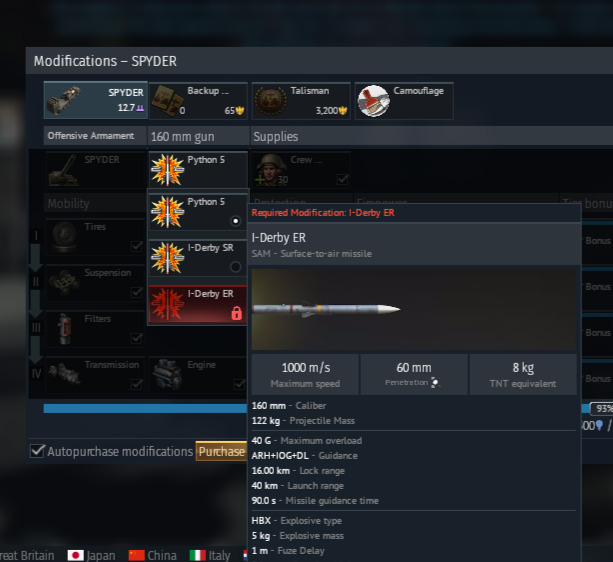
But is it modeled as dual pulse
and has completly new propulsion code
        "mass": 122.0,
        "fireDelay": 0.0,
        "propulsion0": {
          "impulse0": {
            "time": 4.0,
            "force": 18800.0,
            "massLost": 32.0
          }
        },
        "propulsion1": {
          "impulse0": {
            "time": 2.0,
            "force": 17625.0,
            "massLost": 15.0
          }
        },
          "propulsionAutopilot": {
            "propulsionActivation0": {},
            "propulsionActivation1": {
              "startTimeMin": 4.0,
              "timeToHitMin": 5.0,
              "velocityMin": 350.0
            }
          }
6 Likes
So the last 3 lines are the most important parts it seems. And this is my understanding of it.
startimemin means essentially that the missile must have been operating for atleast 4 seconds before it starts the second pulse
and timetohitmin could be when the missile has 5 seconds left to hit the target.
velocitymin could be that it starts the second pulse when speed gets to 350m/s or around Mach 1
2 Likes
Cannot wait for the other Dual pulse missiles.
Off the top off my head, at least for air to air, the remaining dual pulse missiles are:
Mica em ng
Pl-15
R-77m
Not sure if I’m forgetting anything else
1 Like
They’re missing one more line, something like a minimum velocity closure rate, so that the missile is still guaranteeing the ability to hit targets in rear aspect.
Does it? I’m pretty sure it’s using the same code as time to hit timer which does calculate speed difference (not acceleration)
Videos do show Derby-ER speeding up when it gets down to mach 1, so I think it’s a missile speed and not speed difference, I’d love to be wrong though.
Nvm it might be as you said.
i meant for hit time it calculates relative speed, idk what min speed does, i assume it does reboost if missile goes tho slowly
The AIM-174B is also a dual-pulse missile.
really? damn, thing may have 600km of range
Currently derby er only burn for 4 seconds then the sustainer only activates depending on certain factors
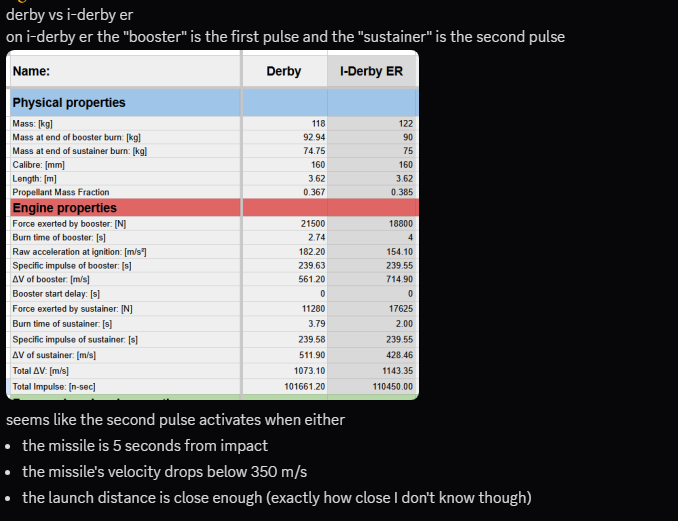
So its not a true dual pulse
Actually, disregard that, the Gunslinger might not have a dual pulse motor as it appears that only SM-6 Block 1B has a dual-pulse motor.
how a “true” dual pulse should behave?
Dual pulse at least for the derby er it should be a boost sustainer for about 6 seconds like the regular derby then the second pulse is a separate section and will only burn depending on certain conditions like we currently have in the
dev
Now the question is how long the burn time is on the second pulse