Would you like to see this Hind in-game?
- Yes, as a Tech-Tree Vehicle
- Yes, as a Premium Vehicle
- Yes, as a Squadron Vehicle
- Yes, as an Event Vehicle
- No, I don’t want to see this in-game
Mi-24VD: The Experimental Rear-Gunned Hind
The Mi-24VD was an experimental variant of the Soviet Mi-24V attack helicopter, developed during the Soviet-Afghan War to address a tactical weakness discovered in combat. While the Mi-24 was highly effective in offensive operations, it had little means of defending itself against enemies firing from behind after completing an attack. To solve this problem, engineers designed a unique rear defensive weapon station equipped with a heavy machine gun. Although the concept showed promise, the project remained experimental and never entered serial production due to significant technical and operational drawbacks.
Background and Development
Spoiler
The Mi-24 originated in the late 1960s from Mikhail Mil’s concept of a heavily armed helicopter that could both carry infantry and support them on the battlefield. The first prototype, designated V-24, flew in 1969 and combined a troop compartment with short wings, substantial armour and fixed or turret-mounted weapons. The initial production Mi-24A entered service in the early 1970s, but its broad, shared cockpit gave the crew limited visibility. This led to the improved Mi-24D, which introduced the now-famous stepped tandem cockpit, with the gunner seated ahead of and below the pilot, as well as upgraded weapons and protective systems. Further development produced the Mi-24V, which entered production during the second half of the 1970s. It retained the Mi-24D’s general airframe and four-barrel 12.7 mm chin gun but added the more capable 9M114 Shturm-V anti-tank missile system, improved engines and updated targeting equipment. The Mi-24V became one of the most widely produced and recognizable members of the family, serving extensively with Soviet forces and numerous foreign operators.
Combat experience in Afghanistan revealed that Mi-24 helicopters were especially vulnerable during the withdrawal phase following an attack. Once the helicopter passed over its target, insurgents often opened fire from the rear, taking advantage of an area that the aircraft’s existing weapons could not cover. Approximately 46–48 percent of the hits received by Mi-24s occurred while they were withdrawing from the target, compared with roughly 25–27 percent for Mi-8s. The difference was attributed partly to the Mi-8’s ability to carry a machine gun covering the rear sector. The Mi-24, however, lacked a comparable defensive position. Although crew members could sometimes fire through the side doors or windows, these offered only limited coverage and left the helicopter’s direct rear sector largely unprotected.
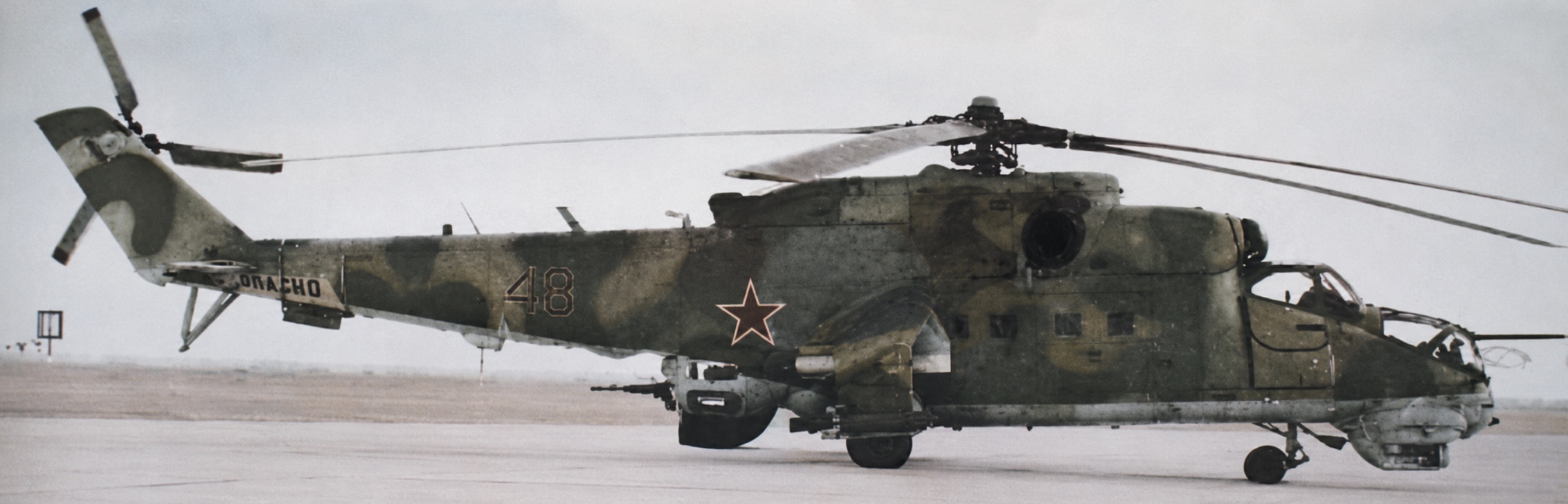
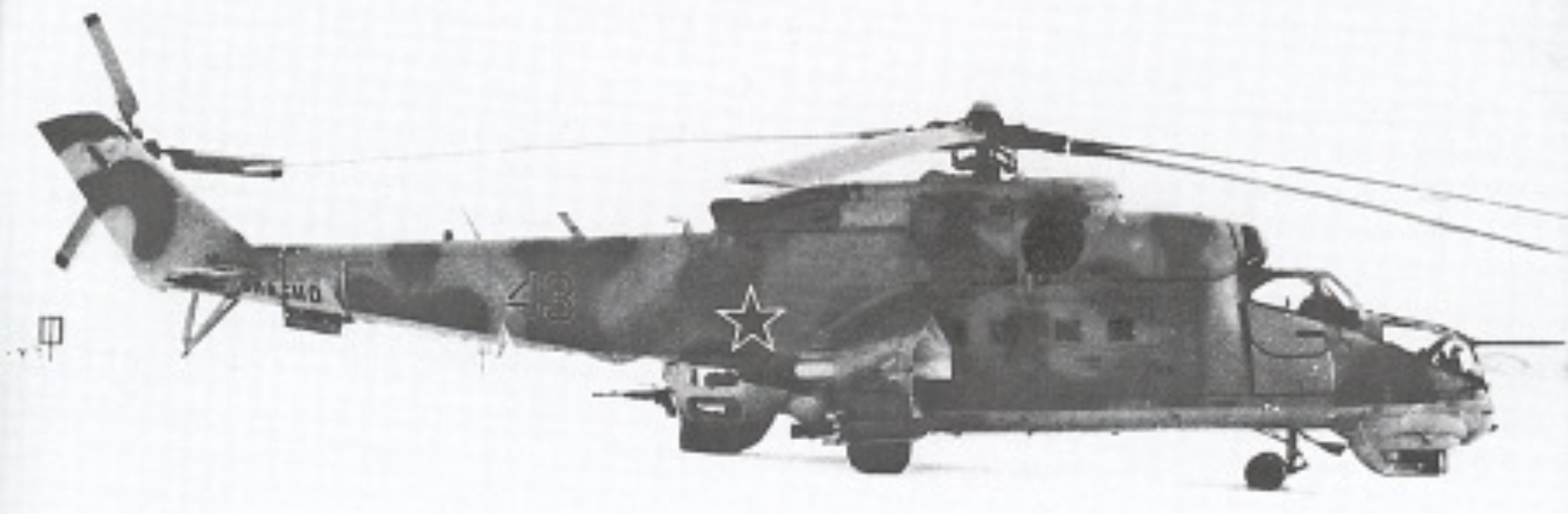
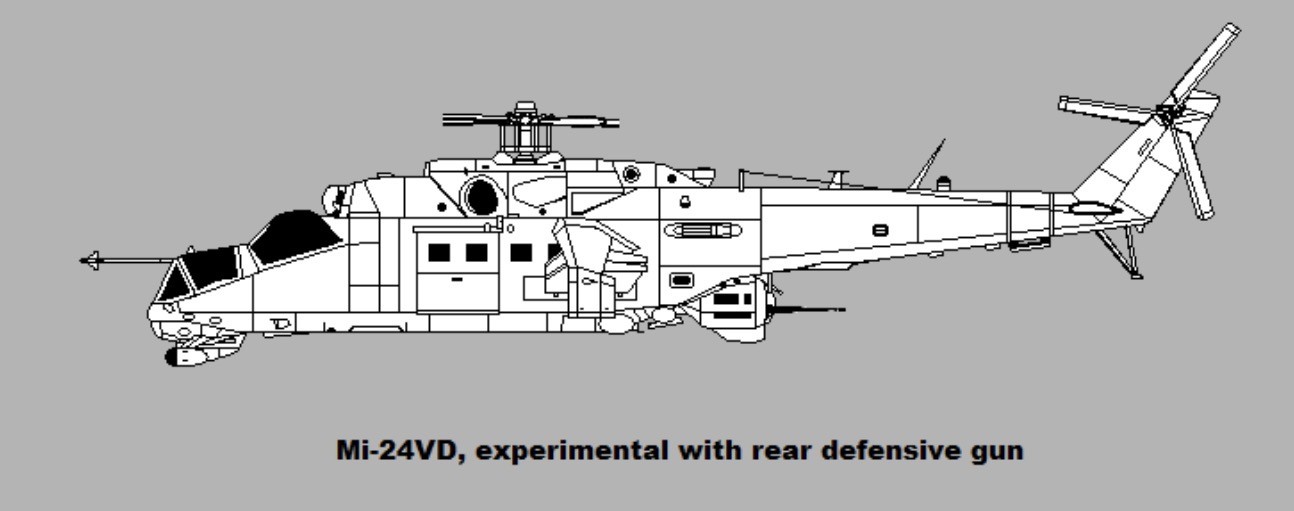
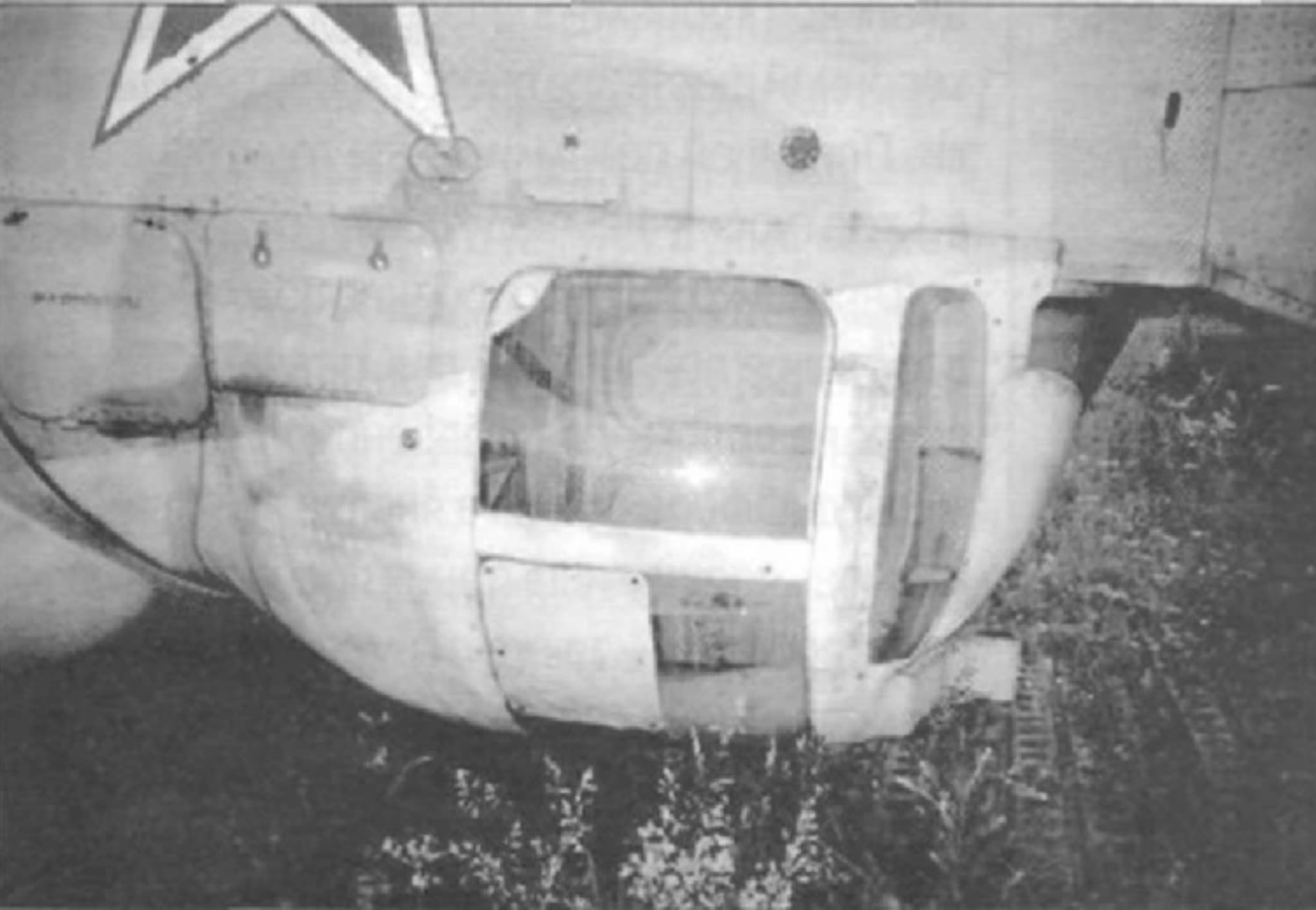
To improve survivability, the Mil Design Bureau began work in 1985 on a modified Mi-24V fitted with a dedicated rear-facing gun position. The resulting aircraft became known as the Mi-24VD, but only a single prototype was completed for evaluation. The defining feature of the Mi-24VD was a new gunner’s station installed beneath the rear fuselage, just ahead of the tail boom. This enclosed position housed a manually operated 12.7 mm NSVT “Utyos” heavy machine gun, supplied with approximately 300 rounds of ammunition. Unlike the helicopter’s standard forward-firing armament, the new weapon was intended solely for rear defense. Its purpose was to suppress enemy fighters engaging the helicopter as it departed the target area. All of the Mi-24V’s original weapons remained unchanged. The aircraft retained its chin-mounted YakB-12.7 machine gun, anti-tank guided missiles, rockets, bombs, and other external stores.
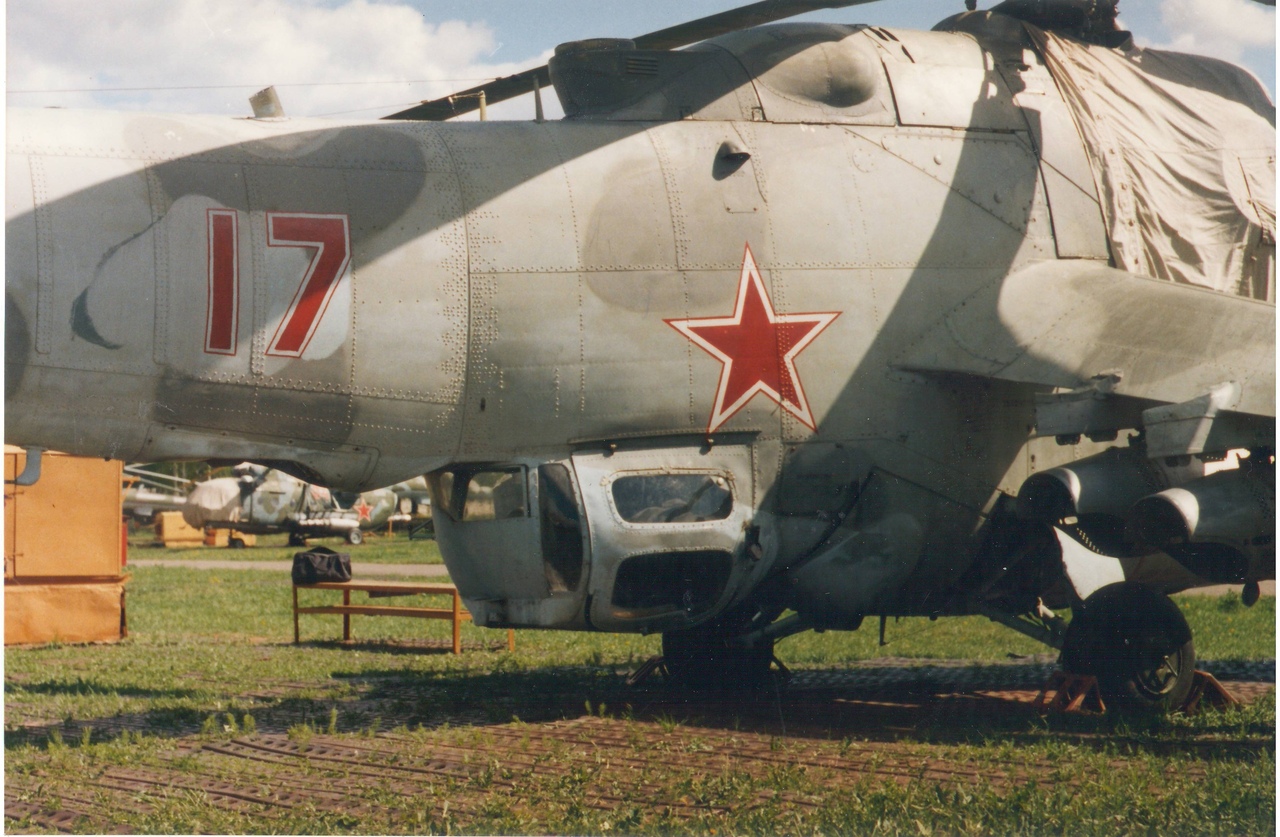
Installing the gun position required extensive modifications to the airframe. Because the lower rear fuselage already contained fuel tanks, electronic equipment, structural members, and the tail rotor drive shaft, there was no room for a conventional compartment. Engineers created a narrow crawlway from the troop compartment, allowing the gunner to reach his station by crawling into an extremely confined space beneath the aircraft. The space was so tight that during a demonstration an overweight Soviet general got stuck in the crawlway. Alternatively, the gunner could access the turret through a side hatch on the left side of the turret. The gunner sat facing backwards inside a heavily glazed enclosure. His legs extended into flexible fabric covers below the fuselage, a distinctive feature visible in photographs of the prototype. Although the station provided rearward visibility, it was cramped and difficult to access, making operation uncomfortable and emergency evacuation problematic. The modified helicopter also required an additional crew member to operate the rear weapon, increasing the normal crew complement and adding further weight.
Testing and Evaluation
Spoiler
Flight testing demonstrated that the concept addressed a genuine battlefield problem, but it also exposed numerous practical shortcomings. Positioning a heavy machine gun, its ammunition, the turret structure, and an additional crew member near the rear of the helicopter shifted the aircraft’s center of gravity aft. This negatively affected handling characteristics and reduced maneuverability. The installation also increased the helicopter’s overall weight and aerodynamic drag. These penalties reduced performance, particularly in the hot, high-altitude conditions commonly encountered in Afghanistan. Visibility from the gunner’s position proved less effective than anticipated. Despite the extensive glazing, portions of the aircraft structure restricted the field of view, limiting the weapon’s effectiveness against ground targets while the helicopter maneuvered.
Another issue involved crew safety. The rear gunner occupied an extremely confined compartment that was difficult to enter and exit. In the event of a crash or emergency landing, escaping from the position would have been extremely challenging. The compartment also lacked sufficient space for normal parachute use, further increasing the risks faced by the gunner. Because the gunner’s legs extended into external fabric covers beneath the fuselage, his feet were highly exposed to enemy small-arms fire. Reports from testing also noted problems with engine exhaust gases accumulating around the rear gun position, creating an uncomfortable and potentially hazardous working environment. Maintenance presented another challenge. The new installation occupied an already crowded section of the airframe containing fuel systems, electrical equipment, and transmission components, making servicing more complicated than on a standard Mi-24.
The principal reasons the Mi-24VD was not adopted included:
- Significant rearward shift of the center of gravity.
- Increased overall weight.
- Additional aerodynamic drag.
- Reduced maneuverability and flight performance.
- Cramped and unsafe working conditions for the rear gunner.
- Difficult emergency escape procedures.
- Restricted visibility and limited firing arcs.
- Increased maintenance complexity.
- Problems caused by engine exhaust entering the gunner’s compartment.
Collectively, these issues made the modification unsuitable for operational service. Engineers concluded that the penalties imposed on the helicopter exceeded the additional protection provided by the rear-mounted weapon.
Following the cancellation of the Mi-24VD, Soviet forces adopted less complex methods of improving rear defense. Pilots were equipped with rear-view mirrors to increase situational awareness, helicopters operated more frequently in mutually supporting pairs, and crews relied on tactical maneuvering to reduce their exposure after attacks. These measures proved more practical than introducing a permanently installed rear turret. The sole Mi-24VD prototype never entered production and remained a unique experimental aircraft. It served for some time as a training aid at an aviation technical school before eventually being scrapped.
Introduction into War Thunder
Spoiler
In my opinion, the Mi-24VD would make an interesting addition to War Thunder as an Event, Squadron, or Premium helicopter for the USSR. It would give players the opportunity to acquire one of the most historically significant Mi-24 variants (with a pleasant add-on) without having to grind through the Soviet helicopter tree.
Fortunately, the rear-facing 12.7 mm machine gun is the same caliber as the forward-mounted machine gun used on the Mi-24A, meaning that it won’t be entirely useless. While its practical combat effectiveness would naturally be limited due to the gameplay we currently have, it could provide some entertaining tactical opportunities. For example, after performing a close-range unguided rocket attack, the player could use the rear gun to finish off lightly armored vehicles while flying away from the target. It could also serve as a last-ditch defensive weapon against attacking aircraft, allowing players to fire at a jet that overshoots or misses its attack during a high-speed pass. The infantry mode, however, could give this helicopter the role it was truly built for. Only time will tell how Gaijin decides to go about implementing it.
Although the rear turret would likely be more of a novelty than a game-changing feature, its historical uniqueness and unconventional design would make the Mi-24VD stand out from every other Hind currently in the game. The ball turret makes the Crocodile look like an even more menacing mean green killing machine than it already is. It would offer a fresh gameplay experience while introducing one of the least-known experimental variants of the legendary Mi-24 family.
Specifications
Spoiler
General Characteristics
| Specification |
Mi-24VD |
| Type |
Experimental attack helicopter with rear defensive gun |
| Base model |
Mi-24V (NATO reporting name: Hind E) |
| Year converted |
1985 |
| Number built |
1 (converted from a production Mi-24V) |
| Crew |
4 (pilot, weapons operator/copilot, flight engineer, rear gunner) |
| Troop capacity |
Up to 8 troops |
| Medical evacuation capacity |
Up to 4 stretchers |
| Internal cargo |
Up to 1,500 kg |
| External sling load |
Up to 2,000 kg |
| Maximum external weapons load |
Approximately 2,400 kg |
The fourth crew member was required specifically to operate the manually controlled rear-mounted machine gun.
Dimensions
| Specification |
Measurement |
| Overall length |
21.35 m |
| Fuselage length |
17.51 m |
| Main rotor diameter |
17.30 m |
| Tail rotor diameter |
3.91 m |
| Stub-wing span |
6.66 m |
| Fuselage height |
Approximately 3.97 m |
These dimensions remained essentially unchanged from the standard Mi-24V airframe.
Powerplant
| Specification |
Details |
| Engines |
2 × Isotov/Klimov TV3-117V turboshaft engines |
| Maximum engine power |
Approximately 2,200–2,225 shp each |
| Main rotor |
Five-bladed |
| Tail rotor |
Three-bladed |
The Mi-24VD retained the standard powerplant despite the additional weight of the rear gun installation.
Weight
No official weight figures were published specifically for the Mi-24VD. The following values are based on the standard Mi-24V:
| Specification |
Approximate Figure |
| Empty weight |
8,500 kg |
| Normal takeoff weight |
11,200 kg |
| Maximum takeoff weight |
11,500 kg |
The experimental conversion would have increased the empty weight because of the additional gun position, structural reinforcement, ammunition, and fourth crew member.
Performance
The following figures represent the standard Mi-24V, as no verified performance data for the Mi-24VD has been published.
| Specification |
Figure |
| Maximum speed |
Approximately 320 km/h |
| Cruising speed |
Approximately 260–265 km/h |
| Combat range |
Approximately 450–595 km |
| Ferry range |
Up to 1,000 km |
| Service ceiling |
Approximately 4,500 m |
| Hover ceiling (IGE) |
Approximately 2,000 m |
The additional weight and drag of the rear turret reduced the helicopter’s speed, range, and maneuverability compared with the standard Mi-24V.
Fixed Armament
Forward Armament
| Specification |
Details |
| Weapon |
YakB-12.7 rotary machine gun |
| Calibre |
12.7 mm |
| Mount |
USPU-24 remotely controlled chin turret |
| Ammunition |
1,470 rounds |
| Traverse |
60° left/right |
| Elevation |
+20° |
| Depression |
–40° |
Rear Defensive Armament
| Specification |
Details |
| Weapon |
NSVT “Utyos” heavy machine gun |
| Calibre |
12.7 × 108 mm |
| Operation |
Manually aimed by dedicated rear gunner |
| Location |
Glazed compartment beneath the rear fuselage |
| Ammunition |
Approximately 300 rounds |
| Feed system |
Twin ammunition containers |
| Purpose |
Rear-hemisphere defense during withdrawal from attack |
The exact traverse and elevation limits of the rear gun were never officially published.
External Weapons
The Mi-24VD retained the same external weapons capability as the Mi-24V, including six underwing hardpoints capable of carrying a wide range of Soviet air-to-ground ordnance.
Typical weapon options included:
| Weapon Type |
Examples |
| Anti-tank guided missiles |
9M114 Shturm-V (4–8 missiles) |
| 57 mm rocket pods |
UB-32 with S-5 rockets |
| 80 mm rocket pods |
B-8V20 with S-8 rockets |
| 122 mm rocket pods |
B-13L with S-13 rockets |
| Heavy rockets |
S-24 |
| Cannon pods |
UPK-23-250 with GSh-23L 23 mm cannon |
| Machine-gun pods |
GUV gun pods |
| Automatic grenade launcher pods |
GUV with AGS-17 |
| General-purpose bombs |
FAB-100, FAB-250, FAB-500 |
| Cluster munitions |
KMGU-2 dispenser |
| External fuel tanks |
PTB-450 |
Actual weapon loads depended on mission requirements and aircraft weight limitations.
Avionics and Defensive Systems
The Mi-24VD retained the standard equipment fitted to the Mi-24V, including:
- ASP-17V pilot’s gunsight
- KPS-53AV sight for the weapons operator
- Raduga-Sh missile guidance system
- SRO-1P Identification Friend or Foe (IFF) system
- SPO-15LM radar warning receiver
- Four ASO-2V-02 flare/chaff dispensers
Sources
Spoiler
Mi-24VD :: Ruslet
Вертолеты Ми-24. Техника и вооружение 2012 02