Yeah because the mig-21bis is overperforming in thrust.
The point is these people have zero principle. They will buff and nerf with zero regard. They are solely interested in regurgitating, recycling content and spoon feeding it to you every business quarter.
Regardless of if you still cannot tell me what installed thrust is required to equal a 1:1 thrust to weight ratio in the MiG-29. I still care about you Chief.
Hint:
its around 8,300kgf…
2 Likes
The empty weight of the plane 11,010 kilograms.
So each engine only needs 5005kg thrust to equal 1:1 thrust to weight ratio.
Thats not gross weight that is empty weight.
Thrust to weight is not determined by empty weight lol.
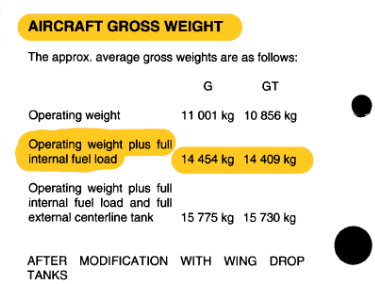
Thrust to weight is determined by take-off thrust, operating weight & full internal fuel.
That is not even how combat thrust to weight is determined operating weight & two air to air missiles.
add the r27/r73 weight plus the central fuel tank (maybe even the plane fuel tanks )
Why?
Where is proof that thrust to weight ratio is only for the maximum possible weight of the aircraft?
Thrust to weight ratio is determined by operating weight & full internal fuel.
Do you need me to explain what operating weight is? I can if you like.
Combat thrust to weight is combat thrust to weight is determined by operating weight & 50% internal fuel/two air to air missiles.
Take-off thrust rating used to determine flight characteristics. TWR is one of them.
No one said anything regarding maximum take-off weight of the aircraft.
Simply gross weight, operating weight plus full internal fuel
I find it hilarious that dudes will say the Mig-29 is underperforming and then go out of their saying anything to shut down anyone other than themselves doing the work to change it.
The MiG-29 is a special aircraft it comes 1:14 right out the gate with enormous thrust. It is the backbone of the Soviet Union’s entire tactical fighter element for a reason.
So are you trying to say that the RD-33 loses over 3,000kgf of thrust simply because it was installed in the MiG-29? Are you crazy??
You joking right? He’s joking guys.
He does knows more about these jets than he appears…
1 Like
Where is the proof though?
Thrust to weight is just thrust/weight. There is no codified weight that is used to determine thrust to weight ratio. Where is it even specified in the manual?
There is & I am trying to find the strength to get it for you, but I feel you are just being difficult. You already know this aircraft is underpowered in thrust like a mofo. So, I don’t get what you are trying to do.
1 Like
Why does the installed values from the RU manual show significantly lower thrust than what you are claiming then? Why does the plane currently overperform in terms of acceleration?
1 Like
The Soviet (VVS) states out right the aircraft is a 1.14 thrust to weight ratio at Take-off.
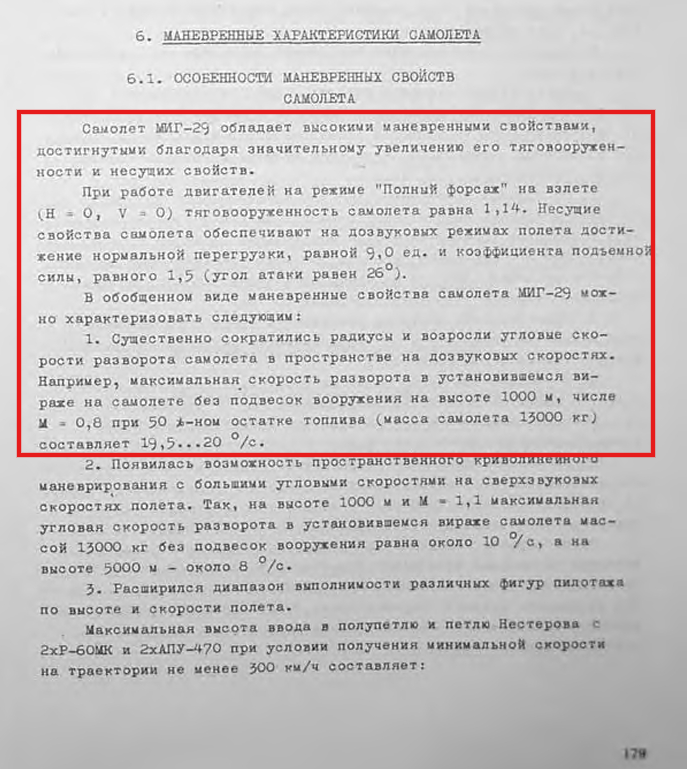
The MIG-29 aircraft has high maneuverability properties, achieved thanks to a significant increase in its thrust-to-weight ratio and lifting properties.
When the engines are operating in the “Full afterburner” mode during takeoff (HO, V0), the thrust-to-weight ratio of the aircraft is 1.14. The lifting properties of the aircraft ensure that in subsonic flight modes a normal overload of 9.0 units and a lift coefficient of 1.5 (the angle of attack is 26°) are achieved.
You guys are just smoked out do not know what you guys are reading I suppose. I don’t know.
1 Like
Im pretty sure squish is talking about these charts
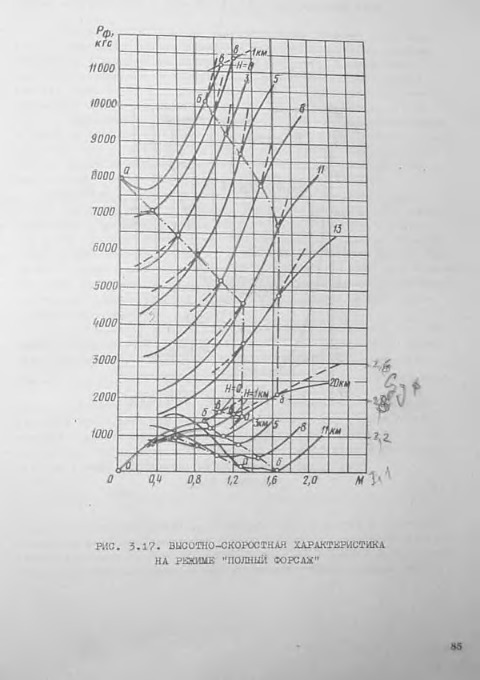
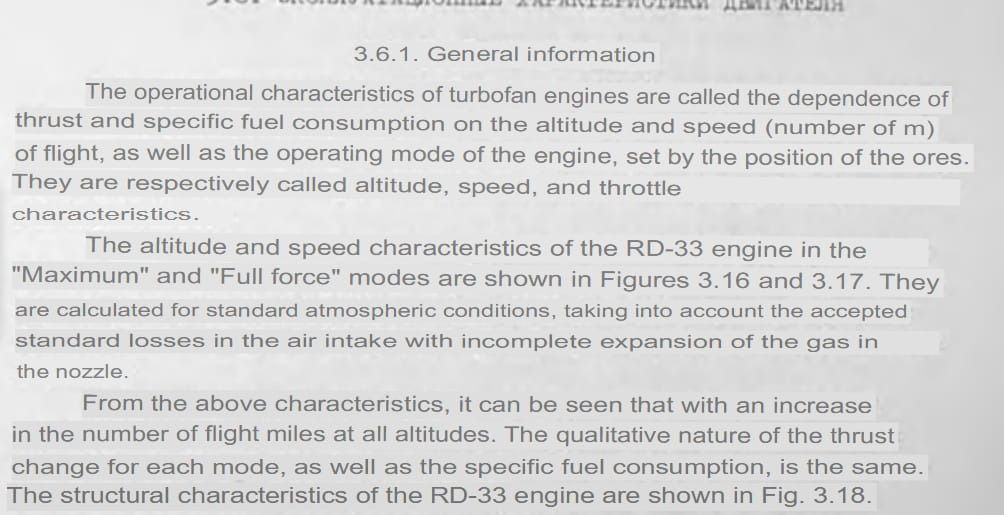
And these charts contradict your earlier statements on “takeoff thrust”
Once again no weight is cited here. You are assuming at takeoff means at maximum gross weight and at 0 airspeed.
Does the plane also turn at 9G while at 0 airspeed?
altitude -speed characteristics in full AB?
Yes, this figure, 3.17 is for full afterburner. You can verify that in the second image I posted there
Not assuming literal aerospace engineering textbooks that will say the same thing lol
The Definition of Static Thrust At Sea level, Standard day
“Take-off thrust is commonly considered to be the static thrust quoted by the manufacturer. The static thrust is the thrust measured with the engine stationary, as would be the case when the aircraft is initiating the take-off roll.”
“Note that the take-off thrust is usually taken to mean the sea-level static thrust and is equal to the gross thrust at sea level…”
“This relation is reasonably accurate up to Mo=0.3. Note that the take-off thrust Fto is usually taken to mean the sea-level static thrust (Vo=0) and is equal to the gross thrust at sea level. The take-off thrust determines the take-off characteristics of an aircraft.”
Source: Theory of Aerospace Propulsion 1st Edition - Pasquale M. Sforza Pages 395-396 & Theory of Aerospace Propulsion 2nd Edition Pasquale M. Sforza Page 475.


1 Like
This has nothing to do with the manual values though. For instance Su-27 manual uses only 25% internal fuel as reference for performance figures.
1 Like
Take-off thrust = 0.3 Mach.
OMG you guys are hyper incompetent. Please stop.
That’s the line for 3km altitude. The line for 0km altitude starts at 0 Mach….