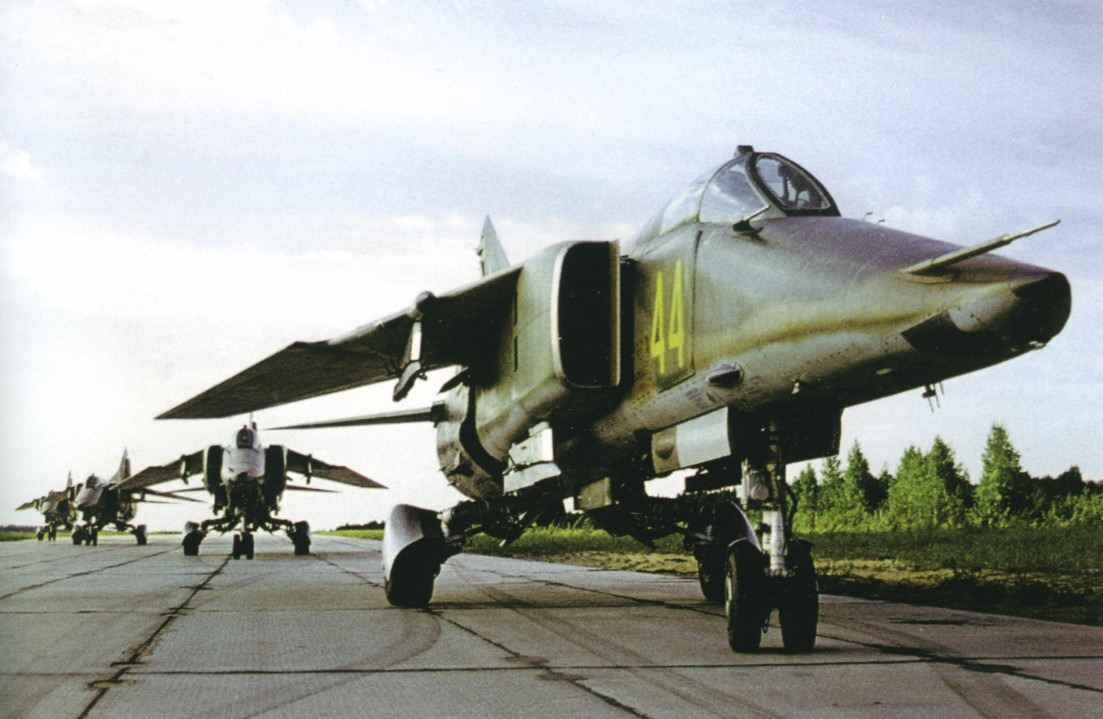
Expand
Origins
A number of projects would have been designated the MiG-27. In the early 1960s, the Soviets were looking to replace the MiG-17 in the ground attack role. It might seem surprising that the MiG-17 was still in service even while the Su-7B was available. The Su-7 was extremely fast, cheap, reliable, and could carry a substantial payload. However, it had poor low-speed performance, a long takeoff run, primitive avionics, and poor cockpit visibility. This meant that while the Su-7 was highly effective as a bomber it was actually less effective than the MiG-17 at destroying mobile ground targets like vehicles.
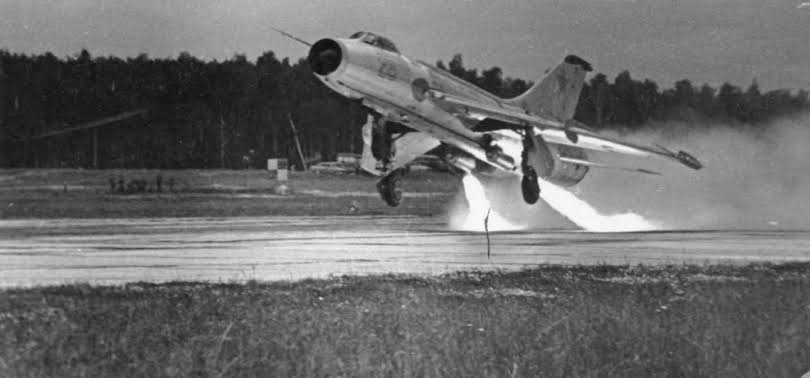
Mikoyan would propose two subsonic strike aircraft based on the MiG-21. The MiG-27-11 would be a tailless design with a large double-delta wing, while the MiG-27Sh would be a more conventional low-wing design. While intended to use MiG-21 components wherever possible to cut costs, both proposals were essentially brand new aircraft. Both aircraft offered superior visibility and payload capacity to the Su-7 while also providing the pilot a longer time to locate and engage a ground target, plus a much shorter takeoff run. However, as Sukhoi was quick to point out, the lower top speeds of these strike aircraft proposals would make them significantly more vulnerable to enemy air defenses and fighters. Plus, the new Su-7BKL with fittings for RATO pods slashed its takeoff run to a figure comparable to the projected performance of these MiG-27 proposals. So really why should the VVS spring for a new Mikoyan aircraft when Sukhoi’s keep improving? If only there was a way to combine the subsonic performance of a straight-winged aircraft and the top speed of a swept-wing one…
Model of Mikoyan’s original MiG-27s
The Su-7BKL was fitted with SPRD-99 RATO pods that significantly cut down its takeoff run. Interestingly the fitting of these same pods on the MiG-21PFM and onwards also would kill the MiG-23-01 STOL project
A Platypus?
Now around this time Mikoyan was also working on a successor to the MiG-21. The MiG-23 was intended to be faster than its predecessor, with BVR capability, and a shorter takeoff run. For the last objective, development initially focused on the use of lift-jets, with the Izdeliye 23-01. However, a second option considered was the use of variable-sweep wings. With the 23-01 proving underpowered and the American F-111 proving that swing-wings could work, development focus shifted instead to the Izdeliye 23-11 swing-wing fighter. This variable-sweep configuration would allow the aircraft the short takeoff run and good low-speed handling of a straight-winged aircraft as well as the high top speed of a swept-wing one.
Naturally, this would be a better basis than the MiG-21 for Mikoyan’s new strike aircraft. Designated the MiG-23B Izdeliye 23-41, aircraft 23-11/4, the fourth MiG-23 prototype, was modified for testing. It was fitted with bomb racks from the MiG-25RB and the radar was removed. In place of the radar was fitted the KN-23 automatic control and bombing system based on the Peleng of the MiG-25RB. This system allowed for precise level bombing at high speeds, a considerable advantage over the primitive avionics of the contemporary S-22I (what would become the Su-17). However, this simple conversion was unable to meet the design requirements. Flaws included a low payload, underpowered engine, and poor cockpit visibility.
The next MiG-23B design, the Izdeliye 32-24, was a more significant redesign. The first prototype, 32-24/1, was built on a modified MiG-23S and featured a reinforced structure with additional hardpoints. The next two prototypes would be based on the refined Model 2 MiG-23 (1971) airframe under development with its larger wing area. With the removal of the large Saphir-23 radar, the nose was redesigned to slope sharply downwards to improve visibility while still providing ample room for the ground-attack avionics. The engine was replaced by the new AL-21F-3 engine, optimized for high-speed low-altitude strike aircraft, also used by the Su-17 and Su-24. The prototype 32-24/1 first flew on 18th February 1971, and the type was accepted into production in early 1972. Production MiG-23Bs would differ from the prototype by being based on the further improved Model 3 MiG-23M airframe. Armament included a built-in GSh-23L and two more in external pods, unguided rockets and bombs, Kh-23 AGMs, and RN-28 “special stores”. Avionics consisted of the Sokol-23 suite including the KN-23 navigation and control system, Fon laser rangefinder, and S-17VG-1 and PKB-3 sights; an SPO-10 RWR, and SPS-141 and SB-1 radar jammers.
Performance of the MiG-23B was more than satisfactory. Despite being twice as heavy as a MiG-21, it had a lower takeoff and landing speed. Top speed exceeded 1,800km/h at altitude with a 3-tonne bomb load, and the range with only internal fuel was 50% greater than the MiG-23M. The pilot was offered the utmost protection thanks to extensive cockpit armour, and the aircraft could perform precise strikes in dive, level, and toss-bombing missions as well as destroy any armoured vehicle of the time with the new Kh-23 missile. And flying it was easy- the KN-23 handled most of the flight automatically and the nose design provided ample visibility to line up on ground targets, especially compared to the Su-17M. Pilots affectionately nicknamed the MiG-23B Utkonos, “Platypus”, owing to its duck-billed nose.
And yet only 48 MiG-23Bs were produced. The problem was the engine. The AL-21 was expensive and time-intensive to produce, and the Su-17M and Su-24 priority for the engine. Additionally, the AL-21 was considered high technology and was not allowed for export.
So, a modified version of the MiG-23B was created without the AL-21. Designated the MiG-23BN Izdeliye 32-24B, this aircraft was essentially identical to the MiG-23B except for mounting the R-29-300 engine of the MiG-23M. Widely exported to the Warsaw Pact and beyond from 1973, the Soviets were dissatisfied with the MiG-23BN’s performance compared to the MiG-23B and only purchased a very small quantity for training and familiarization. Instead, an improved domestic version was concurrently developed- the MiG-23BM.
“11 Red,” s/n 242002718, one of two surviving production MiG-23Bs. Aircraft 321 is also preserved, but recall that it is different from the production standard, being based on the MiG-23S airframe instead of the MiG-23M!
While the overwhelming majority of MiG-23BNs were exported, a few were operated by the VVS
Bring the BRRRT
For some time, the Soviets had been looking to phase out the 23mm calibre for a more powerful 30mm calibre for aircraft weapons. In the air-to-air role, fighters were getting faster and faster, giving less time for a gun pass in a dogfight. In the air-to-ground role, the 23x115mm cartridge had very limited penetration, being stopped by even the lightest of armoured vehicles and structures. The 30x165mm cartridge promised to solve both problems.
And it not just the size of the cannons that was being reconsidered. So too was their design. Soviet aircraft utilized conventional autocannons, or in the case of the GSh-23L, Gast cannons. Compared to the revolver and rotary cannons popular in the West, these guns were lighter, more compact, and relatively simple. However, they offered lower fire rates. For a fighter jet where weight is at a premium, a worthwhile trade. For already heavy strike aircraft…
Now the Soviets did already have a rotary cannon in service- the 30mm AO-18, part of the AK-630 naval CIWS system. It was on the basis of this weapon that two aircraft rotary cannons were created: the 23mm GSh-6-23, to be mounted on the Su-24 for strafing soft targets; and the 30mm GSh-6-30, to be mounted on the MiG-23BM and Sukhoi T-8 for strafing armoured ones. While most rotary cannons were externally-driven, the AO-18 was gas-operated, and the GSh-6 cannons would share this design. For a CIWS, gas-operation offered the advantage of instantaneous response to threats. For an aircraft, the advantages were a much lighter and more compact design. However, it also conferred certain disadvantages that would soon become apparent.
To create the GSh-6-30, the AO-18 had to be modified considerably. Most significantly, the AO-18 is water-cooled, whereas the GSh-6-30 would need to be air-cooled. The water jacket was removed and the barrels made shorter and lighter. New armour-piercing ammunition was developed for the anti-armour role. The resulting GSh-6-30A (Aviatsiya, "Aviation) would have to be mounted almost entirely outside the fuselage to provide enough airflow to cool its barrels. Compared to the contemporary GAU-8, the GSh-6-30A weighed just over half as much, with a 50% higher fire rate, comparable projectile mass, but somewhat lower velocity. It was, and is, the most powerful aircraft cannon ever produced.
The MiG-23BM Izdeliye 32-25 itself was to be based on the MiG-23BN, though the first two prototypes were converted from MiG-23Bs. Of course the most notable modification was the removal of the GSh-23L and addition of the GSh-6-30A with 300 rounds of ammunition, angled slightly downwards to direct the recoil force towards the aircraft’s center of mass. The variable air intakes were replaced with fixed ones. This would result in a decrease in maximum speed but saved weight, cost, and simplified maintenance. The front landing gear was shortened to reduce angle-of-attack while on the runway, and all gear were reinforced due to the higher weight of the BM compared to the B or BN. The airframe was reinforced and maximum payload capacity was increased to 4,000kg. The Sokol-23 avionics suite was replaced by the more advanced digital PRNK-23 which increased bombing accuracy by around 25% and allowed for automatic execution of 11 different flight profiles. Guidance for the Kh-23 missile was built-in to the aircraft, eliminating the need for an external Delta-NG pod. The aircraft retained the SPO-10 and SPS-141 defensive avionics, and introduced the KNS-23 countermeasure dispenser on the central pylon.
The first prototype, 32-25/1 or 351, converted from a MiG-23B, first flew 17th February 1972. It was shortly followed by a second prototype, 32-25/2 or 352. The GSh-6-30A immediately made an impact on pilots and spectators during test flights. In the words of test pilot V.N. Kondaurov, “as soon as I placed the central reticle on the sight and pressed the fire button, such a menacing “TRRRRRK!” rang out that I involuntarily jerked my hand back. The firing shook the entire plane and almost stopped in mid-air from the powerful recoil of the gun mount. The unmanned target, which had just been banking ahead of me, literally disintegrated in the air. I barely recovered from the surprise and admiration: ‘What a caliber!’”. Against ground targets, too, the cannon had remarkable results. One test against BTRs resulted in, “the targets - APCs - shreds of torn metal and burnt crumbs where the trucks had been. Where the burst passed, there remains a dug-up ditch up to the knees and blazing steppe grass”. Safe to say, the new cannon was powerful.
Perhaps too powerful.
While intended to fire all 300 rounds of ammunition in one continuous burst, testing found that the GSh-6-30 overheated after only half as many shots and required 15 minutes to cool to a safe temperature. And that was far from the only problem. The first time the cannon was fired in flight, several cockpit instruments cracked after only 25 rounds. Propellant fumes could be ingested by the engine and cause a flameout. Prolonged bursts would frequently cause cracking in the 1A fuel tank fitted just behind the cannon. The forward landing gear could become damaged, warped, or jammed. Perhaps most dramatically, on one occasion vibration from the cannon caused the canopy ejection charges to fire. These issues were resolved by redesigned mounting of the GSh-6-30, reinforced and redesigned structures, and the addition of deflector plates and blast shielding. Even still, pilots were advised to fire in short bursts of no more than 40 or 50 rounds to minimize the likelihood of damage to their aircraft.
Production was allocated to the Irkutsk Aviation Plant in early 1973, replacing the MiG-23UB on the production lines. Production target was 160 aircraft in 1974. Not too difficult. Except that the MiG-23 and MiG-23BM were actually rather difficult, and the aforementioned troubles with the GSh-6-30A caused significant delays. It was only in September 1974 that the MiG-23BM truly entered production. But by God the Irkutsk Aviation Plant would not fail to meet production goals. Over the next four months, the factory ran 24/7 in an emergency production state with workers and engineers literally living on-site. To incentivize maximum output, workers who put in the most overtime were rewarded with rare luxury goods- TVs and refrigerators. MiG-23BM peaked at nearly two aircraft every day, and by New Years 1975 all 160 had been delivered. The MiG-23BM would be officially accepted into service in February 1975. Owing to its considerable departure from the design of the MiG-23M, the aircraft would be designated the MiG-27, though the name MiG-23BM was still used occasionally. A further 200 aircraft were produced until 1977, for 360 total.
The primary weapon of the MiG-23BM was the 30mm GSh-6-30A, with which players are likely already familiar. The MiG-27 family would be the first to mount the weapon, and also the last due to its excessive recoil and vibration
Aircraft 32-25/1, the first MiG-23BM prototype, survives at Riga Aviation Museum in Latvia
Service and Upgrades
The MiG-27 was deployed across the Soviet Union and Eastern Europe, but ultimately the MiG-27 sans suffix would never see combat. By the time the MiG-27 had its combat debut in Afghanistan in 1987, they had been replaced by the MiG-27D. The MiG-27D was an upgrade to the existing fleet of MiG-27s to MiG-27M standard- the MiG-27D and MiG-27M functionally identical and only differed in the retention of the original BD3-UMK fuselage bomb racks and RSBN-6S SHORAN system. 304 aircraft plus one prototype were thus converted from 1982 to 1989.
In service the MiG-27 was popular. Pilots praised its handling as superior to the MiG-23 and overall rated the aircraft as easier to fly than the Su-17. Maintenance crews found the aircraft relatively reliable and easy to maintain- at least after a number of flaws were fixed during the aircraft’s first two years in service.
However, two major problems persisted with the MiG-27 through its service. The first of course was the gun, which still had excessive recoil and vibration. Use of the cannon was prohibited from 1977 until 1979, with gunnery training performed with SPPU-22 gun pods. Reinforcements to the airframe resulted in a lift on the firing ban in late 1979 but pilots were still instructed to fire only in short bursts of 40 or 50 rounds, and to assist in this the belt was often loaded with a gap after that many rounds so a single trigger pull would fire a burst before hitting the empty link. Loading also was an issue- the MiG-27 had a capacity of 300 30mm rounds but crews often only loaded 260 because poor accessibility of the ammunition compartment made it difficult to fit the full load.
Engine flameouts were also a problem noted during early testing with the Kh-23, R-13M, and S-24, but these issues were resolved with adjustments to the anti-surge system.
Second was the type’s dangerous flatspin tendency. Like the MiG-23, the MiG-27 could quickly and without warning enter a near-unrecoverable flatspin when maneuvering at maximum sweep. In 1980 after a fatal crash and another near-miss, the angle-of-attack was limited to 16 degrees at minimum sweep and 22 degrees when swept, and when swept maneuvers were limited to 5.5gs. With these restrictions it was difficult to accidentally enter a flatspin, and the aircraft was forgiving to fly.
MiG-27s would see some minor design changes during their production and service. From s/n 61912530017 the KN-23 was replaced with the improved KSK-23. From s/n 61912545020 the wing mounts were modified, and from s/n 61912561300 the flaps were modified. These two changes were made to improve the low-speed handling and reduce the likelihood of a spin. 61912561300 was also the first MiG-27 to lack the SB-1 Bar’yer which had proven ineffective.
At first the MiG-27 could carry a maximum of one 500kg bomb on each of its seven hardpoints, but from s/n 61912522041 the wing mounts could be fitted with D3U-1A twin bomb locks to allow a total of eight 500kg bombs.
A MiG-23BN (26) and MiG-27 (20) of the 760th Research-Instructor Fighter-Bomber Aviation Regiment in formation, 1975. The 760 IIAPB was the primary unit responsible for testing and evaluation of the MiG-23B/BN and MiG-27
The MiG-27 fires the GSh-6-30A