There absolutely is, note that both 200 Volts, and 3.5kVA (Volt-Amps, the AC equivalent to Watts for a DC power ) and 400hz are listed in the following brochure, which provides an absolute upper limit to the laser, prior to incurred efficiency losses within the system itself
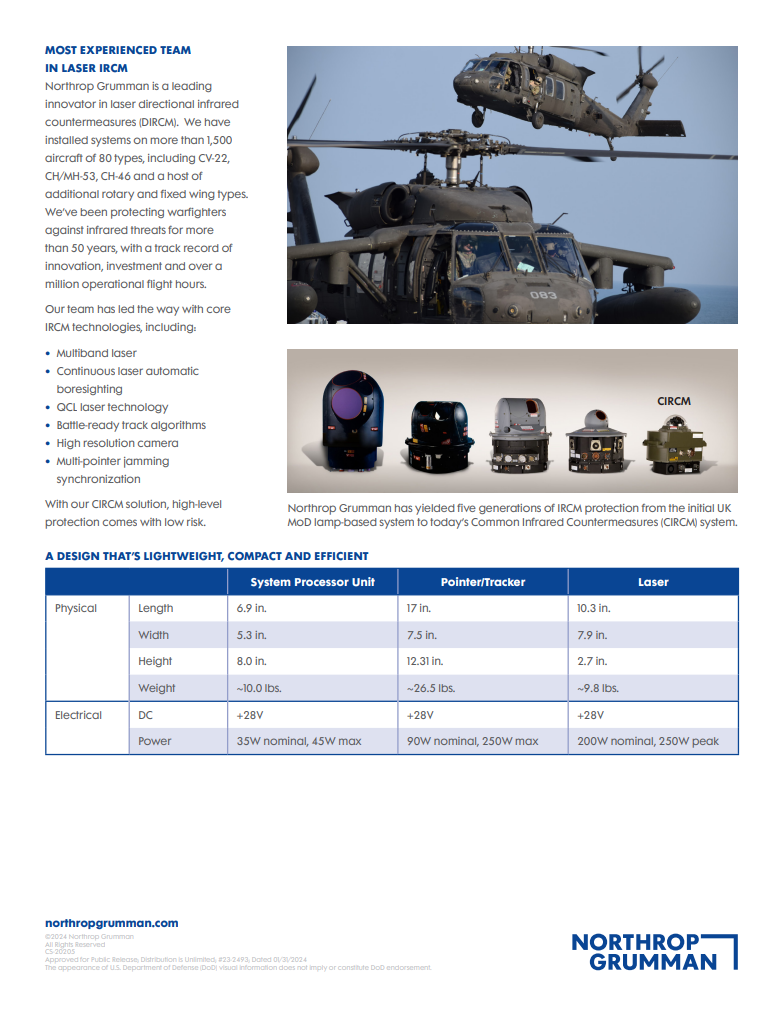
Similarly the CIRCM family of systems has in it’s datasheet listed values of 200~250 watts specifically listed for the Laser.
Further;
is not possible based on established metrics (according to [Volume 7 of the Infrared Handbook, 3.3.5.1 Detector Damage ] needs about 63kW to be delivered) and known power draw President-S uses 3.5kVA, assuming 100% of said power was transmitted and a full duty cycle (Sans jamming waveform) that means it would take ~18 seconds to destroy a generic seeker. and with a stinger for example self destructing at 17 seconds, it would take too long to be useful even at the stingers maximum range, falling inside the system’s minimum.
And considering it’s rated for ranges between 500 and 5000m The stinger has a time of flight to said ranges of ~1.3-11.7 seconds it’s unrealistic for that to even be attempted unless the system is a 60KW DEW, of which is a class of weapons used on Ships, so it needs to go a fair way in terms of miniaturization to be viable.
It should be fairly obvious that it can’t realistically function as such anyway, and for example with a stinger it still doesn’t explain how it impacts the UV channel which should be complexly unaffected anyway since it’s outside the bandwidth of the laser.
Yes but that’s not telling you output power. That’s how much it draws to run it.
The important part is the output frequency, wavelength of the laser and power of the individual laser diodes in the assembly. If you want to filter or protect from the laser you need to know what wavelength, power and the modulation frequency
Exactly, and if even were to somehow be 100% efficient it’s not anywhere near the ballpark it would need to be to even approach damage to the seeker, Thus it’s a pretty good indication that that’s not how it works.
And that the CIRCM listing, specified 250 Watts peak power, so it’s even further anyway.
The Duty cycle is reduced somewhat due to the use of a Tailored jamming waveform, that needs to be effective against the various methodologies that seekers employ (AM, FM, Con-Scan, Rosette, IIR), any given section of the program will only be effective against a single method at a time (to be most energy efficient and so minimize engagement time before OBL (Optical Break Lock) is achieved), and it will cycle though various techniques over time to provide full spectrum defense, and avoid susceptibility to Anti-Jamming responses that change the characteristics of the Guidance mechanism on more modern / reprogrammable missiles.
Which needs to actually be inside to wavelength of the Missiles detector to actually inject the Jamming signal into the autopilot, so it’s limited to a fairly inefficient band for transferring energy, and as lasers aren’t broadband it’s not effective outside those channels, such as the UV band the the Stinger POST uses.
It would be very inefficient to waste precious space and energy in a band that most encountered threats simply don’t respond to, also you would need a very different optical train and aperture geometry to focus both an IR and UV source (let alone ) onto the same point.
A lot can be done in software to detect and counteract the induced jamming signal, and with field reprogrammable systems (FIM-92C and later for example) there is a lot of latitude as to what could be done in response to encountering a novel system.
he is proving that you are wrong, and if you cant understand the pretty simple terms he was using you clearly dont know enough about the topic to argue
yes it is very clear, that you somehow think that the laser can output significantly more power than the entire unit consumes
it is very simple logic that the maximum power of the laser is less power than is consumed by the unit, and the energy on target at the systems engagement distance will be much lower
You do understand that nominal and peak draw are for the entire laser assembly (you can look at the weight and dimensions too) and not just the specific of the laser right?
Sure it might have some sort of novel Jamming technique generator that does some neat things, but for the most part functional signals used to defeat; AM, FM & Con-Scan methods are conceptually known and “solved” issues, mostly due to the tracking methods being fairly basic, them not having evolved much after the first tranche of systems came online in the '60s, sure some things have changed with the move away from Incoherent sources. and that there isn’t much “official” for jamming Rosette or IIR class threats, they aren’t that conceptually difficult to evolve an understanding of from prior techniques (it’s not really possible for a truly generic waveform to be developed, as countermeasures would be readily available to a modern system), though they would require a much higher level of performance and so the jump to a straight up DEW is a far simpler task, and realistically the only real way to absolutely keep pace with the higher end Modern threats.
The point is to establish that solely from an energy perspective either of the prospective DIRCM (either CIRCM or President-S) systems do not have anywhere near the energy output they would need to sufficiently physically damage the detector of a generic missile, within the time it would take for a missile launched at maximum range to impact them (Stinger for example Self destructs at 17 seconds), even if they were using the full capability of the laser (100% duty cycle) to maximize energy transfer and not injecting the jamming waveform which of course as a pulsed signal, doesn’t use the entire duty cycle available to the laser.
What they are perfectly capable of doing is injecting an appropriately formatted jamming waveform into the guidance section of threat missiles, in effect a similar waveform (as outlined above) to those used by Incoherent-IRCM systems (e.g. ALQ-144) would do so just fine (the swap to DIRCM does solve some inherent issues with and provides greater latitude in terms of what can actually be injected, a digitally controlled laser can obviously react far faster than two rotating elements in front of a carbon arc lamp).
But as to how exactly the President-S (as implemented in game), or CIRCM would go about dealing with the Stinger POST (and later variants)'s UV guidance channel while only having IR lasers (focusing and sizing of optical elements for a UV laser is very different to an IR one, and doing that in a single train is fairly complicated, and takes a portion of the total energy from the IR band) I don’t know, or be expected to get around any potential digital Counter-Countermeasure regime that the Reprogrammable systems could be able to field deploy an update for tailored defeat to seems unlikely on its face.
No it’s very much general data about the laser assembly as a whole and not specifics (wavelength, power, etc) because that data is classified.
You’re not wrong. But that doesn’t mean that most militaries don’t classify that data anyway. That’s not saying it can’t be sussed out with open source info (hell if you’re an EE or good enough at math) you can easily calculate a lot of it.
The OP asked if anyone had any data on the specifics or sources on the output power of DIRCM systems. And I said that it’s unlikely because specifics are almost always classified.
General statements about whole system are typically ok, specifics get troublesome.
And that’s the confusion. Litterally no one said either of those systems had that capability.
Ish, he asked about them as a whole and not just CIRCM.
But the response was quoted to me, with in depth discussion of how they work specifically to show CIRCM doesn’t possess the power which doesn’t make a lot of sense because I never suggested it did.
Sure for an optimal countermeasure, these things would like to be known. though it’s obviously bounded by both the Transmittance of the optical train, and the sensitivity of the detector for any given threat system. as well as the limited number of material Laser configurations that actually emit within said sensitive band(s), though they may well be sitting on an exotic or novel approach that provides some leeway, or reserve capability in these areas.
I’ve provided sources for input power, which of course provides the upper bounds for the output, and I think it should be fair to compose sources to estimate the performance of a generic system using what is known of various systems to come to fairly broad conclusions.
Hell you could probably work backwards from known power draw of older systems like the ALQ-144, and the geometry of the aperture of modern systems to get an idea of the the scale in performance since they in effect replaced the ALQ-144 on the AH-64 the power budget could be assumed to be similar.
I mean I’m not particularly aware of any other Western DIRCM systems outside the AAQ-24 that have actually entered service let alone been type classified, the ALQ-144 and -157 are Incoherent-IRCM systems. so it’s not obvious at to the existence of any other potential systems you could possibly be referring to in the following claim;
excepting of course DEW systems, but they have different use case entirely
No one said otherwise. I said that the specifics are classified in response to the OP’s post.
Yes you can largely sus out a lot of the broad details with enough open source digging. But nothing OS/Unclassified exists that documents the specifics of these systems for someone to say “Hey Gajin model this” or you modeled it wrong because it’s for x power not Y power which is what he was asking
That would not be a safe assumption since the ALQ had been sunsetted before the CIRCM was fielded, and the systems do not directly replace each other.
There are several DIRCM countermeasure systems in common use today such as the ALQ-212, Elbit MUSIC (which is a whole series)
Then there are the one off/specialty threat systems that are in various stages of testing or fielded in small batches to specialty agencies or units with unique requirements or special budgets/appropriation channels
All im saying is that I’m aware of atleast one system which has caused some commotion in the industry because it has under atleast some testing conditions shown it has the capability to possibly damage seeker heads. Which can be a big deal because foreign weapon system seeker heads are not something in common stockage and doing so unintentionally tends to be a big deal.
I intentionally did not mention system names and refrain from discussing specifics of any particular system because it’s hard to keep track of what info about what system is at what level and the Army takes a very dim view of unintentional release of information, doubly so right now to WT. And many older/replaced systems are still in use by partner forces or sometimes because of the weirdo rules with aviation.