First, what is meant by a reliable source?
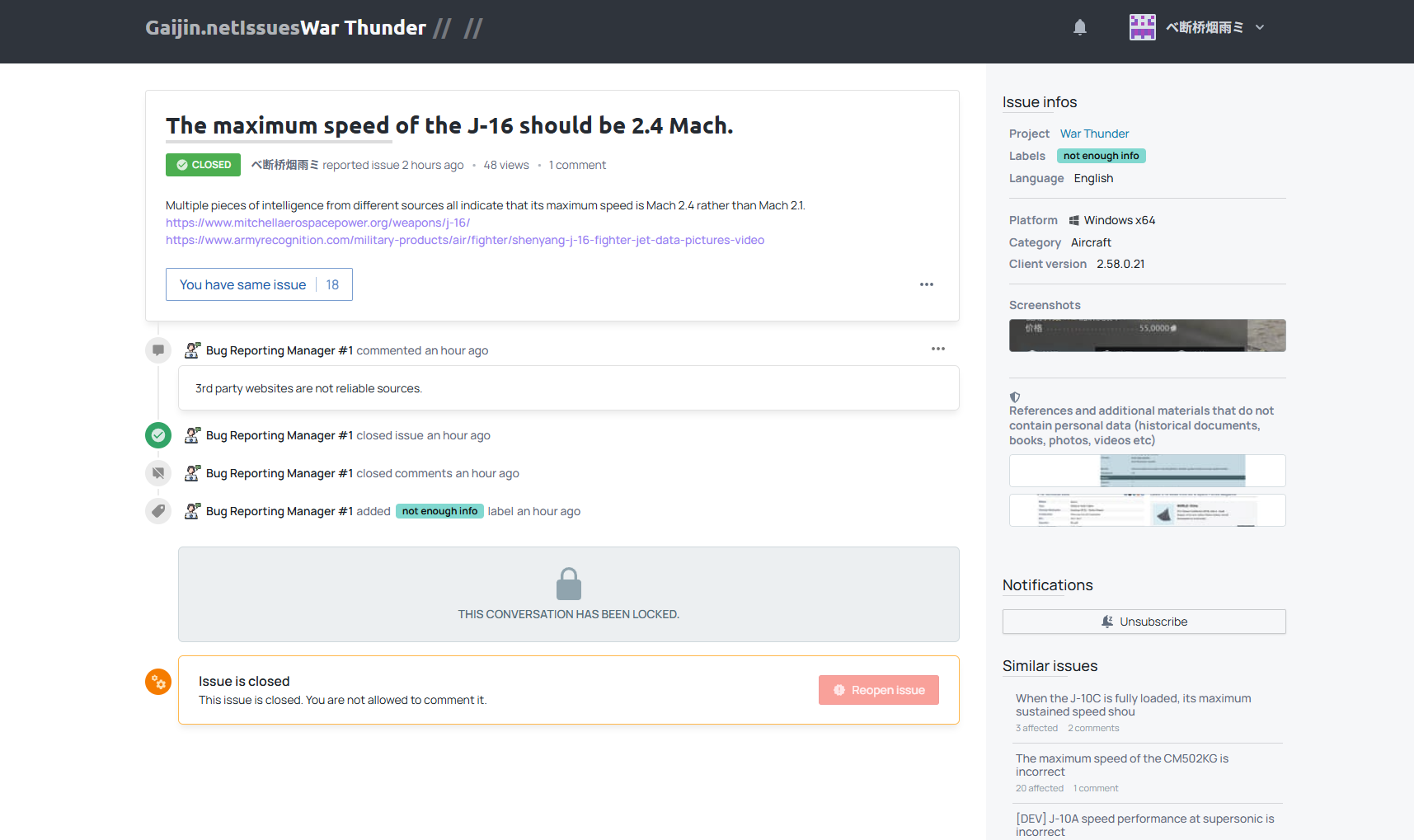
Army Recognition Online Defence
Mitchell Institute
If this counts as a third-party website, then what does not? These are already some of the more authoritative websites globally, long cited by various national militaries, and partially funded by certain countries’ Ministries of Defense.
What does it mean to not accept the tower perspective? On the ground, it is called a plastic model, and if the tower perspective is not accepted, doesn’t that mean you only accept the fire-control perspective from inside the cockpit? Such things cannot exist on the public internet, which means that the existing information is of no use unless it is leaked.
Regarding the flight envelope, airframe, and air-to-air missile overload issues, since they have already been implemented in the game, shouldn’t the STP files and mesh files be released to reduce controversy?For example, there were rumors some time ago about the PL-12’s varying overload capabilities at different times.
Does the suggestion section have a certain bias against China? Chinese equipment is always lagging behind equipment of the same weight and Russian equipment.
Books, Journals, public official documentation. Websites like Army Recognition are just news media not an actual documentation blog that can be used as a primary source—but secondary sources to serve as backing.
Probably the contrary maybe selfishness that chinese content should have some sort of special treatment because every time there’s a complaint that “Chinese vehicles are not properly treated!” there will be someone “Is there a bias against China?”.
May I ask, besides these materials, where else would these data be publicly released? I am very eager to understand the data and channels you mentioned.
In that case, what kind of information can still be considered as primary source material? As far as I know, no country’s Ministry of Defense would disclose the specific detailed specifications of a top-tier operational fighter jet.
In the last article, they believed that an aircraft on a mission aboard an aircraft carrier was carrying two plastic toy models mounted under its fuselage.
Student theses (even if the student is a graduate of a certain authoritative program, do not count). These are publicly available Chinese documents; however, literature that specifically indicates the model number does not appear in public documents and exists only as internal documents. Given this, I believe there is no public information that can prove its specifications, as official media interviews are also not accepted.
I think the Ministry of Defense of any country would not disclose the specific parameters of an advanced fighter jet currently serving on the front line, unless obtained through a leak.
What is meant here by special treatment? Is the overload of the PL-12 inferior to the AIM-7 missile? Is the J-10C/A experiencing more severe G-lock than other models, or is it the drag from the oversized PL-12 composite pylon?
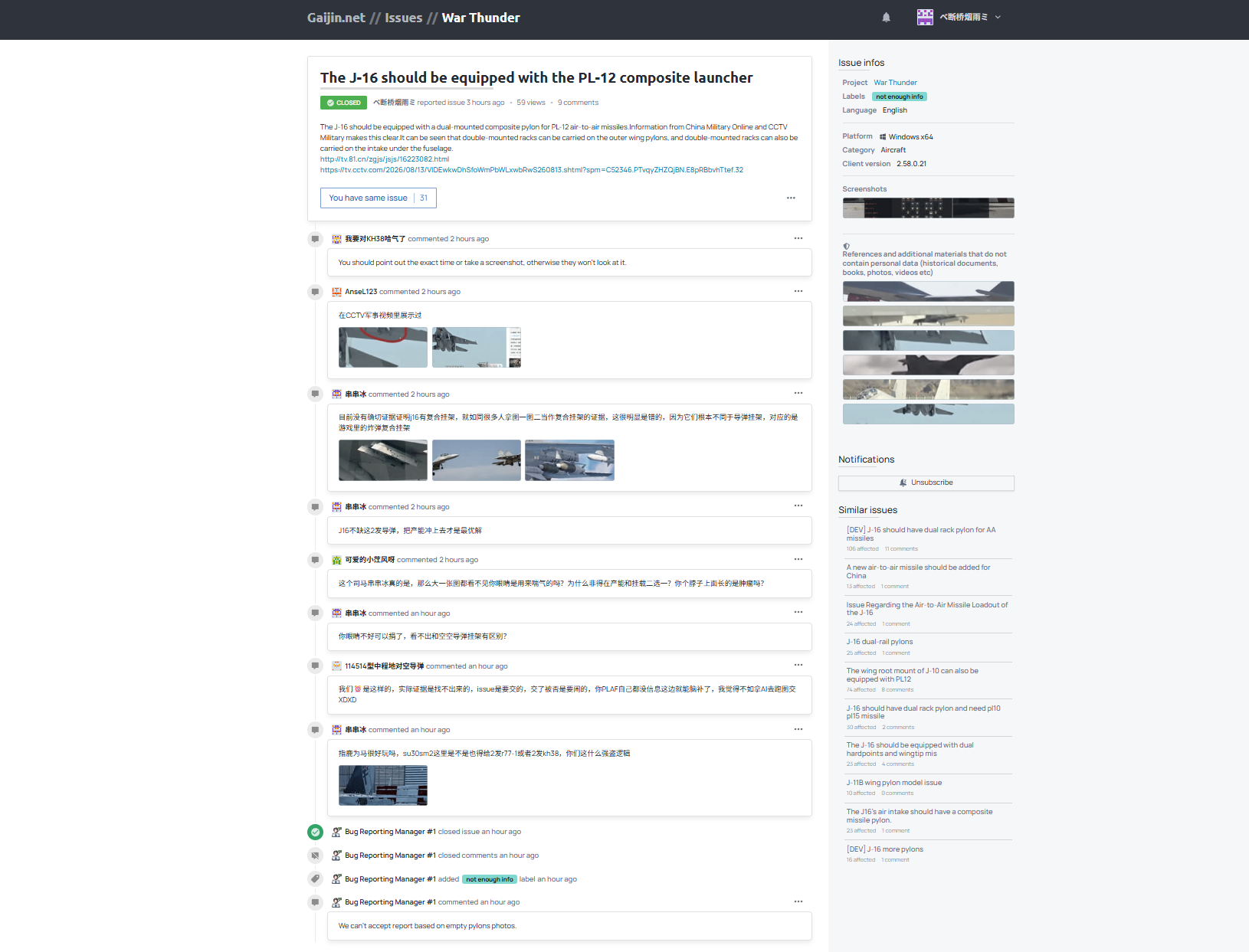
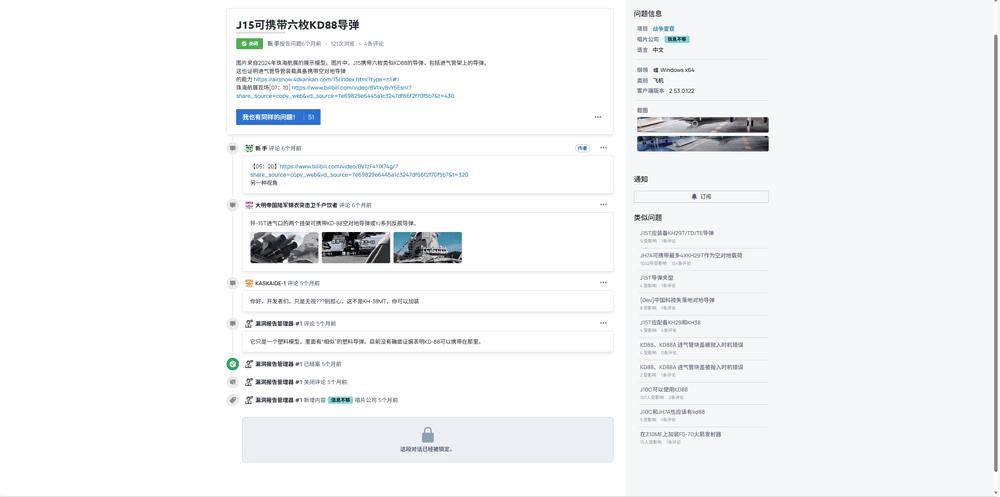
I do not understand what you mean by ‘orthodox sources’? They believe that China’s official military media does not have authoritative value, and they have submitted articles related to China National Radio Military and CCTV Military, all of which were rejected.
According to some tests, the WS-10B engine’s thrust at high altitude drops from 14 tons to 7.5 tons, which is a reduction of 48-50%. What does this imply? Civil aviation high-bypass turbofan engines, in most journals, are directly mentioned to have a thrust decay of about 30%-40%. Moreover, for the CFM56, its theoretical high-altitude thrust decay should not exceed 30% (under standard atmospheric pressure), and some assessments indicate that its actual thrust decay would not be greater than 25% (the specific assessment source cannot be disclosed). Even so, it is still impossible for the decay to approach 50%.
The center of gravity of the PL-12 particle is mentioned in some articles, and it is impossible for the maximum overload in the midsection to be only 22 G
Right now I see people citing media articles & expecting Gaijin to give special exception.
You have to hone the meaning of primary & secondary sources, the source requirements that have never changed.
Every change has been with properly documented source material.
China is treated no differently.
This is a reminder that I know AGM-114s have a range of up to & exceeding 11km, but the source for that is in an archive somewhere.
So for now, it’s 8km in-game, because 8km is the hover-launched range of AGM-114s & is well documented.
So we have to accept what we cannot prove, even if we know what we accept is inaccurate.
However, estimations also need to be based on objective evidence. The nacelle-to-engine ratio (this is an example, with a ratio of 0.7) suggests that theoretical high-altitude thrust decay will not exceed 35% in the 10,000–12,000 m range.
The problem is that you mentioned these pieces of equipment as public data in official documents. In fact, the ones I referred to cannot be publicly released in a short period; a reasonable value needs to be calculated or estimated by think tanks. However, in reality, he did not provide a reasonable value. As I said, the STP files and simulation files are public.
What happens if somebody writes a book and cites Chinese state media for part of the stats on vehicles? Is that suddenly a valid secondary source, because now it is a published author? OSINT and even IISS reference Chinese media for claims on performance; are those guys not knowledgeable enough to know those sources clearly cannot be trusted?
Everybody knows the requirements haven’t changed, the issue is that the requirements for modern vehicles are absurd. Couple that with seemingly bad faith implementation, and you can see the issue, no? Example: the J-16 radar in game is a fictional KLJ-16; the only information, which isn’t concrete on the radar is that it uses a KLJ-4A, which would be an up scaled KLJ-7A for the J-16. Note that the KLJ-7A have been shown with side panels for extended radar coverage.