- Yes
- No
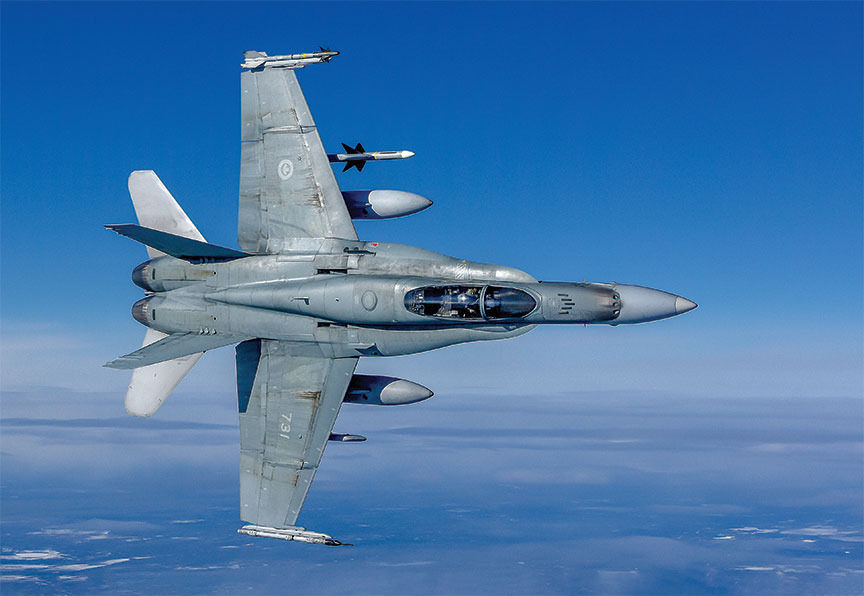
Hello, I’m suggesting something I feel is overdue: the current upgrade of the CF-188s, with modern things like AESA radar and current weapons.
History:
In 1977, it would be identified that there was a need to replace the CF-104, CF-101 and CF-116 by the Canadian government. This would lead to the New Fighter Aircraft competition, which had a budget of 2.4 billion CAD to purchase anywhere between 130 and 150 of the aircraft that won the competition. Despite the number of entries at the start, by 1978, the competitors would be shrunk to just the F-16 and two F-18 models. With the F/A-18 winning in 1980, with 98 single-seat and 40 dual-seat variants purchased, with that equalling a total of 138.
After a report in 2018 from the Auditor General, would find that the lack of serious capability upgrades for the Horents since 2008 has made it so Canada struggled to meet their NORAD and NATO commitments. Well, this had left a gap that needed to be addressed, and with the timeline for replacements seemingly endlessly getting longer, a new upgrade program was looked at for them. With the ball now rolling, a plan was drawn up, and by May of 2020, it was known as the Hornet Extension Project or HEP. The project would be a two-stage project that builds on the previous project, known as the Incremental Modernization Project (IMP), which was completed in 2010.
HEP I would be given to all 94 aircraft as it focused on modernizing the equipment on the aircraft. With the goal of making it compatible with current NATO systems and up to modern civil aviation standards. So it would gain changes that include a new transponder, a new Honeywell intertail and GPS navigation system, helmet night vision queuing devices, Collins Aerospace Gen 6 radios and airborne joint tactical radios, along with upgrades to the sniper targeting pod and mission computer. These changes to the fleet should have been completed in the spring of 2026.
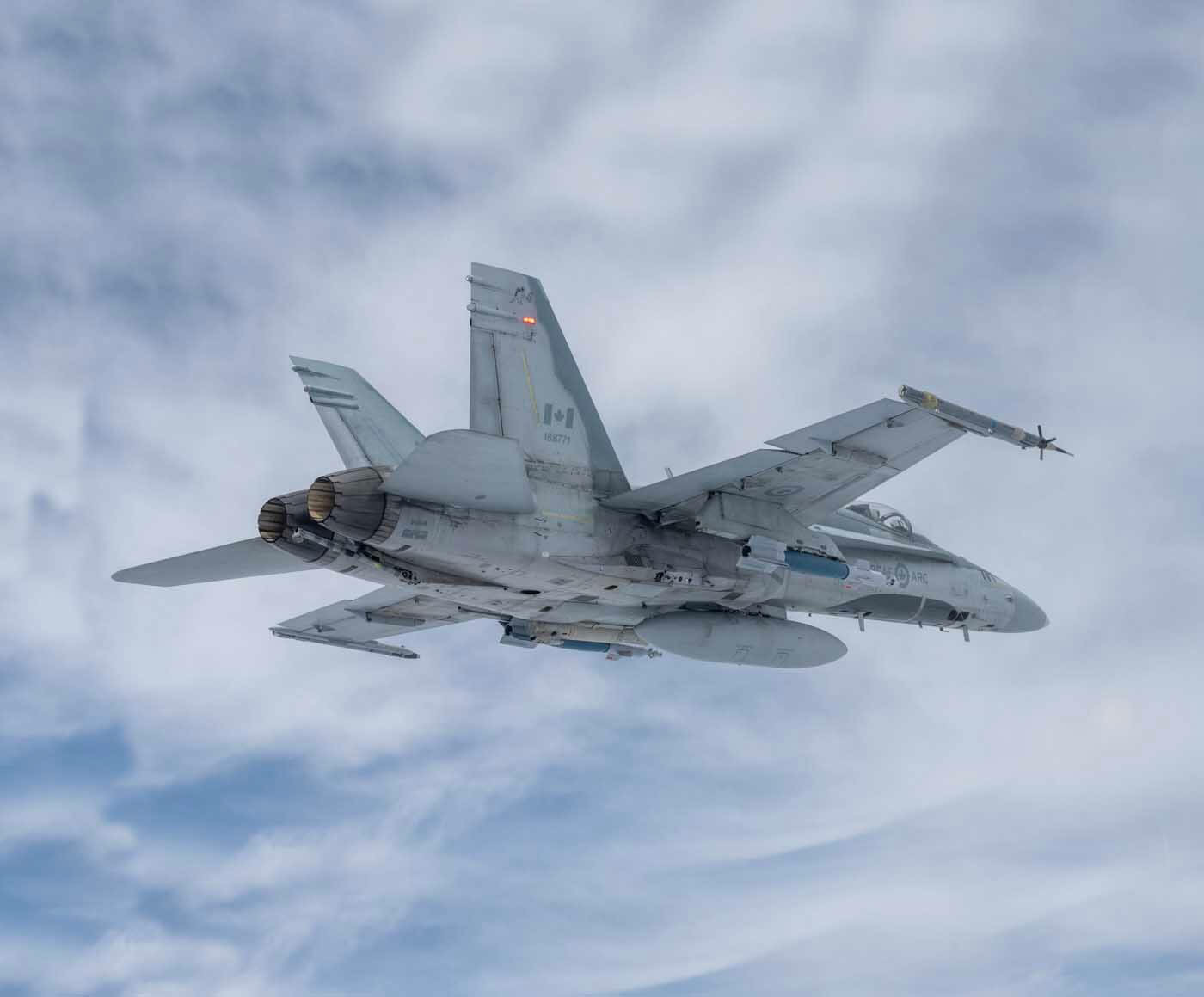
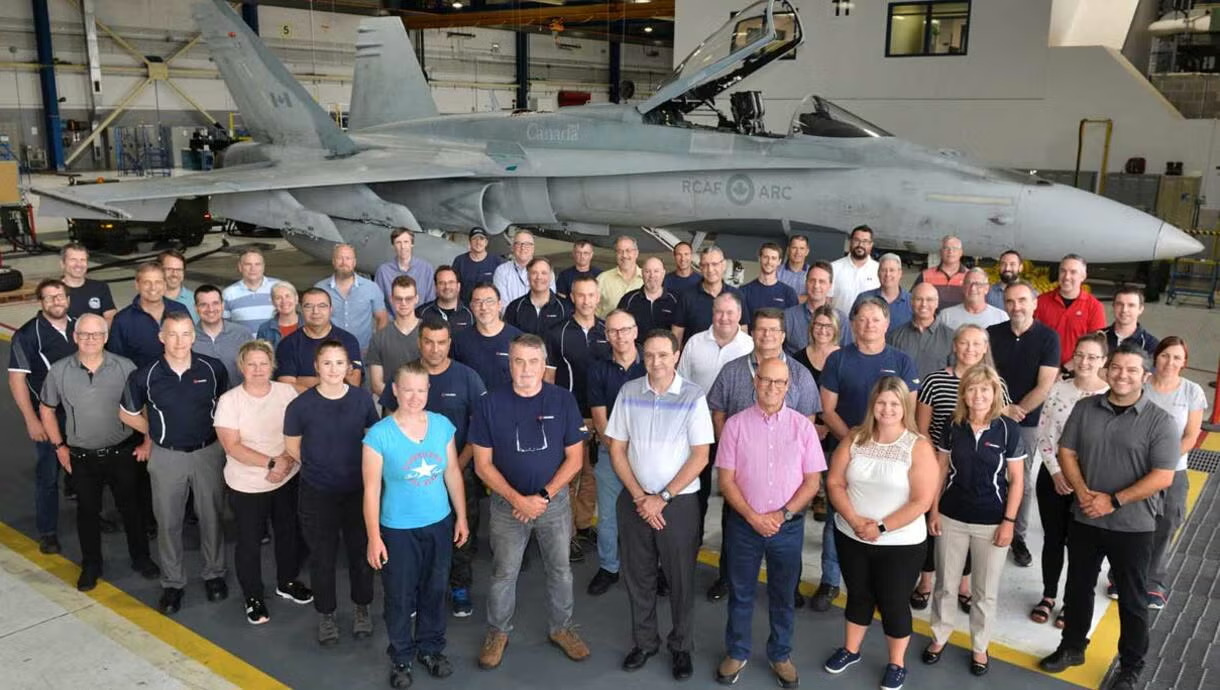
HEP II, on the other hand, was only given to 36 aircraft, with the aircraft picked based on their projected lifespans. They would have their radar change to the Rathon APG79 AESA radar, and upgrades to the advanced distributed combat training system and data links. These would allow the HEP II upgraded Hornets to use a number of new weapons, whose budget was part of the upgrade program. With the Wepons being AIM-9X Block II, AIM-120D, and AGM-154. These 3 weapons help bring the Horents up to the frontline standard of the majority of the other NATO member nations. The upgrades were carried out by L3 Harris and Mirabel, Quebec, with the entire project inculding wepons cost $1.4 bilion CAD. The first aircraft that underwent this upgrade was delivered on August 2nd, 2023, and the full project will be wrapped up in December of 2026.
Specs:
General characteristics
Crew: 1 or 2
Length: 56 ft 0 in (17.07 m)
Wingspan: 40 ft 0 in (12.19 m)
Height: 15 ft 4 in (4.67 m)
Wing area: 400 sq ft (37 m2)
Airfoil: root: NACA 65A005 mod; tip: NACA 65A003.5 mod[90]
Empty weight: 23,049 lb (10,455 kg)
Gross weight: 37,150 lb (16,851 kg)
Max takeoff weight: 51,550 lb (23,383 kg)
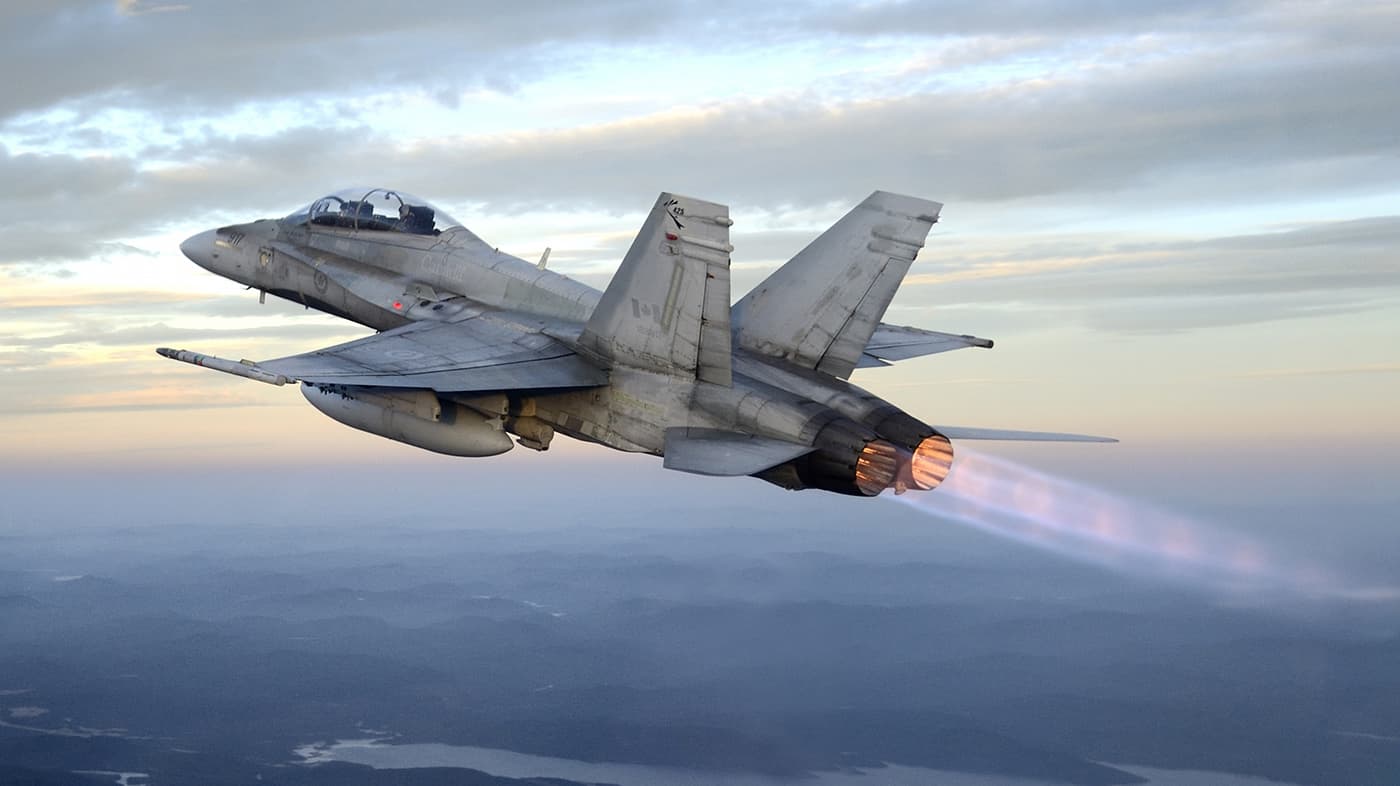
Powerplant: 2 × General Electric F404-GE-400 afterburning turbofan engine, 10,000[91] lbf (44 kN) thrust each dry, 16,000 lbf (71 kN) with afterburner
Performance
Maximum speed: 979.5 kn (1,127.2 mph, 1,814.0 km/h)
Maximum speed: Mach 1.8
Combat range: 290 nmi (330 mi, 540 km) hi-lo-lo-hi
Ferry range: 1,800 nmi (2,100 mi, 3,300 km)
Service ceiling: 50,000 ft (15,000 m)
Rate of climb: 50,000 ft/min (250 m/s)
Armament
Nine weapon/store stations (5 pylons: 1 under fuselage and 4 wing stations) carrying up to 13,700 lb (6,215 kg) of missiles, rockets, bombs, fuel tanks, and pods
2 LAU 116 on sides of fuselage: deploy AIM-7 Sparrow and AIM-120 AMRAAM missiles; 2 LAU 7 on the wing tips: deploy AIM-9 Sidewinder missiles
1 × 20 mm M61A1 Vulcan internal rotary cannon with 578 rounds, with a firing rate of 4,000 or 6,000 rounds per minute
Missiles and rockets:
Air-to-air: AIM-9 Sidewinder (primarily AIM-9X), AIM-120 AMRAAM (primarily AIM-120D), AIM-7 Sparrow missiles
Air-to-ground: AGM-65 Maverick missiles, CRV7 rockets
Bombs: Mk 82, Mk 83 and Mk 84 unguided bombs; Paveway GBU-10, -12, -16, -24 laser guided bombs; JDAM GPS bomb guidance kits; AGM-154 JSOW glide bombs; and most commonly GBU-49 laser and GPS guided bombs.
Avionics
Raytheon AN/APG-79(V)4 AESA radar
BAE Systems AN/APX-111 IFF
Rockwell Collins AN/ARC-210 RT-1556/ARC VHF/UHF Radio
General Dynamics Advanced Information Systems AN/AYK-14 XN-8 mission computer
Smiths Aerospace AN/AYQ-9 Stores Management System
Sources
https://www.youtube.com/watch?v=w3IogrW0mNk
RCAF completes live fire testing of new medium range missile for CF-18 - Skies Mag
https://www.canada.ca/en/department-national-defence/services/procurement/fighter-jets/hornet-extension-project.html
L3Harris delivers first aircraft of Hornet Extension Project - Skies Mag
https://canadiandefencereview.com/cf-188/
https://www.canada.ca/en/air-force/services/aircraft/cf-188.html
McDonnell Douglas CF-18 Hornet - Wikipedia
RCAF CF-18 Hornet Extension Project upgraded fighter achieves IOC
L3Harris Delivers the First Aircraft of the Hornet Extension Project | L3Harris® Fast. Forward.