History
In 1970, Hawker Siddeley and McDonnell Douglas (MCAIR) partnered on a joint project to explore improvements for the Harrier jump jet. This effort was commonly referred to as the AV-16A Super Harrier project. The concept centered on installing a new Pegasus 15 engine capable of producing 24,500 pounds of thrust. However, the RAF showed no interest in pursuing the variant due to tightening budgets, and as development costs continued to rise, both governments considered the program unacceptable in the midst of unstable economic conditions. The effort was terminated in 1975, after which each company continued along its own separate development path.
At the same time, the US Marine Corps was seeking a replacement for its aging A-4 Skyhawk fleet. An improved Harrier was an attractive option, and McDonnell Douglas saw the opportunity to meet USMC requirements without the expense of designing a new engine. The company proposed a significantly redesigned aircraft, the AV-8B.
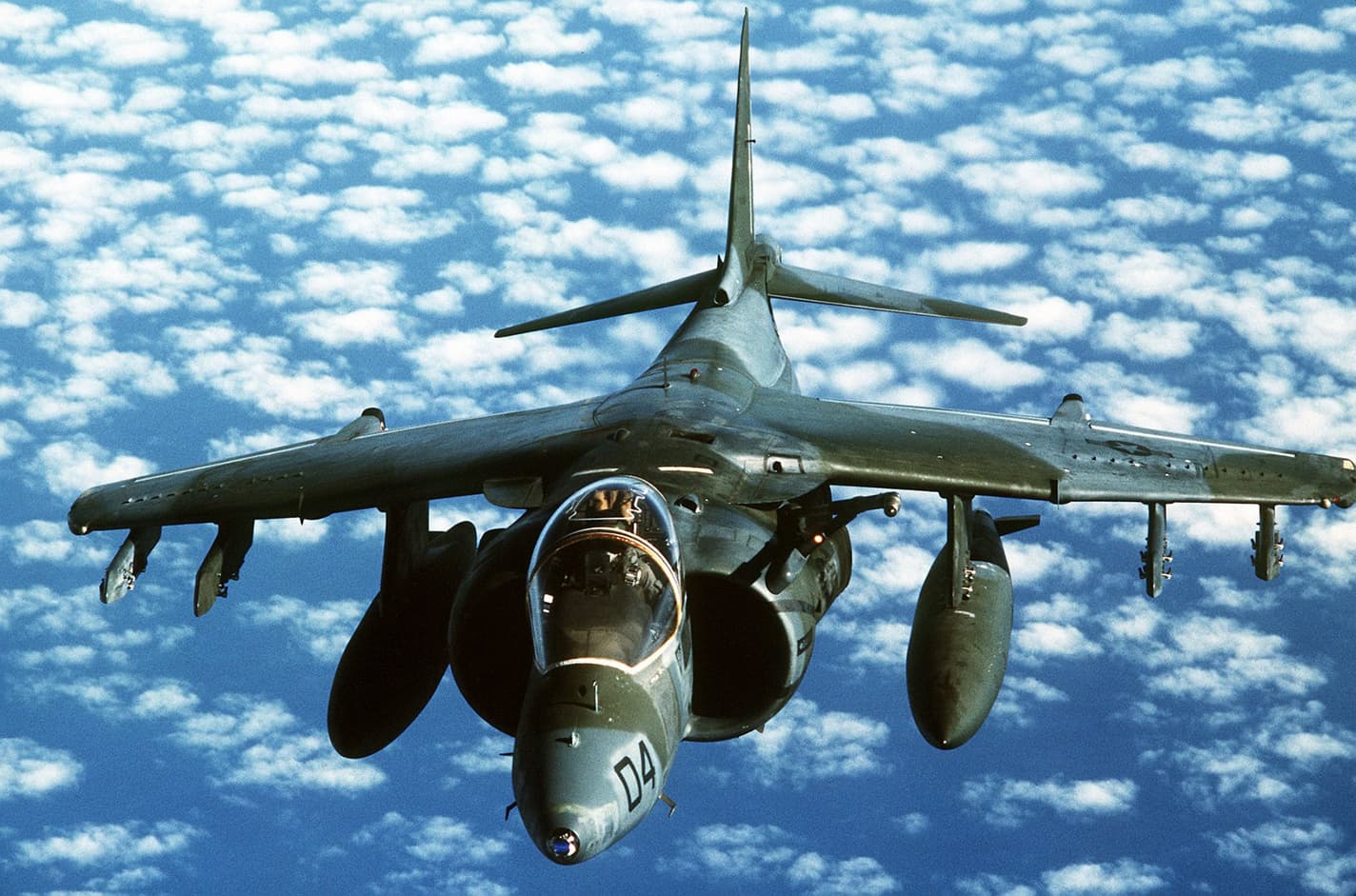
The AV-8B design focused on reducing weight and increasing lift. It introduced a larger, graphite-composite wing with a wider span, large slotted flaps, and leading-edge root extensions to enhance maneuverability. Lift-improvement devices were added beneath the fuselage and gun pods to reduce hot-gas recirculation during vertical operations. The new wing also carried 2,000 pounds more internal fuel than the AV-8A and provided six underwing hardpoints instead of four. The cockpit was raised by roughly 10.5 inches to create more space for avionics and improve pilot visibility beneath a new bubble canopy. The nose was enlarged for additional avionics, and the cockpit layout incorporated features similar to the F/A-18’s, including multifunction displays. The aircraft was equipped with Hughes’ Angle Rate Bombing System (ARBS), already proven in the A-4M. Armament consisted of a single GAU-12/U gun carried in one under-fuselage pod with 300 rounds stored in the opposite pod. Propulsion was provided by the Rolls-Royce F402-RR-406 turbofan.
Two prototypes, designated YAV-8B (BuNos 158394 and 158395), were converted from existing AV-8A airframes. These retained the forward fuselage and cockpit of the AV-8A but lacked the later rear-fuselage extension. They completed their initial flight testing at NAS Patuxent River in early 1979 before moving to the McDonnell Douglas test center in St. Louis that November. The second prototype was lost after an engine failure, though the pilot ejected safely. Despite this, the test program was deemed successful, leading to the construction of four full-scale development AV-8Bs (BuNos 161396-161399), built from scratch beginning in April 1979. The first flew on November 5, 1981, and all four participated in further trials at NAS Patuxent River. Success in the FSD program prompted the USMC to order 12 production AV-8Bs. The first flew on August 29, 1983, and deliveries began in January 1984. Compared to the AV-8A, the AV-8B was notably easier to fly, offered greater range and payload, and benefited from the enhanced lift provided by the new devices.
The USMC’s long-term plan called for eight operational attack squadrons of 20 Harriers each plus a training squadron. A total of 332 aircraft were initially planned, a number later reduced to 161.
In August 1990, when Iraqi forces invaded Kuwait, the Marine Corps operated a single large Harrier II training unit and six operational AV-8B Day Attack squadrons, each equipped with 20 aircraft. Five of these squadrons deployed to the Gulf for Operation Desert Storm, marking the final combat employment of the Day Attack AV-8B.
The deployed units were VMA-231, VMA-311, VMA-331, VMA-513, and VMA-542.
The original AV-8B “Day Attack” model had a relatively short frontline service life. When the 87th production aircraft was selected in June 1987 for modification into a night-capable prototype, it was converted as the AV-8B “Night Attack,” and its flight testing successfully validated the new configuration.
This led to upgrading the “Day Attack” Harrier fleet to two major upgraded variants: the AV-8B Night Attack Harrier and the Harrier II Plus. The Night Attack variant, first fielded in 1991, incorporated a forward-looking infrared (FLIR) turret atop the nose, a wide Smiths Industries head-up display, night-vision-goggle compatibility, and a Honeywell digital moving map system. Its FLIR system provided thermal imaging for target identification, and the aircraft was powered by the improved F402-RR-408 engine with electronic controls for increased power and reliability. The flare and chaff dispensers were repositioned, and the fin’s ram-air intake was lengthened. Harrier II Plus was an essentially Night Attack variant with the addition of an APG-65 radar. After most Day Attack Harriers were upgraded, the remainder were gradually withdrawn.