The authors of Tankograd call the term “Кондиционное поражение”, which I translate as “Conditional defeat/damage” as a nominal defeat
You’re literally making up terms, ignoring the words of the article’s authors.
I’m tired of correcting you.
Of course, because the game only counts penetrations when part of the penetrator penetrates inside the fighting compartment, and not the curvature of the rear part of the armor
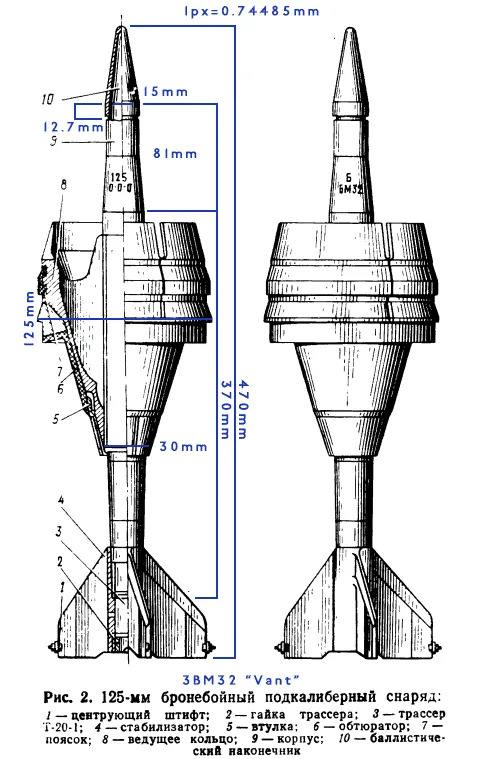
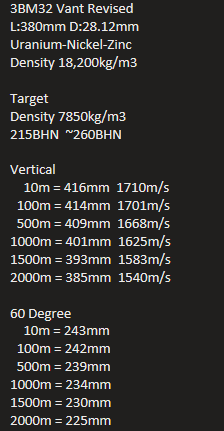
Funny how Vant cannot achieve this level of performance according to L-O ))) Almost as if that’s pressXtoDoubt because of the quality of the tested steel (likely vastly softer than the standard 260 BHN that Gaijin uses)
Tbh it would be believeable if it was for 0km (which it likely was in all actuallity), as DM23 then adjusted for its proper dimensions perforates 415mm, making them basically equals ))))
The idea of armour LOS being provided in documents is that the type of projectile is irrelevant. In theory they should all be treated as long rods so wouldnt be effected by this.
Of course, my guess is that they don’t really care about the inconsistencies in how they treat things, because the players who do care are a tiny fraction of the player base. Either way I was just explaining why those simulations are hardly scientific work.
Dude has nothing besides his funny rusian books/chars from who knows where, that he takes as a given of course. I doubt he can even fathom the idea of rusian sources being full of bs.
You’re discrediting yourself and everyone I’ve spoken to incredibly.
After all, I only used the same sources they did.
@Fireball_2020 used “Частные вопросы конечной баллистики” to weaken the T-64A in his report; I cited the same data here.
Then they started using Tankograd here, and I started cribbing from there as well.
These sources were literally used by those I was discussing with. So either they brought the propaganda themselves and even based their report on it, or you just wrote complete nonsense.
Moreover, I mentioned “if you believe the source” and “if the source is reliable” many times during the conversation.
I, unlike everyone else, approach the issue with skepticism and compare data between sources to ensure they don’t contradict each other.
Absolutelt agree with you. It should be Russia’s fault by not making thick enough armor to withstand modern rods once the ERA is gone, not playerbase’s.
Plus, there is a lot of information floating on T-14 already, it could be added soon - we, nonetheless, have tanks with poorly modelled armor (Leclerc, for example). Russia could still have their advanced T-64 and T-72 against late Leo 1 and AMX 30B2, Leopard 2A4s and M1A1 with DM33 and M829A1 would be brawling against T-72B89 and T-80U, while modernmost Leclercs, Leopards 2A7 and M1A2 challenge the teams full of Armatas. Not a reality we’re in, but it sounds like a much more cool scenario
It’s really more of a problem with the developers, who seem to be omitting something when calculating penetrations, since it’s impossible for the DM63 to penetrate marginally more than the DM33, when the DM63 dates back to 1990.
I’m not sure that information is accurate, because even though the T-14 turned out to be a massive failure, it still has extremely modern armor, and that should be kept strictly secret. Besides, the T-14’s counterparts should be other prototype models like the Abrams X, etc. To counter the M1A2 and any tank that’s an upgrade of previous tanks, there are already the T-90M, B3, and T-80BVM, which are upgrades of earlier tanks.