There are just too many replies. All I want to say is: Russians could try using their own explosive reactive armor to intercept nuclear missiles—just mount that double-layered Fossil Explosive Reactive Armor on interceptor missiles, and you can stop anything!
Relikts 250 mm value was likely calculated from LOS protection of T-90M (800mm, where armor LOS is 550 and ERA LOS is 250) but in game its like 290 mm at 60° in reality, if you check it yourself. And that is post-normalization so its like 300 at 60° LOS in game. In real life its much more potent as it degrades long rod by around 40%.
As for flat protection values, theyre pretty low, iirc like 40-50 mm. The issue with upgraded side ERA is not an issue, its ERA bricks being angled
It takes more skill to hit the armor 😆
~40mm comes from the ERA boxes.
54mm flat isn’t “absurd” in the slightest.
…it doesn’t, they’re 5-10 mm thick
10x2 is 20mm /cos 68 = 53mm. And 40 at 60.
…that’s not what flat means. Also Relikt is placed at 60 deg
1 Like
It’s shocking how many people struggle with the idea that a steel plate is still a steel plate, regardless of whether or not it’s being throw with explosives, it’s also worth noting that Kontakt-5 (and I would assume Relikt) uses an asymmetric explosive interlayer that rotates the flyer plate as it’s thrown out, which means that it still has some affect, even if minimal regardless of the impact angle.
Also a Relikt side bag has 2 relikt plates held apart by metal plates so a side shot has to pass through the holder box, flyer plate, explosive, backer plate, mounting bracket, space, mounting bracket, backing plate, explosive, flyer plate, holder box, side skirt, then the actual tanks armour.
Edit: To clarify, the side bag has lots of Relikt plates each set of “slats” is 2 paired Relikt plates held back to back
2 Likes
You said angled, not flat.
No ERA in War Thunder has over 100mm of protection flat.
And no, the ERA is placed in multiple positions, with many configs being aligned with the 68 degree UFP.
are you blind?

long rod doesn’t struggle with rubber skirts and structural steel. Only throwing “degrading” plates and actual armor
Not in real life, at least
that’s still 4 distorting plates and having the round “guillotined” twice which would negate tipped APFSDS and that’s not even accounting for the fact that those “slats” overlap each other. And structural steel and rubber absolutely affect APFSDS, composite armour and NERA especially is ENTIRLY based off that fact. It’s not that they offer a significant level of protection on their own, but that when paired with other materials their different shockwave propagation speeds causes distortions in the materials that break up the penetrator.
Where is this asymmetric Plate? There is no second flyer plate only a pair of offset (9 degrees) 4S20 / -22 tiles.
K-1
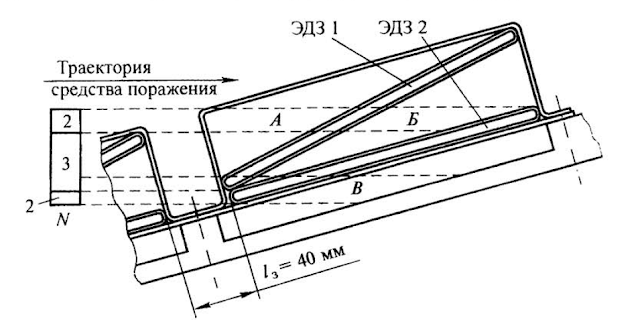
K-5
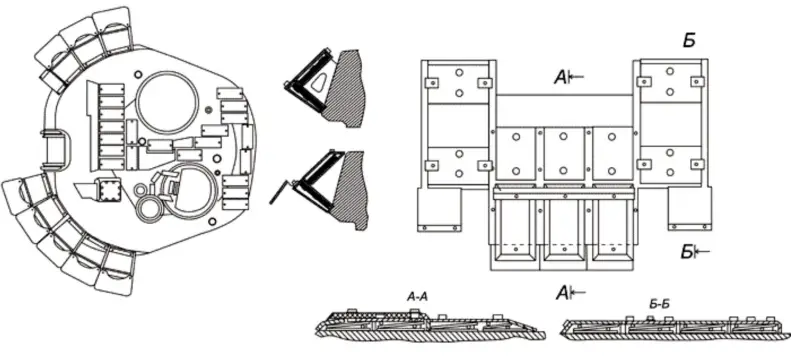
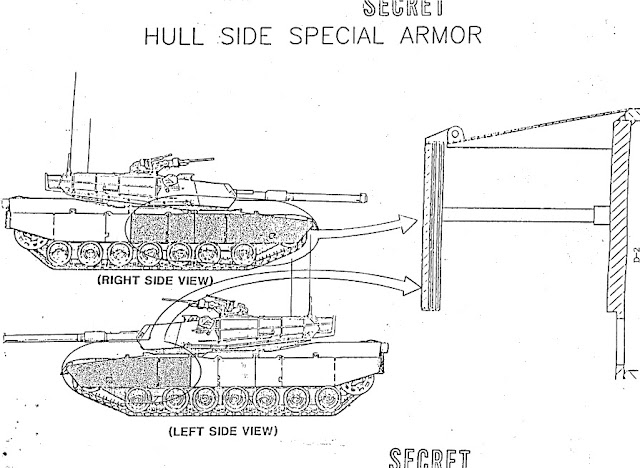
And the M1’s Composite side screen is made up of DU. and yet barely does anything considering that 65mm of composite somehow barely adds 30mm(29.4mm) RHAe (87-(30+27.6)) of protection. even though it incudes multiple DU elements & a 20-25mm RHA strikeface.
3 Likes
What says that it is DU? Special Armour =/= DU
Try actually reading what I typed
Source? and even if it is, DU offers the same single hit protection as tungsten alloy but we are not talking about the Abrams in anyway, what ever the Abrams side skirts are made of is not related to how Kontact or Relekt work
First time I’ve heard of asymmetric explosive being used in the 4SXX series, or in any type of heavy ERA. It seems to me that inducing rotation in the flyer plates could improve effectiveness at certain impact points, but at others it might significantly reduce it. Depending on the impact angle and the direction of rotation, the projectile could actually encounter less material along its path and it would be even more problematic with a 4S23 sandwich.
I can’t find exact details for it, just that one side of the explosive was a little thicker than the other to produce more rotation in the flyer plate, so I’m not making any claims it was some type of magic, just that they did account for and improve it’s ability to deal with less that optimal impact angles
Special Armor in the context of the report denotes;
“Special Armor referred to in this document consists of the specific Tri-plate installed in the first generation Abrams Tanks and its associated threat mechanisms”.
Theoretically nothing, but it’d be pretty hard to weld plastic, as the guide instructs for repair.
I guess it could just be a alternating Plastic-Steel-Plastic panel similar to Chobham as it would make sense in terms of a “Tri-Plate” (Three element). But it differs as there is no space for bolts of any kind and directly mounting Plastics to Metal without encapsulation if difficult and Glues or Epoxies probably wouldn’t have the service life in the environment considering the vibrations involved in the life cycle of a vehicle, or be easy to repair since de-bonding plastics is exceedingly difficult to do non-destructively.

Let alone how else the skirt + side armor would meet requirements for 350mm against a KE threat at +/- 25 degrees, when it’s only got ~57-75mm of RHA otherwise.

Are they somehow not a motive element that would work to bend a penetrator out of alignment? They do seem to be hinged and it’s not like none of the energy from a penetration would be imparted to the skirt. and with the spacing between the hull being about 400mm a reasonably long penetrator would form multiple points of contact simultaneously with the skirt and side armor. So may segment the penetrator.
Possibly, it doesn’t take much yaw to be imparted to the penetrator to begin to have a significant negative effect on it’s ability to penetrate the armour, I think its something like if the tail of the rod is 2 degrees out of alignment with the tip it will lose about 6% of its penetration.
also looking at the picture of it you have a RHA plate backed by NERA, so A HEAT or APFSDS would strike the RHA then as it penetrates the strike face the NERA would distort to try and break apart the tip of the HEAT jet or rod (I don’t now if it would be enough to break the tip of an APFSDS) which causes extreme degradation to the penetration ability, HEAT will lose about 30% of it’s pen and and APFSDS about 20%.
Also sorry for the slow response, it was nearly 2am here so I needed to sleep.