HISTORY
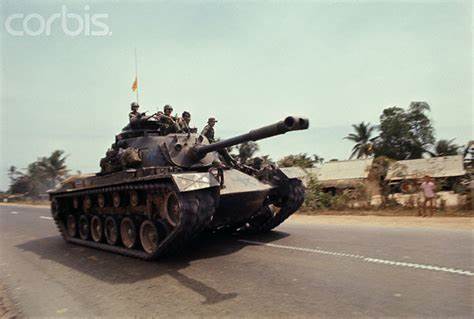
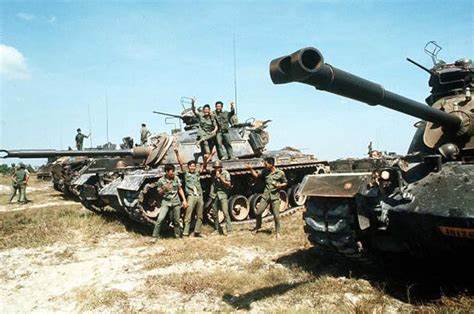
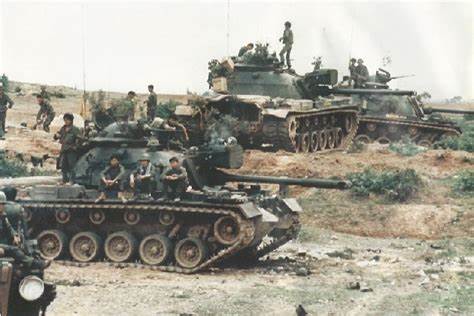
During the Vietnam War, the United States supported the nation of South Vietnam in many ways, from direct involvement to training and even providing vehicles; among those many many vehicles were both M41A3s and M48A3s.
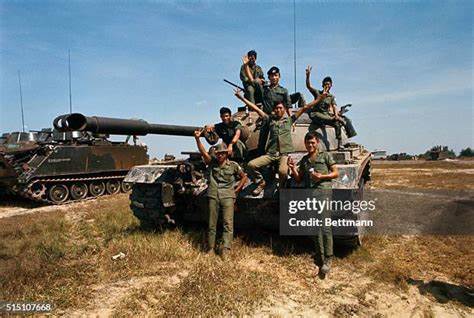
At the time the M48A3’s being used by both the US and the ARVN received the G305 cupola riser and received the designation MOD.B as a result, this designation was dropped when all US M48A3’s received this upgrade. This improved the commander’s visibility from the cupola. However, unlike many US crews, the ARVN crews preferred using the cupola because it offered greater protection than an exposed machine gun, which US crews often jerry-rigged to their M48s due to the cramped interior of the cupola.
History of the M48A3:
The development of the M48A3 Patton was not a “new” tank design, but rather a critical mid-life modernization program intended to fix the lethal shortcomings of the earlier M48A1 and A2 variants. In the late 1950s, the U.S. Army faced a crisis: its primary medium tanks were powered by a high-octane Continental AV-1790 gasoline engine. These “gas-burning” Pattons had a dismal operational range and were notorious for catching fire instantly when hit. The M48A3 program, initiated in 1959, focused on “dieselizing” the fleet to improve range, reliability, and crew survivability. The technical core of the M48A3 conversion was the installation of the Teledyne Continental AVDS-1790-2A V-12 air-cooled diesel engine, which produced 750 horsepower. By swapping gasoline for diesel, the Army not only reduced the fire risk but also dramatically increased fuel efficiency. When combined with an increased internal fuel capacity of 375 gallons, the M48A3’s operational range jumped to approximately 300 miles—more than quadruple that of the original model. This upgrade required a total redesign of the rear engine compartment, leading to the distinctive rear deck and the addition of massive air-cleaner boxes on the fenders to handle the dust of field operations. While the engine was the priority, the M48A3 also received a sophisticated fire control overhaul. It retained the 90mm M41 main gun, but accuracy was significantly enhanced by integrating the M17B1C coincidence rangefinder and the M13A4 ballistic computer. These systems allowed the gunner to calculate the range and elevation required to hit targets at distances exceeding 2,000 yards with a high first-round hit probability. Additionally, the commander’s station was upgraded with the M1 cupola, which housed a .50-caliber machine gun that could be aimed, fired, and reloaded from inside the turret, protecting the commander from small arms fire and shrapnel. Ballistic Protection and Structural Integrity. The M48A3 utilized a massive, single-piece cast-steel hull and turret, offering protection far superior to that of the aluminum-hulled M551 Sheridan. The frontal hull armor was 4.3 inches thick and provided an effective relative thickness of over 8 inches against kinetic-energy penetrators. The turret mantlet featured 7 inches of solid cast steel. This heavy protection brought the vehicle’s combat weight to approximately 52 tons (104,000 lbs). While this weight made the Patton impossible to air-drop, it provided the ruggedness necessary to survive the heavy anti-tank mines and RPG-7 rounds encountered in the dense jungles and rice paddies of Southeast Asia. By the time the M48A3 reached full-rate conversion at the Red River and Anniston Army Depots, it had become the “Gold Standard” for American armor in the 1960s. Though the newer M60 tank was beginning to enter service with a larger 105mm gun, the M48A3 remained the workhorse for the U.S. Marine Corps and many Army armor battalions during the Vietnam War. Its development proved that a 1950s-era chassis could be successfully retrofitted with modern diesel technology and fire control systems to remain a capable weapon on the battlefield.
The integration of the M48A3 into the ARVN began in 1971 as part of the “Vietnamization” program, where the U.S. sought to provide the South Vietnamese with a way to counter the growing threat of North Vietnamese (NVA) heavy armor. Prior to this, the ARVN had relied on the lightweight M41 Walker Bulldog, which was outmatched by the Soviet-supplied T-54. The 52-ton M48A3 provided a massive leap in capability; it featured the 750-horsepower AVDS-1790-2A diesel engine, which eliminated the terrifying fire risk of the older gasoline-powered Pattons.
Technically, the M48A3 Mod. B offered the ARVN an incredible tactical advantage in optics and fire control. While the NVA’s T-54s had a larger 100mm gun, the Patton’s 90mm M41 gun was paired m17 coincidence rangefinder that provided the ARVN with the capability to accurately range and engage targets at distances of 2,000 yards or more—often before the NVA tanks even realized they were in a kill zone. The tank’s armor was equally impressive for the era, with a 4.3-inch-sloped front hull and a 7-inch-thick turret mantlet. This protection made the Patton nearly impervious to the 76mm guns of the NVA’s PT-76 light tanks and highly resilient against 100mm rounds at typical engagement ranges.
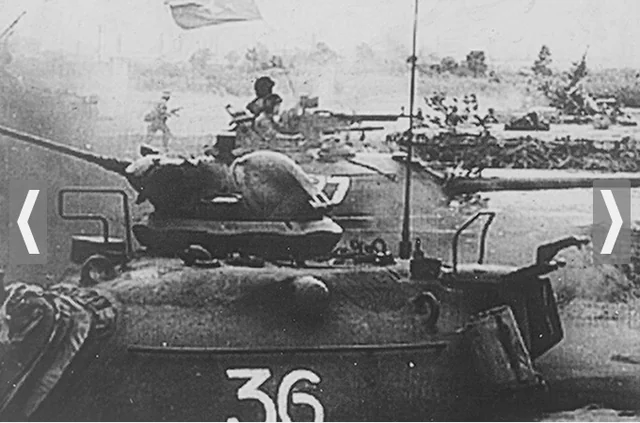
The operational history of the ARVN M48A3 reached its peak during the 1972 Easter Offensive. At the Battle of Dong Ha and later at An Loc, ARVN tankers of the 20th Tank Regiment successfully utilized the Patton’s superior hull-down capabilities to decimate NVA armored columns, proving that South Vietnamese crews could master the complex fire-control systems of a modern Main Battle Tank. However, the tank’s greatest weakness proved to be its logistical tail. By 1975, a combination of reduced U.S. aid and the sheer weight of the vehicle—which made it difficult to retreat across damaged bridges and muddy terrain—meant that many M48A3s were lost not to enemy fire, but to a lack of fuel and spare parts during the final NVA offensive. there is a survinving ARVN M48A3 at the Zone 5 Military Museum, Danang.
The ARVN operated the M48A3 from 1971 to April 30, 1975, when South Vietnam collapsed, and the ARVN ceased to exist.
STATS
Mobility
Top speed: Fwd: 30mph /Rvs: 5mph
Engine: Continental AVDS-1790-2A; 12 cylinder, 4 cycle, 90°, supercharged diesel
Transmission: General Motors CD-850-6A, 2 ranges forward, 1 reverse
Weaponry
90mm T41 (Ammo: 62) Main
7.62mm M73 (Ammo: 5900) Coax
12.7mm M2HB (Ammo: 600) Cupola
Armor
Crew: 4
Turret: 130/76/51
Hull: 110/76/25
Other: features add on track armor and a few sandbags, potentially
Ammo
HEAT: M431
APHE: M82
APCR: M332
SMOKE: M313
HE: M71
HESH: T14E3
Other
Night vision: Yes, Active (driver, gunner) requires the AN/VSS-1 IR spotlight to function
Smoke grenades: No
ESS: No
SOURCES
90mm Gun Tank M48 Patton 48
Patton Tanks in Vietnam – Mike's Research
90mm Gun Tank M48 Patton III
TM 9-2350-224-10
MORE IMAGES

- yes
- no