ARMAMENT
Spoiler
-
1x T25 Turret from Norwegian Defence Technology
-Vertical Guidance: -10°/+50° Approx 4-12 degrees per revolution
-Horizontal Guidance: 360° Approx 4-12 degrees per revolution
-Feed: Dual-feed system for switching between ammunition types
-Ammunition type: NATO-standard 25×137mm ammunition
-Ammunition Stowage: It holds 120 rounds internally, 40 in the upper magazine, 80 in the lower-
Main weapon: 1x 25x137mm Mauser Mk 25 Model E autocannon
-Caliber: 25x137mm NATO
-Operation: Gas-operated, Friberg-Kjellman system with twin locking flaps
-Feed System: Double belt feed, selectable feed
-Rate of Fire: 900 - 1,000 rounds per minute (some sources report 600 rpm)
-Muzzle Velocity: 1,100 m/s (for standard ammunition)
-Total Length: 2.862 mm (2.10 m excluding muzzle brake)
-Weight (complete): 109 - 112 kg
-Barrel Weight: 38 kg -
Secondary Coaxial Weapon: 7.62x51mm MG3 Machinegun
-Placement: Integrated on upper right side of the turret, outside
-Caliber: 7.62x51mm
-Controlled and fired by the gunner
-Ammunition muxture: NM60 Full metal jacket + NM62 Full metal jacket tracer
-
-
Smoke grenades: Undertain amount, 2-4x, installed on the rear of the turret, you can see the egde of one
AMMUNITION (25x137mm)
Spoiler
25x137mm M919 APFSDS-T
APFSDS-T - Armor Piercing Fin Stabilized Discarding Sabot-Tracer
Armor penetration: Still Classified, approx. 100mm RHA at 100m
Total Round Weight: ~0.450 kg (~0.99 lbs)
Subprojectile Weight: ~98g
Cartridge length: ~223 mm
Muzzle Velocity: ~1,420 m/s (~4,660 ft/s)
Effective Range: ~2,200 m (Maximum range is much further)
Penetrator Material: Depleted Uranium (DU)
Stablization: Fine-stabilized in flight
Tracer Burn: Visible up to ~2,000 meters
25x137mm M791APDS/APDS-T
APDS -Armor-Piercing Discarding Sabot
Armor penetration: Approx… 80-100mm RHA 100m
Projectile: Tungsten penetrator within a plastic sabot
Cartridge Case: Carbon Steel
Total Round Weight: ~454g (1.0 lb)
Projectile Weight: ~134g (0.3 lb)
Muzzle Velocity: ~1345 m/s (4413 ft/s)
Cartridge Length: ~223mm (8.78 inches)
25x137mm SAPHEI-T
Projectile weight: 185 g
Muzzle velocity: 1,100 m/s
Tracer: ≥ 1.7 s
Dispersion Standard H&V deviation:** ≤ 0.8 mils
Penetration: 6.5 mm RHA 60° NATO at impact velocity 800 m/s
25x137mm MP-T SD
Projectile weight: 183 g
Muzzle velocity: 1.100 m/s
Tracer/self-destruction: Minimum visible in 5.3 s
Self-destruction after: minimum 5.3 s
Maximum dispersion: Maximum 1.0 m at a range of 1 000 m
Penetration: 15 mm armor plate at 0° NATO at 500 m
25x137mm HEI AND HEI-T
Projectile weight: 198 g
Muzzle velocity: 1.100 m/s
Maximum dispersion: Typical H&V deviation < 0.8 mils
Tracer: > 1.7 s
25x137mm HEI/SD AND HEI-T/SD
Projectile weight: 180 g
Muzzle velocity: 1.100 m/s
Maximum dispersion: Typical H&V deviation < 0.8 mils
Tracer: > 1.7 s
25x137mm SAPHEI/SD AND SAPHEI-T/SD
Projectile weight: 170 g/180 g
Muzzle velocity: 1.100 m/s
Maximum dispersion: Typical H&V deviation < 0.8 mils
Penetration: 10 mm NATO plate at 60° at 200 m
Tracer: > 1.7 s
TECHNICAL DATA
Spoiler
Curb Weight: 9740.44 Kg
Combat Weight: 11155.65kg
Height over MG: 249.6cm
Length: 486.4cm
Width over track shrouds: 268.61cm
Tread: 216cm
Ground clearance: 40.9cm
Top Speed: 59.6 Km/h
Eigne: Chrysler 75M; 8 cylinder, 4 cycle, vee gasoline
Power: 215hp@4,000rpm
Torque 332 ft-lb@2,800rpm
HP/Ton: 17.2
Acceleration (0-20 mph) sec: 10.5 sec
Braking Distance: 12.1 Meter
Turning Radius: 426.7 Meter
Ground Pressure (psi): 7.8
Cruising Range: 482.80 kilometer
HISTORY
In the Late 1970’s to early 1980’s Norway started the development of a new Infantry Fighting Vehicle to provide a mobile, lightly armored vehicle with significant firepower for its mechanized infantry and in 1981 all 53 which were ordered were finished built and put in service of the Norwegain Army. This featured an M113A1 with a turret from Swedish Hägglunds which were used on their Pansarbandvagn 302 vehicles. This was then modified by Norway further by removing the Swedish cannon and installing an 20mm Oerlikon cannon in 20x139mm, along with numerous other changes, such as an coaxial machinegun and smoke grenades.
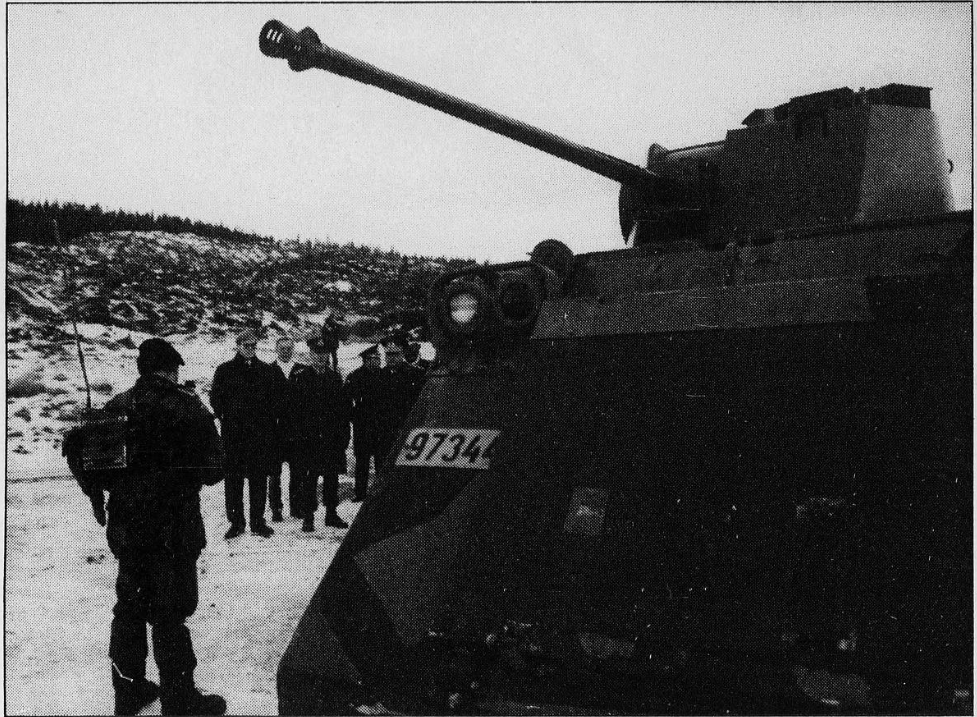
Some years later, in the late 1980’s The Norwegian Defence Technology (which was a name for the Norwegian defence industry company Kongsberg Gruppen in the period 1987–95.) started developing this turret further as a domestic solution amid Norway’s search for M113 replacements in the late 1980s, aligning with broader NATO trends toward more capable IFVs. They swapped out the 20x139mm Oerlikon cannon with one 25x137mm Mauser Mk 25 Model E autocannon with greater firepower and much more variety in ammunition, along with some changes to the turret itself. The turret was named and given the designation T25.
In January 1990 a demonstration at Hengsvann firing range was held by The Norwegian Defence Technology (as described in the Fremtiden article) was part of an effort to attract international interest, including from Turkey, which was evaluating 4-5 competing turret options for its own armored vehicle programs. (Of those were the ACV-15 IFV, which ultimately adopted foreign designs like the French Dragar 25mm turret etc). Turkish Chief of General Staff Necip Torumtay attended the successful test firing during his official visit, alongside Norwegian Defense Chief Torolf Rein. The potential deal was valued at 500-600 million NOK, potentially over 1 billion NOK with add-ons like Penguin missiles which were also discussed, but The Norwegian Defence Technology did not secure the contract—Turkey chose other suppliers via its FNSS joint venture.The T25 remained a prototype and was tested further in 1992 on the Greek Leonidas-2 chassis, where it competed against other turrets (e.g., M242 Bushmaster, DAF/FMC EWS) but was not selected for production. Likely due to a combination of reasons, like gulf war that just broke out a little later.
The project was cancelled at an unknown time after, and the fate is uncertain. It remains an protype and was never adopted by any nation. Norway trialed a handful of infantry fighting vehicles from around the world a couple years later, and in the end settled for the Swedish CV9030 to replace the NM135’s which had been in service since 1981. Tough elements of the T25’s design may have influenced later Kongsberg remote weapon systems like the Protector series, but it did not enter serial production.
IN GAME
In the game this could be a capable infantry fighting vehicle between rank 3 to rank 5, it features and 25mm cannon with a high fire rate and capable AP, APDS and APFSDS ammunition, capable of penetrating 80 to 100mm+ of RHA at 100m. It also has access to a wide variety of HE, SAPHE ammunition great for lightly armored targets and aircrafts. Tough it’s an old M113 chassis, the M113A1 which is not very fast or agile, but it is in turn light.
SOURCES
Spoiler
Vehicle and it’s information
Laagendalsposten, torsdag 7. februar 1991
Norge, Buskerud, Kongsberg, 07.02.1991
Nasjonalbiblioteket
Fremtiden, tirsdag 16. januar 1990
Norge, Buskerud, Drammen, 16.01.1990
Nasjonalbiblioteket
Army Guide
https://www.nammo.com/wp-content/uploads/2024/09/Nammo-Handbook-2024_08_Web.cleaned.pdf
25mm Mauser Model E | Weaponsystems.net
APC M113
M113A1 Armored Personnel Carrier
- Yes
- No