- Yes
- No

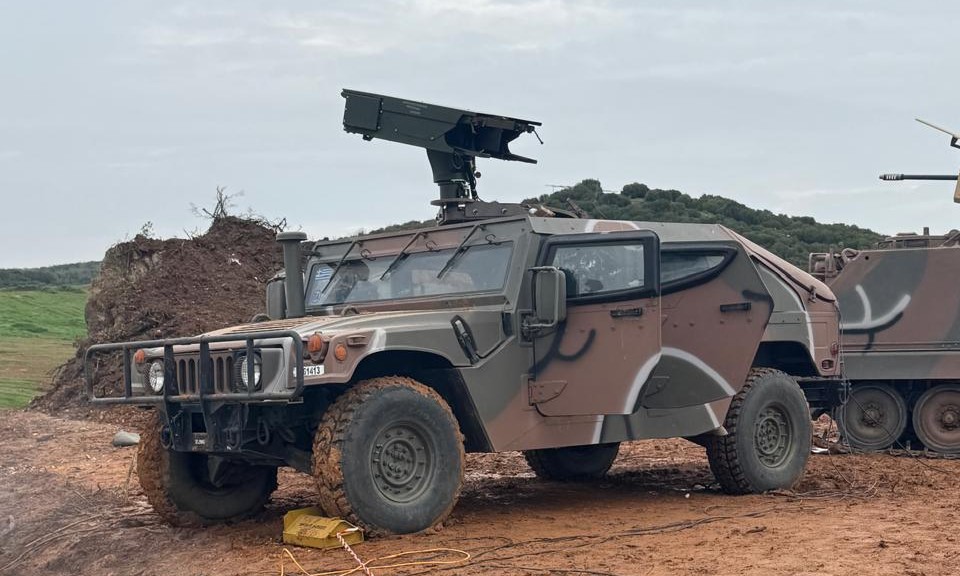
History
Humvee in the Greek Army
The Greek Army acquired its first Humvees (HMMWVs) in 2000 under a major program valued at 3.2 billion drachmas. The initial contract covered 42 M1025A2 vehicles equipped with MILAN anti-tank missile systems and 28 M1097A2 vehicles, intended for the Special Forces and the 116th Mechanized Artillery Squadron (116 A/M BP), part of the 71st Airborne Brigade (71st A/M TAX “Pontus”).
In 2002, the Greek Army ordered 98 M1114GR vehicles (with an option for another 98) under a program that included local participation by the Greek company ELBO. All vehicles intended to carry the Russian missile system were up-armored with Israeli-made composite armor kits produced by Plasan SASA.
In July 2005, another contract was placed for 40 M118GR vehicles to serve as carriers for the BOR-A550 surveillance radar and 20 M118GR vehicles equipped with Margot XXL electro-optical sensors. Finally, in March 2006, a contract was signed for 165 M115, 70 M116GR, 6 M117GR, and 60 M119GR vehicles.
The SPIKE-LR2
The Spike-LR2 (Israeli designation: Gil-2) is the fifth-generation long-range variant of the Spike family of electro-optical (EO) guided anti-tank guided missiles (ATGMs), developed by Israel’s Rafael Advanced Defense Systems.
- Origins in the Spike Family
The broader Spike missile family traces its roots to the late 1970s, when Rafael began developing fiber-optic guided missiles for the Israel Defense Forces (IDF). Early concepts evolved from projects like the NT-Dandy. The first variants entered service in the 1980s, with major expansions in 1987 introducing SR (short-range), MR (medium-range), LR (long-range), and ER (extended-range) versions. These fire-and-forget or fire-and-observe missiles quickly gained international success due to their precision, multi-platform compatibility (infantry, vehicles, helicopters, naval), and versatility against armored, structural, and personnel targets.
- Development of the LR2
The Spike-LR2 was developed as an evolution of the successful Spike-LR (also known as Gomed in Israeli service) to address modern battlefield challenges, including active protection systems (APS) on tanks, electronic warfare, and urban/complex terrain operations. Key improvements include:
- Reduced missile weight (~13 kg vs. previous LR) and system weight (~25 kg total).
- Extended range: Up to 5.5 km ground-launched, 10 km from helicopters (via RF data-link).
- Enhanced tandem HEAT warhead with ~30% better armor penetration, plus an optional multipurpose blast warhead with selectable fusing.
- Advanced seeker with uncooled IR sensor, day camera, AI-supported smart target tracker, and improved counter-APS capability (top-attack angles up to 70°).
- Multiple firing modes: Fire-and-Forget, Fire-and-Observe/Update, Fire-to-Coordinate (grid targeting via IMU), and man-in-the-loop.
- Dual data-link (fiber-optic primary + RF) for resilience and third-party targeting.
- Backward compatibility with legacy Spike launchers.
It was unveiled around late 2017, with full-scale development leading to operational status around 2018. The IDF placed the first order in October 2017
The merge of the Humvee with the SPIKE-LR2
The merge was possible with the SUDOCE system that is visible below
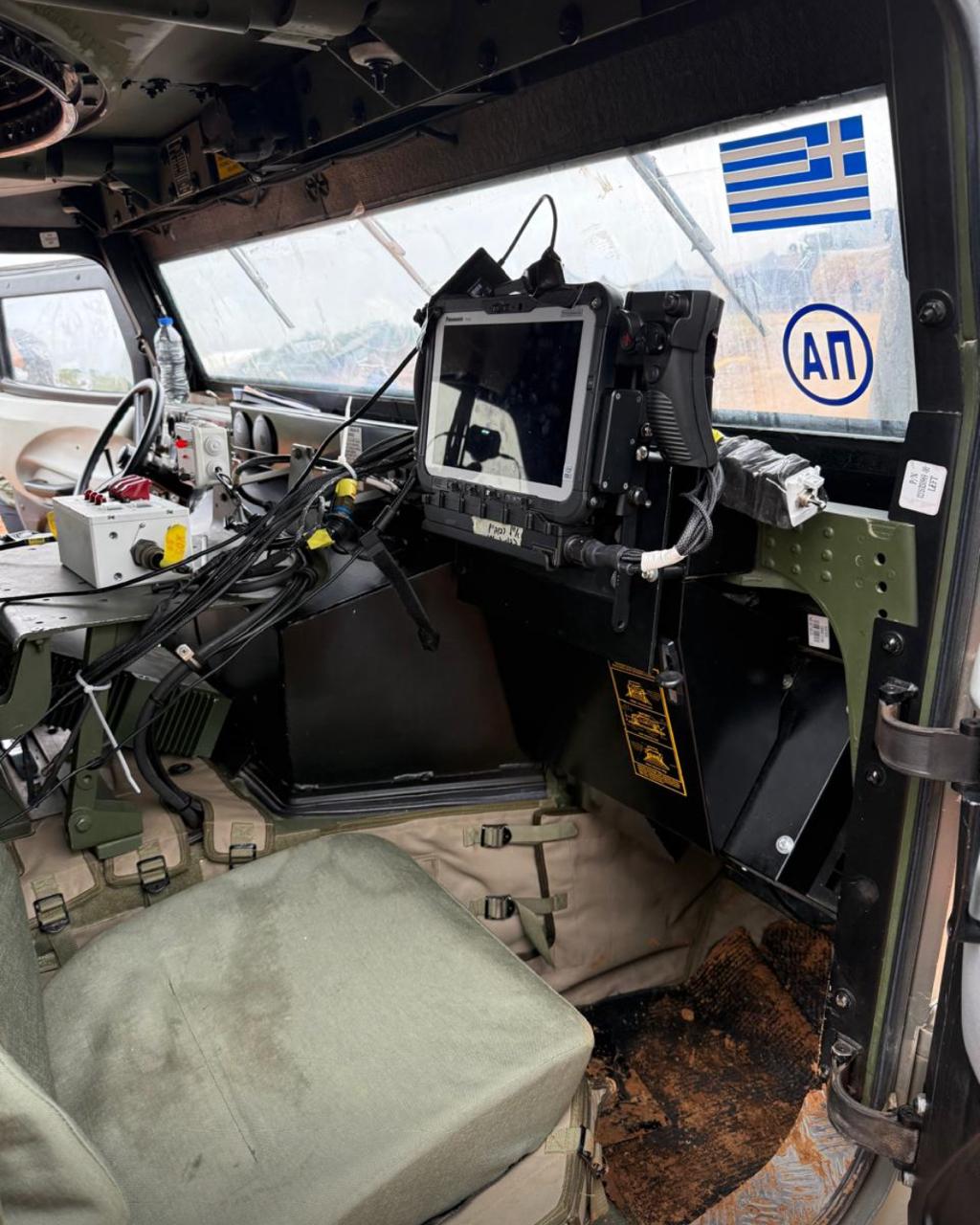
The SUDOCU (Smart Unit of Display for Operational Commanding Use) is a compact tactical tablet/display system developed as part of the Spike LR2 anti-tank guided missile system by the Israeli defense company Rafael Advanced Defense Systems. SUDOCU is typically mounted near the commander’s position (e.g., on the roof of the fighting compartment in vehicles like the German Wiesel 1 MELLS). It connects to the ICLU (Integrated Command Launch Unit) of the Spike system.
Role and Function
- It serves as the commander’s smart display and fire control interface.
- The vehicle or team commander uses it to:
- View exactly what the gunner/operator sees through the missile launcher’s sight (real-time video feed).
- Designate and assign targets to the operator.
- Control and supervise engagements, especially in “Auto” mode (non-line-of-sight or indirect targeting).
- Record video and audio of the engagement for after-action review.
- It effectively replaces older digital recording units (like the previous UGD) with a more advanced, networked tablet-style interface.
Israeli Origin
Although it is fielded internationally with the Spike family, SUDOCU is an Israeli-developed component of Rafael’s Spike LR2 ecosystem. Rafael designed the overall system, including the advanced command-and-control features that SUDOCU enables. It reflects modern Israeli doctrines emphasizing networked warfare, commander oversight, and multi-crew coordination in anti-armor operations.
Live fire testing
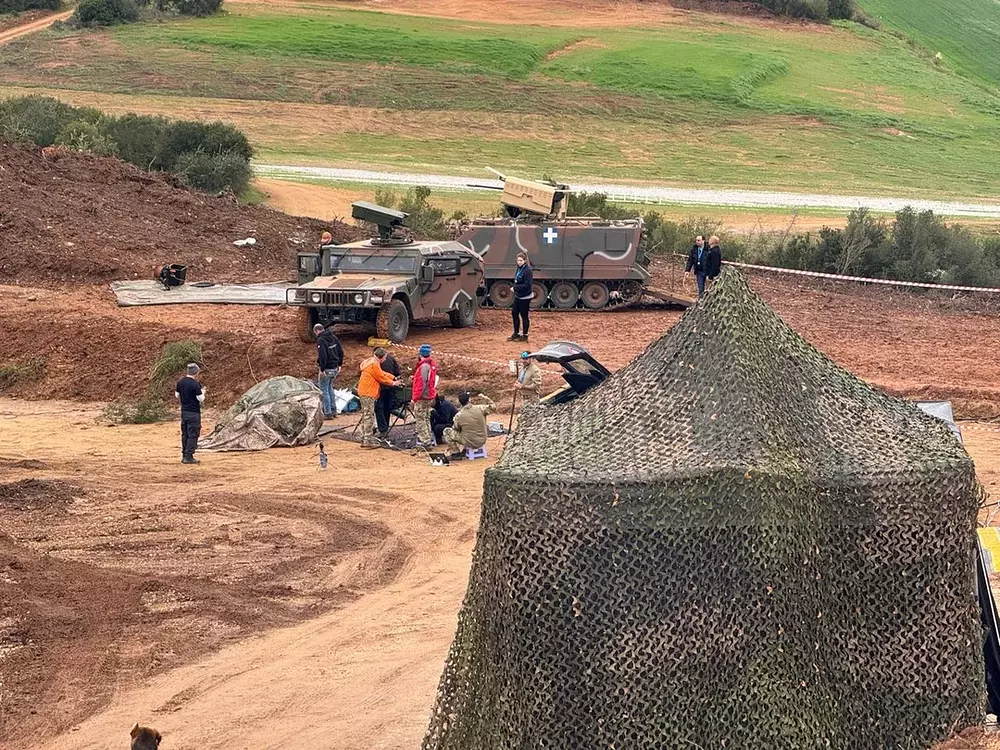
In late February 2025 they were test fires with the M113A1 (SAMSON Dual RWS) in Askou-Prophet fire range in Thessaloniki.
The M1114GR (SPIKE-LR2) fired 2/5 scenarios number 2 and 3:
In the second scenario, a missile was fired in LOBL (Lock On Before Launch: locking onto the target before missile launch) was performed against a target 2.9 km away. The target was a main battle tank.
In the third scenario, the shot was fired from a remotely controlled launcher in automatic mode against a main battle tank simulating the target, at a distance of 2.9 km. A remote sensing system was used to locate and identify the target, and the attack was carried out using the “Smart Display Unit for Operational Commanding Use (SUDOCU: Smart Unit of Display for Operational Commanding Use), which allows the crew commander to monitor the engagement carried out by the missile system operator, assign new targets to the operator, and record the engagement process (for debriefing and training purposes).
Firepower
Spike-LR2 Firepower
- 5th-generation multi-purpose ATGM with tandem HEAT warhead for defeating modern tanks (even with ERA and APS) via top-attack.
- Alternative multi-purpose blast warhead for bunkers, buildings, ships, and personnel (with impact/delay/airburst options).
- Ground range: up to 5.5 km; helicopter range: up to 10 km.
- Advanced EO seeker (day camera + uncooled IR) with AI target tracking for high accuracy.
- Multiple modes: Fire-and-Forget, man-in-the-loop control, and third-party targeting.
- Missile weight: ~13 kg — lighter and more portable than previous version.
- Can engage tanks, fortifications, and other targets in day/night and complex terrain.
- High lethality, precision, and flexibility for infantry, vehicle, and helicopter use.
Protection
Armor: STANAG 4569 Level 2
Ballistic and Blast Specifications
- Kinetic Energy Threat : The primary threat is the 7.62×39 mm API BZ round, requiring the armor to prevent penetration and limit backface deformation across all-around surfaces, including oblique impacts up to 30 degrees elevation.
- Blast Threat : The vehicle must survive a 6 kg TNT equivalent mine detonated under any wheel, track, or at the hull center with a 0.1-meter standoff distance.
- Artillery Fragments : Protection includes resistance to 20 mm Fragment Simulating Projectiles (FSP) traveling at 630 m/s (burst range 80 m) and 12.7 mm FSP at 420 m/s .
- Survivability Criteria : Blast testing focuses on occupant protection, limiting vertical acceleration to avoid spinal/head injuries and preventing incapacitating internal spall from hull deformation
Specifications
- Length: ~5.0 m
- Width ~2.18 m
- Height: ~1.88 m
- Weight: Curb weight around 3,500–4,000+ kg , higher than standard HMMWV due to Plasan armor kit.
- Crew: 3
Mobility
- Engine: Turbocharged 6.5L V8 diesel
- Horsepower: 190hp
- Max speed: 105 km/h
- Full-time 4x4 drivetrain with 4-speed automatic transmission and two-speed transfer case. Independent double A-arm suspension with coil springs for excellent articulation
- High 16-inch (40-41 cm) ground clearance thanks to portal geared wheel hubs
- Strong off-road performance: up to 60% slope climbing, 40% side slope, steep approach/departure angles
- Fording depth up to 1.5 m (60 inches) with preparation
- Operational range typically 480-560+ km depending on load and fuel
- Retains good tactical agility and cross-country mobility despite added Plasan armor and Spike LR2 system weight, supported by run-flat tires and optional CTIS
This makes it a highly capable mobile missile carrier in Greek terrain.
Images
The unit installed inside the HMMWV (SUDOCU: Smart Unit of Display for Operational Commanding Use), allows the crew commander to monitor the engagement being carried out by the missile system operator, assign new targets to the operator, and record the engagement process (for debriefing and training purposes)


Sources
HMMWV: Η ιστορία και οι δυνατότητες του "Humvee"
https://en.wikipedia.org/wiki/Humvee#
https://www.defence-point.gr/apokleistiko-oi-foto-amp-ta-pente-senaria-ton-volon-me-to-spike-lr2
Yunanistan Topraklarında İlk Kez SPIKE LR2 Anti-Tank Füze Denemesi Yapıldı - Birlik Gazetesi
https://www.rafael.co.il/wp-content/uploads/2024/11/spike-lr2-missile.pdf
https://www.rafael.co.il/system/spike-lr2/