- Yes
- No

Retired US Marine Corps LVTH-6 on display at the Motts Military Museum (source: LVTH6)
TL;DR: vertically stabilised 105 mm howitzer mounted on an enormous amphibious vehicle.
The LVTH-6 (landing vehicle, tracked, howitzer 6) is an amphibious fire support vehicle operated by the US Marine Corps and several other countries. It is part of the LVTP-5 family, using the same hull but mounting a stabilised 105 mm M49 howitzer (the same used on the M52 SPH). It entered service with the USMC in 1956 and was eventually retired along with the whole LVTP-5 family in the 1970s, being replaced by the Assault Amphibious Vehicle. However, it was also purchased by several other countries, and today it still serves in the ROC Marine Corps.
The first thing to note about the LVTH-6 is that it’s huge, having almost the same dimensions as the Panzer VIII Maus. Despite its size, it is reasonably manoeuvrable, having a good power-to-weight ratio of over 20 hp/t and a decent top speed of 48 km/h (it can still manage 11 km/h in water). Of course, this comes at the cost of armour, which can’t even stop HMG fire. It has 7 crew members, although the APC version could carry more than 30 soldiers in its hull. The 105 mm howitzer is vertically stabilised for firing in choppy waters, and it also has a coaxial .30 MG and a pintle mounted .50 HMG.
History
The US had experience in amphibious fighting vehicles from the World War II-era LVT (landing vehicle, tracked) series. Nonetheless, when the Korean War broke out in 1950, these vehicles were obviously obsolete, so a crash program was initiated to produce a new LVT incorporating the best features from post-war research and development programs. Design studies began in January 1951, and in August 1952 the first pilot vehicle was completed. Surprisingly, this was the LVTH-6, the subject of this post, and not the LVTP-5 that one would intuitively consider to be the base model. Eventually, the whole LVTP-5 family was developed from the design of the LVTH-6.
The LVTH-6 entered service too late to participate in the Korean War, but they played a major role in the Vietnam War, where they provided fire support for Marines on land. They later also received some unspecified modifications (probably nothing that changes performance) and had their designation changed to the LVTH-6A1. Meanwhile, studies for an improved LVT began in 1964, cumulating in the LVTP-5 family’s successor, the Assault Amphibious Vehicle.
Design and specifications
Crew: 7 (driver, crew chief, vehicle commander, gunner, loader, two ammunition passers)
Dimensions: 9.04 m long, 3.57 m wide, 4.08 m high (to pintle MG)
Armour:
- Hull: 6.4 mm - 15.9 mm
- Turret: 25 mm front, 19 mm sides, 6.4 mm top
Primary armament: 105 mm howitzer M49
- Traverse: 360˚ (hydraulic traverse, 21˚/s)
- Elevation: -4.1˚/+59˚ (manual elevation)
- Stabilisation: vertical
- Ammunition: 151 rounds (typically reduced to 100 rounds in water for weight reasons)
Secondary armament: coaxial .30 M1919A4E1 (2000 rounds), pintle .50 M2HB (1050 rounds)
Weight: 39.3 t combat loaded
Engine: Continental LV-1790-1, 810 hp gross at 2800 rpm
Power-to-weight: 20.6 hp/t
Max speed: 48 km/h on land, 11 km/h in water
More pictures
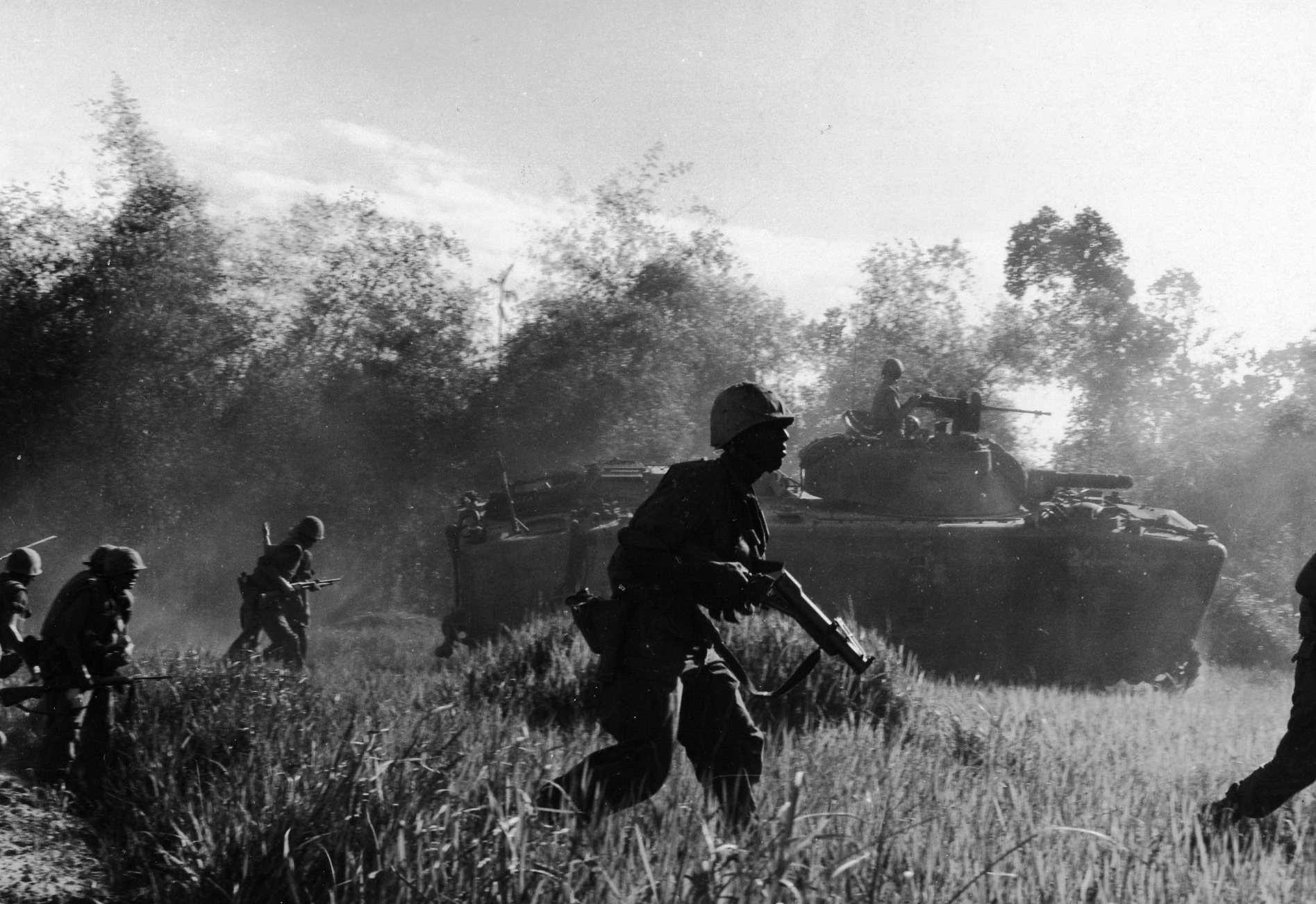
LVTH-6 supporting Company E, 7th Marines during Operation Arizona in the Vietnam War (source: File:A370095.jpg - Wikimedia Commons)
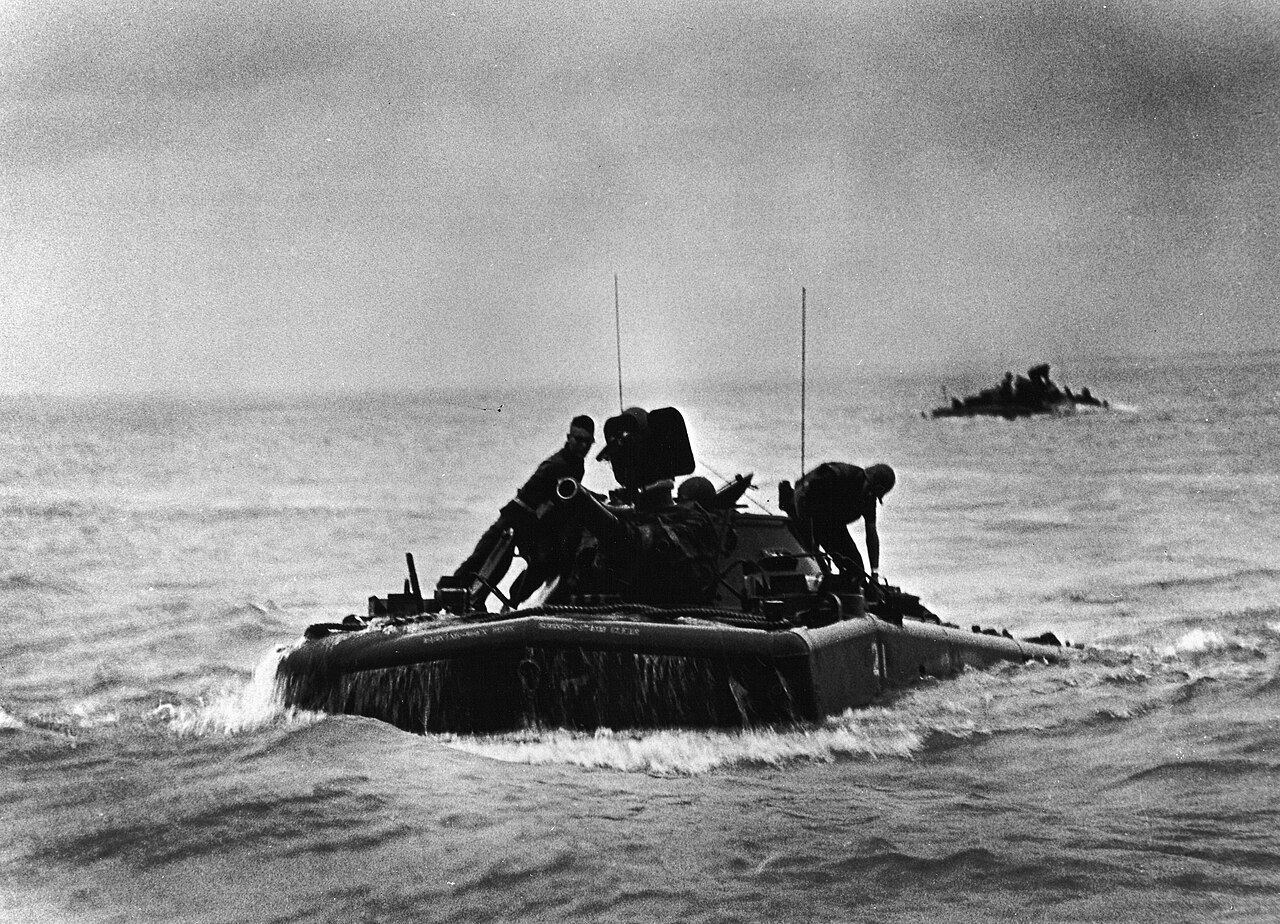
LVTH-6A1 at sea during Operation Deckhouse Five in the Vietnam War (source: File:USN 1142238.jpg - Wikimedia Commons)

LVTH-6 at shore during Operation Deckhouse Five (source: File:USN K-35653.jpg - Wikimedia Commons)
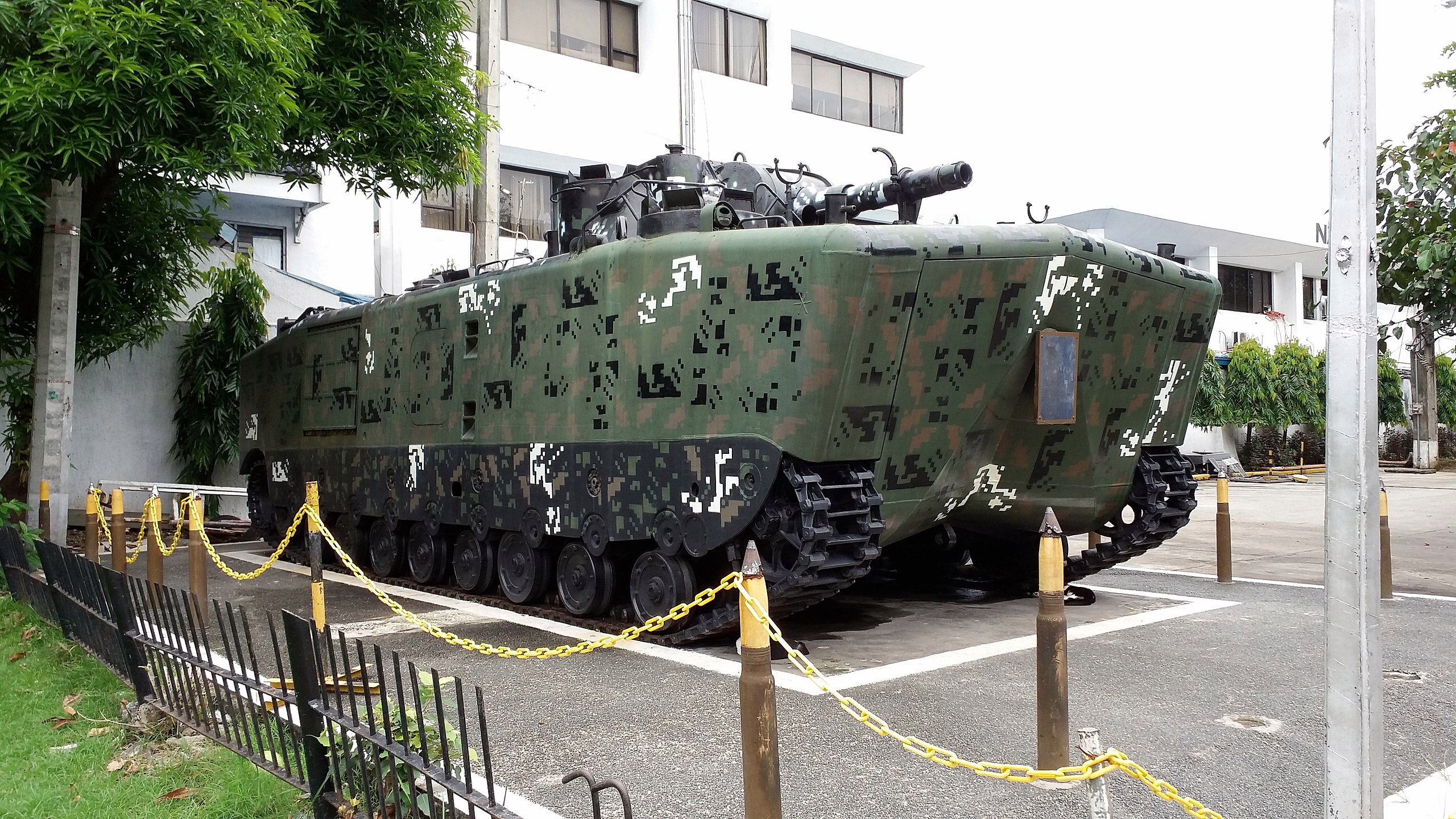
Retired Philippine Marine Corps LVTH-6 on display at Naval Station Jose Andrada (source: File:LVTH-6 AAC.jpg - Wikimedia Commons)


Not a toy model; ROC Marine Corps showing off their LVTH-6 and associated equipment in 2019 (source: https://www.reddit.com/r/TankPorn/comments/1ilaie7/2019taiwan_marine_corps_shows_off_their_lvth6/)
Sources
- “Bradley: A History of the American Fighting and Support Vehicles” by R.P. Hunnicutt
- “U.S. military tracked vehicles” by Fred Crismon
- LVTH6
- https://apps.dtic.mil/sti/trecms/pdf/AD1175911.pdf
- LVTP-5 - Wikipedia