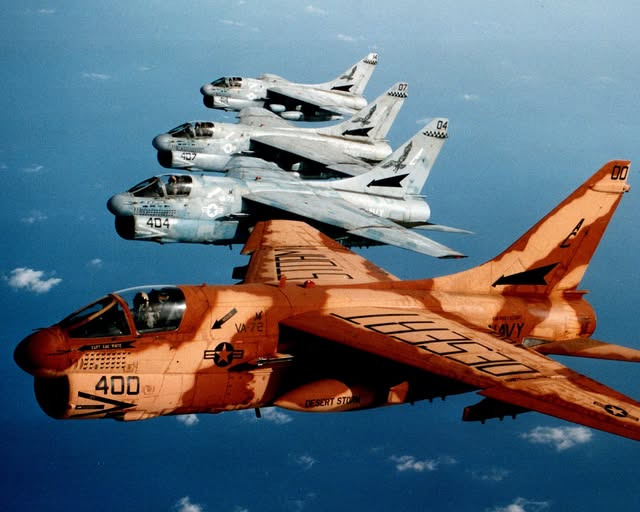
The Ling-Temco-Vought A-7 Corsair II is a carrier capable light attack aircraft. It is based on Vought’s F-8 Crusader, however it is smaller, simpler, and subsonic. It was loved by pilots and ground crew for its stability, ruggedness, simplicity, and ease of maintenance.
History
The A-7 was born from a US Navy proposal to replace the A-4 Skyhawk in the early 1960’s. This proposal evolved into the VAL draft requirement (Heavier-than-air, Attack, Light) which issued a request for proposal to aircraft manufacturers in 1963. Vought submitted their F-8 derived design and received a contract to manufacture the A-7 from the US Navy in 1964. The A-7A first flew in 1965 and quickly entered service in 1967, being deployed to Vietnam.
Initially adopted by USN, the A-7 proved attractive to other services, soon being adopted by the United States Air Force (USAF) and the Air National Guard (ANG) to replace their aging Douglas A-1 Skyraider and North American F-100 Super Sabre fleets. Improved models of the A-7 would be developed, typically adopting more powerful engines and increasingly capable avionics. American A-7s would be used in various major conflicts, including the Invasion of Grenada, Operation El Dorado Canyon, and the Gulf War. The type was also used to support the development of the Lockheed F-117 Nighthawk. The A-7 was also exported to Greece in the 1970s and to Portugal in the late 1980s. The USAF and USN opted to retire their remaining examples of the type in 1991, followed by the ANG in 1993 and the Portuguese Air Force in 1999. The A-7 was largely replaced by newer generation fighters such as the General Dynamics F-16 Fighting Falcon and the McDonnell Douglas F/A-18 Hornet. The final operator, the Hellenic Air Force, withdrew the last A-7s during 2014.
-Valiant Air Command War Museum website
The A-7 maintained a reputation as an advanced, reliable, and cost effective aircraft. Its excellent combat record, with the lowest loss rate of any attack aircraft in Vietnam, largest amount of ordnance dropped on Hanoi for any US attack aircraft, greatest accuracy of any US attack aircraft in Vietnam, and being the very first aircraft to fire an AGM-88 HARM in combat have earned it a place as a historic cornerstone of American naval aviation during the Cold War.
Variants
A-7A — The A-7A was the initial production version, with a TF30-P-6 turbofan engine, 2 20mm Colt Mk12 cannons. It used the AN/APN-153 navigation radar, AN/APQ-115 and AN/APQ-99 terrain following radars and the first heads up display on an American combat aircraft.
A-7B — The A-7B featured a more powerful TF30-P-8 engine, which were upgraded to TF30-P-408 engines later in its service life. The AN/APQ-115 was replaced by the AN/APQ-116 terrain following radar.
A-7C — The A-7C was a renamed early production A-7E with the TF30-P-8 engine. Aside from the engine it is effectively identical to the A-7E.
A-7D — The A-7D was the USAF’s version of the A-7. It featured a hugely improved TF41-A-1 turbofan, an upgraded AN/APQ-126 terrain following radar, and an AN/APN-185 navigational radar. It also featured an M61 Vulcan 20mm autocannon with 1000 rounds of ammunition.
A-7E — The A-7E was the US Navy’s premier version of the aircraft, at 535 units made it was the most produced A-7 variant. It featured a further uprated TF41-A-2 engine compared to the A-7D, also being navalized with a carrier arresting hook, catapult equipment, and folding wings. It featured the same M61 Vulcan cannon with 6 wing and 2 fuselage hardpoints. The A-7E had the AN/APN-190 navigational radar and AN/APQ-126 terrain following radar. It gained compatibility with various advanced weapons like the AGM-62 and AGM-88 throughout its service life.
Specifications
For A-7E
Crew: 1 (Pilot)
Dimensions
Length: 46.13ft
Height: 16.06ft
Wingspan: 38.73ft
Wingspan (folded): 23.77ft
Wing area: 375 Sq. ft
Weights
Empty weight: 19,576lb
MTOW (Normal): 37,279lb
MTOW (Overload): 42,000lb
Fuel capacity: 10,037lb
Armament
M61A1 Vulcan, 1000 rounds
2x fuselage Sidewinder pylons
4x 3,500lb wet wing pylons
2x 2,500lb wet wing pylons
Can carry Mk80 series, BLU-27/B napalm, AGM-88, AGM-62A ER, AGM-62A ER/DL, AGM-65F, Zuni 5" rockets, FFAR 70mm rockets, M117 demolition bombs, AIM-9D up to AIM-9M, AGM-45, AGM-12
Performance
Top speed: 693 mph
Operational ceiling: 43,000ft
Combat radius: 714 miles
Engine: TF41-A-2 -12,950lb continuous thrust (Max thrust w/ 30 minute limit: 15,000lb)
Climb rate: 15,000 feet per minute
Avionics
AN/APN-190 doppler navigation radar
AN/APR-25 + AN/APR-27 RWR (initial)
AN/ALR-45F(V) RWR (upgraded)
AN/APQ-126 terrain following radar
Sources
A-7E 1972 SAC https://www.aahs-online.org/images/Navy_SAC/A-7E.pdf
https://www.usni.org/magazines/naval-history-magazine/2010/december/historic-aircraft
a-7
https://www.valiantaircommand.com/portfolio-collections/vietnam-cold-war/a7-corsair-ii
VOUGHT A-7E CORSAIR II - Pima Air & Space
A-7E Corsair II | Patriots Point Naval & Maritime Museum
LTV A-7E Corsair II - Aviation History & Technology Center
