History
The P-38L was the final production variant of the Lightning and represented a refined development of the P-38J. The major improvement came in the form of new powerplants, as the P-38L was equipped with 1,600 hp Allison V-1710-111 and -113 engines. The P-38L also introduced dive brakes, rocket launcher “trees” for five-inch HVARs, and an AN/APS-13 tail warning radar. Production was divided into two blocks: the P-38L-1-LO (1,290 aircraft) and the P-38L-5-LO (2,520 aircraft). The L-1 block was broadly similar to the P-38J-25-LO apart from the upgraded engines, while the L-5 introduced tank-mounted fuel booster pumps housed in small fairings beneath the wings. The P-38L entered service around June 1944 and became the most numerous Lightning variant produced.
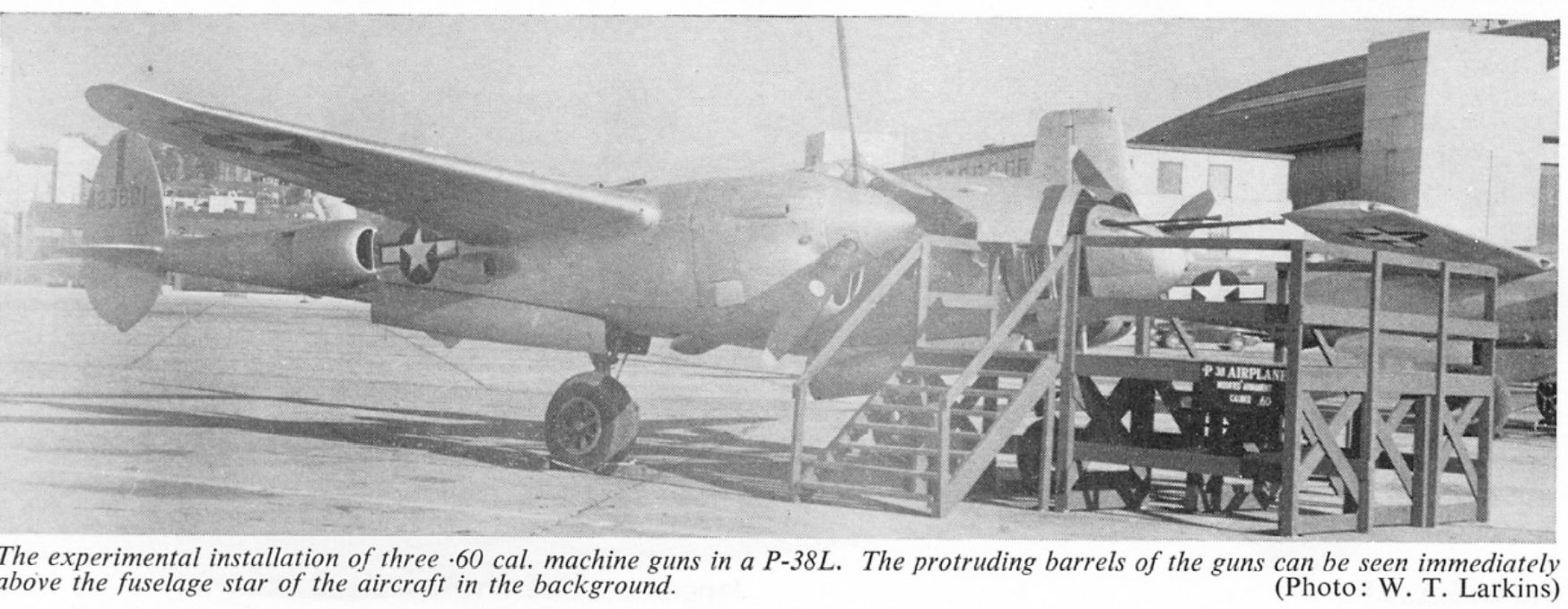
One particularly unusual postwar armament experiment involved P-38L-1-LO serial number 44-23601. The aircraft was fitted with three 0.60-inch (15.2 mm) machine guns, most likely the experimental T17E3. These long-barreled weapons were mounted in the nose section of the aircraft in place of the standard Lightning armament configuration.
The United States had previously acquired examples of the German MG 151 cannon and quickly adapted the concept into a domestic weapon known as the T17 Heavy Machine Gun, manufactured by the US Army Corps of Engineers at Rock Island Arsenal in Illinois. The American 0.60-caliber cartridge was developed with ballistic performance nearly identical to the German 15 mm MG 151 ammunition. Production of both the ammunition and T17 weapons continued from 1942 through 1946.
In September 1943, the improved T17E3 aircraft machine gun was developed. Its electrical ignition system was modeled after that of the German MG 151/20. More than 309 T17E3 guns were manufactured, and over 950,000 rounds of ammunition of various types were fired during testing. The program focused heavily on determining component lifespan and reducing malfunctions. The T17E3 achieved a rate of fire of approximately 600 rounds per minute with a muzzle velocity of 3,500 ft/s (1,066 m/s). Despite these promising characteristics, the T17 remained an experimental weapon and was never standardized for operational service during World War II.
Ground testing was conducted on several aircraft, followed by additional evaluations at Eglin Air Force Base. The Ordnance Corps eventually certified to the Army Air Forces that the gun appeared operationally viable. Consideration was even given to adapting the weapon as an anti-aircraft gun for armored vehicles.
P-38L-1-LO serial 44-23601 was initially tested at Wright Field, Ohio, with the three T17E3 guns installed, before later undergoing evaluations at Orlando and Eglin Field in Florida during 1946. Ultimately, the tests proved unsuccessful. The guns displayed structural weaknesses, and during flight testing at Eglin, ammunition belt links frequently failed under both positive and negative G-forces. As a result, it was abandoned without further development.
Despite the disappointing results, the T17E3 program briefly continued elsewhere. The second prototype, Bell XP-83, a jet escort fighter and interceptor project developed by Bell Aircraft during World War II, was designed to carry six T17E3 machine guns. The aircraft was ferried to Wright Field for gunnery trials. However, the XP-83 itself proved underwhelming in performance, while competing jet designs such as the Lockheed P-80 Shooting Star rapidly eclipsed it. Consequently, the concept of arming operational American jet fighters with T17E3 machine guns effectively died alongside the XP-83 program.
Combined with the failure of the P-38L experiment, the T17 heavy machine gun ultimately remained an abandoned experimental weapon rather than becoming the preferred aircraft armament of the US Army Air Forces or the later US Air Force.