History
When the P-38J entered service, this variant of the Lightning featured a more powerful and rearranged powerplant: the turbosupercharged Allison V-1710-89/-91 engines. These improvements permitted the aircraft to carry up to 4,000 pounds of ordnance, nearly on the same level as a B-17 bomber, making it one of the more versatile Lightning models.
In January 1944, Colonel Cass Hough and General Don Ostrander of the 8th Air Force Headquarters pioneered the idea of using a modified P-38J, accommodating a bombardier, to lead fighter-bomber formations on level bombing missions. Since heavy bombers were much slower and more vulnerable, the concept was to use a leader P-38J to guide a formation of P-38Js carrying bombs. These formations could travel at much higher speeds to and from the target, reduce the number of crews required compared to B-17 Flying Fortress formations, and operate without the need for dedicated fighter escorts.
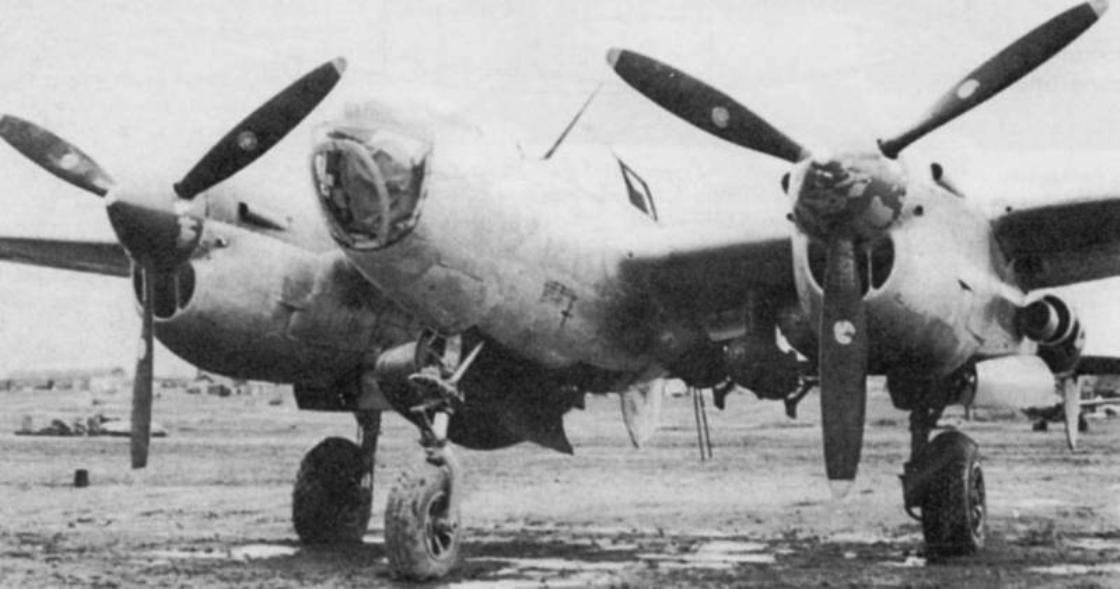
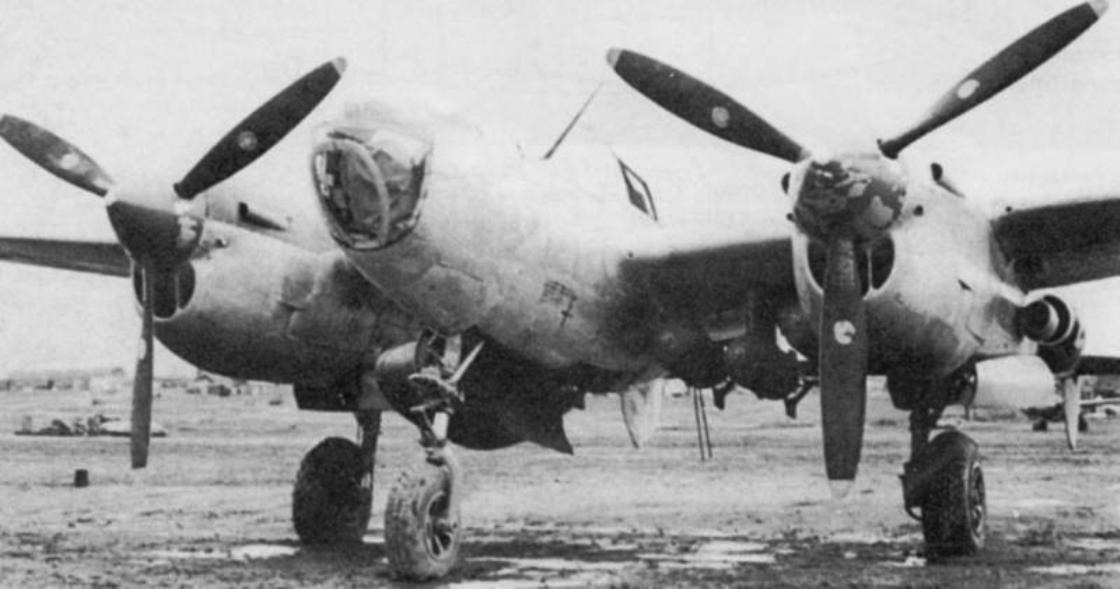
Thus, the project, given the code name DROOP SNOOT, was formulated at Lockheed’s Langford Lodge modification center in Northern Ireland. The requirements for the special P-38J included removal of its guns, installation of a plexiglass nose to accommodate a seated bombardier, and mounting of the Norden bombsight behind the glass nose section. A P-38H (42-67086) was selected for modification to test flight characteristics and identify any design flaws. After successful flight testing, a P-38J-10 (42-68184) became the initial “production” aircraft with the Droop Snoot configuration. It was rolled out in late February 1944 and tested alongside two standard P-38Js to simulate formation bombing.
An interesting feature of the Droop Snoot was its formation-bombing system, which triggered a flashing light in the cockpits of the following P-38J fighter-bombers, signaling pilots to release their bombs. A later system allowed bomb-release toggles to be triggered via radio signal, enabling the lead aircraft to fly within the formation for added protection rather than remaining exposed in front to flak or fighter attack.
Seated in the nose, the navigator/bombardier of the lead aircraft was responsible for navigation, target identification, and operating the Norden bombsight to release ordnance. The Droop Snoot could carry a maximum of six 500 lb bombs, four 1,000 lb bombs, or two 2,000 lb bombs, identical to the standard P-38J.
Testing demonstrated that Droop Snoot crews achieved greater bombing accuracy than standard P-38J fighter pilots. After the bomb release, the Droop Snoot could separate from the formation and return to base, while the remaining P-38Js could conduct strafing runs using their retained armament.
The concept proved successful and was validated operationally. As a result, the 8th Air Force initially ordered three conversions, later expanding the request to fifteen. Estimates of the total number of Droop Snoot conversions range between 23 and 100 aircraft. P-38J-10, J-15, and J-20 production blocks were known to have been used for these conversions.
The first combat mission was flown by the 20th Fighter Group on April 10, 1944, leading elements of both the 20th and 55th Fighter Groups. The 20th FG was unable to attack its primary target at Florennes/Juzaine aerodrome due to cloud cover and ultimately jettisoned its bombs in the English Channel. However, the 55th FG, led by a Droop Snoot, successfully dropped 17 tons of bombs on a secondary target after the primary was obscured by weather.
Over the following months, Droop Snoots were used regularly in level-bombing missions. On at least one occasion, a P-38J Droop Snoot led 56th Fighter Group P-47 Thunderbolts on a bombing mission.
Droop Snoots also saw service with the 15th Air Force in Italy, where P-38 operations yielded more favorable results. In northern Europe, however, Droop Snoot missions offered little to no tactical advantage over light and medium bombers such as the A-20 Havoc, B-25 Mitchell, or B-26 Marauder in terms of total bomb weight delivered against targets like airfields, which often required multiple strikes to render inoperable.
The Droop Snoot remained in service until the end of the war in both Europe and the Pacific.