History
The P-38G represented an evolution of the earlier P-38F, introducing Allison V-1710-51/55 (F10) engines with increased boost ratings and improved War Emergency Power performance, although persistent cooling issues would not be fully resolved until the introduction of the later and more refined P-38J. The P-38G also featured improved controls and oxygen equipment, making it better suited for long-range, high-speed cruising operations compared to the P-38F.
Production of the P-38G began in June 1942, eventually totaling 1,462 aircraft, including 180 photo-reconnaissance conversions and 375 P-38G-13/-15 aircraft converted from canceled RAF Lightning II contracts.
One specific P-38G was selected to serve as a flying testbed for Lockheed’s XP-49 program. The aircraft carried serial number 42-12866, identifying it as a P-38G-5-LO. The G-5 production block introduced revised instrumentation compared to earlier G-1 aircraft. Overall production was divided into several subvariants, including the P-38G-1-LO (80 aircraft), P-38G-3-LO (12), P-38G-5-LO (68), P-38G-10-LO (548), P-38G-13-LO (174), and P-38G-15-LO (200).
The XP-49 program itself had originated in 1940 as an attempt to create a significantly improved twin-engine high-performance interceptor fighter. Initially, it was intended to use two turbocharged Pratt & Whitney X-1800-SA2-G liquid-cooled engines producing between 2,000 and 2,200 horsepower each at takeoff. However, severe development delays and technical difficulties with the X-1800 forced the US Army to require a change to the less powerful 1,600 hp Continental XI-1430-1 engines. Despite outward similarities to the Lightning, only approximately 66% of the XP-49’s components were shared with the P-38.
The XP-49 completed its maiden flight on November 14, 1942. Flight testing revealed disappointing results with the Continental engines, allowing a top speed of only 406 mph (653 km/h) at 15,000 feet rather than the originally projected 458 mph at 25,000 feet using the Pratt & Whitney engines. As a result, the US Army gradually lost interest in the project, and the XP-49 program was effectively shelved during the summer of 1943.
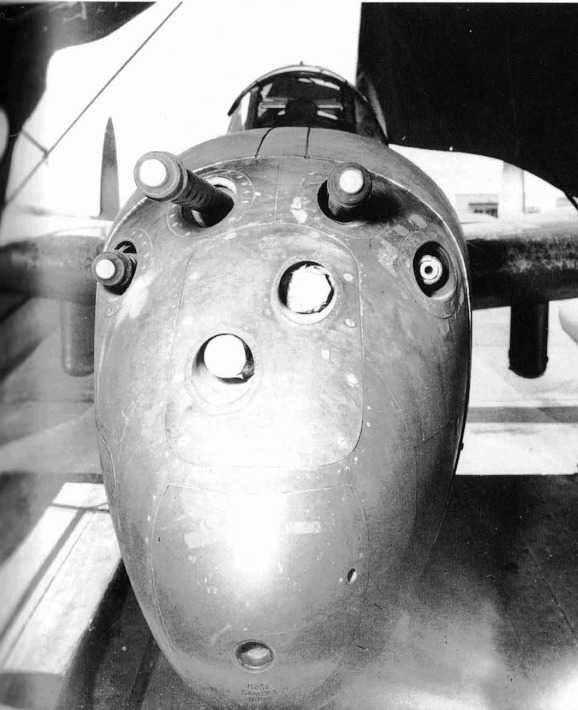
Although the XP-49 prototype itself flew unarmed, the proposed production armament consisted of two 20 mm cannons and four 0.50 caliber machine guns. Each cannon was intended to carry 90 rounds, increasing total 20 mm ammunition capacity from the standard 150 rounds of the P-38 to 180 rounds.
To evaluate this arrangement, P-38G-5 serial 42-12866 had its armament compartment modified accordingly. While retaining the standard machine gun arrangement of the Lightning, P-38G-5 serial 42-12866 incorporated a redesigned central cannon bay that accommodated two short-barreled 20 mm cannons mounted diagonally. Unfortunately, few details survive regarding the actual results of these tests. After testing concluded, the aircraft was disassembled, shipped overseas to Australia, and later reassembled for operational service.
On February 20, 1943, the aircraft departed Port Moresby, piloted by 1st Lt. Arthur R. Bauhof during an escort mission over Gasmata. While returning, the aircraft and two accompanying P-38s became lost and were forced to land on a beach at Huiva Plantation, roughly 200 miles northwest of Port Moresby. All three pilots were successfully rescued and returned to duty.
Later, on May 14, 1943, Lt. Bauhof was declared Missing In Action after crashing into the sea while piloting another Lightning.
The US Army later salvaged two of the three stranded P-38s and transported them back to Port Moresby aboard a barge. However, it remains unclear whether 42-12866 was among the recovered aircraft. The historical trail of this XP-49 testbed effectively ends there.