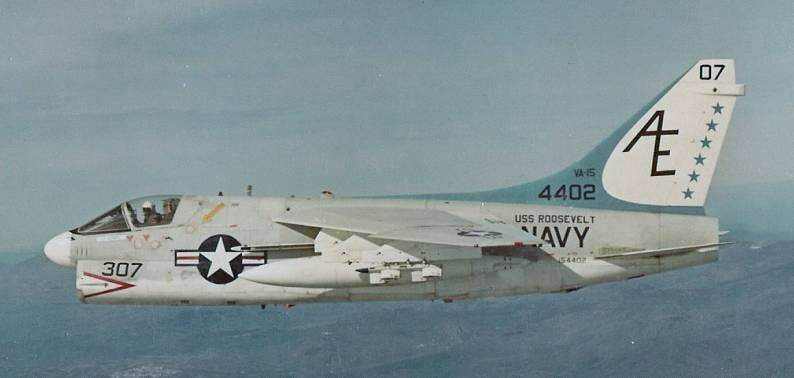
Would you like to see this in-game?
Which engine variant would you like to see implemented on the A-7B?
12,200-lbf TF30-P-8 engine (initial engine)
13,400-lbf TF30-P-408 engine (upgraded engine)
Both. Start with the TF30-P-8 and unlock the TF30-P-408 as a modification.
I said “No” in the first poll.
Ling-Temco-Vought A-7B Corsair II
Hello everybody. I’d like to suggest the A-7B Corsair II for inclusion in the US aviation tech tree in War Thunder. The A-7B was the second production variant of the Corsair II series, developed as an improvement over the earlier A-7A. It incorporated an uprated engine, reinforced wings, and variable-position flaps. Like its predecessor, it was a subsonic, carrier-based attack aircraft and saw extensive combat service during the Vietnam War.
Compared to the later A-7D and A-7E variants already present in the game, the A-7B represents a more basic configuration. It lacked a modern heads-up display (HUD) and did not include flare or chaff countermeasures, instead using a simpler optical reflector gunsight. However, thanks to its strengthened wings, the A-7B could carry a greater payload, including heavier ordnance and the ability to equip two Mk 4 20mm gun pods.
History
While production of the A-7A was still underway, Ling-Temco-Vought (LTV) received a contract from the US Navy to develop an improved variant, designated the A-7B. The key upgrade was the installation of a more powerful Pratt & Whitney TF30-P-8 non-afterburning turbofan engine, rated at 12,200 lbf, an increase over the 11,350 lbf TF30-P-6 used in the A-7A. This provided a modest boost, though the aircraft’s empty weight increased by approximately 1,000 pounds as a result of the new powerplant.
To enhance the A-7B’s combat capability, its wings were structurally reinforced, allowing the aircraft to carry up to 20,000 pounds of ordnance, compared to the A-7A’s 15,000-pound payload. The wings also featured variable-position flaps, and the aircraft was cleared to use Mk 4 20mm gunpods. Despite these upgrades, the A-7B retained the same basic avionics suite as the A-7A, including the simple optical reflector gunsight in place of a modern heads-up display (HUD), which would only be introduced in later variants.
The first A-7B took to the air on February 6, 1968, and production aircraft were quickly delivered to the fleet. The type was first deployed aboard USS Enterprise (CVN-65) with Carrier Air Wing 2 (CVW-2), reinforcing squadrons VA-22 and VA-94. However, it was VA-147 “Argonauts”, the same squadron that first introduced the A-7A into combat, that also became the first to fly the A-7B in combat operations.
A total of 196 A-7Bs were produced across two production blocks, with the final aircraft delivered on May 7, 1969. Production then transitioned to the more advanced, definitive Navy variant, the A-7E Corsair II.
Early in its service, the A-7B experienced engine reliability issues, but these were resolved, and the type gradually replaced the A-7A in front-line squadrons. Toward the end of the A-7B’s operational life, a field modification kit was introduced to upgrade the TF30-P-8 engine to the improved TF30-P-408 standard, increasing thrust to 13,400 lbf.
Specifications
Ling-Temco-Vought A-7B Corsair II
General Characteristics
Crew: 1 (Pilot)
Dimensions:
Length: 46.13 ft (14.06 m)
Height: 16.06 ft (4.89 m)
Wingspan: 38.73 ft (11.80 m)
Wing Area: 375 sq ft (34.84 sq m)
Powerplant Options:
Pratt & Whitney TF30-P-8 (12,200 lbf/54.3 kN)
or TF30-P-408 (13,400 lbf/59.6 kN)
Fuel System:
Internal:
Fuselage: 757 US gal (2,865 L)
Wing: 743 US gal (2,812 L)
Oil Capacity: 5.0 US gal (18.9 L)
Weights:
Empty: 16,133 lb (7,318 kg)
Clean: 23,165 lb (10,507 kg)
Combat: 25,732 lb (11,672 kg)
Max Takeoff: 38,000 lb (17,237 kg)
Flight Performance (Clean)
Power-to-Weight Ratio: 0.53
Max Speed:
Sea Level: 682 mph (1,098 km/h)
At Altitude: 640 mph (1,030 km/h) @ 27,329 ft (8,330 m)
Wing Loading: 62 lb/sq ft (303 kg/sq m)
Rate of Climb: 7,290 ft/min (37.0 m/s)
Service Ceiling: 43,900 ft (13,381 m)
Armament
Avionics Suite:
Radar: AN/APG-116
Navigation:
AN/APN-153(V) Doppler Radar
AN/ASN-41 Navigation Computer
AN/ARN-52(V) TACAN
Systems:
CP-741/A Weapon Release Computer
Heads-Up Display
Electronic Warfare:
Guns:
2 x Mk-12 20mm guns (340 rpg; 680 total)
2 x Mk-4 20mm gun pods (750 rpg; 1,500 total)
Bombs:
250-lb Mk 81 series
500-lb Mk 82 series
1,000-lb Mk 83
1,000-lb Mk 79 Mod-1 (incendiary)
2,000-lb Mk 84
AGM-62 Walleye
Mk 20 Rockeye II (cluster)
Mk 15 Mod 0 Sadeye (dispenser)
Rockets:
19 Round 70mm LAU-3A/A
4 Round 127mm LAU-10/A
7 Round 70mm LAU-32/A
7 Round 70mm LAU-32A/A
Missiles:
Air-to-Air: AIM-9B/D Sidewinder
Air-to-Ground:
AGM-12B/C Bullpup
AGM-45A Shrike
AGM-62 Walleye TV-guided
Mines:
Mk-50 through Mk-56 series
External Fuel:
Electronic Countermeasures Pods:
AN/ALQ-31A
AN/ALQ-76
AN/ALQ-81
Standard Aircraft Characteristics
Related Suggestions
poll
[image]
Ling-Temco-Vought A-7A Corsair II
Hello everybody. I’d like to suggest the A-7A Corsair II for inclusion in the US aviation tech tree in War Thunder. The A-7A was the first production variant of the Corsair II series, developed to replace the A-4 Skyhawk and based on the airframe of its fighter sibling, the F-8 Crusader. It was a subsonic carrier-based attack aircraft that saw extensive service during the Vietnam War. Compared to the later A-7D and A-7E variants already featu…
poll
[image]
Ling-Temco-Vought YA-7F “Strikefighter”
Hello everybody. I’d like to suggest the YA-7F Intruder II for inclusion in the US aviation tech tree in War Thunder. The YA-7F was a stretched, supersonic prototype variant of the subsonic A-7D Corsair II, developed to be fast enough to potentially replace the A-10 Thunderbolt II in the close air support and battlefield air interdiction roles. Two prototypes were built, but the program never took off beyond the testing phase, as the US…
Sources
NAVAIR 00-110AA7-2 Standard Aircraft Characteristics A-7B Corsair II (January 1970)
A-7 Corsair II in Detail & Scale Vol. 22 (1986)
A-7 Corsair II in Action - Aircraft Number 120 (1992)
Osprey Combat Aircraft 048 - US Navy A-7 Corsair II Units of the Vietnam War (2004)
Ling Temco Vought A-7 LTV A-7 Corsair II - Wikipedia
Thank you for taking the time to read my suggestion! 😃
3 Likes
+1 Maybe both in a folder?
Bonrath
October 19, 2025, 10:08am
3
+1.
2 Likes
+1, I’d hope foldered under the A
1 Like